Lepidolite from the Pala Mining District is one of the classic faces of Southern California pegmatite collecting: lilac, lavender, bluish gray, and deep purple lithium mica sparkling around pink tourmaline, quartz, cleavelandite, beryl, and spodumene. The best-known material comes from the Stewart Mine on Tourmaline Queen Mountain, where lepidolite was not just an accessory mineral but an ore body—large enough to make the Stewart one of the most important early American sources of lithium mica, and beautiful enough that much of the earliest output was saved as specimen material rather than merely shipped as ore.
Key facts
Lepidolite from the Pala Mining District is one of the classic faces of Southern California pegmatite collecting: lilac, lavender, bluish gray, and deep purple lithium mica sparkling around pink tourmaline, quartz, cleavelandite, beryl, and spodumene. The best-known material comes from the Stewart Mine on Tourmaline Queen Mountain, where lepidolite was not just an accessory mineral but an ore body—large enough to make the Stewart one of the most important early American sources of lithium mica, and beautiful enough that much of the earliest output was saved as specimen material rather than merely shipped as ore.

Photo: Wikimedia Commons
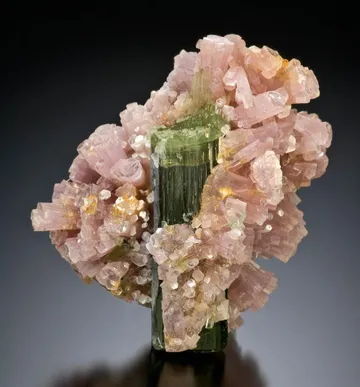
The Pala appeal is not simply color. It is context. These specimens come from a tight, historically famous cluster of rare-element pegmatites northeast of the village of Pala in northern San Diego County, where dikes in gabbroic rocks yielded tourmaline, kunzite, morganite, aquamarine, quartz, cleavelandite, muscovite, lithium phosphates, and lepidolite from the same pocket-bearing systems. In the Stewart, lepidolite formed dense aggregate bodies and stockworks in the central parts of the pegmatite, especially beneath or near quartz-spodumene zones. In collector pieces it often serves as the velvet-colored matrix for rubellite, blue-cap and multicolored elbaite, smoky quartz, pale beryl, and white cleavelandite.

Photo: Wikimedia Commons
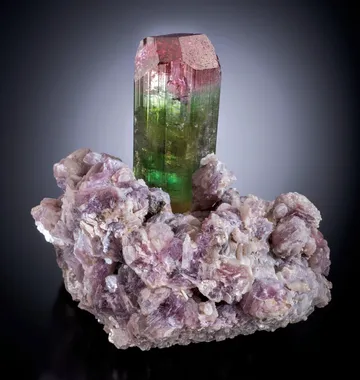
For the serious collector, Pala lepidolite is a matrix mineral with a pedigree. The finest pieces are not merely purple mica masses; they show locality-specific associations—pink tourmaline needles or sprays in lilac mica, gemmy elbaite rooted in lepidolite, lepidolite-coated cleavelandite rosettes, beryl with lepidolite and quartz, and rare pseudomorphic textures where lepidolite records the replacement of earlier tourmaline. The locality’s long collecting history adds another layer: old Stewart, Tourmaline Queen, Pala Chief, and Elizabeth R. pieces circulate with labels from California collections, Pala International, and major dealers, and they remain recognizable by both assemblage and story.
Search for specimens: View all lepidolite specimens from Pala Mining District, USA
The Pala Mining District lies in northern San Diego County, California, in the Peninsular Ranges province. The name “Pala Mining District” is widely used by collectors and mineralogists, though the area was not an organized mining district in the formal claim-recording sense; historic claim documents were filed through county channels. In collector usage the district embraces the Pala pegmatite field around Tourmaline Queen Mountain, Chief Mountain, Hiriart Mountain, and adjacent hills northeast of Pala.
Geologically, the district is a rare-element granitic pegmatite field hosted largely by gabbroic and mafic plutonic rocks of the Peninsular Ranges batholith. Jahns and Wright mapped at least 400 pegmatite dikes in about 13 square miles. Many trend northward to northwesterly and dip gently to moderately westward. They range from thin stringers to large, persistent dikes with bulges approaching 100 feet thick. The productive dikes are internally zoned: graphic granite and wall zones outward, quartz-, feldspar-, and spodumene-rich inner zones, and late pocket or replacement units containing quartz, albite, orthoclase or microcline, muscovite, lepidolite, and tourmaline.
Lepidolite production centered on the Stewart dike, exposed for roughly half a mile along the east slope of Tourmaline Queen Mountain. The Stewart Mine occupied the bulbous southern part of that dike, where large bodies of lepidolite-rich pegmatite were mined from open cuts, adits, rooms, stopes, inclines, and connecting underground workings. Smaller quantities of lithium mica also came from the Tourmaline King, Tourmaline Queen, Pala Chief, Katerina, Vanderburg-Katerina, and other pegmatites.
The historical sequence is unusually vivid. Purple lepidolite and pink tourmaline in the Stewart dike were known before systematic mining; the color led to early misunderstandings, including a prospector who suspected cinnabar because of the red tourmaline. Commercial recognition came only after a Pala lepidolite specimen in a New York collection was identified by a German chemist familiar with European lithia deposits. In 1892, the Stewart produced about 18 tons of lepidolite and rubellite, much of it sold as specimen material. Commercial production expanded around 1900. The district’s main lepidolite mining period ran through the early twentieth century, with strong Stewart production from about 1900 to 1907, renewed wartime activity, a production maximum around 1920, decline after competition from the Harding deposit in New Mexico, and shutdown of larger operations by 1928. Minor small-scale work continued in the 1930s, and later specimen-oriented work and collecting revived interest in the district’s gem-bearing pockets.
The old Stewart workings were extensive and, by the mid-twentieth century, hazardous in many places. Jahns and Wright described collapsed adits, unsupported room backs, caved stopes, and inaccessible older workings. That matters for modern collectors: historical Stewart specimens are a legitimate and important market category, but casual underground access is not part of responsible collecting. Modern fee collecting in the Pala area is centered principally around the Oceanview and Pala Chief operations, with the Pala Chief offering special digs during cooler months and Oceanview-type experiences focused on screening mine material. Access rules, seasons, safety requirements, and ownership conditions change; collectors should treat all mines and dumps as private property unless they have explicit permission or a paid reservation.
Notable Pala finds tied to lepidolite-bearing pegmatites include rubellite-in-lepidolite specimens from the Stewart, blue-cap and multicolored elbaite from Stewart and nearby mines, kunzite discoveries at Pala Chief and Hiriart Mountain, morganite and aquamarine on quartz and cleavelandite, and rare lithium-phosphate assemblages. The district is best known gemologically for tourmaline and kunzite, but lepidolite is the mineral that made the Stewart a lithium mine and provided the purple matrix that gives many Pala specimens their unmistakable character.
Pala lepidolite is most familiar as fine- to medium-grained, glittering aggregates rather than as isolated textbook crystals. The best Stewart ore material ranges from pinkish lilac to lavender, bluish gray, gray-violet, and deep purple. Jahns and Wright noted that the finest-grained, most bluish or darkest-purple dense aggregates generally carried the highest proportions of lithium, with some waxy bluish material exceeding 5.5 percent Li2O and much of the coarser pink to lilac mined material ranging roughly from 2.5 to 4.5 percent Li2O. For collectors, that means the tight, sparkling, blue-lilac masses are not merely pretty; they are also the classic high-lithium-looking Stewart material.
The Stewart Mine produced two contrasting styles of lepidolite-rich pegmatite. The northern ore body yielded gray to bluish-gray and deep-purple material with albite and abundant prismatic rubellite. The southern ore body was commonly purer, coarser-grained, and more reddish to pinkish. Each of the two principal Stewart bodies was about 200 feet long, with broad widths and local thicknesses reaching roughly 18 to 20 feet. Those are mining dimensions rather than specimen dimensions, but they explain why Stewart lepidolite appears on the market both as substantial massive chunks and as matrix attached to tourmaline, beryl, quartz, and cleavelandite.
Specimen habits include dense mica aggregate, scaly crusts, sparkling granular masses, plates and flakes coating cleavelandite rosettes, irregular veinlets in quartz-albite pegmatite, and pseudomorphic or replacement textures. Particularly desirable pieces show pink elbaite or rubellite in or on the lepidolite. Old descriptions from the district mention radiating bunches, fern-like sprays, matchstick-size pink tourmalines, and opaque pink crystals scattered through lilac mica. Some Pala pieces also show lepidolite partly replacing or mantling elbaite, a texture prized by collectors who appreciate pegmatite paragenesis as much as color.
Associated minerals are central to quality. Classic Pala lepidolite companions include quartz, albite var. cleavelandite, muscovite, elbaite, schorl, spodumene, beryl var. morganite and aquamarine, microcline or orthoclase, perthite, lithiophilite, sicklerite, hureaulite, purpurite, stewartite, amblygonite-montebrasite series minerals, and other rare phosphates. In display pieces, the most collectible associations are lepidolite with pink or multicolored elbaite, lepidolite with morganite or aquamarine, and pocket assemblages where quartz, cleavelandite, and lepidolite frame gem minerals without overwhelming them.
Typical collector sizes range from thumbnail and miniature fragments of purple mica with tourmaline to cabinet specimens of lepidolite-rich pegmatite. Massive pieces can be much larger, but aesthetics fall off quickly unless the specimen has color contrast, crystalized surface, tourmaline sprays, beryl, quartz, or a strong old label. A small, sharp elbaite crystal on lively purple lepidolite will usually outrank a much larger but structureless block of mica. Conversely, a large Stewart matrix with radiating rubellite sprays has strong locality appeal even if the tourmaline is opaque.
Quality factors are straightforward but strict. Look for saturated lavender to bluish-purple color, sparkling fresh mica surfaces, natural undamaged association with tourmaline or beryl, clean contrast against white albite or smoky quartz, and specific mine provenance. Avoid crumbly, oxidized, clay-rich pieces unless they show important associations. Be wary of specimens whose purple mica is the entire selling point but whose locality label is vague; “Pala District” is acceptable for older pieces when mine attribution is lost, but Stewart, Tourmaline Queen, Pala Chief, Elizabeth R., or Oceanview provenance adds value when credible.
The central authenticity issue with Pala lepidolite is attribution, not a famous wave of manufactured fakes. Massive lilac lepidolite from several pegmatite districts can look superficially similar, and polished or tumbled lithium mica material from Brazil, Africa, or other localities is sometimes sold loosely as “California” in the general metaphysical trade. Serious Pala specimens should be evaluated by matrix, associated minerals, label history, and, for important pieces, analytic confirmation.
A second issue is mineral identity. “Lepidolite” is a long-used collector and mining term for lithium-rich mica, but in modern mineralogy the mica may require analysis to distinguish species in the trilithionite-polylithionite range or to separate true lithium mica from look-alike purple muscovite. Recent locality notes for the Pala area have specifically warned that some violet mica reported as lithian muscovite from the Oceanview/Chief Mountain area owes its color to manganese rather than lithium. On high-value specimens, especially newer Oceanview- or Chief Mountain-labeled purple mica, buyers should not treat color alone as proof of lepidolite.
Condition is a major concern. Lepidolite is mica: it cleaves, sheds flakes, bruises along edges, and can look dull where handled repeatedly. Pala pocket pieces may also carry clay, altered feldspar, friable albite, and fragile tourmaline terminations. Rubellite-in-lepidolite specimens commonly contain opaque, checked, or incomplete tourmaline crystals; that is normal for the Stewart style, but broken sprays, glued-in crystals, or overly cleaned mica should be viewed critically. Avoid soaking delicate specimens, and never use aggressive ultrasonic cleaning on lepidolite matrix pieces.
Restoration is not automatically disqualifying in Pala pegmatite specimens, especially for tourmaline crystals on matrix, but it must be disclosed. Reattached tourmaline, repaired beryl, stabilized crumbly matrix, and trimmed bases are all possible. The more a specimen’s value depends on a gem crystal rising from lepidolite, the more carefully the contact should be inspected under magnification.
Rarity varies sharply by type. Massive Pala lepidolite and small purple mica fragments remain available. Attractive hand specimens with quartz, albite, and lepidolite are obtainable but not rare. Good Stewart-style rubellite-in-lepidolite sprays are scarcer and strongly tied to old collections. Fine elbaite on lepidolite, blue-cap or multicolored tourmaline with lepidolite, morganite or aquamarine with lepidolite, and true pseudomorphic lepidolite after tourmaline are significantly more collectible. Specimens with old Stewart, Pala International, Bill Larson, or documented San Diego County collection provenance deserve a premium when the label chain is credible.
Modern availability is mixed. Pala-area fee digs and dealer inventories still produce lepidolite-bearing material, especially small pieces and matrix fragments. The historic Stewart Mine material that built the locality’s reputation is finite, and the best pieces are largely in private collections, museums, or recycled through auctions and specialist dealers. For an advanced cabinet, the goal should be one representative massive lilac Stewart lepidolite, one rubellite-in-lepidolite matrix, and, if possible, one gem-mineral association showing why Pala belongs among the world’s great pegmatite districts.
The first story of Pala lepidolite is a story of mistaken color. The Stewart dike was visible from the San Luis Rey valley road, and its purple mica and pink tourmaline were striking enough that local Native people knew the material and showed specimens to newcomers. A prospector named Magee saw the red tourmaline and imagined cinnabar. He staked a claim, tried and failed to extract mercury, and abandoned the ground. The same place was later relocated as a marble quarry, another doomed interpretation of a pegmatite that was neither mercury ore nor marble. Only when a German chemist saw a Pala lepidolite specimen in a New York collection did the district’s true lithium significance begin to come into focus.
By 1892 the Stewart Mine produced about 18 tons of lepidolite and rubellite. Much of that first output was treated as specimen material, an important detail for collectors: from the very beginning, Pala lepidolite straddled industry and beauty. It was ore, but it was also purple matrix with pink tourmaline, the kind of rock people saved.
A decade later, another lithium prospect led to a different California first. M. M. Sickler and his son Frederick were doing assessment work on a lepidolite claim on Hiriart Hill, about a mile and a half east of Pala. Their mining exposed a chalky mass with large quartz crystals. While removing the quartz, they found clear crystals embedded in clay—some lilac, some straw-colored, some colorless. After unsuccessful attempts to identify the mineral, specimens went in December 1902 to Tiffany & Company in New York. George F. Kunz identified them as spodumene, and the pink to lilac gem variety soon entered the world as kunzite. Lepidolite was not the gem, but it was the clue and the setting: the lithium mica prospect opened the door.
The later Stewart story has the atmosphere of a mining novel. In 1968, Ed Swoboda bought the Stewart Lithia Mine for what he called the “firm and frightening price” of five thousand dollars, paid over three years. He had heard from a high-grader that a lower, dangerous, actively caving part of the mine had yielded bright pink crystals. Swoboda did what good mine men do: he talked to people whose fathers had worked underground, listened to midnight-by-lantern operators, and read old reports. Several clues pointed to an “old west adit,” supposedly sealed off by a cave-in while miners were driving west in search of another lepidolite ore body.
Terrance Szenics and Roger Bostard eventually broke into that forgotten ground. To the east, the adit was blocked by the cave-in just as the old accounts said. To the west, it ran more than 150 feet. Around a bend sat an ore car still on its track, loaded to the brim with violet lepidolite ore. Hand tools lay around it. On top of the loose mound of crumbly lithia mica were fist-sized creamy montmorillonite nodules and crystal sections of clear bright pink faceting elbaite. Szenics ran down the mountain to the public telephone in front of the Pala Store; Swoboda made his own fast trip from Los Angeles. Within weeks, the crew was extending the workings down-dip and cutting into the soft core zone. That area alone yielded roughly 200 pounds of pink tourmaline, much of it cutting material rather than specimen-grade crystals.
One specimen from that work distilled the locality in miniature: a bright pink elbaite crystal, five-eighths of an inch by 2 3/4 inches, attached to the side of a terminated quartz crystal measuring about 2 1/4 by 4 inches. The upper half of the elbaite was transparent with bright faces. The lower half had a rind altered to lepidolite, leaving a thin quarter-inch core of elbaite surrounded by replacement mica. It is the kind of object that makes Pala more than a pretty locality: it shows the chemical drama of the pegmatite frozen in a hand specimen.
The Stewart also gave one last surprise when Pala Properties was preparing to move work up the hill to the Tourmaline Queen. The bulldozer was delayed a week. With time to fill, John McLean put a final blast into the Stewart between two adits where a rich lepidolite zone was exposed. When the fumes cleared, a tourmaline crystal measuring 10 by 4 inches lay in the rubble. José Montes first thought it was quartz; then he saw the red and began celebrating. After three and a half years of work, it became the largest and finest tourmaline produced from the Stewart Mine. The episode is a reminder that in Pala, lepidolite zones were not just ore—they were the purple margins of pockets that could still surprise experienced miners.