Ongaing, Mogok Stone Tract - painite type locality; rare red-brown crystals with ruby-associated paragenesis, highly prized by serious collectors.
Key facts
Ongaing—more often spelled Ohngaing in mineralogical literature, and also seen on labels as Ohn Gaing or Ohn Kai—is one of the small names in the Mogok Stone Tract that carries outsized weight for collectors. Its importance rests on painite: the red-brown calcium zirconium aluminium borate that entered mineralogy from gem gravels near this village and, for decades, was nearly synonymous with extreme rarity. The old Ongaing material belongs to the complex Mogok metamorphic environment, where marbles, gneisses, calc-silicate rocks and younger granitic intrusions created a mosaic of skarn and contact-zone gem deposits. At Ongaing, the most important collector setting is the skarn/contact environment near leucogranite and marble, with painite linked historically to the small Sinhalite Mine at the edge of the village.
The classic Ongaing painites are not bright, gemmy thumbnail crystals in the casual sense. They tend toward dark reddish brown, brownish orange-red, garnet-red to almost black body color, with hexagonal prismatic form, strong lengthwise striation, vitreous to sub-adamantine luster and, on the best pieces, flashes of red translucency at thin edges or under backlighting. The great visual prize from here is painite with ruby: blunt, lustrous, deeply colored painite crystals carrying bright red corundum crystals, a paragenesis that fixes the specimen immediately in the Mogok imagination.
Regional View
Country View
Ongaing’s role changed after 2004–2005, when further painite occurrences were identified in and beyond the Mogok region. Those discoveries ended the era when only a handful of painite crystals were known, but they did not erase Ongaing’s status. For serious collectors, a specimen credibly tied to Ongaing is still the type-locality material—the old locality, the name attached to the original description, and the standard against which later Mogok and Namya painites are compared.
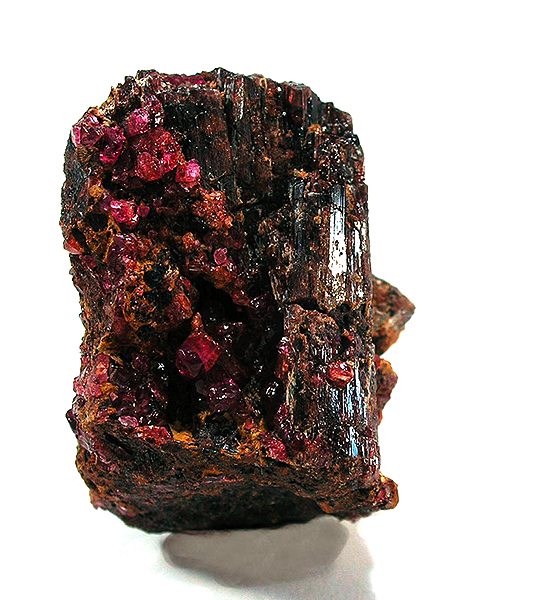
Photo: Wikimedia Commons
Search for specimens: View all specimens from Ongaing, null
Ongaing is a mining area in the Mogok Valley of Mogok Township, Pyin-Oo-Lwin District, Mandalay Region, Myanmar. The village lies just north-northwest of Mogok, in the foothills of Let-nyo-taung, within the broader Mogok Stone Tract. The spelling on specimen labels varies—Ongaing, Ohngaing, Ohn Gaing and Ohn Kai all refer to the same collecting district—and older labels may place it in “Mogok District,” “Sagaing District,” “Mandalay Division,” or simply “Upper Burma,” depending on the era of the label.
The deposit is best understood as part of Mogok’s skarn and contact-metamorphic gem system. The regional rocks include high-grade marbles, gneisses, calc-silicates and granitic to syenitic intrusives, and Ongaing’s painite-producing ground is specifically described as near a contact between leucogranite and marble. This is an important distinction for collectors: Ongaing painite is not merely a random alluvial oddity from ruby gravel. The early crystals were recovered from gem gravels and showed some water rounding, but later work located a likely nearby primary source in weathered material in the upper part of the Sinhalite Mine.
The Sinhalite Mine at the edge of Ongaing is central to the modern locality story. It was described as producing mostly spinel in assorted colors, tourmaline and sinhalite, rather than gem-quality corundum. Painite was reported from the upper portion of the working, in weathered soil close to the leucogranite-marble contact. Mindat’s locality record also notes a small skarn between gneiss and marble at the village edge, with sinhalite, serendibite, amblygonite-montebrasite, jeremejevite and other rare minerals documented from the area. That combination of boron-bearing, aluminium-rich and zirconium-bearing species is exactly the kind of geochemical accident that makes Mogok so rich for rare-species collectors.
Historically, Ongaing entered mineralogical literature through A. C. D. Pain, the British gem collector and gemmologist whose eye for unusual stones made local miners bring him “difficult” material. The first scientifically recognized painite crystal was recovered from gem gravel near Ongaing in the early 1950s and donated in 1952; Claringbull, Hey and Payne described painite as a new mineral in 1957. A second early crystal, also tied to the British Museum collection, came from the same Ongaing-Mogok context. For many years those two specimens essentially defined the species. A third crystal, recognized at GIA in 1979 from a parcel of rough gem spinel reportedly from Mogok, expanded the record but still left painite as one of the world’s most elusive mineral species.
The specimen-producing history at Ongaing had a second pulse in 2004. Brownish-orange and dark painite crystals near Ohngaing were identified and added to George Rossman’s running catalogue of known painites, and by December 2004 local information pointed investigators toward the Sinhalite Mine as the likely primary source. In 2005, attention shifted dramatically west of Mogok, where larger painite occurrences near Kyauk-Pyat-That, Wet-loo and Thurein-taung yielded thousands of crystals and fragments. That later production is the reason painite is now obtainable to collectors, but it also introduced a labelling problem: many specimens have been attributed loosely to Ongaing simply because Ongaing is the type locality, not because the specimen actually came from the village.
Modern collecting access should be regarded as extremely restricted. Ongaing is not a casual field-collecting stop; material reaches collectors through the gem and mineral trade, local miners, old collections and dealer inventories. Foreign access to the Mogok region has long been controlled by permits and local conditions, and in the 2020s the region has also been affected by Myanmar’s wider conflict and shifting control of routes and towns. For U.S. collectors, the additional issue is compliance: Myanma Gems Enterprise is sanctioned by OFAC, and any modern Myanmar gem or mineral purchase should be approached with clear provenance, export documentation and avoidance of sanctioned parties.
Ongaing painite is the classic type-locality material: dark red to reddish brown, brownish orange-red or nearly black hexagonal crystals, commonly striated along the prism faces and often showing only edge translucency unless strongly backlit. The earliest known crystals were small but scientifically momentous—the type crystal weighed 1.7 g, another early British Museum crystal weighed 2.118 g, and the 1979 GIA crystal measured only 8.91 x 3.36 x 2.81 mm—yet later Ongaing-area pieces include lustrous euhedral crystals and matrix specimens with ruby. The best collector pieces from here show recognizable hexagonal form, sharp or only lightly rounded terminations, deep but not dead-black color, bright luster and, ideally, attached ruby crystals or credible old Ongaing provenance; ordinary pieces are broken, water-worn, opaque brown fragments that need analysis or very strong provenance to carry the locality value.
Other minerals documented from Ongaing include corundum, ruby, sapphire, star ruby, star sapphire, spinel, sinhalite, serendibite, amblygonite-montebrasite, jeremejevite, schorl, danburite, garnet-group minerals, topaz, tourmaline, vesuvianite and zircon. Painite is the type-locality species and the mineral that gives Ongaing its international stature, but the surrounding assemblage is just as telling: borates, borosilicates, aluminous oxides and skarn/contact-zone rarities occur together in a narrow Mogok geological setting. Phlogopite is especially important even where not collected as a display species, because it was identified as an inclusion in the original painite crystal and helped point workers toward a metamorphosed limestone or marble-related origin.
The chief collector issue with Ongaing painite is locality accuracy. Because Ongaing is the type locality, specimens from other Mogok painite occurrences—especially the productive post-2005 west Mogok localities—have sometimes been attached to Ongaing by assumption rather than documentation. A label reading simply “Mogok” is not the same as Ongaing, and a label reading “Ongaing” on a recent, inexpensive, abundant-looking specimen deserves scrutiny unless supported by an old collection history, a reliable dealer chain or analytical context.
Species identification is equally important. Dark red-brown Mogok rough can be zircon, tourmaline, garnet, rutile, spinel, corundum or other heavy minerals, and painite’s color alone is not diagnostic. One AIGS account of a large painite parcel even notes a fine rutile crystal mixed into the group and initially represented with the painites. Genuine painite should be treated as an analytical mineral: refractive index, high specific gravity around 4.0, uniaxial negative optics, strong pleochroism and chemistry with Zr, Ca, Al and B all matter. For valuable crystals, a recognized gemological or mineralogical lab report is not a luxury.
No stable, well-documented treatment tradition is associated with Ongaing painite in the way collectors know for heated ruby or sapphire. The more common concern is physical modification: broken crystals, polished terminations, windowed edges, and fragments selected to show color under transmitted light. A polished end does not automatically make a specimen undesirable, but it should be disclosed, because natural terminations and undisturbed prism faces are a major part of the value of a true Ongaing crystal.
Condition standards are severe because most painites are dark, small and imperfect to begin with. Look for lustrous prism faces, uninterrupted striation, a readable termination, minimal bruising on the corners, and any red translucency at the edges. Matrix specimens with ruby are more visually forgiving, but the painite should still be identifiable as painite rather than an anonymous dark mass. Ruby association is desirable, but ruby can also distract from a poor painite crystal; the strongest specimens show both species clearly.
Fluorescence should be checked but not oversold. The original material was reported as showing weak red fluorescence under long-wave ultraviolet and stronger red under short-wave ultraviolet, while later AIGS observations on examined stones did not always record visible fluorescence. In practical collecting, fluorescence is a supporting observation, not a field identification. Painite is hard—about Mohs 8—but fractured crystals chip; store pieces away from corundum, spinel and other hard Mogok species, and do not rely on a contact hardness test for authentication.
Market availability is much better than it was before 2005, but that sentence needs qualification. Painite as a species is now obtainable; fine Ongaing painite is not. The type-locality cachet, old-label scarcity, ruby association and sharp euhedral habit all push value upward. Modest dark fragments from broader Mogok localities can be relatively accessible, while documented Ongaing crystals with strong aesthetics remain specialist specimens.
For decades the painite story was almost absurdly small: a mineral species balanced on a few dark red crystals from a gem district famous for overwhelming abundance. The first recognized crystal was a 1.7 g, singly terminated, transparent deep-red stone from gem gravel near Ongaing village. It had been found in 1952, carried through the hands of A. C. D. Pain, and then transformed from odd gem rough into a new mineral species. Later workers treated it with the care normally reserved for royal stones: when a phlogopite inclusion about 0.5 mm across was studied on the natural face of the original British Museum crystal, polishing the surface for a cleaner analysis was ruled out because preserving the crystal faces mattered more than analytical convenience.
The story then sat almost still. The first two crystals were in the British Museum; the second, catalogued BM 1961,144, weighed 2.118 g. A third known crystal did not come to light until 1979, when Roger Kuchek recognized something unusual in a parcel of rough gem spinel from Burma at the Gemological Institute of America. That third crystal was tiny—0.27 g, 8.91 x 3.36 x 2.81 mm—but it was large enough to confirm that painite was not a mineralogical one-off. Even so, by the mid-1980s the species was still a three-crystal legend.
By July 2004, Vincent Pardieu was in Mogok with Ngwe Lin Htun, known locally as FGA Ko Pauk, the manager of New Aurora Gem Lab. There he finally saw Painite No. 4 in George Rossman’s numbering system, a large specimen with two small ruby crystals visible on the back. This was not just a scientific sighting; it was a Mogok moment—the sort of stone that had moved quietly through a community of miners, dealers, gemologists and visiting specialists who all understood that an unattractive dark crystal might be worth far more attention than a pretty common gem.
In December 2004, another Ongaing crystal reached the AIGS laboratory in Bangkok. It was dark, had a polished termination, weighed 1.8 ct, and was reported from the Ongaing mining area in central Mogok. In Rossman’s list it became Painite No. 9. The following month, AIGS examined three more painites: one dark red crystal from Ongaing and two pale pink Namya stones, one rough at 0.13 ct and one cut at 0.09 ct. For a gemologist accustomed to the blackish Mogok crystals, the small pale Namya cut stone was startling: proof that painite could be more than a mineralogical trophy, even if the dream of beautiful cut stones remained hard to realize.
The most vivid Ongaing-era anecdote is the dusty-showcase crystal. A Mogok owner had kept a red, well-shaped, terminated crystal since 1992, suspecting it might be painite but never getting confirmation. Visitors looked at it and thought red zircon or tourmaline. Twelve years passed. In January 2005, a gemologist who already owned painites visited the house, noticed the red “tourmaline-like” crystal in a dusty showcase, and became nearly certain it was painite. The tests lined up: hardness over 8, strong pleochroism, uniaxial negative optics, and a hydrostatic specific gravity of 4.01—too high for tourmaline and wrong in optic sign for zircon. The stone became Painite No. 12. The owner liked the number because it matched the twelve years he had kept it without knowing for sure what it was.
The post-2005 rush changed the mood completely. While Pardieu was away on a ruby and sapphire field trip, news arrived from west Mogok near Kyauk Pya That monastery: several thousand painite crystals were believed to have been found in mines around the monastery, including the Thurein Thaung area. Suddenly a mineral that had once been the rarest gemstone on earth was being called “plenty-ite” by at least one gem merchant.
Then came the Bangkok tableful. On November 15, 2005, while Pardieu was having coffee near JTC Tower after lunch, a former Burmese AIGS student offered to show him a large painite parcel. Minutes later, there were 40 small plastic bags on the worktable, containing about 700 painite crystals, matrix specimens and two cut stones. The largest crystal weighed 71 ct; the next largest, 53 ct; the larger cut stone was a cleverly cut 2.02 ct dark red gem. From November 15 to 18, the AIGS lab effectively became a painite receiving room as dealers returning from Burma brought in parcel after parcel. Pardieu estimated that four dealers together had about 1,000 pieces, but only around 180—ranging from 0.1 ct to over 3 ct—looked usable for black, brown or dark brownish red faceted stones. His hard collector’s verdict still holds: most Mogok painite is nearly black and nearly opaque, and truly beautiful open-color stones are the exception.