Murray Mine, Nevada — a premier locality for stibnite, barite, and quartz; prized for sugar-cube barite and readable paragenesis, a favorite among collectors.
Key facts
The Murray Mine is one of the great late-20th-century surprises of Nevada mineral collecting: an underground Carlin-type gold mine in the Independence Mountains that unexpectedly produced North America–class stibnite, distinctive “sugar-cube” barite, sparkling drusy quartz, and local quartz casts after stibnite. Collectors know the locality not for visible gold—the ore was the familiar refractory, sediment-hosted kind—but for open-space pockets encountered during hard-rock production in silicified, carbonaceous Paleozoic strata. The best specimens carry the unmistakable Murray look: jet-black to dark gray silicified limestone matrix, blocky white to translucent barite, a glittering frost of microcrystalline quartz, and, on the most coveted pieces, lustrous lead-gray stibnite prisms partly buried by later barite and quartz.
Historically, Murray sits within the larger Jerritt Canyon story. The area was first attractive for antimony, with nearby Burns Basin stibnite shipments predating the gold era; later exploration recognized Carlin-style gold potential in the same structurally complex Independence Mountains terrane. By the late 1990s, when Murray was being mined underground, the mine briefly became a specimen locality of exceptional importance because mine personnel and professional specimen-recovery collectors were present when rare cavities were exposed. Without that combination of timing, access, and cooperation, much of the material now prized in collections would simply have entered the ore stream.
Regional View
Country View
Murray specimens are especially valued when they preserve a readable paragenesis. The strongest pieces show the sequence in three dimensions: stibnite first, then barite, then quartz. Where quartz arrived after stibnite, it locally left casts, giving the mine one of its most distinctive specimen styles—sugary white quartz forms after vanished antimony sulfide, sometimes with remnant stibnite needles still present. The “Sugarbowl Pocket” material is the locality’s signature: blocky pseudocubic barite on black silicified limestone, dusted so evenly with quartz that the crystals appear frosted in sugar.

Photo: Mineral Auctions
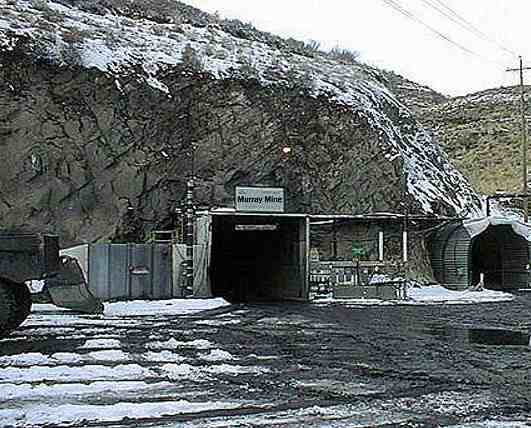
Photo: Geoprime Minerals
Search for specimens: View all specimens from Murray Mine, null
The Murray Mine is in the Independence Mountains mining district of northern Elko County, Nevada, in the broader Jerritt Canyon gold-mining area north of Elko. Geologically it belongs to the family of Carlin-type, sediment-hosted gold deposits: structurally controlled systems in which ore fluids exploited favorable carbonate-rich Paleozoic rocks, faults, fold intersections, and formation contacts. The host package at Murray includes the Ordovician Snow Canyon Formation above the deposit, the Silurian–Devonian Roberts Mountains Formation, and the Ordovician–Silurian Hanson Creek Formation below. Gold mineralization is closely tied to the New Deep fault system and the Saval Discontinuity, the latter an important structural and stratigraphic break near the Roberts Mountains–Hanson Creek contact.
The mineralization was not a conventional display-specimen environment; Murray was an ore mine, not a collector’s adit. Much of the gold occurred as microscopic to submicroscopic mineralization associated with pyrite in black, carbonaceous, decalcified, sulfidized, silicified, and argillized sedimentary rock. Open-space mineral specimens were an incidental but spectacular byproduct of this system. Pockets occurred in highly silicified carbonaceous limestone that commonly did not react to hydrochloric acid, a telling indication of the intensity of silicification. In those cavities, stibnite, barite, and quartz formed the specimens collectors now prize, with stibiconite locally present as an alteration product of stibnite and realgar and orpiment also documented from the mine.
The mining history begins with antimony interest in the Independence Mountains. Nearby Burns Basin shipped roughly 30 to 40 tons of stibnite as antimony ore between 1918 and 1945. In the early 1970s, FMC explored the Burns Basin area for antimony, but the recognition of Carlin-style gold potential shifted the focus. FMC and Freeport Exploration developed the Jerritt Canyon project, and mining began in 1981 at what was known collectively as the Enfield Bell or Jerritt Canyon mine. Corporate names changed through Freeport McMoRan Gold, Minorco, Independence Mining Company, AngloGold, Meridian, Queenstake, and later operators of the broader Jerritt Canyon property. The Murray underground workings were active during the period when the famous mineral specimens were recovered, and specimen-market descriptions and recovery accounts consistently place the important collector production in the late 1990s through early 2000s. The Murray Mine itself had been closed for almost five years by the winter 2010–2011 Geoprime update, placing closure around 2006.
For collectors, the essential Murray story centers on a handful of productive openings rather than long-term specimen mining. In January 1999, mine operations manager Greg Struble escorted Casey and Jane Jones underground to the Z5-100 drift in the Roberts Mountains Formation. A heading had just been blasted and was being mucked with a 5-cubic-yard loader. During that work, a pocket of clear pseudocubic barite became visible in the right rib of the drift. After ground support was installed for safety, the collectors entered a cavity about 1 meter wide, 1 meter high, and 0.5 meter deep. It had collapsed before exposure, so many barites were damaged and iron-coated, but at least one remarkable matrix group survived with a crystal about 10 cm across.
The stibnite pockets were generally smaller. Recovery accounts describe mostly fist-sized to football-sized pockets, many containing needle crystals up to about 2 inches long and commonly showing stibiconite. A notable April 1999 blast produced broken crystals and groups, along with a few undamaged, high-quality specimens from the muck pile. Those finds helped establish Murray as a serious North American stibnite locality, even though large in-situ stibnite voids remained elusive.
The most famous single discovery was the Sugarbowl Pocket, encountered in March–April 2000. It was a several-foot cavity packed with pseudocubic barite on black silicified limestone, with both matrix and barite coated by fine drusy quartz. The material was recovered over several days and yielded hundreds of specimens, but only a small number included stibnite. Many surviving labels give precise pocket provenance such as Zone 4, Level 175, Drift 13, Sugarbowl Pocket; that level of detail adds real value because the Sugarbowl style is so diagnostic and was a limited recovery.
Collecting access today should be regarded as closed. Murray is part of a large, privately controlled modern mine property, and the famous specimens came from professional recovery under mine permission, not public collecting. The broader Jerritt Canyon operation was placed on temporary suspension in 2023, and First Majestic announced in 2026 a restart plan intended to position Jerritt Canyon for renewed gold production in the second half of 2027. That corporate activity does not make the old Murray specimen zones publicly accessible. Serious collectors should expect legitimate material to come from old collections, dealer inventories, and specimens with labels tracing to Geoprime, Bob Griffis, Scott Kleine, the Sugarbowl Pocket, or other known late-1990s to early-2000s channels.
Quartz at Murray is important less as isolated crystals than as the final, glittering stage of the pocket assemblage: fine drusy SiO2 coats barite, dark silicified limestone, and locally earlier stibnite, creating the “sugary” surface that defines Sugarbowl Pocket specimens. The most distinctive quartz pieces are casts after stibnite, where later quartz preserved the bladed or prismatic form after the stibnite was partly or completely removed; examples from the March 2000 Sugarbowl Pocket have been described around miniature to cabinet size, with individual casts approaching 19 mm and residual stibnite needles sprinkled on the quartz. Good Murray quartz specimens are judged by brightness, completeness of the sparkling druse, strength of the underlying barite or stibnite form, and clean contrast against black silicified limestone; ordinary pieces are merely gray-white drusy coatings without the sharp “sugar over cubes” texture or clear pseudomorph story.
Barite from Murray is the mine’s most recognizable collector mineral, especially from the Sugarbowl Pocket, where translucent to white, blocky, pseudocubic to pseudo-rhombic BaSO4 crystals grew on dark silicified limestone and were then overgrown by sparkling drusy quartz. Documented specimens range from small miniatures with crystals around 1.4–2.0 cm to cabinet pieces exceeding 10 cm across, and early recovery accounts mention an exceptional un-drused barite specimen around 12 x 8 cm as well as a Z5-100 barite group with a crystal about 10 cm across. The best barite pieces show sharp blocky architecture, a luminous silvery-white to translucent body color, an even quartz frost, minimal bruising on exposed cube-like corners, and, ideally, a strong label tying them to Sugarbowl Pocket or another specific Murray zone.
Baryte is the same mineral species as barite, but the spelling is common on European-style labels, auction descriptions, and database records, so Murray collectors will encounter both names for the same BaSO4 pocket material. The Murray baryte habit is thick, blocky, and deceptively cubic-looking rather than tabular; crystals may be glassy, translucent, white, or softly silvery beneath a coating of quartz microcrystals, with the richest examples forming sculptural vug linings from the March 2000 Sugarbowl Pocket. Choice baryte specimens preserve the dark matrix, the stepped blocky crystal geometry, and the sparkling quartz overgrowth without heavy iron staining or edge chipping; labels giving Zone 4, Level 175, Drift 13, Sugarbowl Pocket are particularly desirable because they place the specimen in the single classic find that made the locality famous.
Stibnite is the prestige mineral from Murray and the reason the mine earned attention far beyond Nevada collecting circles. Murray stibnite occurs as lead-gray, metallic Sb2S3 needles to stout striated prisms, commonly associated with blocky barite and drusy quartz; dealer and publication records describe small needle pockets with crystals to about 2 inches, market specimens with lustrous prisms to about 3.5 cm, and exceptional Murray material with crude black prisms reported to 10 cm. The finest examples show bright metallic luster, undamaged terminations or sculptural groups, strong contrast with white quartz-coated barite, and an obvious early position in the paragenesis, where barite partially encloses or decorates the stibnite rather than obscuring it; damaged muck-pile pieces, oxidized stibiconite-coated needles, and incomplete casts are more common than truly display-quality stibnite-on-barite combinations.
Other documented Murray minerals include stibiconite, realgar, orpiment, pyrite, calcite, limonite, clays, and other oxidation products typical of a complex Carlin-style hydrothermal and supergene environment. Murray is not known as a type locality, but stibiconite after stibnite is significant here because alteration affects many stibnite pockets and can either add locality character or diminish luster, depending on the specimen. Realgar and orpiment fit the arsenic-rich geochemical signature of Jerritt Canyon–style systems, though they are far less important to collectors from Murray than the stibnite–barite–quartz assemblage.
Murray specimens reward careful label reading. “Murray Mine,” “Queenstake’s Murray Mine,” “Jerritt Canyon,” “Independence Mountains,” and “Sugarbowl Pocket” may all appear on legitimate labels, but they do not mean exactly the same thing. The strongest provenance names the Murray Mine specifically and, for the classic quartz-coated barite, gives Sugarbowl Pocket, commonly with Zone 4, Level 175, Drift 13. Be cautious with vague “Jerritt Canyon” labels on barite or stibnite, because the district contains several mines and the nearby Meikle Mine produced famous barite of a very different character. Murray barite is usually white to translucent, blocky, and quartz-frosted on dark silicified limestone; Meikle barite is better known for golden crystals and calcite associations.
Condition is the main quality issue. Many Murray specimens were recovered in an active underground mine after blasting, mucking, and ground-support work. Broken corners on barite, bruised quartz druse, cleaved or snapped stibnite prisms, and iron staining are common. A small, clean Sugarbowl specimen with complete sugary quartz coverage and crisp barite geometry can be more desirable than a larger cabinet piece with obvious impacts. On stibnite specimens, check the prism faces under strong light for fresh breaks, dull alteration, and contacts hidden by quartz or barite overgrowth. Some alteration to stibiconite is natural and locality-correct, but heavy gray-white alteration can reduce the metallic presence that makes Murray stibnite compelling.
Handling should be conservative. Stibnite is relatively soft, easily scratched, and prone to cleavage damage; barite is heavy and brittle; drusy quartz can abrade neighboring specimens. Store Murray pieces in fitted boxes or on custom bases so that barite corners and stibnite needles do not touch foam under pressure. Avoid aggressive cleaning. Iron coatings were specifically noted during pocket recovery, but acid treatment or harsh mechanical cleaning can dull stibnite, undercut friable matrix, or destroy the fine quartz sparkle. Realgar and orpiment, when present, should be kept away from strong light and handled with normal arsenic-mineral precautions: wash hands after handling and avoid dust.
Market availability is limited but not impossible. The Sugarbowl Pocket yielded hundreds of specimens, so quartz-coated barite appears periodically from old collections, especially in miniature to small-cabinet sizes. Fine stibnite combinations are much scarcer, and truly aesthetic pieces with bright, undamaged stibnite on barite and quartz are significantly rarer than simple Sugarbowl barite specimens. The best Murray pieces now tend to surface as collection resales with older Geoprime, Bob Griffis, Scott Kleine, or auction provenance.
The Murray collecting story has the feel of a timed underground rescue. In January 1999, Casey and Jane Jones arrived at the mine and were taken underground by Greg Struble, the mine operations manager, riding a Kubota mine tractor into the workings. Their target was Z5-100—Zone 5, Drift 100—in the Roberts Mountains Formation. The heading had just been blasted on the previous shift, and a 5-cubic-yard loader was still mucking the broken ore. Between scoops, the collectors moved in, hosed down the muck pile, and searched the wet broken rock for signs of crystallized open space.
After about an hour, the pocket appeared in the right-hand rib of the drift: clear pseudocubic barite, visible in the wall while mining was still underway. Struble told them cavities of that size were rarely encountered. The find was promising enough that they were invited to stay into the night shift, but not to rush in. First the ground had to be made safe. They left the mine through the main adit, waited for the next crew, and returned around 7 o’clock that evening. Two more hours passed while ground support was installed. Only then could they begin collecting the pocket.
The pocket itself was not a perfect treasure chamber. It measured roughly 1 meter wide, 1 meter high, and half a meter deep, but it had collapsed before the blast exposed it. Many of the barites were already damaged, and a thick iron coating hid bruises until the specimens were cleaned or inspected closely. Even so, one matrix group survived with a largest crystal about 10 cm across. The recovery also fixed an important piece of Murray mineralogy: the host rock for the barites and stibnites was a highly silicified carbonaceous limestone, so altered that it did not react to hydrochloric acid.
The mine environment surprised the collectors for another reason. Murray was comfortable by underground Nevada standards. The air hovered around 65° F. Only days before, they had been on the 1075 level of the Meikle Mine, where temperatures were closer to 110° F. The contrast between the two great Nevada specimen-recovery projects—Meikle’s hot, deep barite caverns and Murray’s cooler stibnite-barite pockets—became part of the lore of both localities.
Stibnite proved more elusive than the barite. The Murray workings yielded mostly small pockets, from fist-sized to football-sized, many with needle crystals up to about 2 inches long and stibiconite present. On an April 1999 collecting trip, a blast produced broken crystals and groups on the muck pile, but also a few undamaged, extraordinary specimens. Enough survived to confirm that Murray was capable of producing stibnite that could stand beside far more famous world localities in collector discussions, even though the pockety nature of the occurrence made every fine piece feel like a near miss with the crusher.
The most memorable episode came in March 2000, when mine operations revealed a larger cavity that became the Sugarbowl Pocket. It was not the long-hoped-for giant stibnite void. Instead, it was a several-foot chamber packed with pseudocubic barite on jet-black silicified limestone. Fine microcrystalline quartz coated the barite and even much of the matrix, giving the whole pocket the sugared texture that named it. The pocket was worked over several days and yielded hundreds of specimens, yet only a handful carried stibnite. That imbalance is why Sugarbowl barite, while limited, is still obtainable, whereas top Murray stibnite combinations are genuinely difficult.
One early Jerritt Canyon stibnite story is almost comic in hindsight. Recovery accounts report that before the formal specimen work, a stibnite crystal a foot to a foot and a half long had been collected from the West Generator pit and used for years as a doorstop. It is a perfect Nevada mining anecdote: a specimen that later collectors would recognize immediately as important, surviving not because it was curated, but because someone found it useful and heavy.