A collector's guide to Moscona Mine, Spain: its geology, mining history and notable minerals, illustrated with the 181 specimens documented from this locality on EarthWonders.
Key facts
Moscona is the modern classic of the Villabona–Arlós fluorite district in Asturias: a productive fluorspar mine whose collectible output is instantly recognizable by honey-yellow cubic fluorite on pale carbonate gangue, often sharpened by white to blue baryte, saddle-like dolomite, bright calcite, and occasional pyrite. Geologically, the mine belongs to the southwestern border of the Asturian Permo-Triassic basin, where fluorite mineralization is hosted in a gently dipping Middle Triassic carbonate horizon and is locally fed or modified by fault-controlled veins. For collectors, that setting matters because Moscona specimens do not look like the purple Berbes classics or the big blue La Viesca pieces; they have their own palette: amber, caramel, golden yellow, and, in rare episodes, blue-violet zoning over earlier yellow fluorite.
Regional View
Country View
The best Moscona pieces are not merely “yellow fluorite from Spain.” They show transparent, lustrous cubes in tight plates or mound-like aggregates, with crystal edges picked out by darker inclusions or zoning, and they often respond strongly under ultraviolet light. Fine cabinet specimens can be layered in a way that feels architectural: fluorite as the golden foundation, calcite as rhombohedral or scalenohedral accents, and baryte as white, yellow, or pale blue blades dusted over the display face. Older material and select pocket finds add extra character—pyrite coating fluorite, sulfide-lined phantom edges, unusual stalactitic growths, blue baryte sprays, and the rare violet-over-yellow fluorites that made the Christmas Eve 1999 pocket famous among Spanish collectors.

Photo: Wikimedia Commons

Photo: Wikimedia Commons
Search for specimens: View all specimens from Moscona Mine, Spain
Moscona Mine is at El Pontón de Solís / El Llano, near Solís in Corvera de Asturias, within the Villabona–Arlós mining area of Asturias, northern Spain. It is part of the western fluorite province of Asturias, a region whose Spanish collector identity is built around three major fluorite districts: Caravia–Berbes, La Collada, and Villabona–Arlós. Moscona is the best-known collecting name in the last of these and has remained the reference point for yellow Asturian fluorite.
The deposit is an epigenetic, stratiform fluorite body hosted in a carbonate level of a Permo-Triassic basin resting unconformably on Paleozoic basement. Geological summaries describe the mineralized horizon as Middle Triassic limestone, micritic to locally sandy, with abundant silicification and replacement textures. At Moscona the fluorspar occurs both as stratiform mineralization in the calcareous level and as vein material associated with NE–SW extensional faults that served as conduits for hydrothermal fluids. The overall bed dips gently to the northeast, about 10 degrees in published mine-water and district descriptions, and the industrial ore bed is only a few meters thick but laterally extensive.
The ore is dominated by fluorite, silica, and calcite, with lesser baryte and pyrite. Published mine descriptions give typical run-of-mine material around 30–35% CaF2, about 35% SiO2, about 25% CaCO3, and only a few percent BaSO4. That chemistry is visible in hand specimens: golden fluorite is the collector mineral, but much of the matrix is carbonate and silica, and many pocket pieces are overprinted or coated by calcite, dolomite, baryte, quartz, and small sulfides. The silica component is not just a number in an ore table; in thin section and in specimens it appears as intense silicification, replacement fronts, skeletal crystals, and patchy mineralization textures.
Mining in the broader Villabona–Arlós district predates Moscona. Fluorite concessions near Villabona were marked out in the 1940s, the Cucona area became important later, and Minersa acquired and developed major properties in the district in the 1970s. The Moscona mine began operation in 1979 according to classic collector literature, while other sources place the beginning of mining activity at the end of the 1970s. It became the most productive and durable mine of the district, replacing older Villabona-area workings in importance. Modern administrative records identify the Moscona concession and associated permits as part of the Villabona mine group held by MPD Fluorspar, S.L.U., within the Minersa group.
Industrial extraction at Moscona has been by underground room-and-pillar mining. The ore is moved out through an inclined access, with published geological mapping noting truck haulage on a ramp of roughly 15 degrees and treatment at Minersa’s washing plant at Berbes, Ribadesella. The product is fluorspar concentrate, mainly acid-grade material for hydrofluoric-acid manufacture, with a smaller cement-grade component. This is not an abandoned collector dig; it is an industrial mine system with concessions, underground workings, blasting, heavy equipment, ventilation and water-management issues. Casual collecting should be considered off-limits unless permission is explicitly granted by the operator and all safety requirements are met.
For specimens, Moscona’s most prolific production came from underground cavities and ore zones opened during mining rather than from surface collecting. The ordinary mine run yielded countless small yellow fluorite plates, but the notable pockets produced distinctive styles. Classic early pieces show sharp yellow cubes with baryte, calcite, and pyrite; a 1979 style is represented by intense yellow fluorite with geometric edge zoning and white baryte, larger than typical for the mine. The 1990s produced many of the “textbook” honey-yellow fluorites with sulfide inclusions and vivid fluorescence. In 2012 the Corte del Agua area yielded blue baryte with dolomite, calcite, and minor fluorite. A 2016 find produced unusually bright quartz crystals coating yellow fluorite, and 2017 material included rare stalactitic-looking fluorite growths fringed by complex white calcite. More recent specimen records through the 2020s show that occasional fine yellow fluorite, calcite, baryte, and combination pieces continued to enter collections from mine-related sources, but the finest Moscona material is selective: there is a great difference between common small yellow fluorite and a balanced, damage-free, zoned, fluorescent plate with undamaged baryte or calcite accents.

Photo: Wikimedia Commons
Moscona fluorite is characteristically cubic, transparent to translucent, and honey-yellow to amber, usually in clusters of small sharp cubes commonly under about 2 cm on edge, although exceptional pieces show larger crystals and broad cabinet-size plates. The best examples have wet-looking luster, saturated color, strong geometric zoning, and dark pyrite or pyrite-marcasite inclusions concentrated along phantom edges; many fluoresce under longwave and shortwave ultraviolet light, sometimes with stronger response along the cube edges. Associations are central to the Moscona look: white dolomite rhombs, complex calcite, tabular baryte, and small pyrite can lift an otherwise ordinary yellow plate into a locality classic. Rare violet, blue, or two-color fluorite is much scarcer than yellow and is especially prized when it shows the documented two-generation growth from the 50 m level pocket of 24 December 1999, where later bluish to violet fluorite sits on earlier yellow fluorescent fluorite with calcite, yellow baryte, and dolomite.
Calcite from Moscona is more varied than many collectors expect from a fluorite mine, and published specimen records repeatedly emphasize its richness of forms: scalenohedra, rhombohedra, short prisms, lenticular crystals, rounded polycrystalline groups, doubly terminated crystals, and two-generation coatings all occur on fluorite-rich matrix. Typical calcite is white to translucent, sometimes pale yellowish or cream-colored, and may be dusted or stained reddish by hematite inclusions; individual crystals on fine specimens range from small accents to striking cabinet-size crystals several centimeters across, with exceptional large scalenohedra described as unusual for the locality. The most attractive Moscona calcites are not just clean crystals; they are balanced combinations, where white or translucent calcite rises above a glittering base of transparent intense yellow fluorite, often with dolomite or baryte adding a third texture.
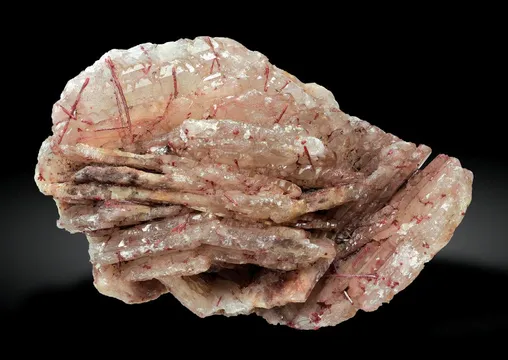
Barite at Moscona occurs as one of the mine’s defining accessory minerals, especially in the Moscona–Arlós sector where baryte is more frequent than in the Villabona area. Collectible barite is typically tabular to lamellar, sometimes arranged in airy sprays, rosettes, book-like aggregates, or thick sharp plates, and it ranges from white and pearly to pale sky blue, deeper blue, yellow, and rarely pinkish. The finest barite pieces show transparent to translucent crystals with crisp edges, strong luster, and clean placement on yellow fluorite or white dolomite; blue baryte groups from the 1990s, 2011–2012 Corte del Agua material, and later selected finds are especially appealing. Ordinary pieces may have baryte only as a sugary coating, while fine examples preserve discrete, undamaged blades and color zoning, especially blue centers grading toward paler edges.
Moscona dolomite is most often a white to cream carbonate accessory on fluorite and baryte specimens, commonly in small rhombohedral crystals with curved faces and saddle-shaped habits. It is visually important because it gives many Moscona pieces their crisp white contrast against the amber fluorite, appearing as scattered rhombs, coatings, or partial blankets over fluorite, calcite, and baryte. Fine dolomite pieces from the mine are judged less by crystal size than by texture and placement: sharp white saddles on deep yellow fluorite, dolomite framing blue baryte, or dolomite accompanying uncommon sphalerite and pyrite associations are preferable to dull, heavy coatings that obscure the fluorite. Because dolomite, calcite, and baryte can all appear as pale secondary minerals on Moscona specimens, careful habit recognition matters when labeling combination pieces.
Baryte is the spelling most often used in European literature and dealer records for Moscona’s BaSO4, and under that name it includes some of the locality’s most elegant combination specimens: blue or white tabular crystals on yellow fluorite, pale yellow blades with calcite and dolomite, and rare pinkish baryte partially covered by dolomite and colorless calcite. The species can be easy to underestimate when it is present as a frosty dusting, but the best Moscona barytes are sharply tabular, lustrous, sometimes doubly terminated, and sufficiently transparent to show the delicate blue, yellow, or white zoning that distinguishes them from common chalky coatings. Color is a major value driver here; blue baryte is a signature style, while yellow baryte is specifically noted as unusual and is particularly desirable when paired with deep amber fluorite or the rare violet fluorite pocket material.
Pyrite from Moscona appears in several collector-relevant forms: tiny cubic or beveled crystals on yellow fluorite, dark inclusions aligned along fluorite phantom edges, iridescent microcrystalline coatings over fluorite cubes, and rare arborescent or skeletal floater groups from the earliest years of mining. The inclusion style is particularly diagnostic for Moscona fluorite, where sulfides can trace growth zones and become dramatically visible under ultraviolet light because the fluorite response outlines the geometry. True standalone pyrite specimens are uncommon from the locality compared with fluorite-calcite-baryte combinations; old arborescent pyrite pieces from the beginning of mining in 1978–1985 are described as rarities. The best pyrite-bearing Moscona specimens have bright, stable-looking sulfide crystals that enhance the fluorite rather than dull, oxidized coatings that obscure faces or suggest poor storage.
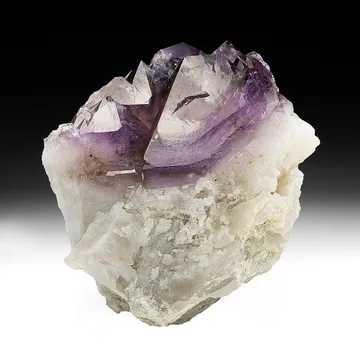
Other minerals documented from Moscona include quartz, sphalerite including marmatite, chalcopyrite, galena, cinnabar, marcasite, tetrahedrite-subgroup minerals, azurite, malachite, aurichalcite, and anglesite. These are mostly accessory or rare collector minerals rather than the main reason specimens are sought, but they matter for interpretation: sphalerite and pyrite can accompany dolomite on fluorite; galena and chalcopyrite explain some metallic inclusions; cinnabar and tetrahedrite connect the mine to the broader low-temperature hydrothermal sulfide assemblage of the district; and quartz is locally notable where later crystals coat fluorite, including a documented 2016 find of bright doubly terminated quartz on yellow fluorite. No Moscona type-locality mineral is part of the accepted published identity of the mine; its importance is instead as a major specimen-producing fluorspar locality.
The most common authenticity issue is locality precision rather than outright fakery. For years, honey-yellow fluorites from the district circulated under broad labels such as “Villabona,” even when the material was from Moscona. Older labels may also say Solís, Villabona, Arlós-Villabona district, or simply Asturias, Spain. A good Moscona label should ideally name Moscona Mine and, when known, El Llano / El Pontón de Solís, Corvera de Asturias, Asturias, Spain. “Villabona” is not necessarily wrong in a district sense, but it can blur the difference between Moscona material and older Villabona or Cucona pieces.
There is no well-established tradition of dyed or irradiated Moscona fluorite in the serious specimen market, and the locality’s yellow, amber, blue, and violet colors are documented in mine and collector records. The more practical concern is over-optimistic identification of associated white minerals. White blades may be baryte, white rhombs may be dolomite, and white scalenohedra or complex crystals may be calcite; on busy combination pieces, two or three may occur together. Blue tabular crystals are usually baryte, not celestine. Dark inclusions and coatings on fluorite are often pyrite or related sulfides rather than dirt or goethite, although oxidation can darken or dull them.
Condition is crucial. Moscona fluorite cubes are often small and closely packed, so edge wear can hide in a sparkling surface until the specimen is tilted under strong light. Baryte blades are far more fragile than the fluorite and commonly show bruised tips, missing plates, or contact marks. Calcite can be cleaved, bruised, or etched, and dolomite coatings may conceal broken fluorite beneath. Some large matrix pieces have been sawn or trimmed on the back; that is normal preparation for display if disclosed, but collectors should distinguish a cleanly trimmed back from repaired or composite construction.
Fluorescence is one of the locality’s pleasures. Many Moscona fluorites fluoresce under longwave and shortwave UV, sometimes with zoned response; baryte may also fluoresce white, and calcite can show minor fluorescence. Use UV as a bonus, not as sole proof of locality, because response varies even within Moscona and can differ between crystal zones. Keep pyrite-bearing specimens dry and stable, especially older material with fine sulfide coatings or inclusions, and avoid long storage in humid cabinets.
On the market, Moscona is available but quality is highly stratified. Small yellow fluorite plates are common enough that ordinary examples remain affordable. Fine cabinet specimens with deep color, transparency, strong zoning, undamaged baryte or calcite, attractive dolomite placement, and documented older pocket provenance are much scarcer. The rarest collector styles are blue-to-violet fluorite from the 1999 pocket, strong blue baryte groups, old arborescent pyrite, unusual large calcite-dominant pieces, and specimens with well-preserved sulfide phantom zoning.
The most memorable Moscona story begins on 24 December 1999, at the 50 m level. While much of the mine’s reputation rests on yellow fluorite, that Christmas Eve pocket was startlingly different: it produced two generations of fluorite, with later blue to violet crystals grown on an earlier yellow generation. The older yellow fluorite was fluorescent under both longwave and shortwave ultraviolet light, and the pocket assemblage included calcite, yellow baryte, and dolomite. Years later, specimen records still singled it out as an exceptional event precisely because comparable material had not reappeared. In a locality known by the thousand for golden cubes, the pocket’s blue and violet crystals became the kind of find collectors remember by date.
Moscona also has a scale that is easy to miss when looking only at thumbnails of hand specimens. One locality account gives a vivid measure of the underground workings: a loaded truck could take about an hour and a half to travel between the farthest mining point and the mouth of the mine. That is the industrial context behind the specimen stream. Moscona was not a small pocket dig; it was a broad underground fluorspar operation in which collectible cavities were opened as part of large-scale ore extraction.
Some of the mine’s most charismatic specimens come from the early years. Pyrite pieces found at the beginning of mining—around 1978 and the early 1980s—are described as rare, including arborescent and skeletal pyrite floaters, and pyrite partially covering characteristic yellow Moscona fluorite. These are not the typical glittering fluorite plates that made the locality abundant in collections. They are reminders that Moscona’s mineralizing system carried sulfides through the same carbonate-hosted structures, leaving metallic growths and inclusions as a minority but highly desirable part of the locality’s output.
A later surprise came in June 2016, when unusual quartz-on-fluorite pieces appeared: bright, mostly doubly terminated quartz crystals coating druses of yellow fluorite. Quartz is not what most collectors reach for when thinking of Moscona, yet the find was notable exactly because it departed from the expected fluorite-baryte-calcite-dolomite formula. Similar small departures—stalactitic fluorite growths in 2017, blue baryte at Corte del Agua in 2012, or large calcite crystals from select pockets—are what keep the locality interesting even after decades of yellow fluorite production.