A collector's guide to Molo Village, null: its geology, mining history and notable minerals, illustrated with the 36 specimens documented from this locality on EarthWonders.
Key facts
Molo Village is the collector-facing name for a small but mineralogically outsized pegmatite district around Khetchel village in the Molo quarter of Momeik Township, northern Shan State, Myanmar. It is not a classic Mogok marble ruby locality, even though older labels often collapse it into the broader “Mogok” gem world. Its importance lies in rare-element granitic pegmatites cutting serpentinized peridotite, within the larger Mogok metamorphic-belt setting of gneiss, marble, and calc-silicate rocks. From those pegmatites and their derived alluvials came an assemblage that immediately caught the attention of collectors and gemologists: colorless to near-colorless phenakite, hambergite, petalite, pollucite, aquamarine, morganite, topaz, schorl, rubellite, and the peculiar botryoidal-to-mushroom tourmalines that became one of the most recognizable Burmese pegmatite specimen styles of the early 2000s.
The best specimens from Molo have a look all their own. Phenakite is typically glassy and colorless, sometimes twinned into compact, sharply terminated “drill-bit” forms, and the most desirable pieces are not merely loose prisms but crystals perched on smoky quartz and K-feldspar matrix. The tourmaline is even more instantly identifiable: pink to red elbaite in globular, hooded, mushroom-like growths, commonly developed around dark schorl cores or stems and set against pale quartz or calcite. Hambergite, by contrast, is a connoisseur’s mineral here—usually small, colorless, and glassy, but valuable because genuinely attractive hambergite crystals from any locality are scarce. For systematic collectors, Molo’s greatest distinction may be quieter but deeper: it is the type locality of perettiite-(Y), a yellow yttrium-manganese-iron borosilicate first recognized as microscopic inclusions in phenakite.
Regional View
Country View
The locality’s collecting history is entangled with several nearby mine names: Palelni, also rendered Kat Chay or Khat Che; the Phenakite Mine; Pheyeou; Moe-Thee; Nagarthwet; and Khetchel Ywarthit. This tight cluster explains much of the label confusion in collections. A loose phenakite labeled “Mogok,” “Palelni,” “Khetchel,” “Katchay,” “Momeik,” or simply “Burma” may all point to the same neighborhood, but the most sharply crystallized phenakites are now generally associated with the Phenakite Mine near Khetchel, very close to Palelni.
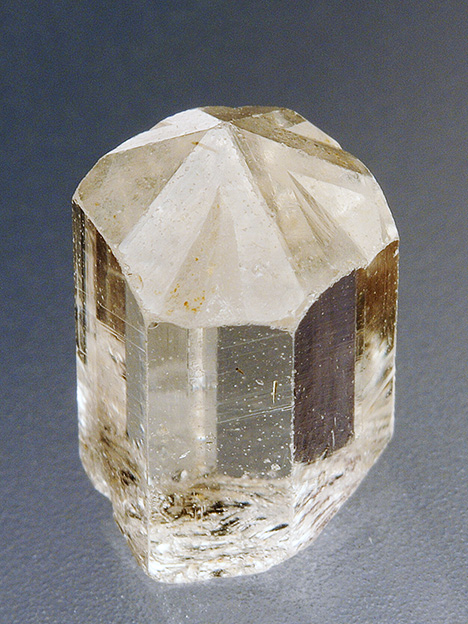
Photo: GIA, Gems & Gemology, “Perettiite-(Y) and Tusionite Inclusions in Phenakite from Myanmar”

Photo: GIA, Gems & Gemology, “Perettiite-(Y) and Tusionite Inclusions in Phenakite from Myanmar”
Search for specimens: View all specimens from Molo Village, null
Molo Village belongs to the Momeik gem-pegmatite district of northern Shan State, Myanmar, northeast of Mogok. The collector locality is best understood as the Khetchel village area in Molo quarter rather than a single, neatly bounded mine. The principal deposits are rare-element granitic pegmatites of LCT affinity: lithium-, cesium-, tantalum-, beryllium-, and boron-bearing bodies that occur as dikes and lenticular pegmatites. Published descriptions place them cutting serpentinized peridotite, with the broader peridotite body hosted by Mogok Group gneiss, marble, and calc-silicate rocks. Individual pegmatites in the Momeik region are described as commonly 2–5 m thick, locally reaching about 10 m, and showing relatively simple internal zoning with crystal-lined pockets.
The pockets are the reason collectors care. They can be lined with K-feldspar and quartz, saccharoidal albite, adularia, and the colorful late-stage minerals that define the district: pink to red elbaite, schorl, hambergite, beryl varieties, petalite, phenakite, and locally rare borates and tantalum-niobium oxides. The assemblage points to highly evolved pegmatitic fluids that were rich enough in beryllium to crystallize phenakite and hambergite, lithium to stabilize petalite and elbaite, cesium to produce pollucite and Cs-rich beryl-group material, and boron to generate unusually complex tourmaline chemistry. The best-known ore or specimen pockets were not metallic ore bodies in the conventional sense; they were gem-bearing pegmatite cavities, with specimen-quality crystals coming both from primary pegmatite and from alluvial sediments derived from those pegmatites.
The mine names most often encountered on specimen labels are Palelni Mine, also called Kat Chay Mine; Phenakite Mine; Pheyeou Mine; Moe-Thee Mine; Nagarthwet Mine; and Khetchel Ywarthit Mine. Palelni is the name most closely associated with the famous mushroom tourmalines, while the Phenakite Mine is the label most closely tied to the sharp, well-developed colorless phenakite crystals and the perettiite-(Y) type occurrence. The Palelni and Phenakite Mine occurrences are very close to one another, which is why older labels and trade descriptions often blur the distinction.
The documented collecting period that matters most to modern specimen collectors begins in the 1990s and early 2000s. Mushroom tourmaline from the Khetchel–Molo area was already known in the trade before detailed gemological articles appeared in 2005. Commercial specimen labels from important dealers record Palelni rubellite material from the 2003–2004 period, and published gemological reports in 2005 described Momeik tourmalines and associated rare gemstones from pegmatites near Molo village. Colorless phenakite crystals were prominent in the trade by the mid-2000s; matrix specimens, rarer than loose crystals, became notably visible to collectors around the 2009 Tucson season. The late 2006 discovery and study of pink pezzottaite from Khat-Chel near Molo added another layer of gemological significance, and the 2015 description of perettiite-(Y) as inclusions in Molo phenakite made the Phenakite Mine a formal type locality.
Collecting access today should be treated as effectively closed to casual field collectors. The area is remote, mine access is private or locally controlled, and Myanmar has been under severe travel advisories because of armed conflict, civil unrest, landmines, arbitrary enforcement of laws, and poor health infrastructure. For collectors outside Myanmar, Molo specimens are overwhelmingly an old-stock, dealer, collection, and show-market proposition rather than a realistic self-collecting target. Provenance work—reading old labels carefully, comparing locality names, and noting whether the piece is Palelni, Phenakite Mine, Khetchel, or only “Mogok”—is part of collecting the locality well.
Phenakite from Molo is best known as colorless to near-colorless, lustrous, transparent crystals from the Khetchel pegmatites, especially the Phenakite Mine; many are distorted or twinned, and the most distinctive crystals show compact “drill-bit” terminations rather than the simpler prismatic habits seen from many other localities. Published gemological work notes etched prism faces, small growth tubes, and tiny solid inclusions, while dealer and show reports describe earlier production mostly as loose transparent prisms, commonly broken at one end, before better matrix pieces appeared with phenakite crystals to about 3 cm on smoky quartz and K-feldspar. Good Molo phenakite is sharp, bright, transparent, and either complete as a floater or aesthetically positioned on matrix; the very finest analytical curiosities contain visible yellow needles or bundles of perettiite-(Y), or platy tusionite inclusions, but those inclusion pieces are extraordinarily uncommon.
Hambergite at Molo is a pocket mineral of the beryllium-rich pegmatite suite, recorded with phenakite, petalite, beryl, albite, K-feldspar, quartz, and pink to red elbaite in the Khetchel–Palelni area. Specimens are generally colorless to white and glassy, with the most desirable examples appearing as clean prismatic crystals or slender needles, sometimes partly coated or accompanied by albite; dealer examples from Molo commonly fall in the thumbnail range, such as transparent crystals around 1.7–2.0 cm long. Because hambergite has strong cleavage and is rarely both complete and transparent, the premium here is on undamaged, lustrous, well-isolated crystals with minimal bruising, not on size alone.
Tourmaline from Molo spans black schorl, green tourmaline, pink fibrous tourmaline, rubellite, elbaite, and chemically unusual olenite-rich material, but collectors know the locality above all for botryoidal and mushroom-shaped aggregates from Palelni and nearby Khetchel mines. The tourmalines occur as euhedral gem-quality crystals, mushroom-shaped aggregates, and rounded masses in pegmatite pockets associated with quartz, orthoclase, calcite, albite, phenakite, petalite, beryl, and hambergite. Good general “tourmaline” specimens from Molo show the locality’s radial or hooded habit clearly, with fresh pink-to-red color, visible dark schorl cores where present, strong contrast against pale matrix, and intact curved caps rather than rubbed, chalky, or incomplete masses.
Elbaite is the visual signature species of Molo, particularly in the Palelni Mine material where rubellite forms raspberry-pink to red, botryoidal, globular, and mushroom-like aggregates that may coat or cap dark schorl crystals like a hood. Scientific work on the unusual Momeik tourmalines describes radial sprays of tiny crystals and compositional zoning from Mn-bearing elbaite toward Al-rich, Li-bearing olenite near pyramidal faces; collector specimens show the same growth drama at hand-specimen scale as pink fibrous bodies, red caps, schorl stems, and pale calcite or quartz matrix. The best pieces have complete rounded caps or spheres, vivid color zoning, clean contrast, good luster for the habit, and undisturbed relationships between rubellite, schorl, and matrix; ordinary pieces are commoner as partial caps, rubbed botryoidal lumps, or broken fragments whose distinctive “mushroom” architecture is no longer obvious.
Other documented minerals from the Molo quarter and its Khetchel mines make the locality far more than a four-species pegmatite. Perettiite-(Y), Y2Mn4FeSi2B8O24, is the formal type-locality mineral, occurring as yellow tapered acicular inclusions in phenakite from the Phenakite Mine; tusionite, MnSn(BO3)2, occurs there as rare yellow platy inclusions; and “avdeevite” is recorded as a first recorded locality item, though not an approved species. Pezzottaite-(Cs) from Khat-Chel near Molo was important as Myanmar’s first reported pezzottaite occurrence, with small pink beryl-like crystals showing strong orange-to-purple pleochroism and high cesium contents. The broader assemblage also includes petalite, pollucite, beryl varieties including aquamarine, goshenite, and morganite, topaz, danburite, albite, microcline, orthoclase, muscovite, lepidolite, fluorapatite, lazulite, columbite-(Mn), stibiotantalite, stibiocolumbite, pyrochlore-group minerals, smoky quartz, chalcedony, spinel, and spodumene.
The most common authenticity issue for Molo specimens is not outright fakery but locality precision. “Mogok” on an older Burmese phenakite or mushroom tourmaline label may be trade shorthand rather than strict administrative geography. Sharp, colorless “Mogok” phenakite with drill-bit twinning is often better understood as Khetchel–Molo–Momeik material, and Palelni, Kat Chay, Khat Che, Khetchel, Molo, Momeik, and Mogok have all appeared in overlapping ways on labels. A careful modern label should preserve the old wording while adding the more precise locality where it is known.
I found no reliable published record of widespread manufactured fakes specifically tied to Molo Village specimens. The risks are more ordinary: repaired mushroom tourmaline caps, glued loose phenakite crystals on matrix, overly broad “Mogok” labels, and species confusion among colorless pegmatite gems. Phenakite, petalite, pollucite, goshenite, topaz, and quartz can be deceptively similar in cut stones or small rough, and Molo produced several of them. For high-value colorless gems or inclusion-rich stones, refractive index, specific gravity, Raman spectroscopy, or laboratory documentation is far better than visual identification.
Condition standards should be species-specific. On Molo phenakite, etched prism faces and odd growth forms can be natural and should not automatically be read as damage; broken bases are common in loose crystals and reduce specimen value unless the termination, transparency, or inclusions are exceptional. Hambergite is brittle and cleavable, so edge nicks and cleavage bruising matter. Mushroom tourmaline has a fibrous to radial internal construction and many pieces are naturally matte rather than glassy; however, broken caps, abraded botryoidal surfaces, and detached schorl stems are serious detractors. Calcite-bearing matrix specimens should not be aggressively acid-cleaned, and any specimen with delicate radial tourmaline or hambergite should be kept out of ultrasonic cleaners.
Fluorescence is worth checking but should not be oversold. Some Molo phenakite specimens have been reported with pale pink short-wave UV response, and calcite matrix on Palelni rubellite specimens may fluoresce under both long-wave and short-wave ultraviolet. Pezzottaite from the area has been reported as weakly greenish white under short-wave UV only, without phosphorescence. These reactions can help characterize a specimen suite, but they are not standalone proof of locality or species.
Market availability is uneven. Mushroom rubellite/elbaite from Palelni appears periodically from old collections and dealer back stock, from thumbnails to small cabinet pieces; the best complete caps on contrasting matrix are far less common than loose or partial examples. Molo phenakite is available more often as loose, transparent, twinned crystals than as fine matrix specimens, and inclusion pieces with visible perettiite-(Y) or tusionite are true rarities. Hambergite from Molo is usually a small-specimen market: affordable thumbnails exist, but clean, well-crystallized, undamaged crystals are still choice for the species.
The pezzottaite story began quietly in late 2006, when small pink, beryl-like crystals from Khat-Chel near Molo reached Patrick de Koenigswarter of MinerK in France. The material came from a pegmatite already known to collectors for near-colorless twinned phenakite, pink mushroom tourmaline, petalite, and hambergite, but these new pink crystals did not fit comfortably as ordinary morganite. Six crystals and crystal groups were examined. They were small, tabular-looking, and built mainly from basal pinacoid and prism faces, with some composite basal terminations described as flower-like and slightly concave. Their color behavior was striking: strong pleochroism shifted from salmon-pinkish orange to purplish pink, visible even without instruments.
The laboratory work confirmed why the material had looked odd. Refractive indices of 1.594–1.609 and specific gravity of 2.92–2.95 were high for beryl but consistent with pezzottaite. Electron-microprobe work showed strong cesium zoning: one crystal analyzed in Nantes ranged from 5.12 to 9.97 wt.% Cs2O, and a second analyzed in Clermont-Ferrand ranged from 2.5 to 12 wt.% Cs2O. Raman spectra showed the diagnostic pezzottaite structural feature near 1103 cm−1. By the time the report was published, the Burmese material had become the third reported pezzottaite occurrence after Madagascar and Afghanistan, and the first in Myanmar. It had already made a public trade appearance at the Munich gem show in early November 2006, reportedly represented as from “Kaha Chee” in the Momeik area.
The phenakite story has its own collector’s turning point. By the 2009 Tucson season, dealers and collectors were accustomed to Burmese phenakite mostly as loose, transparent, colorless prisms: attractive, but often broken at one end and valued chiefly for the twinned, drill-bit-looking termination. Then matrix pieces began to show up. A Mineralogical Record report singled out large-miniature clusters from Demineralia, with fairly sharp smoky quartz and K-feldspar carrying lustrous phenakite crystals to 3 cm, including one doubly terminated crystal. For a locality whose phenakite had been collected largely as isolated loose crystals, the arrival of matrix specimens changed the aesthetic category entirely.
Perettiite-(Y) is the microscopic story that made Molo a type locality. Adolf Peretti first recognized unusual inclusions in phenakite from the Phenakite Mine, and the mineral was later described as a new species in 2015. The type material went to the Natural History Museum Bern as specimen NMBE-43035. In hand specimen, most Molo phenakite is simply colorless and glassy; under the microscope, a few pieces reveal yellow tapered needles, sometimes in beautiful bundles, enclosed inside the phenakite. Those needles are perettiite-(Y). The crystals are only a few millimeters long and may be up to about 0.2 mm in diameter, yet they carry an extraordinary formula: Y2Mn4FeSi2B8O24, a borosilicate chemistry that speaks to how unusual the Molo pegmatite fluids became.
A later GIA note emphasized just how rare those inclusion specimens are. Perettiite-(Y) and tusionite inclusions were found in only a few pieces among a thousand phenakite crystals. The tusionite, itself a very rare tin borate, appears as mica-like yellow plates. The perettiite needles may form isolated tapered crystals, but the memorable pieces are the rare radial bundles—tiny golden starbursts locked inside a colorless phenakite window.
The mushroom tourmalines supplied the locality’s most theatrical hand-specimen form. In the Palelni material, pink to red elbaite grows as rounded caps, spheres, and hooded aggregates, commonly around a dark schorl core or stem. Some specimens look almost botanical: a black tourmaline stalk disappearing into white calcite or quartz, then capped by a red-pink radial growth. Scientific work on the Momeik tourmalines shows that the habit is not superficial ornament. The aggregates are built from microscopic radial crystallites and compositional zoning, with manganese richer toward the interior and aluminum richer toward the outer pyramidal faces. That chemistry and growth texture explain why these pieces do not behave visually like ordinary prismatic rubellite.






