Liufengshan Mine, premier Chinese locality for azurite–malachite, yields lustrous blue druses with vivid green malachite; prized for texture, polish, and colle…
Key facts
Liufengshan Mine is one of the definitive modern Chinese localities for the azurite–malachite association: small vug cavities opened in limonitic iron-oxide matrix yielded intensely lustrous, inky royal-blue azurite druses and rosettes, commonly edged or backed by vivid green malachite. The mine lies in Guichi District, Chizhou, Anhui Province, within the Anqing–Guichi part of the Middle–Lower Yangtze River metallogenic belt, a region better known in economic geology for skarn, porphyry-skarn, and related copper–iron polymetallic systems. Liufengshan is unusual because the collectible material comes from the oxidized and enriched part of a copper-iron deposit, where Quaternary gravels in erosion cavities in Carboniferous limestone, breccia, limonitic goethite, fault clay, and older copper mineralization all meet in a very specimen-friendly supergene environment.
The locality’s importance is not that it produced huge individual azurite crystals; it generally did not. Rather, Liufengshan made its reputation on texture, contrast, and polish of crystallization: glittering blue crystal carpets lining small geode-like hollows, velvety to acicular malachite, banded azurite–malachite nodules, and sliced masses showing spectacular blue rims around rounded green interiors. Around the early 2000s the mine became internationally familiar to collectors, at the same moment that fine Chinese minerals were entering the Western market in large numbers. The best Liufengshan pieces immediately invited comparison with classic Bisbee-style azurite–malachite combinations, though the visual signature is its own: darker, more drusy, more pocket-lined, and often set in earthy red-brown iron oxide rather than hard limestone or sulfide ore.
Regional View
Country View
For collectors, Liufengshan is a locality of first impressions under light. Ordinary pieces are blue and green; fine pieces flash. The azurite should not merely be present as a dull crust—it should show countless sharp, lustrous microcrystals or small bladed aggregates with a deep blue-to-blue-black body color and brighter electric-blue highlights on edges and fresh faces. Malachite, when best developed, gives either a velvety green lining beneath the azurite or contrasting fibrous sprays, balls, rims, and banded interiors. Cabinet pieces over 10 cm exist, and a few illustrated examples reached much larger display sizes, but the finest crystallization is often in miniatures and small cabinet specimens where the vug survived intact.

Photo: Wikimedia Commons
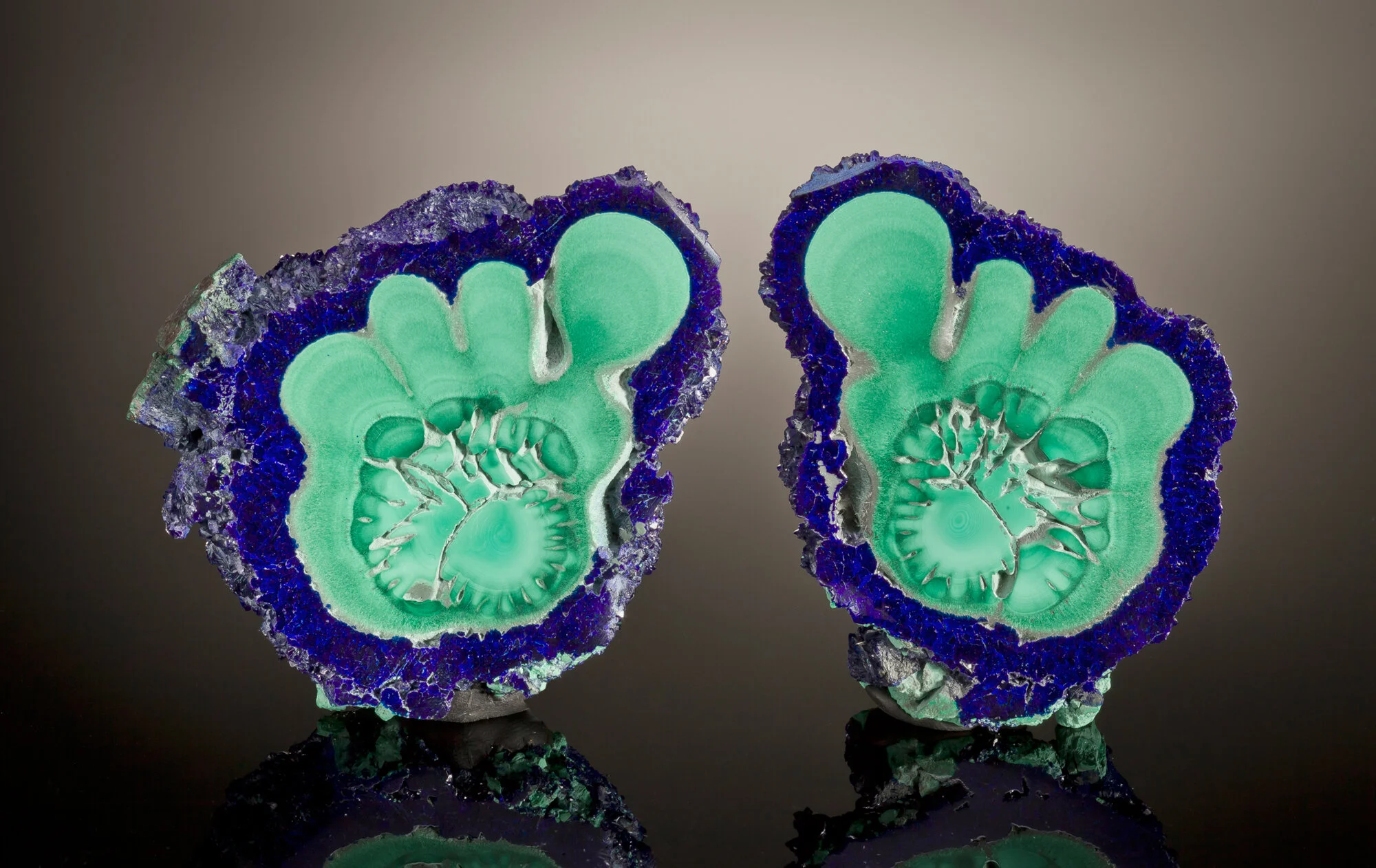
Photo: China Crystalline Treasures
Search for specimens: View all specimens from Liufengshan Mine, null
Liufengshan Mine is the Liufengshan copper deposit of Guichi District, Chizhou, Anhui Province, China; the Chinese locality name recorded for the deposit is 六峰山铜矿床. The mine is in the Li Shan / Lishan area near Xinhua Village, south of Chizhou, and is part of the copper-mining country of southwestern Anhui rather than a remote specimen-only occurrence. The site has been described both as a mid- to high-temperature, strata-bound skarn copper deposit and as an unusual leaching-accumulation copper-iron deposit in which supergene enrichment and oxidation played the decisive role in producing the collector specimens. That combination explains the mine’s dual personality: economically, a small copper-iron-sulfide operation; mineralogically, one of China’s most recognizable sources of secondary copper carbonates.
The primary geological context belongs to the Middle–Lower Yangtze River metallogenic belt, a long metallogenic province that includes the Anqing–Guichi, Tongling, and other ore districts famous for copper, iron, gold, sulfur, molybdenum, lead, and zinc mineralization. In the broader region, copper mineralization is commonly related to Mesozoic intrusions, carbonate host rocks, skarn alteration, and later hydrothermal and supergene overprinting. At Liufengshan itself, the collectible vugs occur in a distinctive oxidized setting: brecciated material, limonitic goethite, red-brown fault gouge, clay, and copper minerals occupying cavities and firmer iron-oxide zones. The azurite and malachite did not form as large open-pocket prisms in a hard, clean cavity system; they grew on the walls of small vugs and nodules in a damp, clay-rich, iron-oxide environment.
The ore minerals documented from the mine include chalcocite, chalcopyrite, covellite, cuprite, native copper, tenorite, delafossite, pyrite, galena, magnetite, hematite, goethite, limonite, quartz, clay minerals, azurite, and malachite. This is a compact but telling suite: sulfides and copper oxides record the ore system; iron oxides and clay record oxidation and brecciation; azurite and malachite record the late-stage carbonate chemistry that made the locality famous. In specimen terms, the crucial host is not massive sulfide but limonitic goethite and clayey breccia, especially where a small cavity wall was firm enough to preserve lustrous crystallization instead of collapsing into mud.
The mine was originally opened as an open pit around 1970, and underground development with shafts expanded in the 1980s. Collector accounts describe a mine property that included headquarters buildings, an adjacent open pit, waste dumps, and a series of three likely interconnected vertical shafts. The open pit was later abandoned, while the best modern azurite–malachite specimens came from underground workings rather than the old surface excavation. A local government chronology records that in June 1984 the Guichi County Liufengshan copper mine produced 14,700 tons of copper concentrate, which was smelted by Tongling Nonferrous Metals Company and yielded more than 1,500 jin of silver, a useful reminder that this was a real working mine, not a boutique collecting pit.
More recent official listings identify the operation as Chizhou Dongyang Mining Co., Ltd. Liufengshan Copper Mine, located at Xinhua Village, Lishan, Guichi District. Government and regulatory materials describe it as a small underground copper mine with a design capacity of 40,000 tonnes per year. A 2024 public list recorded it as suspended, underground, small-scale, and licensed for copper ore. A 2025 Guichi District non-coal mine list again recorded Liufengshan as suspended, underground, and small-scale, with a safety production permit running from November 22, 2024 to November 21, 2027. A 2026 environmental approval notice for a mining engineering optimization project refers to previously approved 2006 and 2017 environmental-impact documents and lists the mining commodities as copper ore, iron ore, and pyrite, with underground mining and natural caving as the stated mining method.
For collecting access, Liufengshan should be treated as an industrial mine locality, not an open collecting site. Historic specimens entered the market through miners, local dealers, Chinese mineral exporters, and visits by professional mineral buyers; that does not imply present-day public access. The underground workings were described as wet, sticky, clay-rich, and challenging, with specimen vugs in unstable breccia and iron-oxide zones. Modern collectors should assume that legal access requires permission from the mine operator and local authorities, and that casual collecting on dumps or underground entries is neither appropriate nor safe.
The best-known specimen pockets were small vug systems in limonitic goethite within the underground workings. Contemporary accounts describe vugs ranging from golf-ball size to basketball size, lined with velvety malachite and drusy azurite. Individual azurite crystals larger than about 1 cm are unusual for the locality; therefore, a specimen with sharply defined, lustrous crystals approaching that size is notably better than the common druse. The finest pieces preserve a complete or nearly complete cavity surface, with the blue azurite concentrated inside the pocket and malachite forming a green rim, lining, backing, or fibrous association. Some masses were sawn and polished to reveal concentric azurite–malachite banding; others were kept as natural vug specimens, where the sparkle of the azurite is the main attraction.
Azurite from Liufengshan is typically developed as dense drusy carpets, sparkling microcrystalline linings, small bladed rosettes, and occasional sharper crystals on limonitic goethite or malachite-rich matrix; individual crystals over about 1 cm are uncommon, making sharp, lustrous crystals in the several-millimeter to near-centimeter range especially desirable. The color is usually deep royal blue to inky blue-black, but the best pieces show electric-blue flashes on edges, small translucent zones, and a wet-looking luster under strong light. It is most characteristically associated with malachite as rims, underlayers, fibrous sprays, balls, and partial replacement textures; cuprite, chrysocolla-like blue-green material, goethite, limonite, and other copper oxides may also be present in the broader assemblage. The standout Liufengshan azurites are not judged by single-crystal size alone but by intact vug form, continuous glittering coverage, strong blue-green contrast, minimal bruising on the pocket edge, and whether the azurite retains sharp faces rather than appearing dull, powdery, or abraded.
Malachite from Liufengshan is both an attractive species in its own right and the essential counterpoint to the mine’s azurite: it appears as velvety green cavity linings, acicular and chatoyant sprays, fibrous balls, “mushroom”-like tufts, rims around azurite pockets, and banded green interiors in nodules and slices. The color ranges from soft velvety grass green to saturated Kelly green, with the best pieces showing clean contrast against deep blue azurite rather than muddy blending into iron oxide. In natural vug specimens, malachite often forms the green substrate or edge on which azurite sparkles; in polished material, it can show rounded, concentric, almost organic banding enclosed by an azurite-rich border. Fine Liufengshan malachite pieces are those where the fibers are fresh, silky, and undamaged, where the green forms a deliberate-looking visual frame for the azurite, or where sawn nodules reveal balanced, sharply separated blue and green zones without excessive resin fill, chips, or overpolishing.
Beyond azurite and malachite, Liufengshan is documented for a compact copper-iron suite that includes chalcocite, chalcopyrite, covellite, cuprite, native copper, tenorite, delafossite, pyrite, galena, magnetite, hematite, goethite, limonite, quartz, and clay minerals. No type-locality mineral species are recorded for Liufengshan in the standard locality compilations, so its claim on collectors rests on excellence of secondary copper-carbonate specimens rather than on nomenclatural rarity. The more interesting supporting species are cuprite and native copper, both natural companions to the oxidized copper system, plus delafossite and tenorite, which point to the copper-oxide chemistry behind the later carbonate showpieces.
Liufengshan azurite–malachite is common enough that small specimens are widely available, but genuinely fine pieces are much scarcer than the locality’s market visibility suggests. Many inexpensive pieces are simply fragments of blue-green crust or broken vug wall; the serious collector should look for undisturbed cavity geometry, lively luster, sharp azurite crystals, and malachite that enhances the piece rather than merely stains it. Because the matrix can be clay-rich and iron-oxide-rich, edges often show bruising, trimming scars, crumbly limonite, or repaired breaks. Examine the rim of the vug, the underside, and any sawed or polished surface for glue, dyed filler, resin stabilization, or reattached chunks.
There is no well-documented, locality-specific fake industry for Liufengshan comparable to the large imitation market for decorative malachite, but mislabeling and treatment are real concerns. Polished azurite–malachite nodules from Liufengshan can be attractive and entirely legitimate, yet they are more vulnerable to undisclosed stabilization, filled voids, and confusion with other Chinese or global azurite–malachite materials. Labels may also be shortened to “Anhui azurite” or “China azurite,” and some non-Liufengshan material may be sold under the better-known mine name. Conversely, many real Liufengshan pieces are sometimes dismissed as too vivid to be natural; the intense blue-green contrast is normal for the locality when fresh and well lit.
Condition is central. Azurite is relatively soft and can be brittle in thin blades and tiny crystals; malachite fibers can mat, fuzz, or break. Avoid soaking, ultrasonic cleaning, steam cleaning, acids, and aggressive brushing. A hand blower, a very soft artist’s brush used sparingly, and stable indoor humidity are safer. Display away from direct sun and high heat, especially for clay-rich matrix pieces and any specimen suspected of being repaired or stabilized. The finest natural vug specimens should be handled by the matrix or mounted, because the most important visual surface is often a thin druse of tiny crystals that can be permanently dulled by abrasion.
On the market, Liufengshan occupies an attractive middle ground. Small miniatures and broken drusy pieces remain affordable, while strong miniatures, complete vugs, older collection pieces, and cabinet specimens with sharp azurite over malachite can command serious prices. The best specimens from the early 2000s and the later pockets around 2020 are now dispersed through private collections, dealer back stock, auctions, and online inventories. A top piece should look unmistakably alive under light: blue crystals sparkling across the pocket, green malachite providing structure and contrast, and just enough iron-rich matrix to tell the geological story without overwhelming the specimen.
The Liufengshan collecting story begins like many great modern locality stories: not with a romantic open hillside, but with an operating copper mine whose specimen potential was hidden in unpleasant ground. Buyers who visited the mine described a property with headquarters buildings, an old open pit, waste dumps, and three vertical shafts that were probably interconnected. The open pit had already fallen out of favor for specimen production; the blue-and-green pockets were underground, in a thick breccia zone full of damp, sticky red-brown fault gouge and clay. It was not the kind of place where clean plates simply popped from hard rock. The reward came only where firmer limonitic goethite held together long enough to preserve little cavities lined with malachite and azurite.
Those cavities were modest in size but rich in effect. Accounts from the early marketing of the locality describe vugs from the size of a golf ball to the size of a basketball. That scale explains both the abundance of small specimens and the relative scarcity of great cabinet pieces. A golf-ball vug might yield one sparkling miniature if broken well; a basketball-sized cavity, if opened carefully, could furnish a plate with real presence. The best pieces were not built around one dominant crystal but around an entire interior surface—an almost geode-like hollow carpeted with medium-to-dark blue azurite, edged or underlain by green malachite.
By 2002, Liufengshan had become a name collectors knew. A 29 cm azurite from the mine, found around that time and formerly in the Bruce Oreck collection, became one of the representative display pieces illustrated in the China Crystalline Treasures project. Its scale is important: 29 cm is exceptional for a locality whose individual crystals are usually small and whose pockets were often only miniature to small-cabinet in size. Another memorable Liufengshan object from the same illustrated tradition is not a natural vug at all, but a matched pair of sawn azurite–malachite slices, 7.7 cm tall, formerly in the Ken Roberts collection. In those slices, the mine’s chemistry reads like a diagram: deep blue azurite around pale to saturated green malachite, with banding and rounded internal forms that look almost botanical.
Liufengshan also has a small but telling economic footnote in the official history of Chizhou. In June 1984, the Guichi County Liufengshan copper mine produced 14,700 tons of copper concentrate, and when that concentrate was smelted by Tongling Nonferrous Metals Company it yielded more than 1,500 jin of silver. Long before the locality was famous among mineral collectors for glittering blue pockets, it was already part of Anhui’s practical mining economy. That dual identity—industrial copper mine and specimen classic—is exactly what gives Liufengshan its appeal: the specimens are beautiful, but they come from a working ore system with a recorded mining life.
A later chapter came with renewed specimen circulation around 2020. Dealer descriptions from that pocket emphasize complete floaters, gemmy azurite crystals, radiating fan-shaped fibrous malachite on the backs of pieces, and specimens that sparkle from multiple directions. The language is promotional, but the visual facts are consistent with the locality: the best Liufengshan azurites can look almost black until they catch the light, then they flare electric blue against a green malachite frame. That sudden transformation under light is the signature collectors remember.







