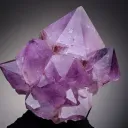
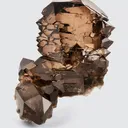
Lincoln County, New Mexico — Smoky quartz from Sierra Blanca with phantoms and large prisms, plus Capitan Mountains Japan-law twins, prized by collectors.
Key facts
For collectors, Lincoln County is the New Mexico smoky-quartz county: a place where alpine-looking, glassy SiO2 crystals came out of an otherwise very New Mexican setting of Tertiary volcanic piles, alkalic intrusions, brecciated veins, and rugged Forest Service high country. The best-known specimens trace principally to two related but visually distinct quartz occurrences. In the Sierra Blanca–White Mountain Wilderness area, the Smokey Bear quartz occurrence produced large, transparent to smoky prismatic crystals, many with phantoms, occasional doubly terminated individuals, and rare fluorite associations. Farther north-east in the Capitan Mountains, Mina Tiro Estrella became famous for clear to smoky Japan-law twins, commonly small but of superb form, set in quartz–feldspar vein material with allanite, titanite, adularia, and other accessory minerals. Together they give Lincoln County a dual identity: big, lustrous, phantom-bearing smoky quartz from Sierra Blanca, and delicate, technically fascinating Japan-law twins from the Capitan alaskite.
The geological setting is a collector’s gift because it concentrates silica-rich late fluids into openings rather than spreading them into dull massive veins. The Sierra Blanca is built on an immense Tertiary volcanic pile more than 4,000 feet thick, mostly andesitic, later cut by intrusive bodies ranging from syenite to diorite and related stocks and dikes. In the Capitan Mountains, the host is alaskite—an alkali-granite body rich enough in silica and feldspar to form quartz–feldspar breccia veins and vugs. The resulting pockets were not ore deposits in the normal sense; they were specimen-producing open spaces where slowly crystallizing fluids made sharp quartz with luster, transparency, smoky zoning, and in the finest pieces a sculptural presence far beyond the modest dimensions of many New Mexico localities.
Regional View
Country View
The county’s quartz reputation should not obscure its broader mineralogical seriousness. Lincoln County also includes the Gallinas Mountains rare-earth and fluorite deposits, the Red Cloud mines, historic gold camps such as White Oaks and Nogal, iron and tungsten occurrences, and the co-type locality for agardite-(La). But the specimens that most collectors recognize instantly are the smoky quartz crystals: tall single prisms with dark caps and internal phantoms, clustered plates of smoky points, and compact Japan-law twins whose two flattened quartz individuals meet in a clean, formal V.

Photo: Wikimedia Commons
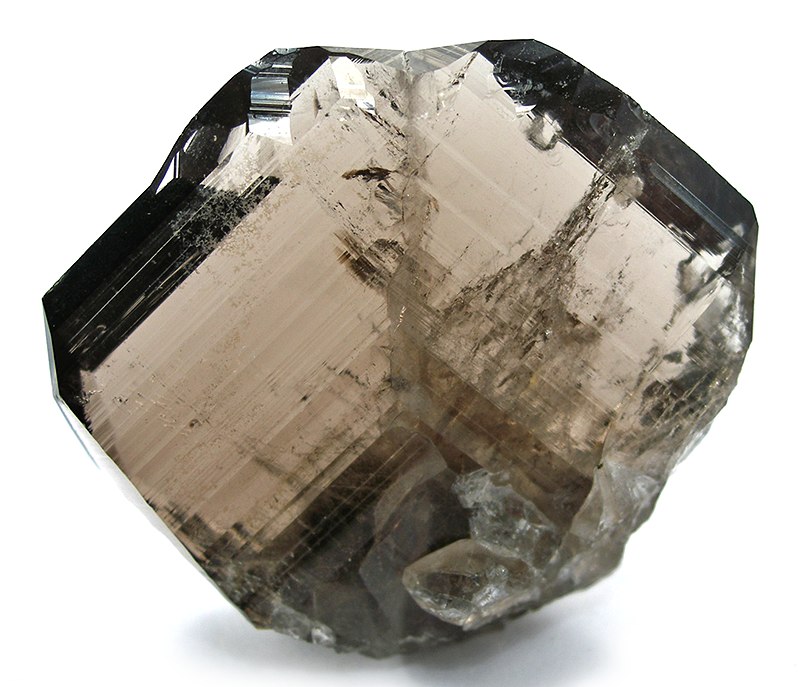
Photo: Wikimedia Commons
Search for specimens: View all specimens from Lincoln County, null
Lincoln County lies in south-central New Mexico, where the High Plains meet the Basin and Range province and where multiple structural trends intersect. The county’s mineral deposits are controlled by a north–south belt of faulting and igneous activity through the west-central part of the county, crossed by the east–west Capitan Mountains trend. The Sierra Blanca range is an igneous complex: thick Tertiary volcanic rocks, mainly andesitic, cut by later stocks and dikes. The Capitan Mountains, by contrast, are dominated by a laccolithic alaskite intrusion, one of the county’s comparatively quartz-rich intrusive bodies. That difference matters to specimen collectors, because the alaskite and its cooling fractures created the setting for quartz–feldspar veins and cavities at Mina Tiro Estrella.
At Mina Tiro Estrella, the specimen-producing zone is a brecciated vein in feldspar- and quartz-rich alaskite. The vein material is chiefly alkali feldspar and quartz; much of the feldspar is altered and crumbly, and pockets occur where open space survived within the fractured vein. Reported pocket sizes are commonly small—around 10 cm, rarely up to about 25 cm—but they produced highly desirable clear to smoky quartz crystals, many Japan-law twins, with allanite and small titanite. The broader Capitan Mountains mineralization includes quartz veins with rare-earth elements, thorium–uranium–REE quartz veins, feldspar bodies, magnetite skarns near limestone–alaskite contacts, and manganese veins. The quartz veins are interpreted as fillings of cooling fractures and brecciated zones in the alaskite, charged by high-temperature, high-salinity magmatic fluids.
The Sierra Blanca smoky-quartz occurrence, commonly referred to in the collector market as the Smokey Bear Quartz Claims or Sierra Blanca quartz locality, is a different style of pocket system. The best specimens are from miarolitic cavities and open fractures adjacent to breccia-pipe mineralization. Documented crystals range from tiny individuals around 0.2 cm to very large examples around 40 cm, with an average near 7 cm; many show phantoms and some are doubly terminated. Collector specimens may be single crystals, loose groups, or matrix plates with smoky prisms rising from pale quartz. The rarest combinations include fluorite—especially fine smoky quartz with fluorite, far scarcer than simple smoky quartz singles.
Lincoln County’s mining history began long before specimen quartz became the county’s collector identity. Placer gold was worked by the 1860s, lode mining followed at the Helen Rae and American mines in 1868, and the White Oaks district boomed after the 1879 discovery of lode gold by George Wilson, “Old Jack” Winters, and George Baxter. The late 19th century brought gold, lead, zinc, silver, copper, and iron activity in districts including White Oaks, Nogal, Jicarilla, and Gallinas. The Gallinas Mountains later became important for fluorspar and rare-earth minerals, with Red Cloud and related properties producing or being explored for fluorite, bastnäsite, copper, lead, and silver. Tungsten was shipped from the county during several years between 1915 and 1952, largely connected with the White Oaks district.
For quartz collectors, the main production period was much later and more episodic. Mina Tiro Estrella Japan-law twins began circulating among collectors by the late 20th century, and Mineralogical Record articles of the late 1970s, 1980s, and early 1990s established both Mina Tiro Estrella and the Smokey Bear/Sierra Blanca occurrence as serious American quartz localities. The Smokey Bear material in particular entered the market in enough quantity to make Lincoln County smoky quartz familiar, but the very best pieces—large, glassy, damage-free crystals with strong phantoms, matrix plates, and fluorite combinations—remain decidedly selective.
Collecting access today is restricted and should be treated with caution. Mina Tiro Estrella is under ownership and collecting is not allowed without permission. The Sierra Blanca occurrence lies in or near the White Mountain Wilderness of the Lincoln National Forest, where commercial extraction is not available and the removal of quartz crystals has been specifically treated as restricted. Land status in this county is mixed—National Forest, Wilderness, private land, patented and unpatented claims, and closed or hazardous workings all occur—so a modern field collector should not assume that an old guidebook locality remains open. Specimens now on the market are overwhelmingly older collected material, legally collected pre-restriction material, or pieces with private-claim provenance; serious buyers should value clear labels and chain of custody.
Quartz from Lincoln County is collectible in two principal expressions: smoky to clear prismatic crystals from the Sierra Blanca/Smokey Bear occurrence, where specimens may range from small crystals to large, lustrous, phantom-bearing prisms and occasional matrix plates, and clear to pale smoky Japan-law twins from Mina Tiro Estrella in the Capitan Mountains, typically smaller but prized for crisp twin geometry, transparency, and fine striated faces. The Sierra Blanca crystals are commonly judged by glassiness, undamaged terminations, strong smoky phantoms, balance on matrix, and the absence of distracting etched or contacted areas; Mina Tiro Estrella pieces rise or fall on the sharpness and completeness of the twin, symmetry of the V, luster, and whether the specimen retains meaningful feldspar or vein-matrix context rather than being a broken loose wing.
Smoky quartz is the county’s signature collector mineral, especially from the Sierra Blanca quartz locality, where the best crystals show pale tea-gray to deep brown smoky color, dark caps, internal phantoms, bright vitreous luster, and a distinctly “alpine” clarity despite forming in a volcanic–intrusive New Mexico setting rather than a classic alpine fissure; documented crystals reach cabinet size, with average crystals much smaller, and the finest specimens include sharp singles, clustered plates, rare doubly terminated crystals, and very rare fluorite associations. At Mina Tiro Estrella, the smoky color is most valued when it accompanies true Japan-law twinning, though buyers should be alert because some darker Capitan Mountains twins have been questioned as artificially irradiated; the most desirable examples are naturally pale to medium smoky, well-formed, transparent when backlit, and complete across the twin junction.
Beyond quartz, Lincoln County is notable for a compact but important suite of accessory and ore minerals. The Smokey Bear quartz occurrence records allanite-(Ce), apatite, ferrimolybdite, and fluorite with quartz. Mina Tiro Estrella adds allanite, titanite, adularia, hematite, magnetite, epidote, ilmenite, and microlite-group material to the quartz story. The Gallinas Mountains and Red Cloud district broaden the county’s mineralogy dramatically with fluorite, barite, bastnäsite, vanadinite, wulfenite, mimetite, cerussite, malachite, azurite, conichalcite, mottramite, chrysocolla, and the type-locality species agardite-(La), a rare lanthanum copper arsenate known from the Red Cloud copper and fluorite mines.
Lincoln County smoky quartz has several locality-specific cautions. The most important is provenance. “Lincoln County” on an old label may refer broadly to Sierra Blanca/Smokey Bear material, Mina Tiro Estrella in the Capitan Mountains, or simply a county-level dealer label with no sublocality. Large phantom-bearing single crystals and plates are usually consistent with Sierra Blanca; small, flattened V-shaped Japan-law twins are characteristic of Mina Tiro Estrella. A specimen labeled “Mina Tiro Estrella” that looks like a large Sierra Blanca-style smoky quartz single should be questioned, as even Mindat’s locality notes warn that smoky quartz similar to well-known Smokey Bear material has sometimes been reported from Mina Tiro Estrella but is probably from the nearby Smokey Bear prospect instead.
Treatment is a real issue. Some Capitan Mountains Japan-law twins are naturally only faintly smoky, and darker examples have long carried suspicions of artificial irradiation. Irradiation can deepen quartz color without changing the overall crystal form, so habit alone does not prove natural color. Strongly dark, nearly black twins from Mina Tiro Estrella deserve extra scrutiny, especially if the label lacks an old collection history or the color looks out of proportion to the pale natural material known from the occurrence. The market generally rewards documented, old-collection, naturally pale to medium smoky twins over anonymous dark material.
Condition is another central concern. Sierra Blanca crystals commonly have contact marks, bruised terminations, broken side crystals, etched areas, or damaged matrix edges. Many specimens came from pockets and fractured ground where pocket collapse or weathering could break clusters before recovery. Transparent smoky quartz also reveals internal veils, clay, healed fractures, and phantom planes; these are not necessarily flaws, but open cracks, chipped caps, and glued bases are. Matrix plates should be checked for repairs, especially where tall prisms emerge from friable quartz or altered host. Mina Tiro Estrella twins are especially vulnerable at the re-entrant twin junction and thin wing edges.
Cleaning history matters. Lincoln County smoky quartz is known to occur with unattractive milky quartz coatings, and some specimens have been etched with hydrofluoric acid to reveal the transparent smoky crystal beneath. Done expertly, this preparation can produce the familiar clean, glassy Lincoln County look; done carelessly, it can dull faces, round fine edges, or remove desirable contextual coatings. Buyers should not automatically reject cleaned specimens—many classic pieces were prepared—but should look for bright natural luster, sharp edges, and credible disclosure when aggressive chemical cleaning has been used.
Fluorite combinations from Sierra Blanca are rare and should be treated as premium specimens when genuine and undamaged. Good fluorite-on-smoky quartz combinations from the Full House Pocket and related finds are far scarcer than ordinary singles. Agardite-(La) from the Red Cloud mines is a micromount to thumbnail-level rarity rather than a cabinet-specimen mineral; attractive examples are typically judged under magnification by color, spray form, and association with fluorite or oxidized copper minerals. Current market availability favors loose smoky quartz crystals and occasional smaller Japan-law twins; top phantom crystals, matrix plates, and fluorite combinations appear only intermittently and are usually old-collection pieces.
One of the most memorable modern Lincoln County pocket stories comes from the Full House Pocket at Sierra Blanca. Philip Simmons described collecting there with his father, Jerry Simmons, before access was closed off. The pocket was not a modest seam; it stretched back into the mountain for almost three meters and produced hundreds of clusters of exceptional smoky quartz. One cabinet specimen, later nicknamed “The Porcupine,” survived because it had been protected from pocket collapse beneath a small ledge. That detail is exactly the sort of thing seasoned field collectors recognize: in a collapsing pocket, a few centimeters of shelter can be the difference between a bruised pile of shards and a near-perfect specimen.
The same Full House Pocket produced an even better collector’s anecdote about a smoky quartz and fluorite combination. Fluorite is exceptionally rare with Lincoln County smoky quartz, and only a small number of fine combinations are known. Simmons first saw the piece in the same area as “The Porcupine” but left it behind because there was no more room in his backpack. When he returned, rain had washed away the dirt and exposed the fluorite. The overlooked specimen immediately became the first piece packed on the second trip—a perfect illustration of why veteran collectors recheck their workings after weather, especially in clayey or decomposed pocket fill.
Lincoln County also sits inside the collecting lives of several well-known New Mexico mineral people. Tom Massis, remembered in Rocks & Minerals after his death in 2024, explored many classic New Mexico mines and enjoyed the exceptional smoky quartz crystals near Sierra Blanca Peak. Friends remembered his garage as the “black hole,” because rocks went in and did not come out, and recalled the sight of Massis arriving in a 1975 International Scout known as the “Orange Tomato,” with Loretta, their three children, and a dog piling out. That is the human side of Lincoln County quartz: not just polished labels and show cases, but long drives, families, dogs, heavy packs, and a lifetime of New Mexico localities now far less accessible than they once were.
Another thread runs through the career of Wayne Thompson and Southwestern collecting in the late 1970s and 1980s. A Mineralogical Record supplement notes that, among many specimen projects, Thompson and associates produced thousands of smoky quartz specimens from Lincoln County, New Mexico. By that period he had logged more than 10,000 hours collecting underground. Lincoln County smoky quartz was part of that broader American specimen-mining era, when determined collectors and small operators transformed obscure pockets and prospects into classic labels.