Lechang Mine, Guangdong — renowned for quartz–hematite specimens with a China classic look, and with sphalerite, galena and pyrite; a notable collector localit…
Key facts
Lechang Mine matters to collectors for one very specific reason: the mine made a modern Chinese classic out of the stark, sculptural pairing of quartz and hematite. The locality is a lead-zinc mine in Lechang County, Shaoguan, in northern Guangdong, within the broader polymetallic metallogenic country of South China. Industrially, it is a sulfide ore deposit worked for Pb-Zn ore dominated by sphalerite, galena, pyrite, and associated iron oxides; aesthetically, it is remembered for specimens in which clear to smoky, red-stained, or hematite-included quartz crystals rise from black to grey-black bladed hematite “roses.” The best pieces have the crisp mineralogical grammar collectors prize: glassy prismatic quartz, sharp terminations, iron-red phantoms or inclusions, and contrasting rosettes of thin metallic hematite blades.
Regional View
Country View
The Lechang style is easy to recognize when the specimen is good and easy to overrate when it is not. Ordinary pieces can be merely iron-stained quartz on dull hematite; fine examples have an architectural relationship between the two species, with open space around the quartz, clean glassy faces, undamaged points, and hematite rosettes that read as individual bladed clusters rather than as a dark, granular mass. Some specimens are almost monochrome—clear quartz on black hematite—while others show the locality’s most desired palette: white, transparent, smoky, yellowish, orange-red, and iron-brown quartz set against metallic grey to black hematite.

Photo: Wikimedia Commons
For mineral collectors, Lechang’s historical importance is tied less to the mine’s lead-zinc production than to the wave of hematite-quartz specimens that entered the international market around the late 1990s and early 2000s. Those finds helped define a recognizable “China classic” look: iron roses as the dark base, quartz crystals as the bright vertical accent, and hematite inclusions or coatings giving the quartz a red, rusty, or phantom-like interior life. Large, undamaged clusters are far scarcer than small damaged fragments, and the best cabinet pieces have become harder to replace as fresh production has dwindled.
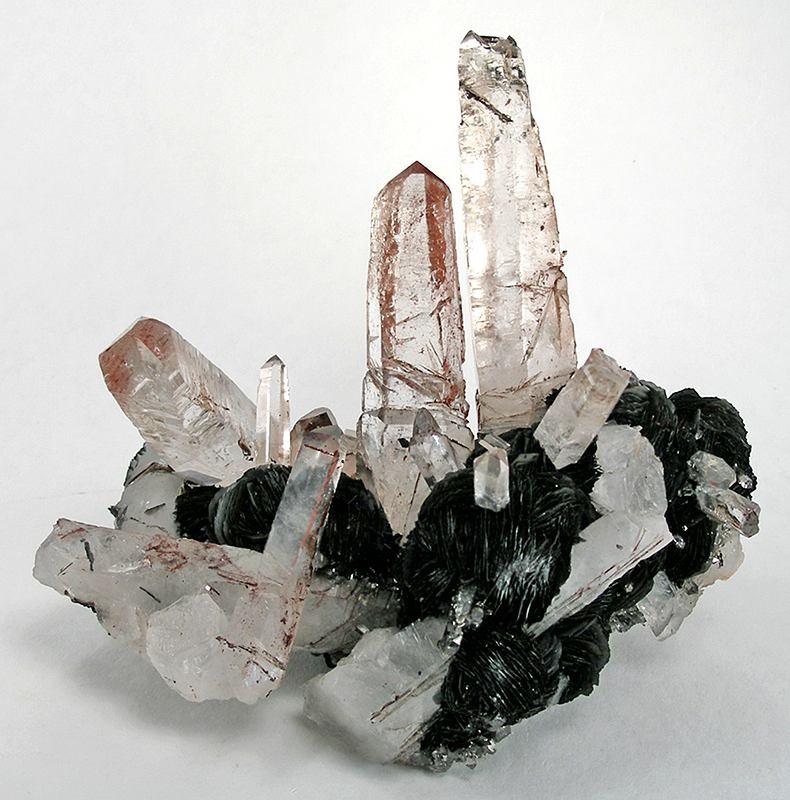
Photo: Wikimedia Commons
Search for specimens: View all specimens from Lechang Mine, null
Lechang Mine is a lead-zinc mine about 4 km east of Lechang City in northern Guangdong, China. Published environmental and mineral-processing studies describe it as a conventional underground Pb-Zn operation covering roughly 1.5 km2, opened in 1959, with the mine’s exploited ore minerals consisting chiefly of sphalerite, galena, pyrite, and chalcopyrite or magnetite, depending on the sampled material and study. Accessory gangue and alteration minerals documented from the mine include calcite, muscovite, chlorite-group minerals, quartz, and feldspar-group minerals. The ore is repeatedly described in technical literature as finely disseminated and metallurgically complicated, a useful context for collectors because it explains why the mine appears in studies of flotation, acid-generating tailings, and metal mobility as much as in specimen literature.
The specimen-producing assemblage is not a broad, colorful suite in the way of Yaogangxian or Huanggang; it is a focused hematite-quartz occurrence within a Pb-Zn mine. In collectible pieces, hematite forms thin bladed aggregates, commonly arranged as rosettes or “iron roses,” while quartz occurs as prismatic crystals, individual obelisks, needles, and clusters. The quartz may be water-clear, smoky, milky, pale yellowish, orange-red, or red-brown from hematite inclusions and iron oxide pigmentation. In some crystals, hematite was engulfed during quartz growth, producing red-brown phantoms or included zones rather than a true citrine color.
The mine also has a well-documented environmental footprint. Tailings from milling were discharged into adjacent tailings ponds, and published studies record high sulfur contents, acid-forming potential, and elevated Pb, Zn, Cu, and Cd in tailings and nearby agricultural soils. That literature is not specimen literature, but it is important locality context: Lechang was an active industrial mine, not a casual collecting pit, and modern collecting should be treated as mine-property access requiring permission, current safety awareness, and respect for remediation work. The mine has been a research site for rehabilitation trials using grasses, soil amendments, fly ash, burnt coal residue, mushroom compost, pig manure, and other materials to stabilize tailings surfaces.
Specimen finds are generally referred to in the market as late-1990s to early-2000s production, with many good pieces circulating through dealer stock, auctions, and older collections rather than appearing as new mine-run material. The best-known pocket style produced hematite rosettes hosting or supporting quartz crystals, sometimes with quartz points rising like red or clear spikes from the hematite. Large clusters exist, including cabinet specimens with quartz crystals several centimeters long, but intact examples are not common. Damage is frequent because the quartz is exposed and the hematite blades are thin, brittle, and easily bruised along rosette edges.
Quartz from Lechang Mine is best known as prismatic crystals on bladed hematite, ranging from small needle-like points and obelisks to cabinet-sized clusters with crystals several centimeters long; the most admired examples are transparent to glassy, with clean terminations, slight smoky tones, orange-red hematite pigmentation, or red-brown hematite phantoms and inclusions. The quartz commonly grew with or through hematite rosettes, and that relationship is the key to quality here: isolated broken points or dull iron-stained clusters are common enough, but top Lechang quartz has bright luster, visible internal clarity, lively red or smoky zoning, and an elegant placement on the dark hematite base.
Hematite from Lechang Mine occurs chiefly as dark grey to black, metallic to submetallic bladed crystals forming rosettes and intergrown “iron rose” aggregates, often serving as the sculptural base for transparent or iron-tinted quartz. Individual rosettes on documented specimens can reach several centimeters across, with the finest pieces showing distinct, sharp, thin blades rather than flattened crusts; condition is decisive, because the edges chip easily and dull, rubbed, or crushed rosettes lose much of the locality’s characteristic drama. The strongest specimens balance intact hematite roses with well-positioned quartz crystals, especially where the black hematite makes the quartz appear brighter and where hematite inclusions carry the red color into the quartz itself.
Other minerals documented from Lechang Mine include galena, sphalerite including marmatite, pyrite, pyrrhotite, marcasite, magnetite, malachite, cerussite, calcite, muscovite, microcline, biotite, chlorite-group minerals, and limonite. No type-locality mineral species are tied to Lechang Mine in the standard locality records; its collector importance rests on the hematite-quartz association, not on species discovery. A notable caution is that older or erroneous labels have attached some minerals to Lechang that do not belong there: spessartine labels have been traced instead to the Tongbei/Wushan spessartine locality in Fujian, and quartz colored by inclusions should not be labeled as true citrine.
The principal authenticity issue for Lechang is locality attribution. Chinese hematite-quartz combinations from Lechang can resemble material from Jinlong Hill, also in Guangdong, and from other Chinese quartz localities where hematite inclusions or iron staining produce red quartz. A Lechang label should be supported by specimen style, provenance, and ideally an older dealer, auction, museum, or collection record. The most typical Lechang look is bladed hematite in rosettes with clear, smoky, orange-red, or red-brown quartz; specimens that are only loose red quartz points without hematite matrix deserve caution.
Mislabelling is also a known problem. “Citrine” should be avoided for Lechang quartz whose yellow, orange, or reddish color is caused by inclusions or coatings rather than true citrine coloration. Spessartine specimens formerly circulated with Lechang labels have been corrected in locality records to the Wushan/Tongbei spessartine locality in Fujian, so any garnet-bearing “Lechang” specimen should be treated skeptically unless supported by unusually strong evidence.
Condition is the collector’s biggest practical concern. Quartz points are commonly chipped at the tips or contacted along exposed edges, and hematite roses lose quality quickly when the thin blades are bent, bruised, rubbed, or broken. Look closely at the perimeter of rosettes, where damage is often hidden in photographs, and inspect quartz terminations from more than one angle. A cut or sawn base is not necessarily a defect on Chinese mine specimens, but it should be reflected in price and disclosed clearly.
The market now treats Lechang hematite-quartz as an older Chinese classic. Small pieces remain obtainable, but genuinely aesthetic, undamaged small-cabinet and cabinet specimens are much harder to replace than the number of old labels might suggest. Recent sales show strong demand for balanced pieces with sharp hematite roses, transparent quartz, and minimal damage; specimens with red phantoms, unusually long quartz prisms, or a dramatic freestanding composition command the most attention. There are no special fluorescence expectations for the classic quartz-hematite specimens, and handling should be gentle: the hematite blades are more fragile than their metallic look suggests.
The most human story at Lechang is not a romantic collecting tale from a crystal pocket but the afterlife of an industrial sulfide mine. By the late 1990s and early 2000s, the same locality that was sending striking hematite-quartz specimens into collections was also becoming a field laboratory for one of the central problems of metal mining: how to stabilize tailings that are chemically hostile to plant life. Researchers described tailings with high Pb, Zn, Cu, and Cd, low nutrient content, and strong acid-forming potential. The bare tailings surface needed cover, not for beauty but to keep wind, rain, and acid drainage from spreading the mine’s geochemical legacy.
One trial at Lechang divided a tailings pond into 12 plots, each 4 m by 4 m, and then divided those plots again into smaller subplots. The experiment tested amendments such as domestic refuse and NPK fertilizer, and compared grasses including vetiver, Bahia grass, Bermuda grass, and Imperata. In another rehabilitation study, the practical recipes were almost agricultural in their specificity: 15 cm of burnt coal residue or 10 cm of fly ash as a barrier layer beneath surface soil, or 38 tonnes per hectare of pig manure plus 6 cm of mushroom compost. In the best plots, Cynodon dactylon, Bermuda grass, achieved 90–100% cover; in the control plots, the toxic and infertile tailings remained a far less forgiving substrate.
Lechang also became a study site for acid mine drainage microbiology. The tailings were not inert waste. Pyrite-rich material oxidized, acidification developed near the surface, and acidic drainage carried metals into the surrounding environment. One study of the mine’s acidic Pb-Zn tailings investigated the bacterial communities involved in these processes, tying microscopic life to the macroscopic problem every mine manager recognizes: sulfide ore does not stop reacting when ore extraction stops. For collectors, that story gives the hematite-quartz specimens a sharper context. These are not abstract objects from an unnamed Chinese mine; they are aesthetic survivors from a working sulfide system whose chemistry continued to shape the landscape after the ore left the ground.