A collector's guide to Kabwe Mine (Broken Hill Mine), null: its geology, mining history and notable minerals, illustrated with the 36 specimens documented from this locality on EarthWonders.
Key facts
Kabwe, long known to collectors under its colonial name Broken Hill, is one of the great African oxidized zinc-lead localities: not because it produced a single fashionable species, but because its old kopjes and deep workings exposed a remarkably complex carbonate-hosted Pb-Zn system where lead, zinc, vanadium, copper, phosphorus, silica, iron oxides, and fossil bone chemistry all intersected. The mine lies at Kabwe in Central Province, Zambia, roughly north of Lusaka, in a steeply dipping Neoproterozoic dolomite succession. Its massive sulfide cores of sphalerite, galena, pyrite, and minor chalcopyrite were wrapped and overprinted by willemite-rich silicate ore, jasperoid, gossan, and a dazzling suite of secondary carbonates, phosphates, vanadates, and silicates.
To mineral collectors, the name Broken Hill, Zambia, immediately evokes three things: superb zinc phosphates, old-timey gossan specimens, and the strange “Bone Cavern” association in which hopeite, parahopeite, tarbuttite, pyromorphite, vanadinite, and other species occurred with fossil bones in the No. 1 Kopje. Kabwe is the type locality for tarbuttite, parahopeite, and zincolibethenite, and it remains the benchmark locality for hopeite as a display mineral. The best pieces have an unmistakable African classic look: honey-orange hopeite crusts sparkling on dark goethitic matrix, colorless to glassy tarbuttite blades thickly scattered over limonite boxwork, pyromorphite and vanadinite in earthy yellow-brown botryoidal habits, and older cerussite and smithsonite specimens from the productive oxidation zones.
Regional View
Country View
The locality also sits at the uncomfortable boundary between mineralogical glory and industrial legacy. Mining began in the first decade of the twentieth century and continued until 1994, leaving large volumes of lead- and zinc-bearing tailings, slag, and waste around a town that still lives with severe contamination. For collectors this matters in practical terms: Kabwe specimens on the market are overwhelmingly old mine pieces, former mine-geologist material, museum-duplicate style specimens, or pieces recovered long ago from dumps and stockpiles. Fresh collecting at the former mine is not a normal field-collecting proposition; the site is polluted, partly controlled by licensed waste-reprocessing interests, and locally affected by artisanal extraction.

Photo: Wikimedia Commons

Photo: Wikimedia Commons
Search for specimens: View all specimens from Kabwe Mine (Broken Hill Mine), null
The Kabwe deposit is a carbonate-hosted lead-zinc deposit in the Kabwe Dolomite Formation, a late Neoproterozoic unit composed of dolomites flanked by shales and phyllites and resting above older metamorphic basement. The principal mineralized bodies were structurally controlled, steeply dipping, pipe-like to vein-like masses in massive dolomite. In the standard modern interpretation, Kabwe is an epigenetic Zn-Pb deposit related to hydrothermal circulation in the Lufilian metallogenic province; it has also been discussed in the broader context of MVT-type and vein-type carbonate-hosted mineralization. For the specimen collector, the essential geological point is simpler: primary sulfide ore was profoundly altered, and that alteration produced one of the richest secondary mineral assemblages in southern Africa.
The old mine was originally expressed at surface as a series of mineralized kopjes, the numbered hills that recur constantly on antique labels and in the literature. No. 1 Kopje was especially important for classic specimens: it was an iron-rich, silicified gossan with cerussite, hemimorphite, goethite, and minor smithsonite, and its lower caverns contained fossil bone material along with phosphate and vanadate minerals. No. 2 Kopje, about a kilometer southeast of the main group, was lead-poor and silicate-rich, with willemite as a major ore mineral; it later became one of the most important specimen sources for tarbuttite and hopeite. The No. 3/4 and No. 5/6 orebodies were major massive sulfide bodies, and No. 5/6 is notable to collectors for fine smithsonite, including scalenohedral and botryoidal specimens collected underground in the 1950s. The X orebody entered specimen lore in the 1970s because of a cavern on the 430-meter level lined with botryoidal and stalactitic vanadinite.
The ore zoning at Kabwe explains much of the specimen character. Massive sulfide cores of sphalerite and galena were bordered by oxidized silicate ore rich in willemite and by jasperoid made of quartz, willemite, cerussite, smithsonite, goethite, hematite, and secondary minerals of Pb, Zn, V, Cu, and P. In collector pieces, this translates into dark ferruginous matrices, porous limonite or goethite boxwork, cellular gossan, and vugs or crusts carrying phosphates and vanadates. Kabwe is not a locality where every good mineral grew in open quartz-lined cavities; many of its classics are crustal, drusy, stalactitic, botryoidal, or replacement-textured, and many combine brilliant tiny crystals with visually rough, iron-stained ore matrix.
Mining at Broken Hill began under the Rhodesia Broken Hill Company in 1904 and reached full production in 1906, closely tied to the arrival of the railway. Over its life the mine produced major quantities of zinc and lead, with vanadium oxide, silver, and cadmium as important by-products. After Zambian independence in 1964, the town and mine name shifted from Broken Hill to Kabwe, though specimen labels continued to use both names for decades. Underground mining ceased in 1994, but the site did not become inert: dump material, tailings, slag, and waste have remained economically attractive, and reprocessing projects and artisanal activity have continued around the former mine area.
The finest specimen era began almost as soon as the deposit was opened. British Museum material arrived in 1907, much of it connected with Percy Coventry Tarbutt, one of the key early figures in the Broken Hill Exploration Company. The early twentieth-century material includes the defining zinc phosphates: colorless hopeite on bone breccia from the Bone Cavern, parahopeite as a new triclinic dimorph of hopeite, and tarbuttite in cellular limonite from No. 2 Kopje. Later collecting episodes added different flavors: late-1920s hemimorphite and smithsonite specimens, mid-century smithsonite from No. 5/6, late-1970s tarbuttite and hopeite from No. 2 workings and nearby dump material, and 1970s vanadinite stalactites and botryoids from the X orebody.
Today, collecting access should be treated as restricted, hazardous, and not comparable to visiting an abandoned mine dump in a casual collecting district. Kabwe is a polluted former lead-zinc industrial site with licensed mineral-waste reprocessing, remaining tailings and slag, and documented artisanal mining. Good specimens are most responsibly acquired through established collections, reputable dealers, and pieces with old labels or credible mine-era provenance. Specimens should be handled as mineral collectibles, not field souvenirs from an accessible public site.
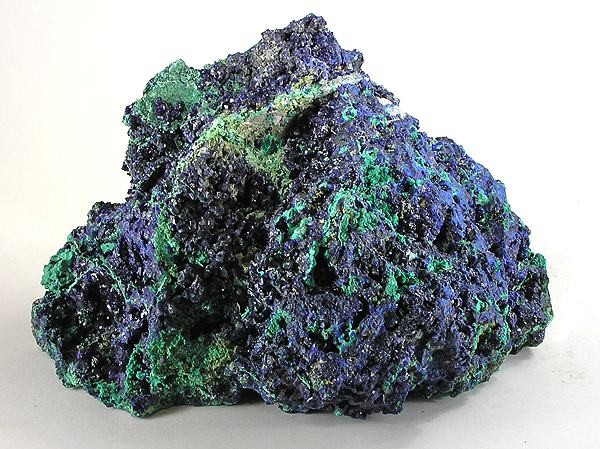
Photo: Wikimedia Commons
Azurite from Kabwe occupies an awkward but important corner of the locality’s specimen story: early literature records sparse copper secondary minerals, including chessylite, the old name for azurite, from oxidized ores at No. 1 Kopje, but later authors noted that azurite had not been seen from the mine in recent decades, and some conspicuous modern market specimens attributed to old 1960s material have been treated with caution because comparable examples are lacking in major institutional collections. The pieces accepted by collectors as Kabwe azurite tend to be dark to electric-blue microcrystalline crusts and sparkly vug coatings with green malachite on massive or ferruginous matrix, rather than the free-standing crystal groups familiar from copper mines such as Tsumeb, Chessy, or Bisbee. The best Kabwe examples are locality pieces first and species pieces second: convincing old provenance, obvious association with malachite and iron-stained oxidized ore, and a natural vuggy surface matter more here than crystal size alone.
Malachite is the most visible of Kabwe’s scarce copper secondaries, but it is still not common in the way collectors expect from classic copper districts. Documented material includes gray-green globules and surface coatings on well-crystallized cerussite recovered in the mid-1970s, apparently partly replacing the cerussite, as well as rounded and layered mammillated masses in iron-stained silicified dolomite. The most diagnostically Kabwe habit is the zoned mammillated material with dark green cores, lighter green intermediate layers, and blue-green outer shells that analytical work related to malachite, zincian malachite, and rosasite. Fine specimens are therefore judged by rich color zoning, compact botryoidal or mammillated form, visible association with cerussite or oxidized dolomite, and credible provenance; ordinary pieces are thin green coatings without the distinctive Pb-Zn-Cu context that makes Kabwe malachite mineralogically interesting.
Hopeite is the soul of Kabwe as a phosphate locality. Although hopeite’s type locality is not Kabwe, Broken Hill made the mineral collectible: before the Kabwe discovery it was exceedingly rare, whereas the No. 1 Bone Cavern produced bone-breccia specimens encrusted with brilliant water-clear crystals up to about 1 cm, scattered singly or grouped in showy clusters with vanadinite, pyromorphite, parahopeite, tarbuttite, and fossil bone material. Later Kabwe hopeite, especially from No. 2 Kopje, tends to be semi-transparent to opaque and strongly iron-stained, giving the crystals a yellow, orange, honey-brown, or deep orange-red surface color; large individual crystals in museum collections reach several centimeters, including a doubly terminated crystal around 4.1 cm recorded in the Natural History Museum collections. Good collector specimens have sharp, lustrous, well-separated orthorhombic crystals or dense sparkling crusts, preferably on contrasting goethitic matrix and with old labels; lesser pieces are friable, dull, heavily corroded, or so encrusted by parahopeite or iron oxides that crystal form is hard to read.
Tarbuttite is a Kabwe signature mineral and one of the locality’s type species, described from material found abundantly in cellular limonite at No. 2 Kopje and named for Percy Coventry Tarbutt, who supplied and collected early specimens. Classic Kabwe tarbuttite forms colorless, transparent to translucent triclinic tabular or bladed crystals scattered over porous goethite or limonite, commonly associated with smithsonite, descloizite, pyromorphite, hemimorphite rosettes, and locally hopeite or parahopeite; No. 2 material collected or available from a dump east of the open pit in the late 1970s is especially important in the modern specimen population. Most crystals are colorless to off-white, but pale yellow, pale green, and reddish aggregates are known, including ball-like or subspherical growths and pseudomorphs after hopeite; some crystals show a moderate fluorescence, reported as pale salmon-pink under medium-wave ultraviolet. Fine pieces show abundant glassy crystals with intact terminations and good contrast against dark gossan, while common examples are sugary, bruised, coated, or reduced to scattered tiny blades on unattractive matrix.
Beyond those four collector-facing species, Kabwe’s mineral list is unusually rich for a Zn-Pb deposit. Its type-locality minerals include tarbuttite, parahopeite, and zincolibethenite; its world-class or historically notable species include hopeite, smithsonite, cerussite, pyromorphite, vanadinite, descloizite, hemimorphite, and willemite. The rarer and more analytical side of the locality includes spencerite, scholzite, parascholzite, veszelyite, corkite, linarite, klockmannite, naumannite, renierite, briartite, wurtzite, and other species either confirmed or discussed in modern reviews. Vanadinite is especially distinctive: Kabwe is not famous for red hexagonal vanadinite crystals, but for botryoidal, banded, stalactitic, and “broccoli-like” material, including specimens from the Bone Cavern and the 430-meter-level X orebody.
The first authenticity issue with Kabwe material is locality confusion. “Broken Hill” appears on labels from Zambia and from the famous Broken Hill district of New South Wales, Australia; the minerals are usually different enough to separate, but old labels can be shortened, copied, or misunderstood. A label reading simply “Broken Hill” on tarbuttite, parahopeite, or hopeite almost certainly points to Kabwe, Zambia, whereas Broken Hill, Australia, is a very different Pb-Zn-Ag metamorphic ore district with its own suite. Conversely, a label on galena, cerussite, smithsonite, or secondary copper minerals may require more scrutiny.
Azurite and azurite-malachite specimens attributed to Kabwe deserve special caution. Early authors did record azurite as a sparse No. 1 Kopje secondary, but modern reviews have flagged some conspicuous market specimens as questionable because they lack counterparts in major old collections. A large blue-green specimen with a vague “old Kabwe” story may be genuine, but it should be evaluated differently from a tarbuttite or hopeite with a long Kabwe collecting tradition. Provenance, old labels, mine-geologist collection history, and consistency with Kabwe’s oxidized Pb-Zn matrix are important.
Hopeite, tarbuttite, parahopeite, hemimorphite, and smithsonite can be visually confused on iron-stained Kabwe specimens, especially when crystals are colorless, pale yellow, sugary, or overgrown. Hopeite and parahopeite have the same formula, Zn3(PO4)2·4H2O, but different structures; tarbuttite is Zn2(PO4)(OH) and may occur with both. Many Kabwe phosphate specimens benefit from XRD or Raman confirmation if the species is not obvious. Old “libethenite” from Kabwe is another known problem: credible Kabwe material historically called zinc-bearing libethenite is now generally regarded as zincolibethenite, making analytical confirmation especially valuable for small green Cu-Zn phosphate crusts.
Condition is a major value driver. Kabwe phosphates often sit on fragile cellular goethite or friable gossan, and crystals may be corroded, iron-stained, bruised, detached, or partly replaced. Hopeite can occur as loosely bonded porous aggregates; tarbuttite has good cleavage and can chip along bright pearly planes; hemimorphite rosettes and blades are easily crushed. Collectors should look for undisturbed matrix contacts, unbroken crystal edges, and a surface that has not been aggressively cleaned. Many old Kabwe specimens are naturally iron-stained, and attempts to bleach or acid-clean them can destroy the historical look and possibly destabilize associated carbonates or phosphates.
Fluorescence can add interest but should not be assumed. Some Kabwe cerussite, smithsonite, and tarbuttite specimens have documented ultraviolet responses, including medium-wave fluorescence in tarbuttite and strong contrasting fluorescence in some smithsonite generations. Because response varies specimen by specimen, fluorescence is a bonus feature rather than a diagnostic shortcut. Banded vanadinite/descloizite stalactites from Kabwe have been reported as mildly radioactive in at least one museum measurement, so large vanadinite-rich pieces are best stored sensibly, kept out of children’s handling areas, and not cut or abraded.
Lead safety is not theoretical at Kabwe. Specimens containing cerussite, galena, pyromorphite, vanadinite, descloizite, lead-bearing malachite, or lead-contaminated gossan should be treated as lead-bearing mineral specimens: do not lick, saw, grind, or dust them; wash hands after handling; keep them away from food preparation areas; and avoid giving friable pieces to children. This is especially important for crumbly gossan, old ore fragments, and dusty tailings-derived material.
On the market, tarbuttite is the most available of Kabwe’s famous zinc phosphates, though fine large, transparent, undamaged pieces remain scarce. Hopeite is less common and more coveted, especially sharp orange to honey-brown crystal crusts and older pieces with museum-style labels. Parahopeite is scarcer and often requires careful identification. Smithsonite, cerussite, pyromorphite, and vanadinite appear irregularly, usually as old collections surface. Malachite and azurite-malachite are available only sporadically and should be bought with provenance discipline.
The discovery story begins not with a carefully planned geological survey, but with a man getting lost. In January 1902, T. G. Davey was prospecting for copper when his guide lost the way in the bush. Near dusk, Davey noticed a steep hill rising from the flat country, climbed it, and found it heavily mineralized. The kopje was not merely stained rock: it was part of a series of low ore hills, some composed largely of oxidized lead and zinc minerals. Davey named the place Broken Hill because it reminded him of Broken Hill in Australia, and the name stayed with collectors long after Zambia’s independence changed the town’s name to Kabwe. The railway soon followed the ore. By 1906, the mine was in full production and had become important enough to influence the northward route of rail transport in the territory.
The most extraordinary collecting episode at Kabwe is the Bone Cavern. In the lower part of No. 1 Kopje, miners encountered caverns containing mammalian bones and mineralized breccia. To a mineralogist, the chemistry was almost theatrical: phosphate supplied by bone apatite met zinc- and lead-rich solutions in an oxidized ore environment, producing hopeite, parahopeite, tarbuttite, pyromorphite, vanadinite, and related species directly on or among fossil material. Leonard J. Spencer, working with specimens supplied by Percy Coventry Tarbutt and others, recognized two distinct zinc-phosphate occurrences at Broken Hill: one in the bone breccia of No. 1 Kopje and another in cellular limonite in No. 2 Kopje. That distinction still explains why some old Kabwe pieces look like pale phosphate crystals sprinkled on fossiliferous breccia, while others are crisp tarbuttite and related minerals on dark gossan.
Then, in 1921, the mine produced a discovery outside mineralogy but inseparable from Kabwe’s history: the Broken Hill skull, now widely known as Kabwe 1. It was found in the lead-zinc mine by Swiss miner Tom Zwiglaar and an unnamed African miner, and became the first historically significant early human fossil found in Africa. Sent to the British Museum, it was described by Arthur Smith Woodward as Homo rhodesiensis; today it is generally treated within Homo heidelbergensis or discussed among Middle Pleistocene Homo fossils. Modern dating places it roughly in the range of 324,000 to 274,000 years old. The specimen is also famous for a grimly human detail: it is among the oldest known skulls showing dental cavities, with caries affecting multiple upper teeth.
Kabwe’s specimen trail also runs through museums and old social circles of collecting. Percy Coventry Tarbutt supplied many of the early specimens studied by Spencer, and some of the finest early material entered the British Museum almost immediately. A handsome tarbuttite was later donated to the museum by Princess Marie Louise, granddaughter of Queen Victoria, in 1928. That is the character of great old Kabwe specimens: they often sit at the crossing of mine management, colonial-era scientific collecting, early twentieth-century museum acquisition, and modern mineralogical re-study. A small label can carry a century of movement from a Zambian kopje to a London cabinet and, eventually, to the specimen market.
There are also later, more workmanlike collecting stories that serious collectors recognize as just as important. In the late 1970s, tarbuttite was still obtainable from the No. 2 open pit area and, more conveniently, from a small dump about 100 meters east of it, where colorless crystals were scattered through cellular goethite. Around the same period, well-crystallized cerussite with malachite coatings and unusual zoned malachite-rosasite material were being documented. In the X orebody, a cavern several meters across on the 430-meter level was found encrusted with botryoidal and stalactitic vanadinite, layered in yellow and brown bands with descloizite. Those later finds lack the romance of the Bone Cavern, but they are the source of many of the Kabwe habits that still puzzle and delight collectors.
Malcolm Southwood, Bruce Cairncross, and Mike S. Rumsey, “Minerals of the Kabwe (‘Broken Hill’) Mine, Central Province, Zambia,” Rocks & Minerals, 94, March/April 2019 — The essential modern collector-mineralogy review, with orebody context, specimen history, museum references, type-locality discussion, and detailed species notes.
L. J. Spencer, “On Hopeite and other zinc phosphates and associated minerals from the Broken Hill mines, North-Western Rhodesia,” Mineralogical Magazine, 15(68), 1908, 1–38 — The foundational paper for Kabwe’s zinc phosphates, including tarbuttite and parahopeite.
Full RRUFF-hosted scan of Spencer’s 1908 Mineralogical Magazine paper — Useful for reading the original species descriptions and early specimen observations.
Fred A. Kamona and Günther H. W. Friedrich, “Geology, mineralogy and stable isotope geochemistry of the Kabwe carbonate-hosted Pb-Zn deposit, Central Zambia,” Ore Geology Reviews, 30(3–4), 2007, 217–243 — The key modern geological treatment of the carbonate-hosted ore system, orebody geometry, and mineralization.
EPA HERO record for Kamona and Friedrich’s 2007 Kabwe deposit paper — Accessible bibliographic and abstract record for the Ore Geology Reviews article.
Nicola Mondillo and coauthors, “Critical elements in non-sulfide Zn deposits: a reanalysis of the Kabwe Zn-Pb ores (central Zambia),” Mineralogical Magazine, 2018 — Important for modern interpretation of Kabwe’s nonsulfide zinc ores, willemite generations, and supergene overprinting.
R. S. W. Braithwaite and coauthors, “A new mineral, zincolibethenite, CuZnPO4OH, a stoichiometric species of specific site occupancy,” , 90, 2005, 1945–1952 — Description of Kabwe’s Cu-Zn phosphate type species and a necessary reference for old “libethenite” labels from the mine.
“BMR Kabwe Video,” UKZAMBIANS, Vimeo — Corporate-style media on tailings and metals recovery at the former Kabwe mine.
“SRB1455 Pyromorphite Kabwe Mine, Zambia,” Crystal Classics, Vimeo — Short specimen video showing a Kabwe pyromorphite, useful for appreciating the locality’s old secondary lead-phosphate material.
“Children of Kabwe Mine,” Sponduly, Vimeo — Short campaign media focused on the human impact of contamination around the former mine.
“Zambia’s toxic legacy: the fight against lead,” DW, 2026 — Current documentary report on the ongoing lead-contamination legacy at Kabwe.
“Zambia: Clean Up Lead Contamination in Kabwe,” Human Rights Watch and Environment Africa, 2023 — Advocacy video documenting the continuing environmental-health consequences of the former mine.
“Zambia’s lead mining poisoning children,” Al Jazeera, 2017 — News video report from Kabwe on lead exposure after mine closure.
Mindat locality page for Kabwe Mine — The most useful online locality index for species lists, photos, synonyms, and collector-submitted records.
Wikimedia Commons category: Kabwe Mine — Open image repository with Kabwe specimen photos, including hopeite, tarbuttite, azurite-malachite, pyromorphite, and smithsonite.
Wikimedia Commons: Hopeite from Kabwe — Licensed specimen image showing the rich orange-brown Kabwe hopeite habit.
Wikimedia Commons: Tarbuttite from Kabwe — Licensed specimen image of colorless tarbuttite crystals on gossan from the type locality.
Princeton University Mineral and Gem Collection: Tarbuttite, specimen 4230 — Museum specimen record for tarbuttite with hopeite from Broken Hill/Kabwe.
Smithsonian Human Origins Program: Kabwe 1 — Clear summary of the famous Broken Hill skull and its significance in human evolution.
Pure Earth: Kabwe, Zambia — Environmental-health context for the former mine and surrounding community.
World Bank: Zambia Mining and Environmental Remediation and Improvement Project — Overview of remediation efforts in Kabwe and other Zambian mining-impacted areas.
Human Rights Watch, “Poisonous Profit: Lead Waste Mining and Children’s Right to a Healthy Environment in Kabwe, Zambia” — Recent reporting on waste mining, contamination, and community risk around the former mine area.
Kabwe Municipal Council Integrated Development Plan PDF — Local-government planning document with background on the mine closure, waste legacy, and town context.
Zambia Statutory Instrument No. 53 of 2019, declaration of the Tarbuttite Site — Official recognition of the Kopje No. 2 tarbuttite type-locality site and its geological significance.
Natural History Museum, London, “Dating the Broken Hill skull: Homo heidelbergensis was younger than we thought” — Museum account of the Kabwe 1 fossil and its scientific reassessment.
Rainer Grün and coauthors, “Dating the skull from Broken Hill, Zambia, and its position in human evolution,” Nature, 580, 2020, 372–375 — Modern dating study for the Broken Hill skull recovered from the Kabwe mine.