Antsahanana quarry, Madagascar — rare-element pegmatite locality yielding unusually large lemon-yellow londonite–rhodizite crystals on albite; prized by collec…
Key facts
Antsahanana is a modern rare-element pegmatite quarry in the Sahatany Valley near Mount Ibity, in Madagascar’s Vakinankaratra Region, and it matters to collectors for a very specific reason: it has produced unusually large, attractive yellow londonite–rhodizite-series crystals in a pegmatite field already famous for tourmaline, rare borates, tantalum oxides, spodumene, and gem pockets. The quarry belongs to the Sahatany–Ibity swarm of complex lithium-cesium-tantalum granitic pegmatites, a district of Proterozoic metamorphic country rocks intruded by highly evolved pegmatitic dikes. In the collector’s hand, the best Antsahanana pieces are not anonymous grains of a rare species; they are displayable cabinet and miniature specimens—luminous lemon-yellow, equant londonite crystals on white albite, sometimes accompanied by small red tourmalines of the elbaite–liddicoatite association.
Regional View
Country View
The Antsahanana quarry is mapped at about 20°5'34" S, 46°57'27" E, only a few hundred meters from Manjaka, also called Sahananana in recent usage. That proximity is important: Manjaka is the type locality for béhierite and one of the classic Sahatany occurrences for yellow rhodizite–londonite material, while Antsahanana is the locality name now attached to some of the most notable recent collector specimens.
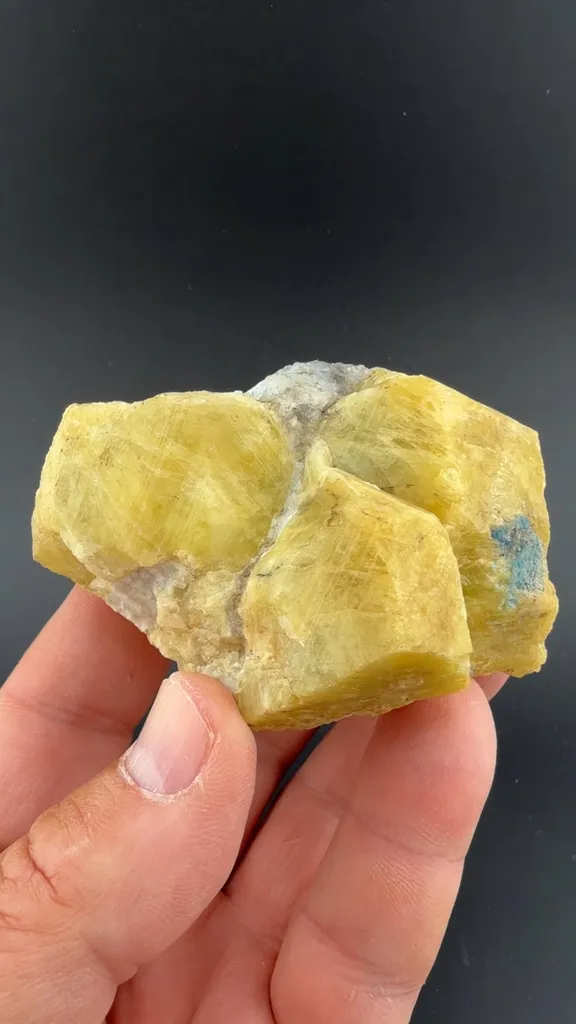
Photo: EarthWonders / Weinrich Minerals
Search for specimens: View all specimens from Antsahanana quarry, null
Antsahanana is a quarry locality within the Sahatany Valley pegmatite field, Ibity, Antsirabe II District, Vakinankaratra, central Madagascar. The deposit is best understood as part of the Sahatany rare-element pegmatite system rather than as a single isolated mine: small to moderate pegmatitic bodies in this area are highly fractionated, lithium-rich, and enriched in the elements that make collector pegmatites so chemically interesting—boron, beryllium, tantalum, cesium, rubidium, manganese, and fluorine. Nearby detailed work at Manjaka describes pegmatite dikes in the Itremo-region metamorphic package, including calc-silicate host rocks and sharply bounded pegmatite contacts; Antsahanana lies close enough to be treated by collectors as part of the same mineralogical neighborhood, while retaining its own quarry name in recent specimen records.
The ore body worked at Antsahanana is not a conventional metal vein but a gem- and rare-element pegmatite. Spodumene records show the lithium character of the quarry, while tantalite-(Mn) points to the tantalum side of the LCT signature. For collectors, the decisive mineralization is in the pocket and albite-rich parts of the pegmatite, where yellow rhodizite–londonite-series crystals can occur with albite, red to purplish tourmaline, spodumene, and rarer borates. Béhierite, a tantalum borate, is also documented from Antsahanana, although its classic type-locality story belongs to adjacent Manjaka.
Mining in the wider Sahatany Valley predates the modern collector boom. Alfred Lacroix published on Vakinankaratra pegmatite minerals in 1912, and the field was later treated in Malagasy geological work and in mineralogical summaries by authors including Rakotoarison, Larsen, Lefevre and Thomas, and Pezzotta. Antsahanana itself appears most prominently in recent collector and museum records: 2022 is the year attached to notable MIM Museum londonite specimens, and current marketplace material shows that the locality has continued to feed the collector circuit in the 2020s.
Public occurrence records do not point to a single large industrial operator behind Antsahanana specimen production. The pattern is the familiar one for Madagascar’s best pegmatite localities: artisanal mining, local trading routes, and a few specialist dealers and collectors who preserve precise locality information. Bruno Tesseron of Mineralphil Madagascar is cited for Antsahanana béhierite, tourmaline, and rhodizite occurrences, while Michel Ambroise specimens are cited for tantalite-(Mn). That provenance trail matters, because Antsahanana’s valuable specimens are rare-species pieces whose worth depends heavily on accurate locality and species determination.
Access today should be regarded as working-quarry access, not casual field collecting. The locality is part of an active rural mining landscape, and collecting rights, safety, land permission, and export rules must be handled locally and legally. Most serious collectors will encounter Antsahanana material through dealers, Malagasy mineral channels, or institutional collections rather than by visiting the quarry with a hammer.
The standout find style from Antsahanana is now clear: yellow londonite–rhodizite-series crystals, sometimes unusually transparent, on pale albite with red tourmaline. Documented museum examples include a 65 g, 4 x 3.5 x 3 cm floating londonite crystal from probable 2022 extraction and a 150 g matrix piece measuring 9.5 x 6 x 3 cm with a 2.1 cm main londonite crystal on albite and small red liddicoatites. Recent market examples extend the scale of the locality further, including a specimen with large blocky yellow londonite crystals reported to 5.0 cm on matrix with minor elbaite.
Antsahanana londonite is prized as one of the most impressive modern expressions of the rhodizite–londonite series from Madagascar: blocky to equant yellow crystals, commonly pale lemon to rich luminous yellow, occur on white albite matrix and may be associated with small red to purplish elbaite–liddicoatite tourmalines; recorded specimens range from 1.5 cm londonite crystals on thumbnails and miniatures to exceptional matrix pieces with crystals reported to 5.0 cm, while museum-quality examples from probable 2022 production include a 65 g single crystal and a 2.1 cm transparent crystal on albite. The key collector distinction here is not merely size but documentation and quality: because rhodizite and londonite are visually inseparable without chemical data and may be compositionally zoned, top Antsahanana pieces combine a reliable label, bright saturated yellow color, sharp undamaged faces, unusual transparency, and an attractive albite–red tourmaline paragenesis.
Elbaite from Antsahanana is chiefly a companion mineral in the rare-borate assemblage rather than the quarry’s main prize, but it gives the best londonite specimens much of their visual character: small red to purplish-red tourmalines occur with yellow londonite and white albite, and at least one documented Antsahanana tourmaline specimen is described as gem elbaite–liddicoatite series, measuring 26 x 13 x 10 mm. Good Antsahanana elbaite pieces are therefore judged differently from the great Malagasy tourmaline pockets elsewhere in Sahatany; here the premium is on sharp, colorful, undamaged accessory crystals that confirm the evolved boron-rich pocket environment and make a strong color contrast with londonite, rather than on large freestanding tourmaline prisms.
Other documented minerals from Antsahanana include rhodizite, béhierite, spodumene, microcline, tantalite-(Mn), and tourmaline, with gemstone production also recorded as a commodity. Béhierite is especially significant in the immediate district: its type locality is neighboring Manjaka, about 0.2 km from Antsahanana, where grayish-pink pseudo-octahedral crystals were described. Antsahanana specimens of béhierite remain rare, but their presence reinforces the quarry’s status as a tantalum- and boron-rich LCT pegmatite locality. Spodumene and tantalite-(Mn) are less glamorous to the display collector here, yet they are the geological backbone of the occurrence; they explain why the quarry can yield the chemically extreme pockets required for londonite–rhodizite-series crystals.
The main authenticity issue at Antsahanana is not a known wave of manufactured fakes; it is species naming. Londonite and rhodizite form a series, and visually similar yellow crystals may be Cs-dominant londonite, K-dominant rhodizite, or compositionally zoned material. For unanalysed Madagascar specimens, the conservative label “rhodizite–londonite series” is often the most defensible choice. A specimen offered simply as londonite should ideally come with analytical support, strong provenance, or a dealer history that justifies the specific name.
Condition is the second major issue. Antsahanana crystals can be large for the species, but prominent equant crystals expose edges and corners that are easily bruised. Inspect the highest points of the yellow crystals under magnification: small chips along ridges, cleavage-like bruises, dull contact faces, and pocket-rubbed surfaces can sharply separate a fine example from a merely large one. Matrix pieces with intact albite and red tourmaline accents are more desirable than loose or repaired crystals unless the crystal is exceptionally transparent and complete.
Acid cleaning should be avoided. Rhodizite–londonite-series minerals are hard, but rare borate specimens from evolved pegmatites deserve conservative treatment: no acids, no aggressive ultrasonic cleaning, and no prolonged exposure to harsh direct sunlight or heat. Dust with a soft brush or air bulb, and leave iron staining or clay in recesses unless a specialist has evaluated the piece. Associated elbaite is generally durable, but small red tourmalines on albite are easy to snap at the base.
Rarity is nuanced. Ordinary small yellow rhodizite–londonite-series crystals from the Sahatany region have become more visible in the market because of recent lithium-pegmatite work, but truly fine Antsahanana pieces remain scarce. A 1–2 cm crystal with good color is collectible; a transparent, well-formed, documented Antsahanana londonite on matrix is a serious rare-species specimen; a 4–5 cm crystal with good faces and attractive albite–tourmaline association is a top-tier locality piece.
Current availability is unusually good for such a rare mineral, but it is concentrated in recent collector channels and can fluctuate quickly. Antsahanana has appeared prominently in recent EarthWonders londonite listings, including specimens with elbaite and examples described as large blocky yellow crystals on matrix. For buying, the safest approach is to demand exact locality, dimensions of the main crystal, full condition disclosure, and—when the price reflects the name londonite rather than the series—some basis for the Cs-dominant identification.
The most memorable recent Antsahanana story is not a dramatic mine accident or a lost pocket tale, but the sudden arrival of museum-caliber londonite from a locality many collectors had barely learned to spell. In the MIM Museum record, one specimen from probable 2022 extraction is described as a 65 g floating londonite crystal from Antsahanana, 4 x 3.5 x 3 cm, “very well formed” and unusually transparent for the species. That single piece captures why the find caused attention: londonite is normally the kind of mineral advanced collectors expect as small yellowish crystals, often requiring a careful label and a loupe; here it appeared as a substantial, sculptural object with real presence.
A second MIM specimen makes the paragenesis even more vivid. It is a 150 g matrix piece, 9.5 x 6 x 3 cm, with a 2.1 cm main londonite crystal sitting on white albite and accompanied by small red liddicoatites. The contrast is exactly what one hopes for in a Malagasy rare-element pegmatite specimen: yellow borate, snow-white albite, and red tourmaline, all from a chemically extreme pocket system. The museum note again emphasizes transparency as unusual, which is a crucial point for collectors; Antsahanana’s best pieces are not merely large for the species, they can be bright and gemmy enough to read visually from across a display case.
The wider Manjaka–Antsahanana mining area also shows how rare-species collecting and lithium mining have become entwined in Madagascar. Reports from nearby Manjaka describe renewed production since 2016, with about 120 people working the deposit in October 2022 and rhodizite–londonite gem rough appearing as a by-product of lithium-ore mining. That setting explains the recent rhythm of Antsahanana material: a quarry driven by practical pegmatite extraction, but with enough pocket rock moving that rare yellow borates occasionally reach collectors, dealers, gem cutters, and museums.






