
You can now suggest a change to another member's specimen, suggest a missing species, and find a tidier menu on the website. Plus collector Tony H. Gill's report on a new topaz find at Esenköy, Türkiye, Matthew Parshchikov on David Giacomini's lab-grown alum, and a spotlight on Tama Higuchi's collection with two of her pieces available exclusively on EarthWonders.
A warm welcome to everyone who has joined EarthWonders since our last issue. In this issue, you can now suggest a change to another member's specimen, suggest a species that is missing from our list, and find a tidier menu on the website. Plus collector Tony H. Gill's report on a new topaz find at Esenköy in Türkiye, Matthew Parshchikov on David Giacomini's lab-grown alum, and a look at Tama Higuchi's collection, with two of her pieces available only on EarthWonders.
Suggest a Change to a Specimen
Spotted a wrong locality, a missing reference or a better photo on another member's specimen? You can now send its owner a correction. Sign in, open the specimen and click Suggest a change in the Spotted a mistake? box. You can correct the photos, species, locality, size, weight, description, publications and previous owners, and add a message of up to 1,000 characters saying where your information comes from. The specimen stays exactly as it is until the owner accepts.
The owner is notified and sees every changed field next to its current value. They can accept everything at once, accept or reject each change, or decline the whole suggestion. You can follow your suggestions in My submissions in your account menu, and an accepted suggestion counts as a contribution worth 5 points. In the EarthWonders app, open the specimen and tap Suggest a change.
Watch the video in the Help Center
Suggest a Missing Species
If a mineral species or variety is missing from our species list, you can now suggest it. On the EarthWonders website, open Create and choose Suggest a species. Enter the English name as it appears on Mindat or the IMA list, and the form tells you if the name is already in our list or already in review. Add a reference that shows the species exists, such as its Mindat page, the IMA list or a publication, and the chemical formula and other names if you have them. The team checks every suggestion, completes the species data and emails you the outcome. Suggest a species or read how it works.
A Tidier Menu on the Website
We have tidied up the menu on the EarthWonders website, with fewer items and your settings in one place. Seller Policies and Documents are now tabs in Preferences & Settings, next to Account, and Blocked users lives there too. Collection insights is one page with three tabs: Audience, Collection Mix, and Value and trends. Your specimen alerts are on the Alerts card in your Dashboard. The same changes are coming to the app next.
A New Topaz Find at Esenköy, Türkiye
In August 2021 a wildfire burned around 10,000 hectares of forest near Esenköy, in the Yatağan district of Muğla Province, Türkiye. The fire cleared the vegetation and pine needle cover, and firefighting crews cut new roads through the hills. That gave local collectors access to outcrops that had been hidden under the forest.
A team of collectors and lapidary specialists (Habib Şanlı, Zafer Yumuk, Erdem Heral, Celal and Cem Uysal, and Burhan Çucuk) made three trips to the area. The first turned up small white and champagne topaz crystals. The second produced larger red and pink crystals. The third added more single crystals and matrix specimens, with topaz on calcite and quartz.
Collector Tony H. Gill documented the find, and his article is now on the EarthWonders blog. It covers the geological setting, the three trips, the crystals and the matrix pieces, and what further study still needs to answer. The crystals reach about 5 cm, with colors ranging from pale champagne to deep golden and, less commonly, pink and red.
Seven specimens from the find are in Tony’s collection on EarthWonders.
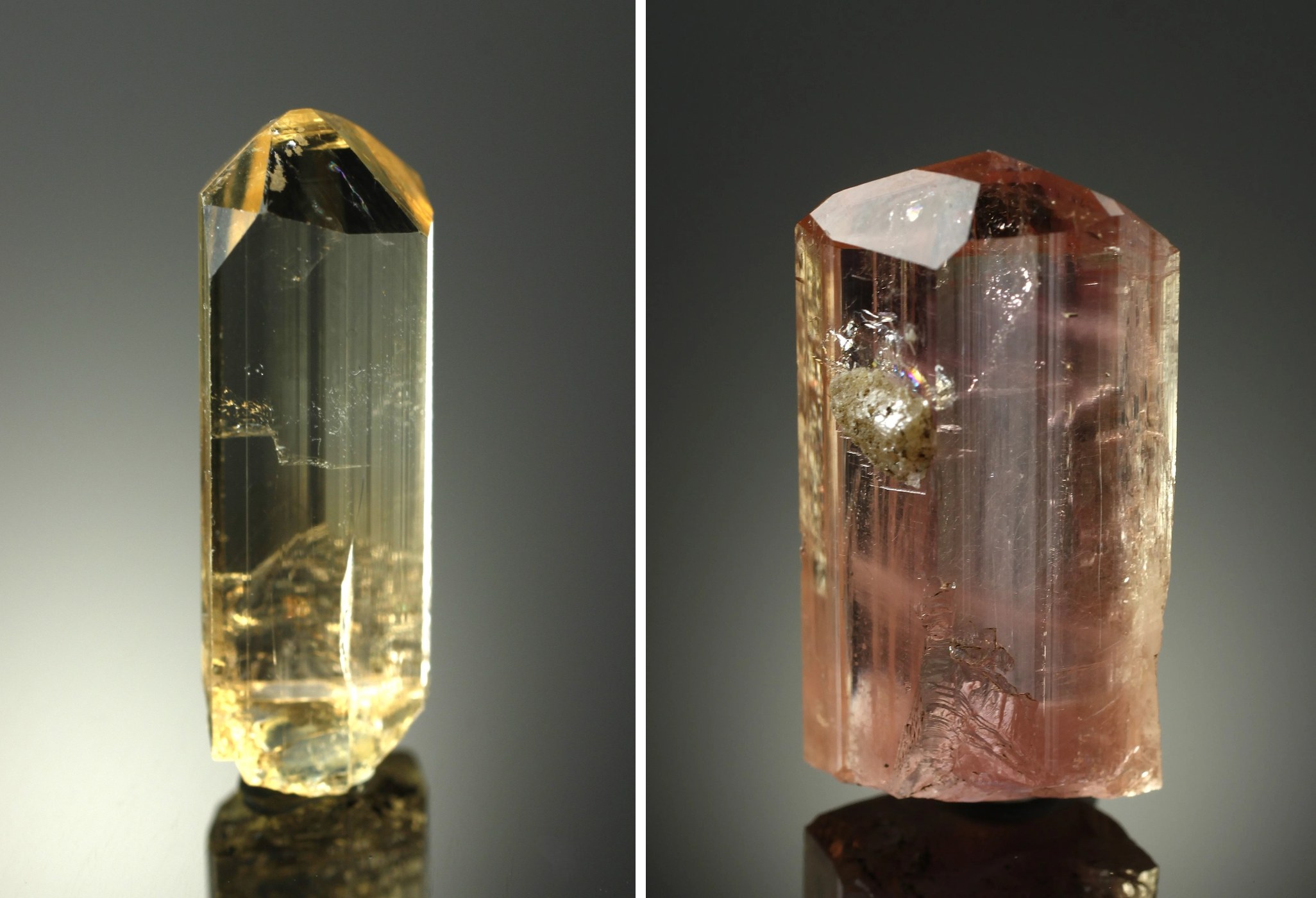
Sherry topaz (left) and pink topaz (right) from Esenköy, Yatağan, Muğla, Türkiye. Photos: Tony Gill
Size: 2.5 x 1.0 cm (left) and 2.8 x 1.6 cm (right)
Synthetic Mineral Art: Neither Fake Nor Scam
Written by Matthew Parshchikov, a young mineral collector on EarthWonders.
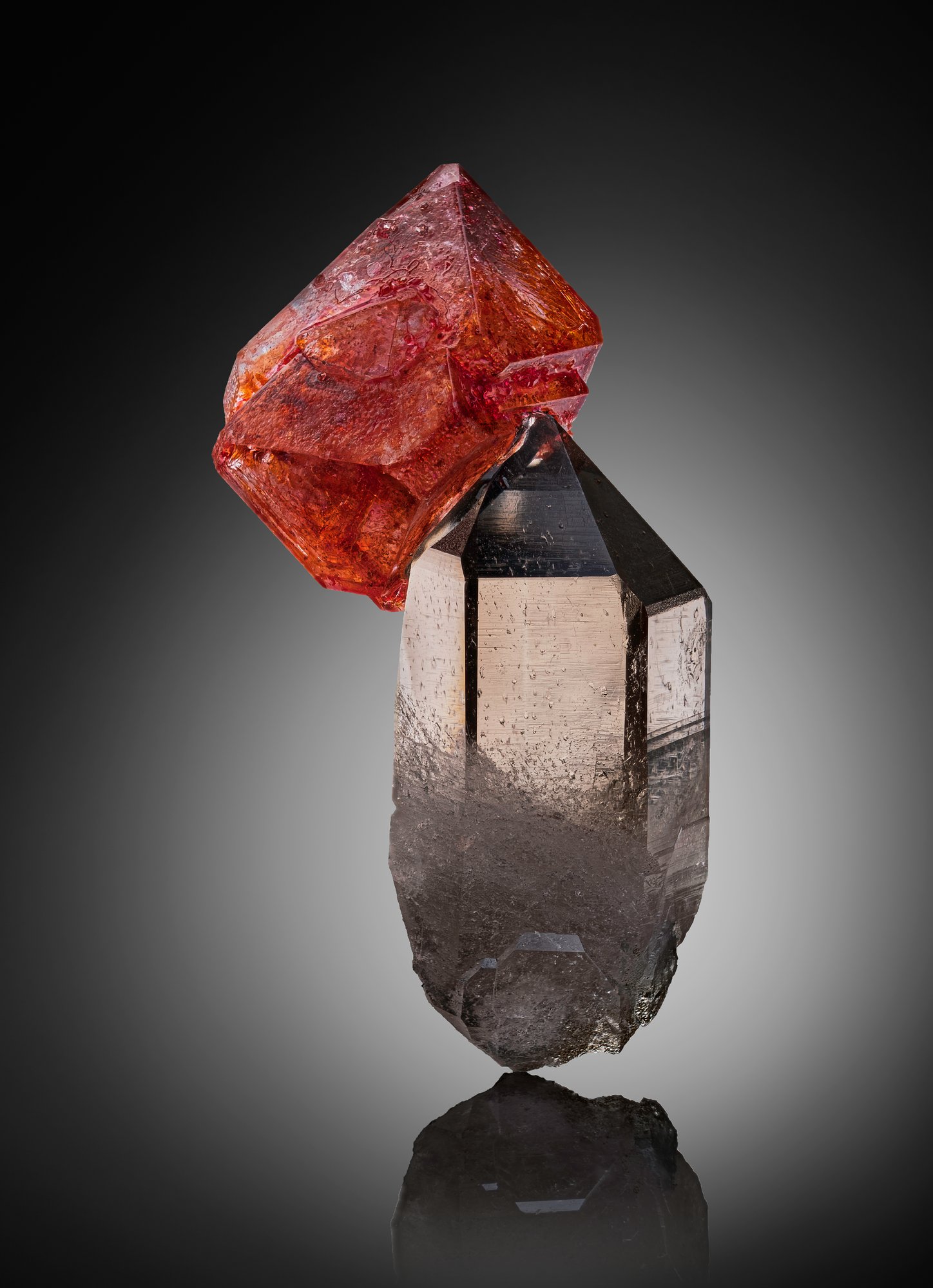
Lab-grown red alum octahedron on smoky quartz, Alpine style. Photo: Matthew Parshchikov
Size: 3.8 x 1.9 x 1.8 cm
For quite some time now, David Giacomini from Luxembourg has been marrying crystallography, chemistry, and creativity while playing mad scientist in his home and creating mineral specimens of alum. While alum on matrix has been around for a long time, the creations of Minerals De Lux are more similar to natural pieces than the large-scale productions one can find in museum shops.
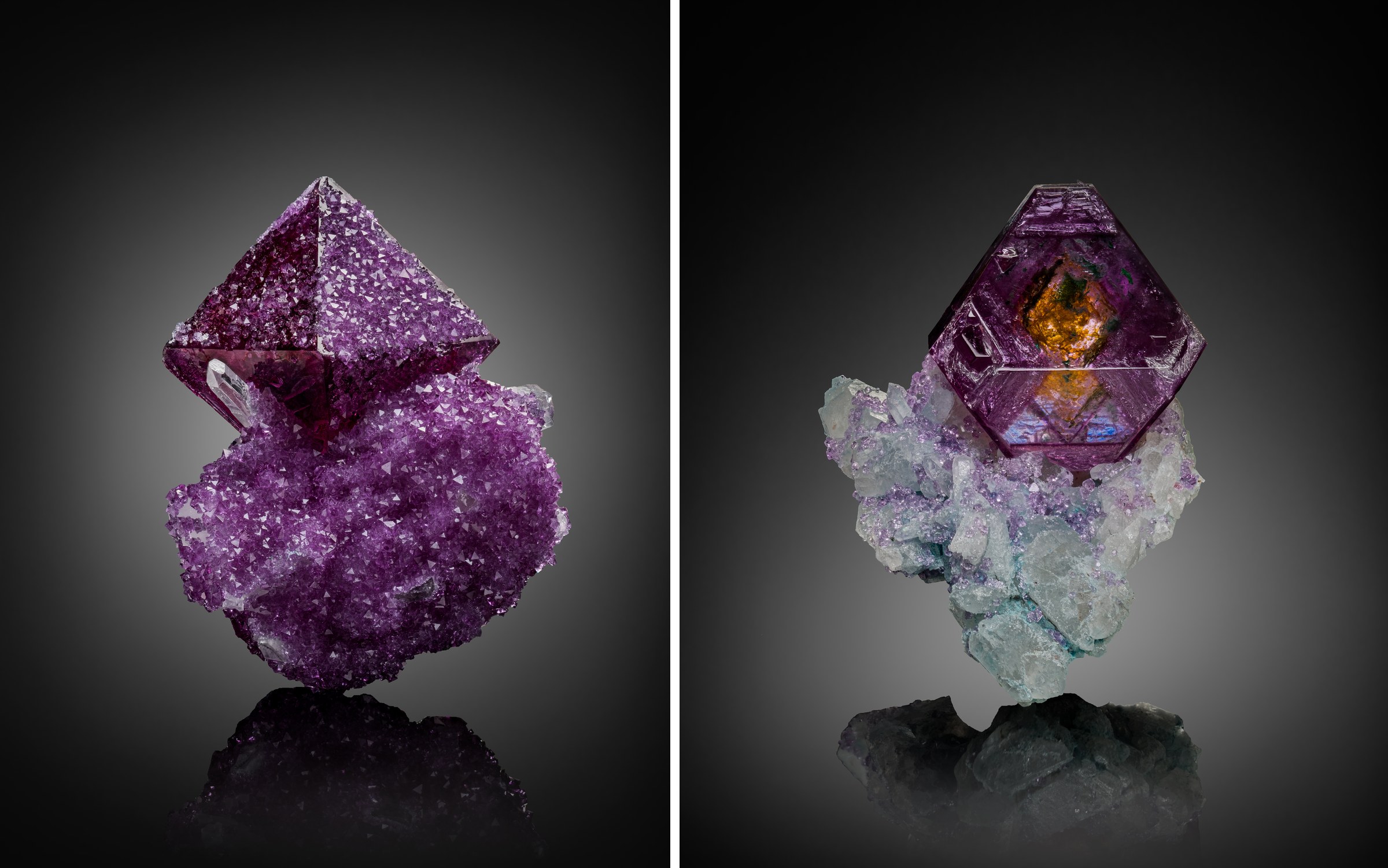
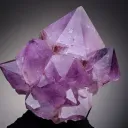
Left: Purple alum octahedron with a secondary "sugarcoat". Right: Purple alum cube-octahedron with yellow phantoms and recrystallized faces. Photos: Matthew Parshchikov
Size (left): 4.2 x 4.3 x 3.5 cm
Size (right): 4 x 4 x 3 cm
Alum is a translucent sulfate mineral, most commonly potassium alum with the formula KAl(SO₄)₂·12H₂O, and belongs to the isometric crystal system. While alum can be found naturally in the oxidation zones of sulfide-bearing rocks, it mostly occurs as a white crust and seldom forms large crystals. Lab-grown specimens are made by dissolving alum powder in hot water to create a supersaturated solution. As the liquid cools and slowly evaporates, suspended seed crystals precipitate into distinct, glassy octahedral formations.
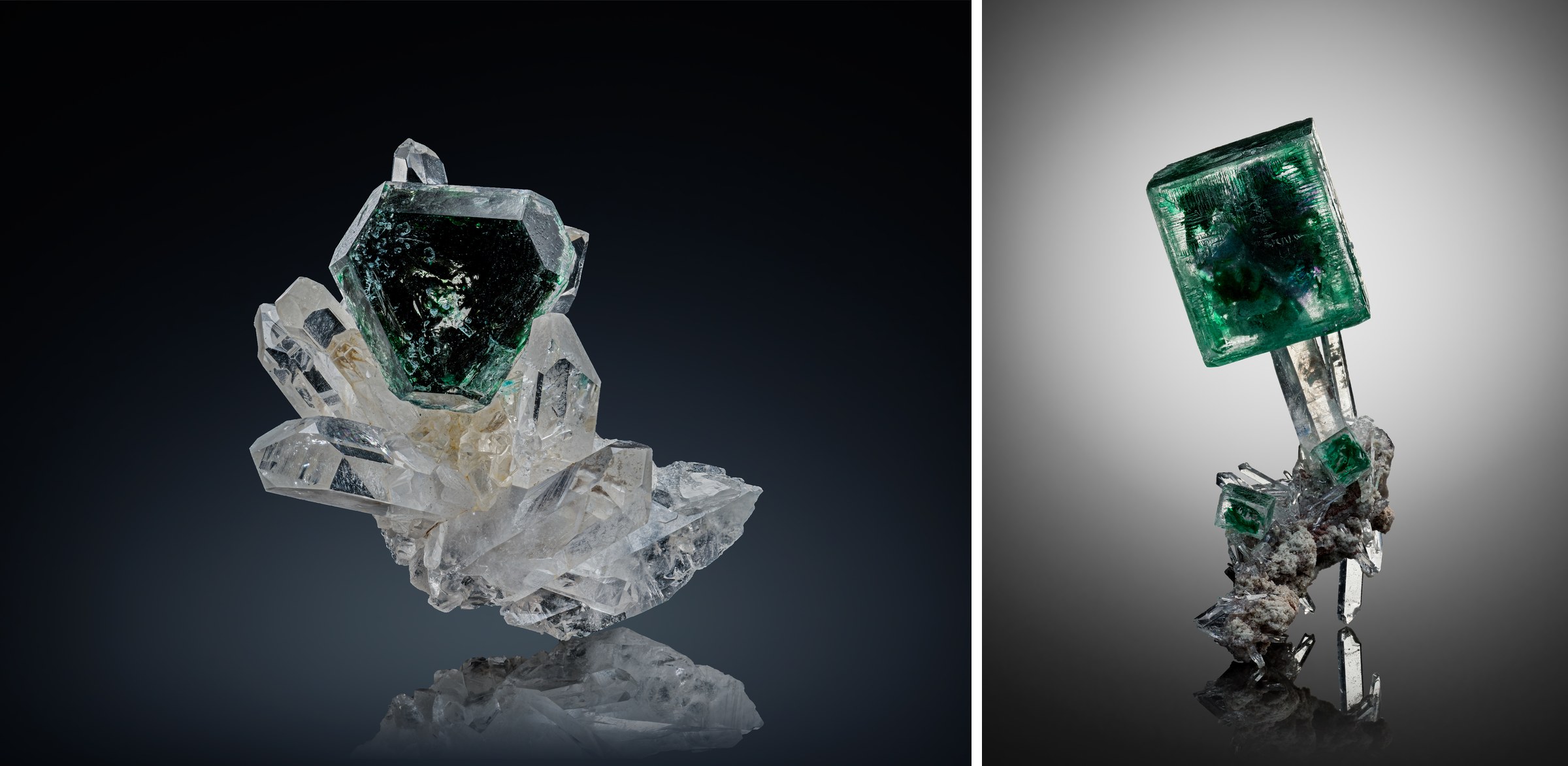
Left: Flattened green alum cube-dodeca-octahedron with different colored inclusions. Right: Green cubic alum with phantoms. Photos: Matthew Parshchikov
Size (left): 4.5 x 2.5 x 3.3 cm
Size (right): 4.8 x 3 x 3 cm
The problem with basic, commercially available alums is that they look fake. David wanted to create something in a way that nature would have made it. The process is straightforward: find a large, promising seed crystal in the solution, glue it onto the matrix (David has used many different host rocks, but quartz is currently the most frequent), and return it to the solution to continue growth. With time (and different additives), the crystals grow bigger and develop into octahedrons. In his case, though, it is not certain whether a batch will turn out successfully at all because he chooses not to control every parameter as one would in a lab, instead allowing for a certain amount of chaos (the secret ingredient to creating something).
David didn’t stop there; he continued to experiment. Patience and, mainly, accidents led to elongated, cubic, and even cuboctahedral forms. His recent creations are reminiscent of the famous Alien Eye fluorites because of their similar phantoms.
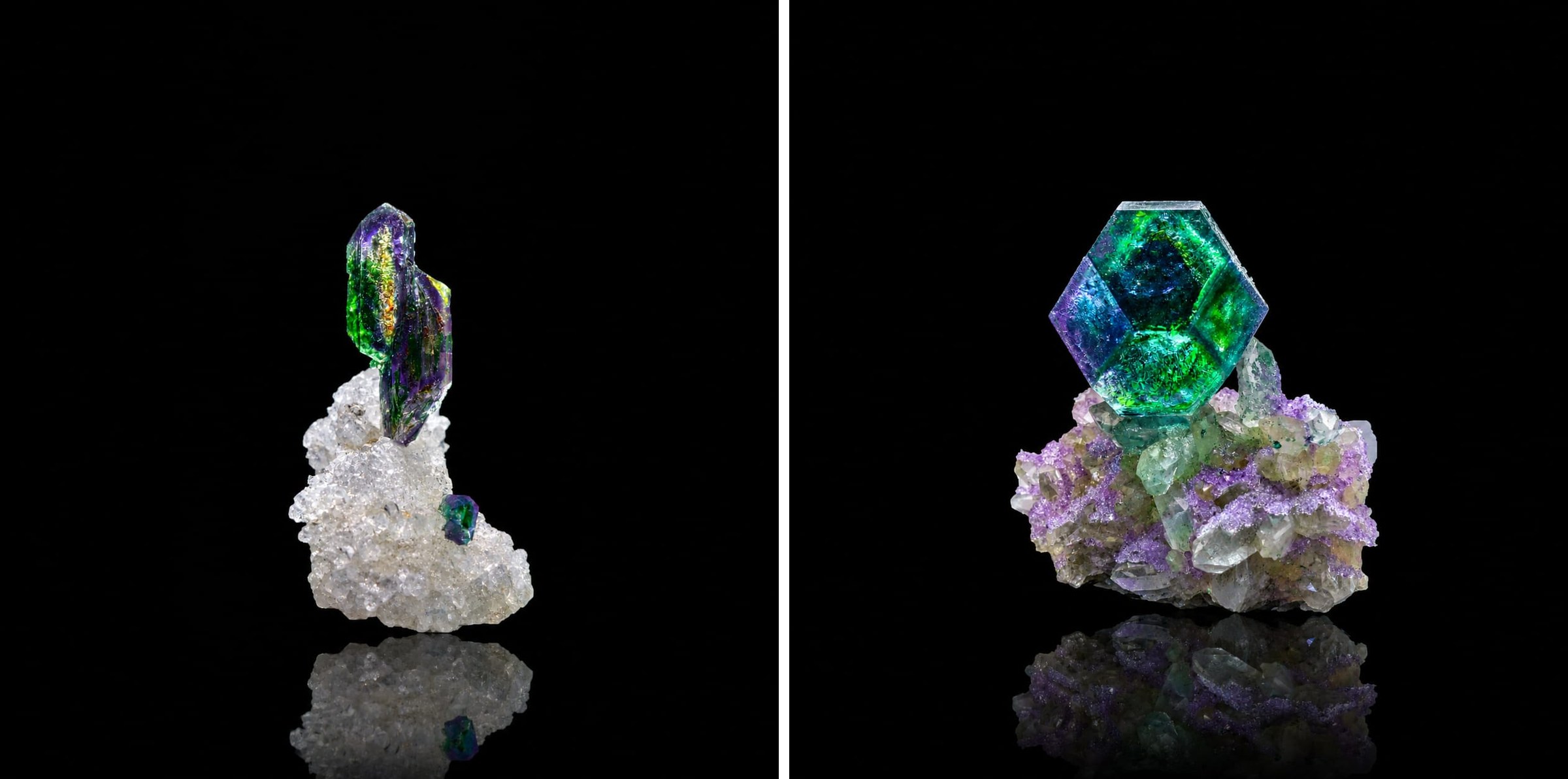
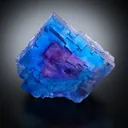
Left: Elongated "accidental" alum crystal on matrix. Right: Blue-green alum cube-octahedron on matrix, with phantoms reminiscent of Alien Eye fluorite. Photos: David Giacomini
What makes crystal growing an art is the time spent studying, taking notes, and attempting to reproduce results while carefully building a composition and hoping it will come out as intended. Because of this, David’s creations should not be considered “fake mineral specimens.” What people are buying are unique pieces. The only difference is the creator. Minerals De Lux continues to capture collectors’ attention because, just like in nature, it is always a surprise what he has come up with.
Written by Matthew Parshchikov.
Collector Spotlight: Tama Higuchi, from Dallas, Texas
This month, say hello to Tama Higuchi, a collector from Dallas, Texas, who has been collecting since 2015. In her own words, she is a "Mineral artist/watercolorist, photographer, and thumbnail collector," and she is senior director of the board of the Young Mineral Collectors. Her 33 pieces on EarthWonders range from benitoite from the California State Gem Mine to rhodochrosite from the N'Chwaning I Mine in South Africa. Explore Tama's collection.
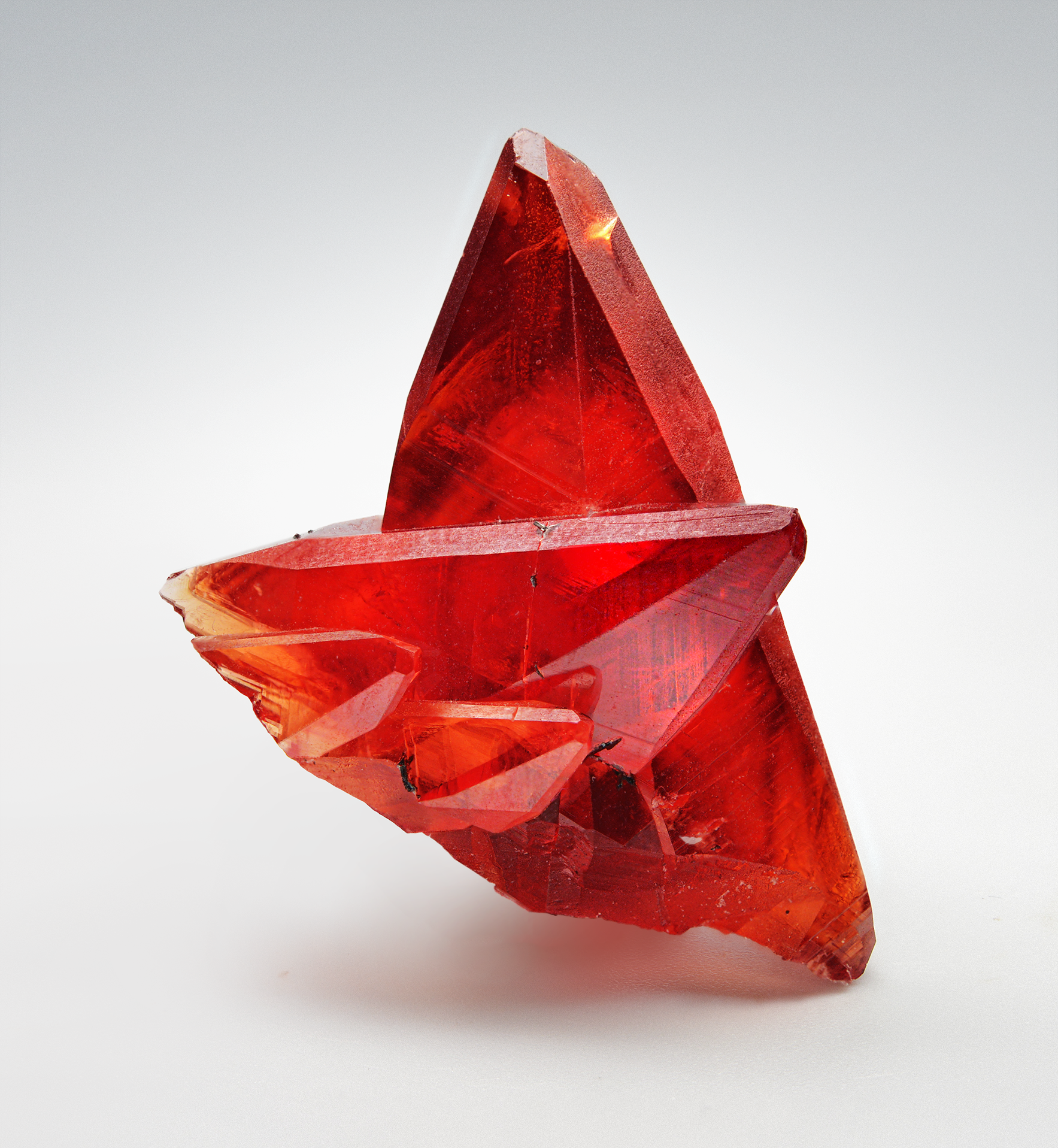
Rhodochrosite from N'Chwaning I Mine, Northern Cape, South Africa. Photo: Tama Higuchi
Size: 2.9 x 1.9 x 1.7 cm
Exclusive to EarthWonders: Two Pieces From the Tama Higuchi Collection
Two pieces from Tama's collection are for sale exclusively through EarthWonders.
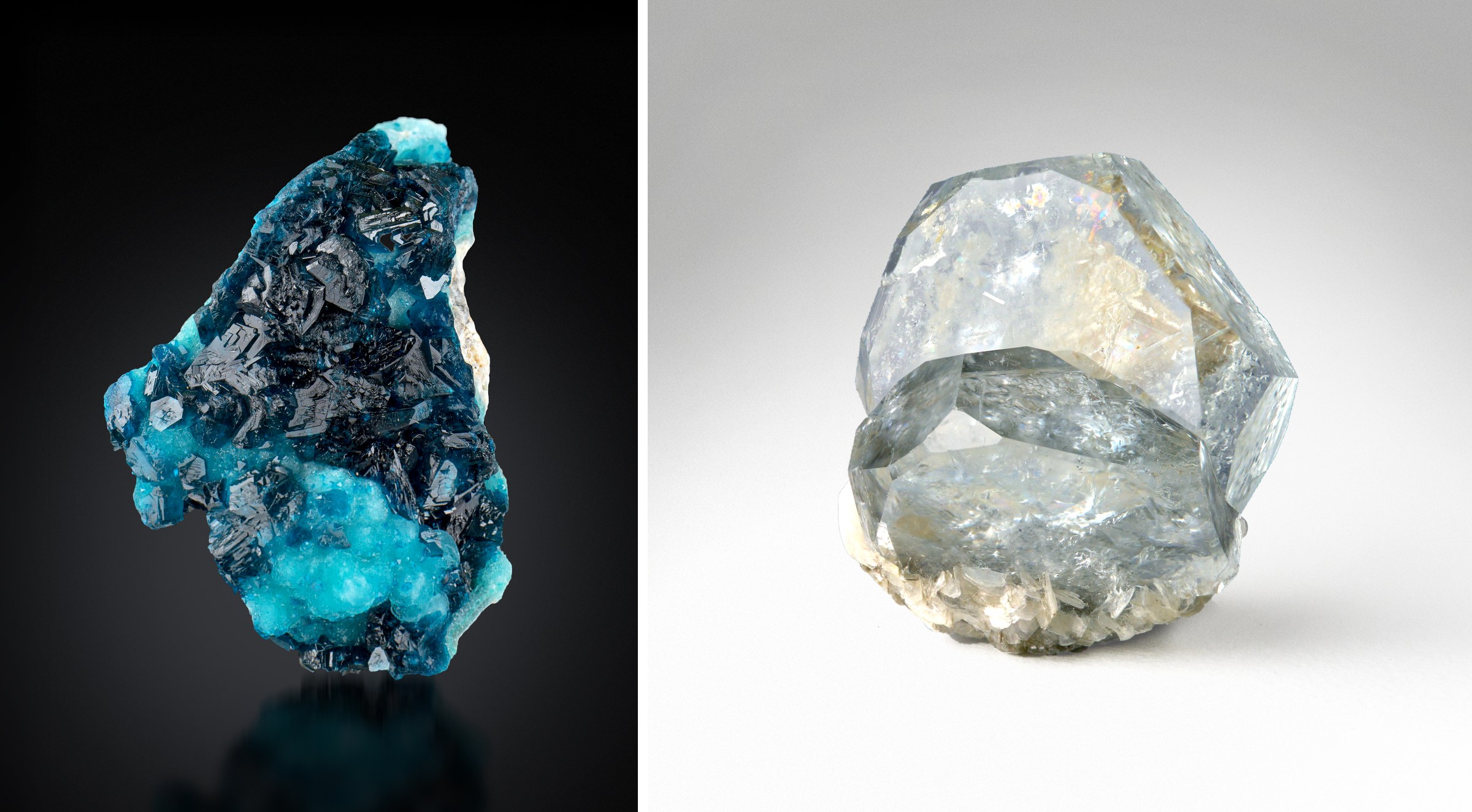
Left: Veszelyite from Palabanda quarries, Mfouati, Bouenza Department, Republic of the Congo. Right: Aquamarine from Mount Little Xuebaoding, Pingwu Co., Sichuan, China. Photo: Tama Higuchi
Size (left): 2.5 x 2.0 x 2.0 cm
Size (right): 2.8 x 2.5 x 2.1 cm
Shop Tama's pieces on EarthWonders
If you have specimens, locality information, research, or stories that could help others discover the world of minerals, we would be very happy to hear from you. Reach out to the team, info@earthwonders.com
Until next time, friends!