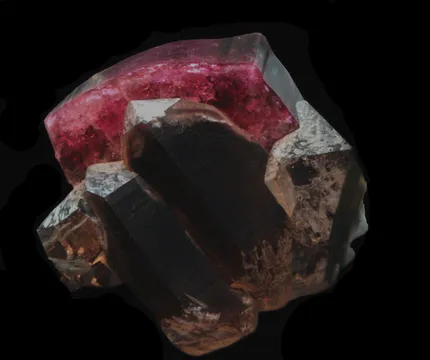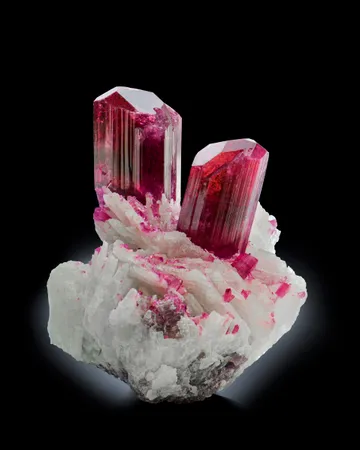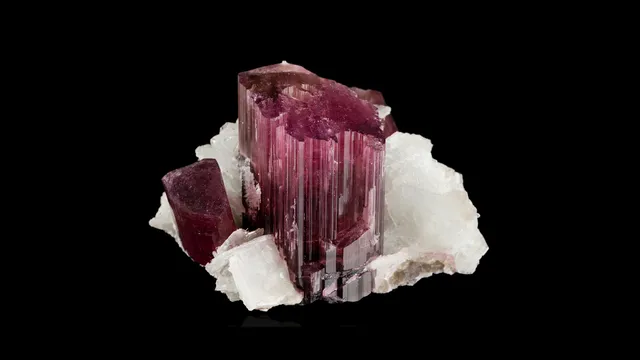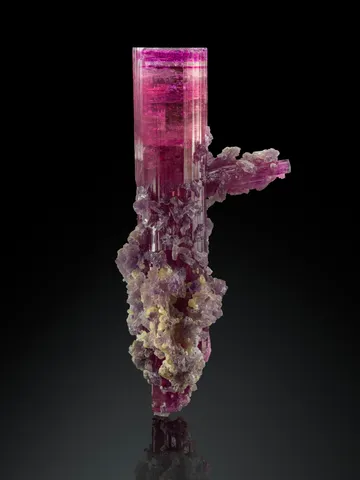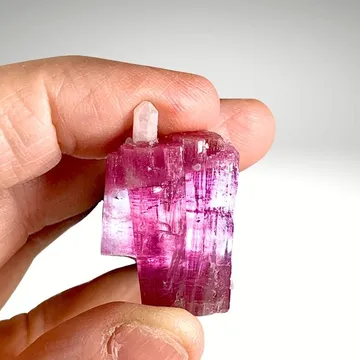
Rubellite - red-to-deep pink tourmaline prized for saturated color, high clarity, and brilliant luster; top localities include Jonas Mine Brazil, Malkhan, Russ…
Key facts
Rubellite is the prized red-to-deep pink variety of the tourmaline group (most commonly manganese-bearing elbaite). Its allure lies in saturated cranberry, raspberry, or hot-magenta hues that can glow intensely in transmitted light. Crystals typically form as elongated trigonal prisms, often striated and capped by flat pinacoids or complex pyramids. The best pieces combine vivid color with high clarity and glassy luster; when perched on white cleavelandite, quartz, or lavender lepidolite, rubellite’s color impact is extraordinary.
While rubellite is a varietal name rather than a distinct species, collectors treat it as a category unto itself because exceptional reds are rare and charismatic. True “stoplight red” or richly saturated raspberry rubellites are genuinely uncommon. Legendary pockets—such as the 1978 Jonas Mine discovery in Brazil—produced huge, gemmy crystals that set an enduring benchmark. Fine rubellite is at home in elite museums, yet smaller attractive crystals and thumbnails remain attainable, offering a broad entry point for collectors.
Rubellite’s reputation was cemented by spectacular finds in Brazil (Jonas, Cruzeiro), followed by modern classics from Russia’s Malkhan field and long-running production in Afghanistan’s Nuristan region. California’s Pala District (especially the Himalaya Mine) contributed historically important pink-to-red elbaites, while Mozambique’s Alto Ligonha pegmatites provide both robust crystals and complex multi-species associations.
Demand is consistently strong because truly top color is rare and unmistakable—deep red tones that read as red even in modest light, paired with transparent upper sections and brilliant luster, command immediate attention. Major pieces are fiercely competed for and often repaired due to pocket breakage; unrepaired matrix examples are especially coveted. Though prices for world-class rubellite rival major gemstones, good smaller examples still offer strong value, keeping interest high among both new and advanced collectors.
The 1978 Jonas (Itatiaia) pocket is one of mineral collecting’s defining moments: enormous, vividly colored rubellite crystals—some over 30 cm—yet still gemmy, with rich cranberry-red coloration. The mine’s best examples show stout prisms with bright luster and striking transparency, often standing alone as sculptural single crystals. Even small Jonas thumbnails are treasured, while large, clean pieces are among the most valuable tourmalines ever mined. Many specimens were broken in situ and later repaired; pristine or minimally repaired crystals from this find hold near-mythic status.
Cruzeiro is a long-running pegmatite famed for consistent production of colorful elbaite, including elegant pink-to-red rubellite crystals. Typical pieces are slender to medium-thick prisms with vivid “hot pink” through raspberry hues, often with clean, lustrous faces and sharp terminations. Matrix associations with cleavelandite, quartz, and lepidolite amplify contrast. While sizes trend smaller than the Jonas giants, Cruzeiro’s finest rubellites have superb color and clarity and remain staples of serious collections.
Since the 2000s, Siberia’s Malkhan field (Zabaykalsky Krai) has produced rubellite crystals of remarkable saturation—deep wine-red to raspberry, often thick and highly lustrous. Classic specimens feature robust trigonal prisms with flat, mirror-bright terminations, occasionally with attractive color zoning. Snowy cleavelandite, smoky quartz, and mica provide dramatic red-on-white contrast. Large, transparent crystals to 15–20 cm set a modern standard and are widely regarded as among the best red tourmalines of recent decades.
The Himalaya Mine is renowned for prolific pink-to-red elbaite through the 20th century, including exquisite rubellite crystals with glassy luster and bright, glowing interiors. Clusters with lepidolite mica are classic. While many crystals are slender, occasional stout, gemmy prisms and attractive matrix pieces exist. Older, well-preserved Himalaya rubellites remain strongly collectible for their color, form, and historical importance.
Paprok is famous for delicate, transparent elbaites, including fine rubellites ranging from vibrant pink to cherry-red. Typical crystals are slender, highly lustrous, and sharply terminated—often in elegant clusters with cleavelandite or quartz. The best pieces combine limpid clarity with saturated color and are frequently repair-free single crystals. While deep, pure reds are less common than pinks, top Afghan rubellites are admired for their gemmy brilliance and graceful form.
Color
Clarity and Luster
Crystal Form and Termination
Condition
Aesthetics
Repairs and Reattachments
Polishing
Color Treatments
Handling
Light Exposure
Temperature
Cleaning
Storage
By focusing on vivid, saturated color, sharp terminations, high luster, and strong aesthetics—preferably with documented provenance—you’ll build a rubellite suite that captures the drama and rarity that make this variety one of the most beloved in the tourmaline family.