North Macedonia: Prilep ruby in white marble and Allchar thallium minerals; prized for saturated color, crystal form, and historic collecting appeal.
Key facts
North Macedonia is a small country with an outsized mineralogical voice. For collectors, its fame rests above all on two very different environments: the snow-white dolomitic marbles of the Prilep region, where corundum and ruby occur in a metamorphic carbonate setting, and the Allchar deposit in the Kožuf Mountains, a low-temperature Sb-As-Tl-Au system whose thallium mineralogy is among the most distinctive on Earth. Together they give the country a remarkable collecting identity: rose-red ruby in white marble on one hand, and microscopic to thumbnail arsenic-thallium sulphides in orange-red realgar and yellow orpiment on the other.
The Prilep rubies are the classic collector pieces from the country. They occur in the Sivec marble quarries and nearby marble-hosted occurrences, typically as pale pink to deeper red corundum crystals embedded in white dolomitic marble or freed from it as barrel-like, tabular, prismatic, bipyramidal, or partly rhombohedral crystals. Their great gemological signature is the oriented intergrowth of diaspore with corundum: silvery lamellae that produce the optical effect now known as diasporescence. The best specimens are not transparent cut-gem rubies in the Burmese sense; they are locality pieces, valued for saturated pink-red color, recognizable crystal form, contrast against white marble, and the characteristic silky, silvery internal flash.
Regional View
Country View
Allchar gives North Macedonia its other collecting legend. The deposit is repeatedly spelled Allchar, Alšar, Alsar, or Alshar in the older literature, and it has long been famous for lorándite, TlAsS2, and a suite of rare thallium sulphosalts. For the cabinet, Allchar is a locality of small but highly significant specimens: cherry-red lorándite tablets, orange-red realgar prisms, yellow orpiment, raguinite, vrbaite, jankovićite, dorallcharite, bernardite, and related rarities. Its appeal is partly aesthetic and partly intellectual. Few localities have so thoroughly blurred the boundary between mineral collecting, ore geology, crystal chemistry, and solar physics.
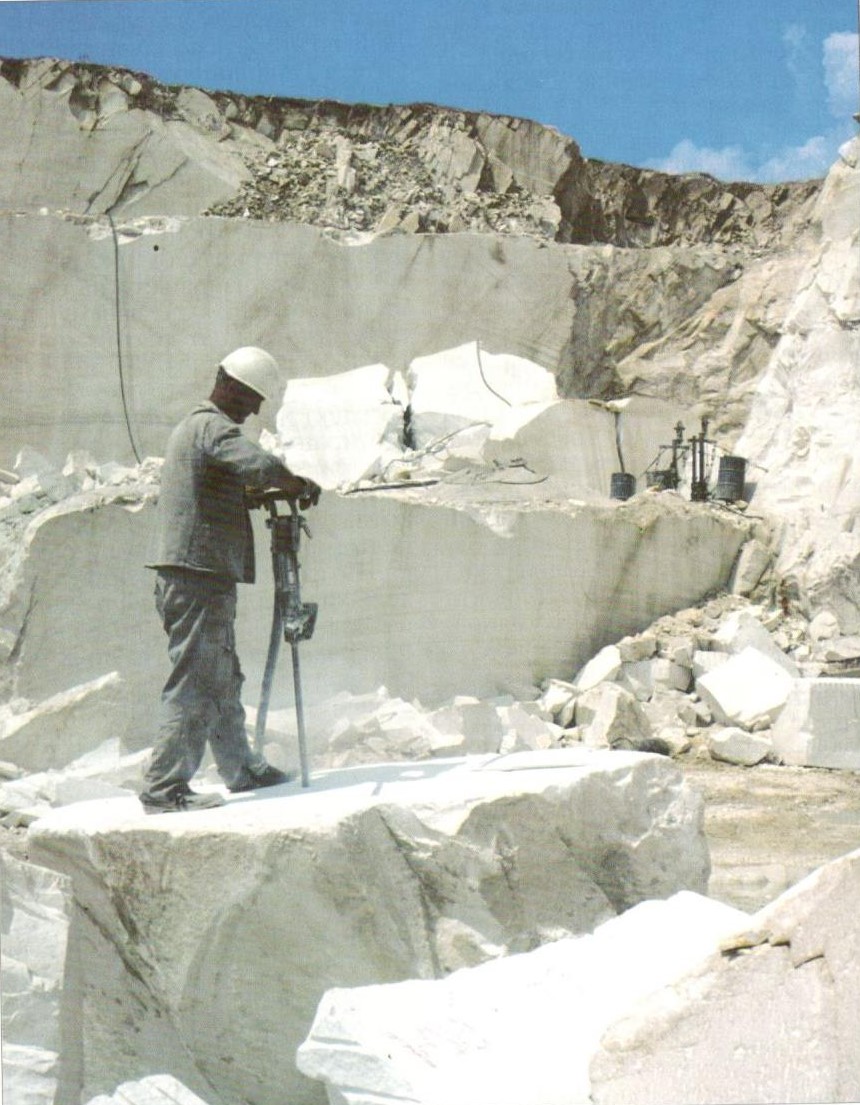
Photo: Wikimedia Commons

Photo: Wikimedia Commons
Search for specimens: View all specimens from North Macedonia
The principal collector locality for corundum and ruby is the Sivec marble quarry area on Sivec Mountain near Prisad, north of Prilep. The marble belongs to the central Pelagonian Massif, within a thick high-grade metamorphic marble series formed by metamorphism of carbonate rocks. The Sivec material is a fine-grained, sugary, white dolomitic marble, commercially important as dimension stone and worked today by modern quarrying methods. The quarry field includes several named operations and neighboring marble quarries; in the mineral literature, Sivec is the most important ruby occurrence, while Beloto and Belovodica are also noted for corundum in the Prilep dolomitic marble district.
The corundum is not evenly distributed through the marble. It is associated with calcite nests and veins in the dolomitic host and accompanied by a small but distinctive assemblage that includes calcite, dolomite, fluorite, rutile, phlogopite, diaspore, almandine, clinochlore, muscovite, quartz, zoisite, and related mica-group minerals. X-ray and infrared studies of Sivec material have confirmed the core collector assemblage of calcite, dolomite, fluorite, rutile, diaspore, corundum, and several silicates. In specimen terms, the productive material is where the white marble is cut by small calcite-rich zones containing corundum crystals, commonly with brown limonite films, diaspore lamellae, or remaining marble adhering to crystal faces.
The Sivec quarrying district is historically important well beyond mineral collecting. The white marble was exploited in antiquity and became a sculptural stone of high reputation in the Roman and Late Antique periods. Modern organized quarrying developed after the Second World War, and Mermeren Kombinat A.D. Prilep remains closely associated with the commercial SIVEC® marble name. For mineral collectors, however, Sivec is not a casual collecting ground. It is an active industrial marble operation, and specimens should be regarded as quarry-recovered material obtained through legitimate permission, dealer channels, old collections, or quarry by-product recovery rather than from open collecting.
Allchar lies far to the south in the Kožuf Mountains near Ržanovo and Majdan, in Kavadarci Municipality. It is a complex volcano-hydrothermal Sb-As-Tl-Au deposit, spatially associated with Pliocene calc-alkaline to shoshonitic magmatism and structurally controlled by faulting along the western side of the Vardar Zone. The host package includes carbonate rocks, volcaniclastic rocks, and altered sedimentary units, with mineralization expressed as replacement bodies, vein-lens zones, disseminations, and strongly altered porous ore rock. The deposit has been compared with Carlin-type systems because of its Au-As-Sb-Hg-Tl geochemistry, carbonate reaction, argillic alteration, and very fine-grained sulphide associations, although Allchar’s thallium mineralogy gives it an individuality unlike Nevada’s better-known gold camps.
Mining at Allchar was most active from the early 1880s to 1913, with interruptions. The historical work focused mainly on arsenic ore, which was exported through Thessaloniki and to Germany, and later investigations evaluated antimony, thallium, and gold. The Crven Dol part of the deposit is especially important for thallium mineralization and for collector specimens of lorándite and associated Tl minerals. Adit No. 21 and Adit No. 25 appear repeatedly in the technical literature; samples from the northern part of the deposit include cherry-colored lorándite, orpiment, realgar, and altered dolomitic material. Subsequent exploration in the 1950s, 1960s, 1970s, and especially the LOREX-related work of the late 1980s and early 1990s reopened parts of the old workings for scientific sampling rather than specimen mining.
Collector access at Allchar should be considered restricted and hazardous. The site includes old underground workings, arsenic and thallium minerals, acid mine drainage, unstable dumps, and scientifically significant ore bodies. Specimens seen on the market are usually old-time material, microscope material recovered during scientific or collector visits, or pieces that entered Europe’s mineral trade in small waves. The notable pockets were not large, open, display-quality cavities in the Alpine sense; the important finds were sulphide-rich seams, vugs, and altered zones where realgar, orpiment, lorándite, raguinite, vrbaite, and rarer Tl species occur as small crystals or grains requiring magnification and analytical confirmation.
North Macedonian corundum for collectors means the Prilep dolomitic marble occurrences, above all Sivec, where crystals occur in calcite nests and veins within snow-white dolomitic marble of the Pelagonian Massif. The crystals are commonly partly developed rather than textbook-perfect, with pinacoidal, bipyramidal, barrel-like, prismatic, and rhombohedral forms; published study material ranged from about 1.5 to 6 cm, though attractive collector crystals may be smaller or larger depending on how much marble remains. Color ranges from pale pink through rose and purplish red, with blue sapphire noted as the rarest color variety. Good corundum specimens from Sivec show sharp habit, recognizable hexagonal geometry, minimal limonite masking, and strong contrast with white marble, while ordinary pieces tend to be broken, chalky, heavily iron-stained, or so saturated with diaspore parting planes that they lose both form and color.
Ruby from North Macedonia is the pink to red variety of corundum from the Prilep marble district, and its identity is inseparable from Sivec’s oriented diaspore inclusions. These inclusions occur as lamellae and oriented intergrowths through the crystal, sometimes visible to the naked eye as silvery glitter and, in cut stones, producing diasporescence; this effect can lighten the apparent body color, reduce transparency, and make the best pieces more prized as unusual gem-mineral specimens than as facetable rough. The best Sivec rubies combine saturated rose-red to pigeon-blood red color, translucency, clear hexagonal or barrel-shaped habit, and either a clean white marble matrix or a complete free crystal with only minor limonite. Many are better suited to cabochon cutting than faceting, and published cutting tests showed that hollowness, heterogeneous color, strong diaspore lamellae, and splitting along parting planes are major limitations in turning rough into gems.
Realgar from North Macedonia is best known from Allchar, where it is a major arsenic sulphide in the Sb-As-Tl-Au deposit and a common host or associate for lorándite and other rare thallium minerals. Specimen realgar occurs as orange-red to red translucent crystals, crusts, and vug linings, commonly with orpiment, lorándite, raguinite, parapierrotite, fangite, dorallcharite, and secondary arsenates or sulphates in the oxidized portions of the deposit. Most fine Allchar realgar specimens are small: crystals in the 1–2 mm range in shallow vugs are typical of older cabinet pieces, while micro specimens can be far more mineralogically interesting than they first appear. The best examples have lustrous, undarkened crystals, a secure old or analytical label, and an intact association with lorándite or another Allchar rarity; dull orange masses, light-damaged pieces, and mislabelled arsenic sulphide mixtures are much less desirable.
Beyond corundum, ruby, and realgar, North Macedonia is especially important for type-locality and rare-element mineralogy. Allchar is the type locality or classic source for a suite of thallium minerals including lorándite, vrbaite, raguinite, picotpaulite, parapierrotite, rebulite, simonite, jankovićite, dorallcharite, and bernardite, with many of these occurring as minute grains or crystals in realgar-or piment-rich ore. The country has other type-locality minerals as well: macedonite, PbTiO3, was described from the Crni Kamen area near Prilep; nežilovite and ferricoronadite are tied to the unusual Zn-Pb-Mn-Fe oxide assemblages near Nežilovo in the Jakupica Mountains; and recent work from the same broader area has continued to add rare and highly specialized species. For display collectors these names can be challenging, but for systematic collectors North Macedonia is a deeply productive country.
The first authenticity issue with North Macedonian ruby is locality confidence. Genuine Sivec/Prilep material commonly shows pink to red corundum in white dolomitic marble, diaspore lamellae, partial limonite coatings, and hexagonal to barrel-like crystal forms. The diaspore intergrowth is a powerful origin clue: in published studies it is treated as characteristic of Prilep material and is visible in many specimens as silvery lamellae or glitter. That said, not every red corundum in white carbonate matrix is automatically Sivec, and loose crystals without matrix should be bought with good labels, provenance, or diagnostic inclusions.
Synthetic ruby is a separate concern, especially for cut stones sold as “Macedonian ruby.” The Prilep material is usually translucent to opaque, included, parting-prone, and cabochon-suitable; clean, bright, faceted stones with strong transparency should be treated cautiously unless accompanied by reliable gemological documentation. The distinct diaspore-related silk and diasporescence are helpful, but they require magnification and experience. For mineral specimens, the more common problem is not synthetic replacement but over-optimistic naming: pale pink corundum may be sold as ruby, blue material as sapphire, and heavily altered or limonite-coated pieces as finer than they really are.
Condition is central to valuation. Sivec corundum often breaks from marble along parting or inclusion planes; many crystals have bruised edges, missing terminations, open fractures, or iron staining. For matrix pieces, check whether the crystal is naturally embedded or simply glued into white marble. The best pieces show natural contact, undisturbed matrix texture, and consistent mineral relationships. Loose crystals are acceptable and historically common, but complete-all-around form, strong color, and clean faces matter.
Allchar specimens require much stricter handling. Realgar and orpiment are arsenic sulphides and should be kept away from food preparation areas, children, pets, and abrasive cleaning. Do not grind, trim, saw, or ultrasonically clean them. Wash hands after handling, store friable pieces in boxes, and avoid inhaling dust from crumbly matrix. Lorándite and related thallium minerals add a second toxicity concern: thallium compounds are not casual display minerals. Serious collectors usually keep Allchar thallium species boxed, labelled, and minimally handled.
Light sensitivity is also important. Realgar can alter with prolonged light exposure, especially in sunlight or strong display lighting, producing yellow-orange alteration products and dulling once-bright crystals. Allchar realgar, lorándite-realgar combinations, and orpiment should be stored in the dark and displayed only sparingly. Old labels are valuable, particularly those linking specimens to named adits, Crven Dol, old European collections, or historic dealers. Because many Allchar species are visually similar at small scale, analytical confirmation by SEM-EDS, XRD, or Raman spectroscopy is often necessary for high-value thallium rarities.
Market availability is uneven. Prilep/Sivec ruby appears with some regularity as loose crystals, marble matrix pieces, cabochon rough, and small polished stones, but top specimens with saturated color and strong form are not common. Allchar realgar is obtainable, yet fine historic examples and specimens with verified lorándite, raguinite, vrbaite, dorallcharite, or jankovićite are scarce and increasingly specialized. The best Allchar material trades in a narrow systematic-mineral market where labels, analytical data, and careful storage history can matter as much as visual appeal.
The Sivec quarries are a rare place where a mineral specimen and a sculptor’s block share the same landscape. The great white benches near Prilep have supplied marble prized for its purity and workability since antiquity, and archaeological studies have traced high-quality Roman and Late Antique sculpture back to the Sivec Mountains. The modern collector standing before a ruby in white marble is looking at the same geological body that produced stone for ancient carving: a high-grade dolomitic marble in which, here and there, the chemistry tipped from carbonate purity into aluminum-rich pockets capable of growing corundum.
The Allchar story is stranger. Its very name preserves a mining partnership: Allatini, the bank institution that held the concession, and Charteau, the mining engineer associated with the workings. From that combination came “Allchar,” a name now attached to one of the world’s most unusual thallium localities. Historical mining began in earnest in the 1880s, and ore was taken out for arsenic, moving along Balkan trade routes toward Thessaloniki and Germany. The old workings were not famous at first for beautiful cabinet specimens. Their later fame came because the red and yellow arsenic sulphides contained a chemical surprise: thallium minerals of extraordinary purity and diversity.
Then the story left mining and entered physics. In the 1970s and 1980s, lorándite from Allchar became a proposed natural detector for solar neutrinos. The idea was audacious: thallium in lorándite could interact with solar neutrinos over geological time and produce lead-205, potentially preserving a long-term record of the Sun’s proton-proton neutrino flux. To make the experiment meaningful, scientists had to know not only the chemistry of lorándite, but the age of the mineralization, the depth history of the ore, the uranium and thorium background, erosion rates, and the distribution of thallium in the deposit. Old adits, especially in the Crven Dol area, were reopened from 1987 through 1993 to obtain material. A specimen of lorándite from Allchar can therefore be more than a rare thallium sulphosalt; it can be a hand specimen from one of the more improbable intersections of mineral collecting and solar astrophysics.








