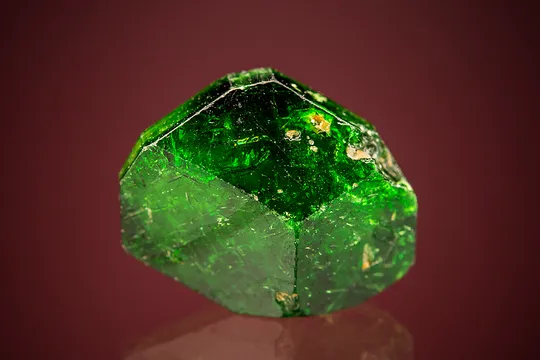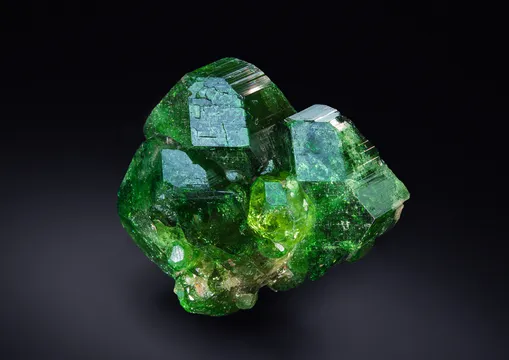
Dravite: sodium–magnesium tourmaline with sharp trigonal prisms and hues from honey-yellow to chrome-green; forms in metamorphic marbles and offers classic cry…
Key facts
Dravite is the sodium–magnesium member of the tourmaline group, typically forming sharp, striated trigonal prisms with flat pinacoidal or steep pyramidal terminations. Its classic colors range from warm honey-yellow and root-beer brown to deep forest green when chromium and/or vanadium are present (often termed chrome-dravite). In metamorphic marbles and calc-silicate rocks, dravite frequently grows with diopside, tremolite, calcite/dolomite, graphite, and tsavorite garnet, making for striking white–green or white–brown contrasts on matrix.
For collectors, dravite offers textbook tourmaline form and a spectrum of earthy to vivid hues at generally approachable prices compared to elite elbaite varieties. However, the best pieces—especially saturated chrome-green single crystals or pristine matrix specimens on bright marble—are scarce and command strong premiums. Well-formed crystals commonly show glossy luster, triangular cross sections, and beautiful internal “whiskey” glow in brown varieties or vivid bottle-green in Cr/V-rich pieces.
Dravite has long taken a back seat to the more gem-trade-driven elbaite, yet it remains a connoisseur’s favorite for classic crystallography and locality specificity. Its warm browns appeal to those who appreciate subtle, natural tones, while chrome-dravite from East Africa provides dramatic, saturated greens with world-class luster and form. Key discoveries—such as Landanai chrome-dravite in Tanzania and marble-hosted clusters from Namibia and Madagascar—have cemented dravite as a serious collector’s species. Today it occupies a sweet spot: abundant enough for newcomers to find handsome examples, but with a top tier (especially green Cr/V-rich crystals on matrix) that is decidedly rare and competitive.
Landanai, in Tanzania’s Longido area, is the reference source for world-class chrome-dravite. These crystals, colored by chromium and vanadium, range from hot bottle-green to deep forest green with glassy luster and razor-sharp terminations. Most occur as stout prismatic singles from 2–8 cm, with occasional matrix pieces on marble or magnesite. Associations can include tremolite, diopside, and calcite; when present, snowy white matrix makes the green crystals “pop.” Pockets have been sporadic, and many crystals were recovered as loose singles—true, undamaged, on-matrix specimens are therefore much rarer and more valuable. Classic Landanai pieces display bright, reflective prism faces, strong color even without backlighting, and crisp triangular cross sections that define tourmaline’s trigonal symmetry.
Better known for tanzanite and tsavorite, Merelani has also produced attractive dravites—typically honey-yellow to cognac-brown prisms in calcite/graphite-rich marbles. Crystals are often gemmy toward the tips, with bright luster and excellent form in the 1–5 cm range. Associations with diopside, tremolite, calcite, and graphite are common, and occasional greenish dravite occurs. Many pieces were recovered as singles during tanzanite mining, so fine matrix specimens are less frequent. Merelani dravite is prized for its “whiskey” glow and textbook form, offering an aesthetic contrast to the area’s blue-violet zoisites and green garnets.
Color:
Clarity and Luster:
Crystal Form:
Matrix and Associations:
Condition:
Size vs. Aesthetics:
Repairs:
Treatments:
Handling:
Cleaning:
Light and Temperature:
Storage:
With thoughtful selection and care—favoring luster, color, sharp terminations, and clean aesthetics—dravite can anchor a tourmaline suite, from subtle whiskey-browns to the electric greens of chrome-dravite masterpieces.