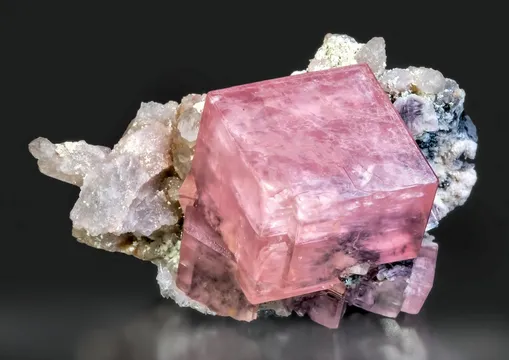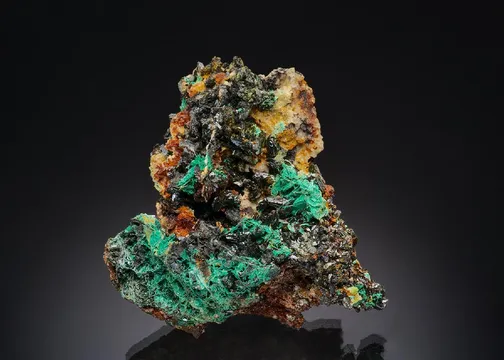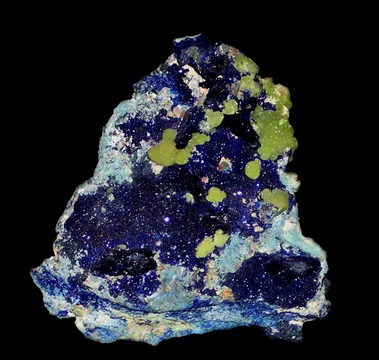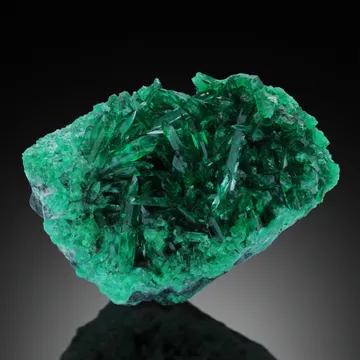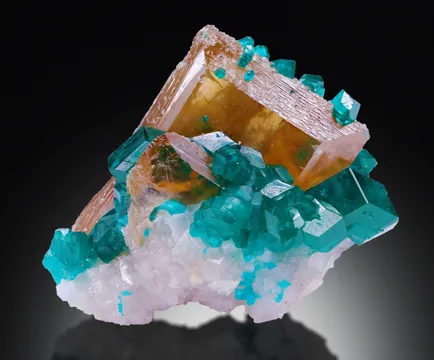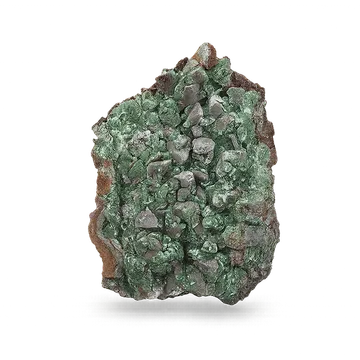
Olivenite from Tsumeb Mine, Namibia — connoisseur’s arsenate prized for olive- to forest-green crystals, dramatic habit, and valuable provenance.
Key facts
Olivenite from Tsumeb is a connoisseur’s arsenate: not usually the loudest mineral from this legendary mine, but one of the most revealing. In the best pieces it appears as lustrous olive- to forest-green crystals on strong matrix, often set against malachite, azurite, duftite, quartz, hematite, or sulfide ore. The species belongs to the adamite–zincolivenite–olivenite compositional story that has made Tsumeb such a testing ground for modern specimen mineralogy. A dark green crystal that once would have been sold as “zincian olivenite,” “cuprian adamite,” or “cuproadamite” may, under quantitative analysis, fall into a different species field altogether; for the serious collector, that ambiguity is part of the locality’s fascination.

Photo: Wikimedia Commons
Tsumeb’s olivenite formed in one of the most chemically fertile supergene environments known: a copper-lead-zinc-silver ore pipe hosted in Otavi Group dolomites, cut by a remarkably effective groundwater “plumbing system.” Oxidizing fluids interacted with primary sulfides rich not only in copper, lead, and zinc, but also arsenic, germanium, cadmium, gallium, silver, molybdenum, and other trace metals. The result was a mine in which ordinary secondary-mineral rules often fail. Tsumeb produced arsenates and arsenites in bewildering variety, and the adamite–olivenite series is among the most attractive and diagnostically important parts of that suite.

Photo: Wikimedia Commons
The finest Tsumeb olivenites appeal for more than color. Collectors prize the unusual habits: acicular sprays in malachite-lined cavities, glossy prismatic crystals rising from duftite, dense druses of 1–2 mm crystals under malachite after azurite, and complex vugs where several generations of olivenite, azurite, and malachite record a miniature paragenetic sequence. The great old specimens tend to have early-mine character—first oxidation zone, open pit, or upper levels—and good provenance is a major value factor. A label to Wilhelm Klein, Charles Palache, Bill Pinch, the Kegel Collection, or another documented Tsumeb collection can transform a pleasing green arsenate into a scientifically meaningful specimen.
Search for specimens: View all olivenite specimens from Tsumeb Mine, Namibia
Tsumeb Mine, also known as the Ongopolo Mine, lies at the town of Tsumeb in the Oshikoto Region of northern Namibia. In specimen-mineral terms it is one of the essential localities on Earth: a deposit of only modest physical size, yet astonishing chemical range, world-class aesthetics, and unusually well documented mining levels.
Geologically, Tsumeb is best understood as a polymetallic carbonate-hosted replacement deposit developed in the Otavi Dolomite. The orebody formed as a steep, irregular pipe-like structure, locally elliptical in plan, with massive peripheral ore, manto-style ore, disseminated ore, and stringer ore. Its mineralization was hosted in dolomite and dolomite breccia, with feldspathic sandstone and sandstone breccia in the pipe core. Arcuate fractures, brecciation, karst collapse, hydrothermal alteration, and later oxidizing groundwater all played roles in creating the structure that collectors know through its minerals.
The mine’s secondary minerals owe much to three vertical oxidation zones. The first oxidation zone extended from the surface to roughly 11 Level and included the open pit and early shallow workings. This is the classic environment for much of the early olivenite: malachite, azurite, quartz, and olive-green arsenates in near-surface cavities and vugs. Between about 24 and 35 Level, the second oxidation zone centered on the North Break Zone produced an even more complex supergene assemblage, especially rich in secondary arsenates and famous for dioptase, mimetite, smithsonite, and many rare species. A third oxidation zone was later recognized from around 42 Level downward, where partially oxidized arsenic species and unusual germanium-rich associations appeared in the final decades of mining.
Mining history gives Tsumeb specimens much of their collecting aura. Indigenous Africans worked the copper-rich outcrop before European mining; European explorers in the 1880s encountered copper ore and smelted metal being transported and traded. Commercial development began under the Otavi Minen und Eisenbahn Gesellschaft, with trial shafts in 1900 and full-scale production after completion of the railway in 1906. Early ore came from the open pit and shallow shafts, then mining moved underground as surface ore was exhausted. For almost a century, through interruptions caused by the two World Wars and the Great Depression, Tsumeb produced copper, lead, zinc, and byproduct metals including arsenic, cadmium, germanium, and silver.
Olivenite was recognized from the earliest years of mining. Wilhelm Maucher, studying ore sent to Germany for metallurgical testing, preserved and described secondary minerals from the deposit in the first decade of the twentieth century. Later, Wilhelm Klein recorded olivenite as common between the surface and about 100 m depth, especially with azurite and malachite, and his collection is unusually important because he recorded levels for many specimens. The Mineralogical & Geological Museum at Harvard preserves a major portion of the Klein Collection, including an outstanding open-pit olivenite with malachite.
Large-scale mining ceased in the mid-1990s. In mid-1996, during labor unrest, the pumps had to be switched off and the mine flooded rapidly. Small-scale work in the upper levels continued for a time, and a short-lived attempt at specimen mining followed from 1998 to 2002. For modern collectors this means Tsumeb olivenite is not a newly mined commodity; it is recycled classic material, old-collection material, and occasional pieces released from dealer stocks or estates. Casual collecting access to the mine is not a practical consideration.
The ideal formula of olivenite is Cu2(AsO4)(OH), but Tsumeb does not allow the collector to think of that formula in isolation. The mine is one of the benchmark localities for the adamite–zincolivenite–olivenite series. Adamite is the zinc end-member, olivenite the copper end-member, and zincolivenite the intermediate species. Many older labels using “cuproadamite,” “cuprian adamite,” “zincian olivenite,” or “zinc-rich olivenite” need modern scrutiny. Southwood, Števko, and Carr’s study of 43 Tsumeb specimens showed that visual habit and color are useful clues but not always enough; quantitative chemical analysis is the secure route when a specimen lies near a species boundary.
Strict olivenite from Tsumeb is typically olive-green to blackish green, but the color field is not simple. Higher zinc content tends to lighten the green and improve crystal development, a point already recognized by Maucher. In practice, dark olive, bottle-green, blackish green, and forest-green crystals are more likely to be copper-rich; spearmint to emerald-green material may drift into zincolivenite or mixed/zoned compositions. Some crystals show real zoning, so a specimen can carry olivenite and zincolivenite in the same visual field.
Habits are varied and locality-diagnostic. Early descriptions noted fine-grained aggregates and small columnar crystals to about 1 mm, as well as blackish-green crusts and crystals. Klein described radial masses, sometimes with drusy terminations, in the upper first oxidation zone. The great open-pit style—acicular translucent olive-green crystals in malachite-lined vugs—is especially prized because it is seldom seen in modern collections and appears to belong to the upper levels of the first oxidation zone. Harvard’s Klein specimen, MGMH 106045, is a 200 mm malachite-rich cabinet specimen with olivenite needles reported to 20–25 mm depending on the description, an exceptional size and habit for Tsumeb olivenite.
Other Tsumeb habits include equant blackish-green crystals to several millimeters, elongated blade-like radial aggregates, pale acicular crystals, elongated prismatic crystals, partly hollow prismatic forms, and later fibrous generations coating earlier crystals. A Palache-collected Harvard specimen from the first oxidation zone shows several of these habits together, with olivenite as massive matrix, free-standing crystals, and later fibrous encrustations, followed by azurite, malachite after azurite, and non-pseudomorphous malachite. Such pieces are especially instructive because they preserve a sequence, not merely a species.
Associations matter greatly. The most characteristic Tsumeb olivenite partners are malachite and azurite, especially in first oxidation zone material. Duftite adds superb contrast: glossy dark olivenite prisms on fine green duftite matrix are among the most elegant combinations for the species. Quartz is common in vuggy sulfide-ore pieces, and hematite/goethite can provide the rusty or dark background against which small green crystals stand out. Other documented associations include adamite or adamite-like material, zincolivenite, rosasite, tennantite-(Zn), cerussite, germanite-bearing matrix, and malachite pseudomorphs after azurite.
Size expectations should be realistic. Most Tsumeb olivenite crystals are millimetric: 1–2 mm druses, 3–5 mm equant or prismatic crystals, and sprays visible best under a lens. Good miniatures and small cabinets are more often valued for composition, luster, association, and provenance than for crystal size alone. Crystals around 1 cm are already notable. Prismatic crystals to about 1.4 cm on duftite, acicular crystals to about 2 cm in malachite, and open-pit needles reported to 25 mm are exceptional rather than routine.
The best quality factors are crisp terminations, strong vitreous luster, saturated but natural green color, intact sprays or vug linings, and contrast. The finest specimens do not look like anonymous green crusts; they show architecture. A radiating spray centered in a cavity, a row of glossy prisms on duftite, or olivenite carpeting beneath sharp malachite pseudomorphs after azurite all carry more Tsumeb character than a featureless coating. For scientifically minded collectors, analyzed material and labels that distinguish olivenite from zincolivenite are especially desirable.
The chief authenticity issue with Tsumeb olivenite is not widespread fakery but nomenclature. Older labels may be wrong, especially where the specimen sits in the adamite–zincolivenite–olivenite series. “Cuproadamite” is a discredited name, and many specimens once sold under that label are now properly considered zincolivenite. “Zincian olivenite” can be visually plausible yet analytically imprecise. If the piece is important, expensive, or compositionally borderline, ask whether it has EDS, WDS, electron-microprobe, or other analytical support. A dealer’s careful wording—“olivenite with zincolivenite,” “zinc-bearing olivenite,” “olivenite–zincolivenite series,” or “visually identified”—may be more honest than an overconfident species claim.
Condition is a serious matter. Tsumeb olivenite can occur as delicate acicular sprays, radial aggregates, or drusy linings in vugs; these are easily bruised. Look for crushed needles, flattened spray tips, missing patches in cavity floors, and areas where green crystals stop abruptly at a contact. On malachite-associated pieces, fibrous or chatoyant malachite pseudomorphs can distract the eye from olivenite damage underneath. On sulfide matrices, check for friability and old trimming scars. A hand lens and oblique light are essential.
Because many specimens are old, provenance and surface condition should be judged together. Old collection pieces may have minor peripheral wear, dust, or small contacts that are acceptable if the display face is intact and the history is strong. Conversely, a “clean” specimen with no old label and vague composition may need more caution than a slightly worn but well-documented example from a known Tsumeb collection.
Tsumeb olivenite remains available, but fine examples are not abundant. Ordinary small druses and mixed green arsenate specimens appear periodically, while highly aesthetic matrix pieces with robust crystals, malachite-after-azurite associations, duftite contrast, or old provenance are much scarcer. Recent market examples show the range: a 2025 EarthWonders listing for olivenite with zincolivenite from Tsumeb was priced at $1,250, while a February 2026 MineralAuctions small-cabinet specimen of olivenite with chatoyant malachite after azurite, ex Dr. Erika Pohl-Ströher, sold for $832 against a stated $2,500 valuation. Those figures should not be read as a fixed price guide; they simply show that serious Tsumeb olivenite lives in the same market as other classic, provenance-sensitive Tsumeb secondary minerals.
Handle olivenite sensibly. It is a copper arsenate, so avoid generating dust, do not lick or wet-test, wash hands after handling, and keep fragile pieces away from children and pets. Cleaning should be conservative: air bulb, soft brush, and minimal water only if the matrix tolerates it. Avoid acids, ultrasonic cleaners, steam, and prolonged soaking.
The earliest Tsumeb story begins not with a crystal pocket but with a hill. African miners had worked copper from the outcrop long before the formal mine existed, and European explorers in the 1880s saw copper ore and roughly smelted metal moving through trade routes. In January 1893, the British mining engineer Mathew Rogers reached the place then written as Soomep. His reaction has become part of Tsumeb lore: “I have never seen such a sight as was presented before my view at Soomep, and I very much doubt if I shall ever see such another in any other locality.” For collectors who know the later minerals, the quote feels prophetic. Rogers was looking at an orebody; the next century would reveal a mineralogical universe.
The first specimen-aware chapter came almost by accident. In 1900, a large sample of Tsumeb ore was shipped to Germany for metallurgical testing. Wilhelm Maucher, then at the Bergakademie in Freiberg, recognized that the test material was not merely ore. It carried well-crystallized secondary minerals worth preserving and describing. That metallurgical shipment became one of the first scientific windows into the mine’s supergene minerals, including olivenite. A specimen mineral was already escaping the smelter’s logic.
Wilhelm Klein later gave Tsumeb collecting something just as valuable as fine crystals: context. A senior manager at Tsumeb between 1916 and 1939, he recorded levels in a way many early collectors did not. His olivenite specimens, now at Harvard, anchor the species to the open pit and 4 Level rather than leaving them as romantic but vague “Tsumeb” greens. One of them, Klein specimen 1050, is the great open-pit olivenite with malachite: a 200 mm block of massive malachite containing vugs, dark green mammillary malachite, and translucent lighter green acicular olivenite. Its crystals are exceptional for the locality, and a very similar specimen survives in the Smithsonian’s Kegel Collection as NMNH R8600. The two specimens are like paired witnesses from the upper first oxidation zone, preserving a habit that later deeper mining apparently did not reproduce.
Charles Palache’s olivenite adds another human thread. During the Shaler Memorial Expedition to South Africa, Palache visited Tsumeb underground in early April 1922 and collected a 75 mm first-oxidation-zone specimen that is now in Harvard as MGMH 146260. It still carries Shaler Expedition field number 13934. The specimen is not a simple crystal group: much of its matrix is massive olivenite with minor goethite, while voids contain several different olivenite habits, azurite, and malachite after azurite. In a single hand specimen, Palache brought back both the mineral and the sequence of alteration—olivenite first, azurite later, malachite afterward.
Tsumeb’s adamite–olivenite story also produced one of the great collector-labeling puzzles. Before modern analytical work, specimens moved through collections as “cuproadamite,” “cuprian adamite,” “zincian olivenite,” or even the wrong species entirely. In the Klein Collection, three specimens later understood as cuprian adamite/zincolivenite had been misidentified as tsumebite. In the Karabacek Collection, a specimen believed by its owner to be a unique Tsumeb veszelyite was later shown by analysis at Harvard to be adamite-series material. The errors are not embarrassing footnotes; they show how far Tsumeb was ahead of the naming tools available to collectors. The mine made the specimens first, and mineral nomenclature had to catch up.
The modern turning point came with the approval of zincolivenite in 2006 and the discrediting of “cuproadamite.” Suddenly, countless old Tsumeb labels became historically interesting but scientifically suspect. Southwood, Števko, and Carr later took the issue directly to Tsumeb material, selecting 43 specimens across colors and habits for wavelength-dispersive analysis. Their results showed what many careful collectors had suspected: visual differences carry meaning, but not enough certainty at the boundaries. The familiar green “cuproadamite” of old Tsumeb labels was, in most cases, zincolivenite. For olivenite collectors, that result sharpened the value of true copper-rich olivenite and made analyzed transition specimens more desirable, not less.