






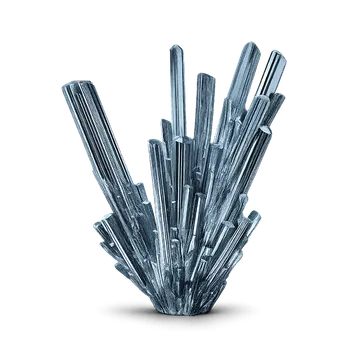
Stibnite from Xikuangshan Sb Deposit, China — world’s largest antimony ore field; lustrous blade-like crystals and dramatic sprays prized by collectors.
Key facts
Xikuangshan is one of the essential modern stibnite localities: an enormous antimony ore field in central Hunan that has supplied both industry and collectors for more than a century. For collectors, its appeal is immediately visual. The best specimens show steel-gray to silver-black, intensely metallic stibnite in bladed, prismatic, striated crystals, often in sprays, bent or gently arcing aggregates, isolated spears, and dramatic stibnite-calcite combinations. The locality is especially important because it is not merely a specimen occurrence attached to a minor mine; it is the world’s largest known antimony deposit, with stibnite as the principal ore mineral.
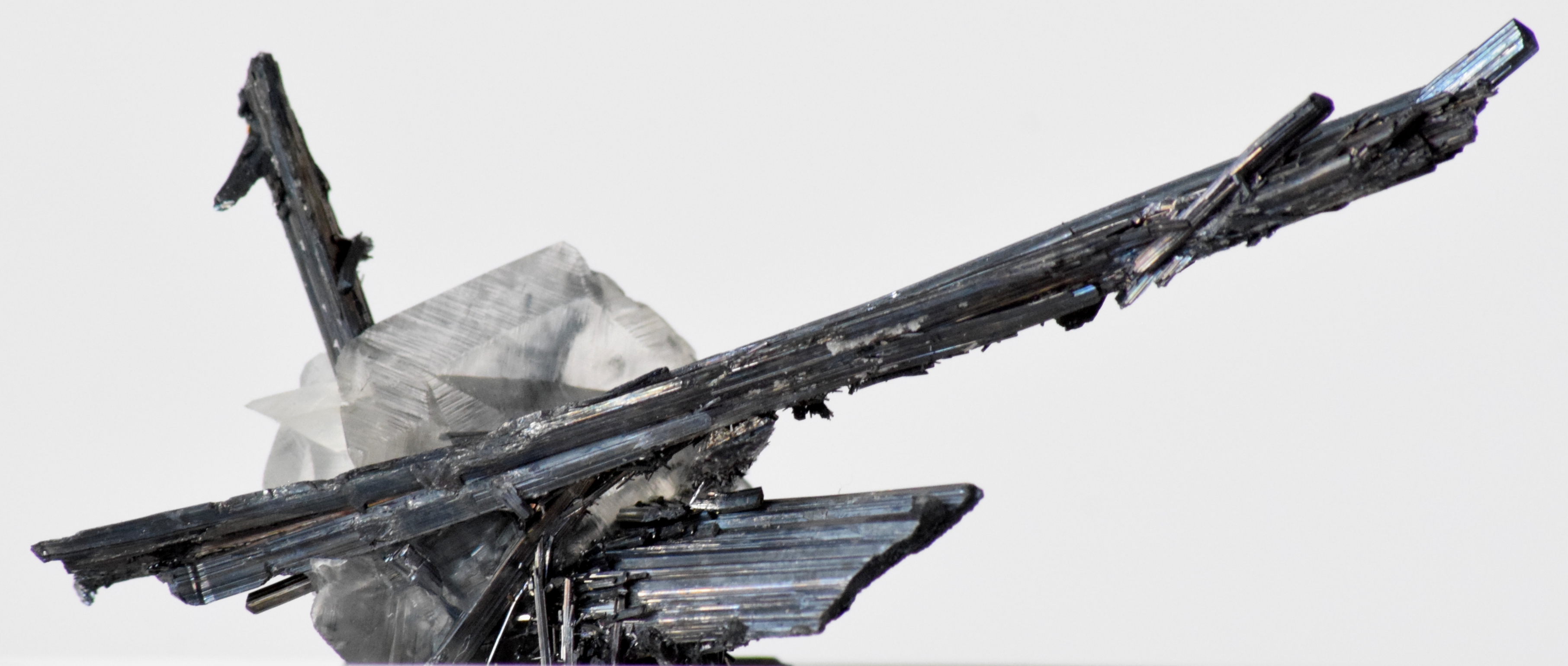
Photo: Wikimedia Commons / Klaproth
Geologically, the deposit sits in the Xiangzhong metallogenic province of central Hunan, within the broader South China antimony metallogenic belt. The ore field is controlled by folded and faulted sedimentary rocks, with antimony mineralization concentrated in silicified limestone and closely tied to the F75 fault system and the Xikuangshan complex anticline. The main ore is simple in composition: stibnite is the economic ore mineral, accompanied chiefly by quartz and calcite, with fluorite, barite, talc, and several supergene antimony minerals appearing in lesser amounts.
The collecting significance of Xikuangshan rests on the contrast between mass mining and delicate crystallization. Ore studies describe massive, network-like, brecciated, and disseminated stibnite ores, yet the collector market also sees lustrous, sculptural crystals and matrix pieces that could only have survived careful extraction. The most desirable pieces balance metallic luster, sharp striation, intact terminations, three-dimensional form, and convincing provenance. Stibnite on pale calcite is the signature combination, but pieces with quartz, barite, dolomite, native sulfur, valentinite, or partial alteration to stibiconite add special character.

Photo: Wikimedia Commons / James St. John
Historically, Xikuangshan is inseparable from China’s antimony industry. Antimony deposits in the area are reported as having been known since the Ming Dynasty, and China’s first antimony plant was established there in 1897. Over the past century the district became famous as the “World Antimony Capital,” with Xikuangshan material moving from ore bins and smelters into museum cases, private cabinets, and international mineral shows.
Search for specimens: View all stibnite specimens from Xikuangshan Sb Deposit, China
Xikuangshan Sb Deposit is in Lengshuijiang County, Loudi, Hunan Province, China, at about 27°47′N, 111°29′E. Mindat lists the locality as an active deposit, and modern geological work treats it as the largest known antimony deposit in the world. The ore field lies in central Hunan, near Lengshuijiang City, in the northern part of the Xiangzhong Basin.
The deposit is hosted mainly by Upper Devonian and Lower Carboniferous sedimentary strata. The key host sequence includes the Upper Devonian Shetianqiao Formation, dominated by limestone with local shale, and the overlying Xikuangshan Formation, an interbedded shale-carbonate unit with a hematite layer. The younger Lower Carboniferous Menggongao, Yanguan, and Datang formations include limestone and sandstone. The antimony mineralization is concentrated in silicified limestone, especially fossil-rich limestone of the Shetianqiao Formation, beneath organic-rich shale in the lowermost Xikuangshan Formation.
Structurally, Xikuangshan is a fault- and fold-controlled hydrothermal deposit. Mineralization is constrained by en echelon second-order anticlines within the Xikuangshan complex anticline and is strongly influenced by the NE-trending F75 fault, part of the Taojiang–Chengbu regional fault system. The main named ore blocks are Daocaowan, Laokuangshan, Tongjiayuan, Wuhua, and Feishuiyan. Most orebodies occur in the footwall of F75, and silicification strengthens toward that structure.
Orebody geometry is substantial. Published descriptions give individual antimony orebodies extending roughly 30–600 m along strike, dipping downward 1300–1800 m, and ranging from 1–5 m thick, locally reaching 20 m. Ore grades are reported generally around 3.5–5.7 wt% Sb, averaging about 4.0 wt% Sb. In specimen terms, those numbers matter because they explain the abundance of stibnite-rich material, but they do not mean fine crystals are common; attractive, undamaged crystal groups are a small survival fraction from a large industrial system.
The ore assemblages are commonly grouped into early and late stages. Early-stage mineralization includes quartz-stibnite, fluorite-quartz-stibnite, and barite-quartz-stibnite veins. Late-stage mineralization is represented by calcite-stibnite veins. Quartz-stibnite veins are the dominant ore type and account for more than 80% of the district’s Sb ore reserves in one modern study. Fluid-inclusion work has argued that Xikuangshan is better regarded as mesothermal rather than epithermal, with stibnite and its apparently intergrown gangue minerals precipitating from different hydrothermal solutions.
Dating of Xikuangshan mineralization has been an active research problem. Earlier Sm-Nd calcite dating gave Mesozoic ages, but newer in situ calcite U-Pb work on syn-stibnite calcite reported Paleocene and Eocene ages: calcite-stibnite veins from Daocaowan at 58.1 ± 0.9 Ma, and quartz-stibnite veins from Feishuiyan at about 50–52 Ma. The age question remains important because Xikuangshan is a reference deposit for interpreting the broader South China antimony belt.
Mining history is long and intensive. The region’s antimony deposits were known historically, and the industrial antimony enterprise at Xikuangshan began in 1897. Hsikwangshan Twinkling Star Co., Ltd., associated with China Minmetals, has described itself as a large non-ferrous enterprise engaged in antimony mining, separation, smelting, and research and development, with annual capacities reported in 2017 at 600,000 t of antimony ore, 20,000 t of antimony ingot, and 40,000 t of antimony trioxide. Local-authority data cited in 2025 reported nearly 2 million metric tons of antimony metal produced from Xikuangshan over the preceding century.
Collecting access should be understood realistically: Xikuangshan is an active, industrial antimony district, not a public collecting site. Specimens on the market have come through mine-related recovery, Chinese mineral dealers, older collections, and international specimen circulation. Serious collectors should value old labels, credible chain of ownership, and precise locality wording—Xikuangshan Sb deposit, Lengshuijiang County, Loudi, Hunan, China—because many Chinese stibnites enter the market under broad or abbreviated labels such as “Hunan, China.”
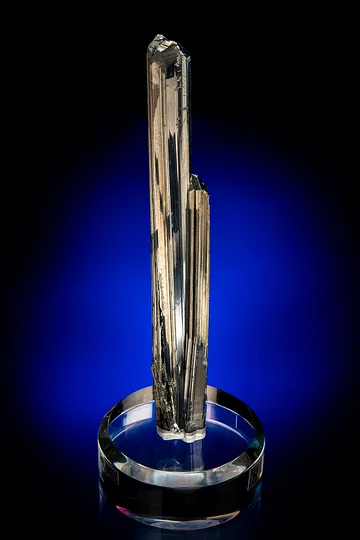
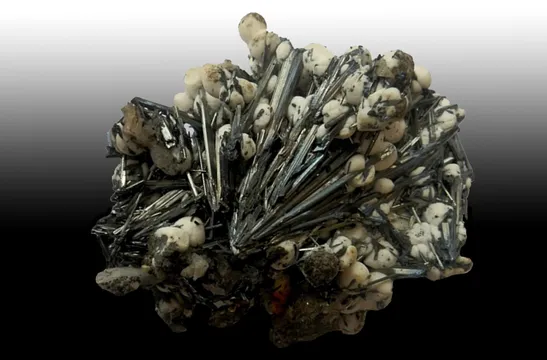
Xikuangshan stibnite is classically metallic, steel-gray to silvery gray, and strongly striated along the prism direction. The collector habit ranges from individual slender prisms to stout blades, sprays, divergent clusters, jackstraw aggregates, cruciform groups, and arcing or slightly bent crystals. Some specimens are almost architectural: a strong central blade crossing a spray, a spear piercing calcite, or a mass of parallel blades rising from pale carbonate.
The most familiar high-quality pieces are small-cabinet to cabinet specimens, commonly in the 5–15 cm range, though single crystals and groups can be smaller or larger. Dealer-documented examples include miniature isolated crystals around 3 cm, calcite-stibnite combinations around 4–5 cm, cabinet pieces around 10–15 cm, and larger display specimens exceeding 16 cm. One documented large-cabinet specimen from the market measured 16.7 × 5.6 × 3.7 cm and carried individual stibnite crystals to about 10.2 cm. Wikimedia’s Xikuangshan stibnite-calcite photograph records a longest stibnite crystal of 7 cm.
The signature association is calcite. Xikuangshan calcite may appear as pale, clear, whitish, amber, honey, or golden flattened rhombs or masses, with stibnite embedded in, piercing, resting on, or projecting through the carbonate. Quartz is another common companion, especially in quartz-stibnite ore; specimens with visibly aesthetic quartz are less routine in the collector market than simple stibnite or stibnite-calcite pieces. Barite, fluorite, dolomite, native sulfur, valentinite, stibiconite, cervantite, senarmontite, pyrite, sphalerite, pyrrhotite, and minor supergene antimony minerals are also recorded from the locality.

Quality is judged first by luster and integrity. Fine Xikuangshan crystals should show bright metallic reflectivity, strong longitudinal striation, and clean terminations. Because stibnite is soft and sectile, and because the crystals are often long and narrow, broken tips, contacted ends, bruised ribs, and cleavage damage are common. The best examples have minimal tip loss, strong three-dimensional composition, and enough openness between crystals for the form to read clearly.
Aesthetic Xikuangshan stibnite-calcite pieces are especially desirable when the calcite is not merely massive gangue but forms distinct rhombs or blades that contrast with the black-silver stibnite. A single stibnite crystal piercing a single calcite rhomb is a particularly satisfying and less common style. Stibnite with dolomite, barite, sulfur, valentinite, or partial stibiconite alteration can be attractive, but these should be evaluated carefully: some are mineralogically more interesting than classically beautiful.
The locality’s material differs from the classic Japanese Ichinokawa style by being generally less about giant, solitary, museum-scale blades and more about modern Chinese sprays, clusters, and combination pieces. Compared with Wuning and other Chinese stibnite localities, Xikuangshan has the added weight of being the great antimony ore field itself; for many collectors, that locality significance elevates even modest, well-labeled examples.
Xikuangshan stibnite is available on the collector market, but truly top-condition examples are much less common than the name recognition suggests. The deposit produced abundant ore and many specimens over time, including important waves of Chinese stibnite that appeared internationally in the late 20th and early 21st centuries. Today, market offerings include fresh-looking dealer stock, older 1980s–1990s material, ex-collection pieces, and occasional stibnite-calcite combinations from recognized collections.
Condition is the central issue. Stibnite has Mohs hardness around 2 and is easily scratched, bent, bruised, or broken. Xikuangshan sprays often have peripheral tip damage, contacted side crystals, broken back-side blades, or trimmed bases. None of these automatically disqualify a specimen, but the price should reflect them. A cabinet spray with several obvious broken terminations is a different object from a sharp, balanced cluster with only hidden peripheral contact.
Repairs and stabilization are always worth checking on fine stibnite, especially where long crystals meet matrix or where a dramatic spear would be especially vulnerable. Use magnification and a long-wave/short-wave UV light to look for glue lines, unnatural junctions, or fluorescence at contacts. Because Xikuangshan stibnite commonly forms sprays and intergrowths, natural contacts can look complicated; the goal is not to distrust every complex specimen, but to confirm that the composition is geological rather than assembled.
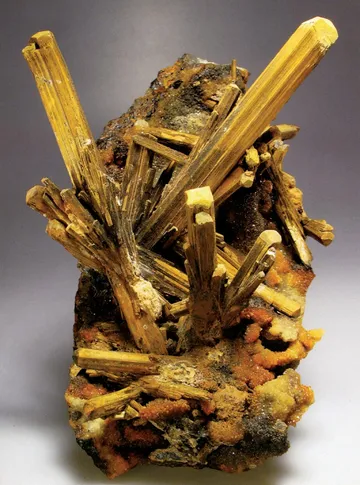
No single famous, locality-specific fake type dominates Xikuangshan stibnite in the way some other minerals have well-known fraudulent forms. The more realistic concerns are repaired crystals, glued reattachments, reconstructed sprays, incorrect or vague locality labels, and altered material described imprecisely. Specimens partly converted to stibiconite should be described as “stibnite altering to stibiconite” when metallic stibnite remains, or “stibiconite after stibnite” when the original stibnite habit is preserved but the sulfide is largely replaced. That distinction matters to mineralogical accuracy and market value.
Mislabeling is a practical concern. At least one auctioned Xikuangshan stibnite-calcite specimen was noted by the seller as having been erroneously labeled “Henan” rather than Hunan. Older labels may use spelling variants such as Hsikwangshan or simplified locality wording. Strong provenance should include Xikuangshan, Lengshuijiang, Loudi, Hunan; “China stibnite” alone is insufficient for serious locality collecting.
Prices vary widely. Small, clean thumbnails and miniatures may be relatively accessible, while large, lustrous, undamaged sprays or fine stibnite-calcite combinations can command substantial prices. Recent documented auction examples ranged from modest sums for altered or damaged pieces to hundreds of dollars for attractive cabinet groups, and over $1,000 for large, showy, relatively undamaged specimens. A specimen’s premium comes from the convergence of locality, luster, form, condition, and provenance—not simply from being stibnite from China.
Handle Xikuangshan stibnite gently and store it away from abrasion. Keep it out of crowded drawers where harder minerals can scratch the metallic surfaces. Avoid ultrasonic cleaning and aggressive washing; dust should be removed with a soft brush or air bulb. Stibnite contains antimony sulfide, so do not grind, lick, or expose it to children or pets; normal display handling is straightforward if one washes hands afterward and avoids creating dust.
Xikuangshan’s name carries an irony: it means “tin mine mountain,” yet its fame rests on antimony. Local accounts trace the discovery of antimony deposits in the area back to the Ming Dynasty, but the modern industrial story begins in 1897, when China’s first antimony plant was established there. Over the following century the mountain became an industrial landmark, producing nearly 2 million metric tons of antimony metal according to local-authority figures cited in 2025. That output was described as about one-third of China’s total and one-quarter of world production, enough to give Lengshuijiang the title “World Antimony Capital.”
The human memory of the mine is not only metallic luster and cabinet specimens. China Daily profiled Xie Guoxiu, 83, whose family had lived for generations in the Xikuangshan area. She remembered the core mining district roughly two decades earlier, when hills around her home were stripped bare and covered with toxic slag. Xie had worked as an ore-washing worker in the old days, and she recalled “hundreds of small, private mining workshops” in the region. Her memory of pollution was domestic and exact: “We couldn't grow vegetables in the yard and had to buy vegetables from an urban area far away.” The air was bad enough, she said, that many neighbors moved away.
That same landscape has been recast in recent years. Xikuangshan’s ecological restoration campaign began in 2006 under the Lengshuijiang city government. Early work included moving residents from subsidence-affected zones, dredging polluted rivers, and building alternative water-supply systems. In 2013, Hunan’s “No. 1 Project” for comprehensive pollution treatment along the Xiangjiang River included Xikuangshan among eight key mining areas. From 2018 to 2021, more than 300 million yuan—reported as $42.6 million—was invested in restoration, reviving 187 hectares of forest and 160 hectares of farmland.
The contrast is startling: abandoned mining sites replaced by photovoltaic stations and wind farms; denuded slopes turned into forest, grass, farmland, and scenic destinations. Xie Guoxiu’s family now runs a rural restaurant and guesthouse. During the May Day and National Day holidays in 2025, she said the establishment was fully booked, and during that year’s May Day holiday the Xikuangshan scenic area welcomed more than 20,000 tourists. Xikuangshan was showcased in 2021 at COP15 in Kunming as one of China’s ecological restoration cases, and in 2025 it was selected as one of 20 exemplary cases under the UN Decade on Ecosystem Restoration.
For a collector holding a bright stibnite spray from Xikuangshan, those stories sharpen the specimen. It is not an anonymous Chinese sulfide. It is a survivor from a giant ore system, a century-old industrial mountain, and a locality whose name now carries mineralogical, economic, environmental, and cultural weight.

_2.jpg)
