Orange River quartz - hematite-bearing quartz with red phantoms, brick-red cores, and clear overgrowths; a district-wide classic with amethyst variants.
Key facts
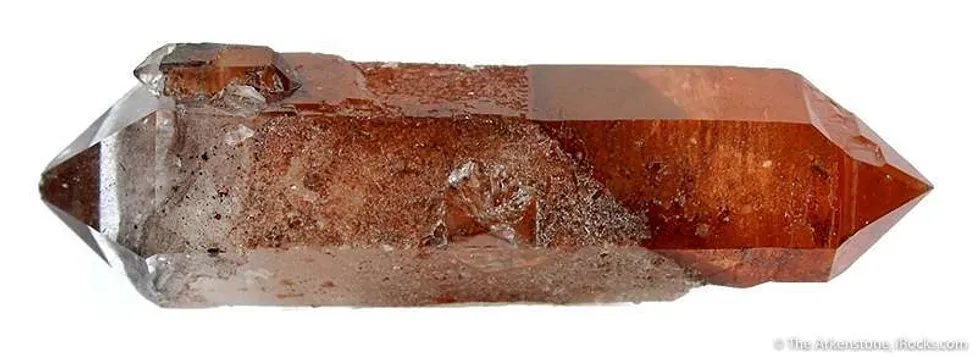
Orange River quartz is a collector’s name for a distinctive family of hematite-bearing quartz from the arid border country of Namibia and South Africa. The best specimens are not merely “orange” quartz: they are growth histories frozen in silica. Clear to smoky or amethystine crystals carry brick-red hematite phantoms, internal speckling, iron-rich caps, and late clear quartz overgrowths that can give the crystals the look of embers under glass.

Photo: Géry Parent, Wikimedia Commons
The locality is best understood as a broad collecting and mining district rather than a single pit. Mindat treats “Orange River, Southern Africa” as a mining area extending roughly 200 km, with material coming from both sides of the river. That ambiguity matters: the same visual style occurs on the Namibian and South African sides, and experienced workers have noted that there are no reliable specimen features that separate the two. Labels reading “Orange River, Namibia,” “Orange River, South Africa,” “Warmbad,” “Karas Region,” “Northern Cape,” “Namaqualand,” “Goodhouse-Vioolsdrift,” or simply “Orange River” may therefore describe the same specimen tradition at different levels of precision.
Mineralogically, the classic look is produced by hematite in and on quartz. Fine red to black hematite may mark former crystal faces as phantoms, collect in granular clouds, or coat an earlier quartz generation before a later clear generation sealed it inside. This is why fine Orange River pieces often show a red core, a clear skin, and a sharp termination at the same time. Amethyst is also part of the district’s identity, commonly appearing as violet caps, windows, smoky-amethyst zones, or scepter-like later growths.
Geologically, the area lies within the broader Orange River Pegmatite Belt and adjacent hydrothermal systems of the Namaqua-Natal metamorphic province. The great pegmatite belt is Mesoproterozoic in age and is famous for quartz-feldspar-muscovite bodies, rare-metal pegmatites, albitization, greisenization, and later hydrothermal alteration. The collectible hematite-phantom quartz is specifically associated with vuggy hydrothermal quartz-carbonate veins that have experienced strong epithermal and supergene overprint. In collector language, that means open spaces, repeated fluid pulses, iron mobility, and enough later silica to preserve earlier red growth surfaces as phantoms.

Collectors look first for contrast: glassy transparent quartz over sharp red hematite phantoms, fiery orange-red color visible by transmitted light, violet amethyst accents, and undamaged terminations. The strongest pieces have depth rather than surface color alone. A specimen with multiple growth generations, suspended red phantoms, and clean terminal windows has far more mineralogical interest than a uniformly rusty cluster. Scepters, floaters, doubly terminated crystals, and clusters with undisturbed clear overgrowth are especially desirable.
Search for specimens: View all quartz specimens from Orange River, Southern Africa
Orange River quartz comes from a wide, dry mineral belt along the lower Orange River, the river that forms much of the boundary between southern Namibia and South Africa’s Northern Cape. The collecting locality is not a single mine name but a regional label used for quartz finds from scattered pockets, farms, veins, and pegmatite-related workings near the river.
The broader Orange River Pegmatite Belt is a major pegmatite field, approximately hundreds of kilometers long, developed within the Namaqua-Natal Province. Modern geological work describes the belt as a Mesoproterozoic system, emplaced around one billion years ago, with both LCT and NYF pegmatite associations in different sectors. In the South African part of the belt, mineralized pegmatites commonly show quartz-feldspar-muscovite-garnet-beryl border and wall zones, spodumene-lepidolite-bearing intermediate zones, and quartz-K-feldspar cores. The pegmatites and their country rocks may be albitized, greisenized, silicified, kaolinized, or otherwise hydrothermally altered.
The collectible hematite-phantom quartz, however, is not simply “pegmatite quartz” in the sense of massive core quartz. The best pieces occur in vuggy hydrothermal quartz-carbonate veins and related open-space pockets. These veins were repeatedly mineralized, coated, and overgrown. Hematite precipitated during interruptions in quartz growth; later quartz sealed those iron-rich surfaces inside the crystal, preserving internal red phantoms. Supergene processes added additional iron mobility and staining, while late silica growth gave many specimens their glassy outer skin.
Mining and collecting history is uneven. The lower Orange River pegmatites have seen sporadic mining and mineral interest since the 1900s, especially for industrial feldspar, beryl, rare-element minerals, and specimen pockets. The quartz now recognized by collectors as “Orange River quartz” was only sporadically known before the late 1990s. Major late-1990s finds brought the hematite-included and amethystine material into the international collector market, and by 2000 the finds were sufficiently important to be treated in European mineral magazines.
The most often cited named pocket is the Kalkgat pocket on Girtis Farm 109 in Namibia’s ǁKaras Region. Girtis had produced pale to dark amethyst quartz sporadically before the major late-1990s discoveries. The Kalkgat pocket produced large, intense reddish-brown crystals, many occurring on pink albite or as floater groups. Girtis-style labels are highly desirable when supported by old collection records, but many Orange River specimens were traded with broader locality data.
Between 2003 and 2005, much of the material sold under the Orange River label is reported to have come from the South African side of the river. This is important for label interpretation: “Namibia” should not be assumed unless there is a reliable old label or field documentation, and “South Africa” should not be dismissed merely because a specimen resembles Namibian examples. The river-border district produced visually overlapping material.
Collectors should not treat the area as open public collecting ground. Much of the land is private, under mining claim, conservation jurisdiction, or otherwise controlled. The lower Orange River also intersects major diamond-mining history. Namdeb’s land-based diamond operations include Oranjemund and satellite mines along the Orange River, and alluvial diamond mining has long shaped access and security on the Namibian side. Independent field collecting requires explicit permission from landowners, mineral-rights holders, and relevant authorities.
The signature Orange River specimen is prismatic quartz with hematite. Crystals may be stout or slender, singly terminated or doubly terminated, clustered or isolated on matrix. The most collectible pieces show successive growth generations: an earlier quartz crystal coated by hematite, followed by later transparent quartz. In the best examples, the red phantom sits crisp and three-dimensional beneath colorless, smoky, or amethystine outer quartz.
Color ranges from water-clear to milky white, smoky gray, pale violet, deep amethyst, yellowish, orange, brick red, brown-red, and nearly blood red. The red and orange tones are not a separate quartz species; they are caused by hematite as inclusions, coatings, or phantom-forming layers. German literature often uses the term Eisenkiesel for strongly ferruginous quartz of this kind. Many specimens show black hematite specks as well as red granular clouds, giving the crystals a peppered appearance under magnification.
Amethyst is a recurring and important variety. It may appear as a violet terminal cap, a purple zone near the tip, a smoky-amethyst body, or a later scepter-like growth on a hematite-rich stalk. Some specimens show pale smoky bases, red hematite phantoms, and purple windows in the same crystal. These multicolor pieces are among the most diagnostic and attractive Orange River examples.
Typical specimen sizes range from thumbnail and miniature crystals to small-cabinet clusters. Many traded crystals are only a few centimeters across, but fine cabinet pieces occur, and some documented examples have individual crystals around 7–8 cm. Clusters may reach cabinet size or larger, though damage-free, well-composed cabinet specimens are much scarcer than loose points and small clusters.
Common habits include:
Associated minerals documented from the Orange River quartz occurrence include hematite, fluorite, amethyst, opal-AN or hyalite-like opal, calcite, albite, muscovite including fuchsite-bearing material, and goethite. Fluorite may occur in colorless to purple rounded crystals or crusts in the broader district. Albite is particularly important for some Girtis/Kalkgat material, where red-brown crystals occur on pink albite. Calcite and hyalite-like opal can add fluorescence interest in some specimens.
Quality is judged by depth, luster, and preservation. A fine specimen should have glassy, unworn faces; sharp terminations; internal hematite phantoms that are visible without backlighting; and attractive color contrast. The most desirable pieces are those where the red hematite is inside the quartz rather than merely dirtying the surface. Strong backlit red color, violet amethyst accents, and clean transparent “windows” dramatically raise appeal. For matrix clusters, composition matters: good three-dimensional architecture is far scarcer than flat plates of small points.
Orange River quartz is widely available in small sizes but genuinely fine pieces are not common. Loose points, small clusters, and modest hematite-included groups appear regularly from dealers, online shops, and older collections. Sharp cabinet specimens with saturated red phantoms, amethyst accents, and excellent condition are much harder to replace. Older labels from well-known southern African collections, especially Heini Soltau material or specimens documented before the recent crystal-shop trade boom, carry added confidence and collector value.
The first authenticity issue is locality precision. The broad Orange River label is often honest, but a more specific country or farm attribution should be treated cautiously unless backed by reliable provenance. The visual features alone do not reliably distinguish Namibian from South African Orange River quartz. Labels that assert a precise farm, pocket, or side of the river without an old label, collector history, field source, or dealer documentation should be considered possible but not proven.
The second issue is treatment confusion. Natural Orange River quartz can look suspiciously vivid because hematite gives real crystals a strong orange-red glow, particularly when backlit. This leads beginners to mistake good natural pieces for “aura” quartz, dyed quartz, or heat-treated amethyst. Conversely, ordinary iron-stained quartz from elsewhere can be marketed as Orange River material. The safest tests are visual and contextual: natural Orange River specimens typically show hematite as internal phantoms, granular inclusions, red caps, or coatings trapped beneath later quartz, not as a uniform metallic rainbow film or an artificial surface sheen.
No well-documented, locality-specific treatment scandal is established in the mineralogical literature for Orange River quartz, but collectors should still be alert to general quartz enhancements. Avoid pieces with unnatural iridescent vapor-deposition colors, waxy orange dye concentrated in cracks, or uniform burnt-orange color that resembles heat-treated amethyst rather than hematite inclusion. A hand lens should reveal internal particulate hematite, phantom planes, or natural iron-rich growth zones on better examples.
Condition issues are common. Quartz is hard, but Orange River clusters often have exposed terminations, delicate scepter heads, and contact points from pocket growth. Minor chips to tips and edges are frequent. Iron-rich coatings can also conceal bruises, repairs, or contacts. Examine terminations under magnification, especially on red tips where small chips can be visually masked. On clusters, check the rear and underside for sawn bases, missing crystals, repaired points, and areas where the hematite layer is exposed because the later clear quartz skin has broken away.
Cleaning should be conservative. Removing loose dirt is fine, but aggressive acid cleaning can destroy useful iron-rich context and may strip the very hematite coatings that define the specimen. The broader lower Orange River mineral trade has included acid-cleaned fluorite and quartz-associated material, and collectors should be aware that brilliant “clean” surfaces may not always reflect the pocket as found. For Orange River quartz, internal hematite phantoms are safe from cleaning, but surface hematite, goethite, and iron-rich matrix can be altered or removed.
Market value follows a steep quality curve. Small orange points are accessible. Miniatures with clear red phantoms, doubly terminated crystals, or amethyst caps are more desirable. Cabinet clusters with strong color, depth, luster, and minimal damage command a premium, especially when they show both hematite and amethyst. The rarest collector-grade forms are pristine scepters, floaters, and large three-dimensional clusters with intense internal red color and a transparent late quartz generation.
The best Orange River quartz stories are not of a single famous mine opening like Sweet Home rhodochrosite or Tsumeb dioptase, but of a desert district slowly revealing that its “ordinary” quartz was anything but ordinary. For years, collectors knew the lower Orange River pegmatites mostly as remote, hard country: quartz and feldspar bodies in the bush, scattered industrial workings, long drives, and pockets that might reward a day’s work with little more than broken milky quartz. The landscape itself became part of the mineral’s identity — wide vistas, river sunsets, quiet nights around a fire, and the smell of dry vegetation after a day of searching.
Then the late 1990s changed the reputation of the district. Specimens that had once been sporadic began arriving with an unmistakable style: prismatic quartz lit from within by hematite, red-brown crystals on pink albite, amethyst windows in iron-rich bodies, and clusters that looked as if one crystal generation had been painted red and then sealed under ice. The finds were strong enough that by 2000 they were being described in German-language mineral magazines as spectacular Orange River quartz.
The Kalkgat pocket on Girtis Farm became one of the names collectors remembered. Before the late-1990s finds, Girtis had only sporadically produced pale to dark amethyst quartz. Kalkgat was different: it yielded superb large crystals of intense reddish-brown color, with some pieces perched on pink albite and others recovered as floater groups. That combination — red-brown quartz, albite, and floater aesthetics — gave the pocket a character distinct enough to survive in specimen labels and collector memory.
Another small story is preserved in a single cabinet specimen photographed by Robert M. Lavinsky. The specimen, 13 x 9 x 6 cm, was described as part of an Oranje River quartz suite that had been built over 20 years and was “one of Charlie’s prides.” The largest crystal measured 8 cm, and the piece was singled out as among the most dramatic, with intense red hematite color and a custom Lucite display base. It is a quiet but telling detail: Orange River quartz was not merely a recent bulk commodity; serious collectors were building suites, saving the best pieces, and treating them as a long-term specialty.
Dealers’ and collectors’ descriptions from the 2000s and 2010s repeatedly return to the same visual surprise. One 5 cm doubly terminated miniature from the Heini Soltau Collection was described as an earlier quartz crystal coated with hematite and then overgrown by a second glassy quartz layer. Another documented 6.7 cm crystal was noted for an etched base that revealed the interior, with rich orange-red color when backlit. These are not just sales flourishes; they describe the reason the locality matters. The beauty is structural. The red is a record of interrupted growth, not a surface paint.