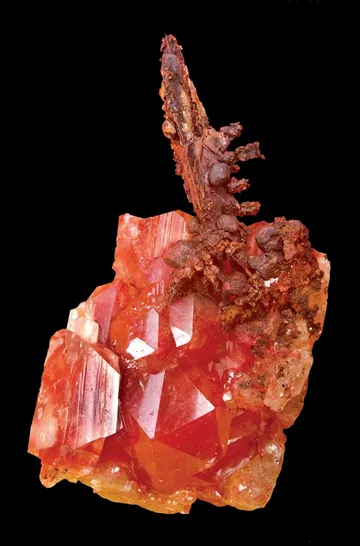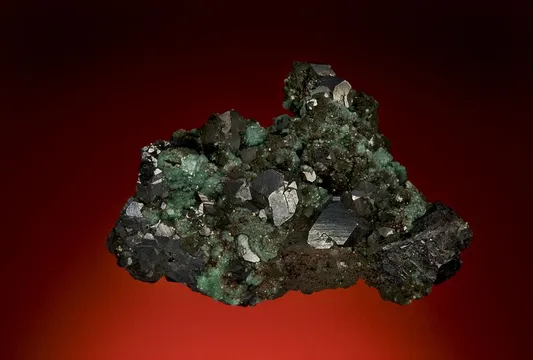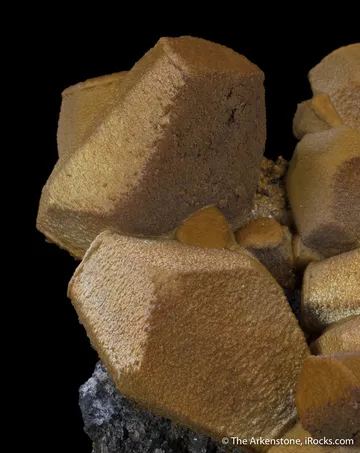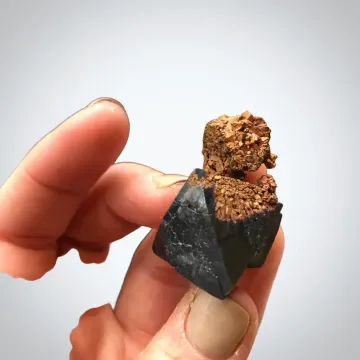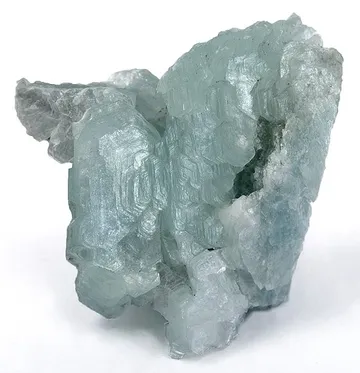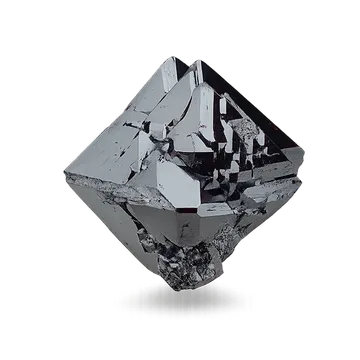
Cuprite from Onganja Mine, Namibia — large, sharp crystals with malachite skins and deep red interiors; a historic locality prized by collectors.
Key facts
Onganja cuprite occupies a singular place among copper-oxide classics: it is the locality where cuprite crossed from “beautiful mineral” into the realm of legendary gem crystal. The best specimens are large, sharp, equant crystals of Cu2O, commonly modified octahedra and cuboctahedra, their surfaces often cloaked in a thin mossy to velvety green skin of malachite. Under that skin, breaks and small natural windows can reveal the famous internal color: deep cherry red, wine red, or blood red, sometimes gemmy enough to have yielded faceted stones of extraordinary size for a species that is normally too dark, soft, and brittle for practical jewelry use.

Photo: Wikimedia Commons
The mine lies in the Onganja mining district near Seeis, northeast of Windhoek, in Namibia’s Khomas Region. The specimen locality is also encountered on old labels as Emke Mine, Emka Mine, Otjisongati Mine, or Ogonja Mine, and those names should be read as part of the locality’s history rather than as automatic warning signs. The cuprite and native copper specimens are tied especially to the Voitskopf-Maygift vein system, a copper-bearing vein complex developed in metamorphosed rocks of the Southern Zone of the Damara Orogen.
The collector’s image of Onganja is inseparable from the early-1970s finds. The classic material includes heavy, malachite-coated cuprite crystals, complete thumbnails and miniatures, crystals on calcite, chalcotrichite in or on calcite, and rare matrix pieces with native copper. Mineralogical literature repeatedly singles out the 1973 cuprite find and the 1974 non-pseudomorphous malachite finds as the events that made Onganja a famous locality. Today, with the mine described in the classic literature as closed and flooded, good cuprite is essentially an old-collection mineral: a specimen whose label, provenance, surface history, and condition matter nearly as much as its color.

Photo: Wikimedia Commons
Search for specimens: View all cuprite specimens from Onganja Mine, Namibia
Onganja Mine is on Helen Farm 235 near Seeis in the Windhoek Rural constituency of Khomas Region, Namibia. Mindat places the locality at 22° 5' 58" S, 17° 27' 41" E, and records the historical names Emke Mine, Emka Mine, Otjisongati Mine, and Ogonja Mine. In the specimen trade, “Emke Mine” and “Onganja Mine” are often used interchangeably for the classic cuprite material.
Geologically, Onganja is not a simple oxidized cap on a random copper showing; it is part of a structurally controlled copper district in the Southern Zone of the Damara Orogen. The country rocks include amphibolites, biotite-plagioclase schists, pelitic schists, and related metamorphic lithologies. Modern work describes a history of polyphase deformation, shearing, albitization, calcite and quartz-albite veining, and copper mineralization associated with chalcopyrite, chalcocite, pyrite, magnetite, hematite, molybdenite, and locally native gold. Moore’s 2010 study classified the system as Neoproterozoic mesothermal Cu(-Au) mineralization, while Hales’ 2024 dissertation argued that the mineralization is best regarded as late-orogenic, shear-related copper mineralization rather than a true IOCG system, despite some IOCG-like features such as Cu-Au-Mo-U-REE association, magnetite/hematite, and albitization.
At the scale most relevant to collectors, the key structure is the Voitskopf-Maygift vein system. The Onganja mine exploited the Voitskopf vein, continuous with the Maygift vein across the Helen 235 and Klein Onganja 148 farm boundary, and the majority of cuprite and native copper specimens are attributed to this vein system. The broader Onganja mining area also includes named veins such as Omahanga, Kronriff, Feldspatriff, Stanley, Kriegsfeldgang, and several lettered veins.
Mining and collecting history are unusually intertwined here. The district has older copper-working history, with published secondary summaries noting copper mining from at least early historic times and more formal company work beginning in the late nineteenth century. The mine was worked intermittently by various operators, and later dump treatment by heap leaching continued into the 1990s. The great specimen era, however, is the early 1970s: large, well-formed cuprite crystals in 1973, and fine primary malachite in 1974. The most famous specimens passed quickly into major private and museum collections, which is why old labels from the mid-1970s carry special weight.
For field collecting, Onganja should be treated as closed/private rather than as an accessible collecting locality. The classic Mineralogical Record account describes the mine as closed and flooded, making future specimen recovery unlikely. In practice, serious collectors acquire Onganja cuprite through old collections, dealer inventories, and auctions, not by visiting the workings.
Onganja cuprite is prized first for scale. Whereas many cuprite localities are known for millimetric or small thumbnail crystals, Onganja produced crystals large enough to be major hand specimens and, in rare cases, gem rough. Published gemological notes from the 1970s describe crystals up to 5 cm composed of octahedron, dodecahedron, and cube forms. Namibian mineral summaries have reported still larger crystals, with record claims up to 14 cm and 2.1 kg. Museum examples document the scale vividly: the Australian Museum’s Albert Chapman Collection includes an 8.5 x 4.5 x 4 cm cuprite-on-calcite specimen with a single cuprite crystal reported at 5 x 2.4 cm, collected about 1973.
The classic habit is equant and sharply geometric: octahedral to cuboctahedral crystals, commonly modified by cube and dodecahedral faces. Some specimens show the cube-octahedron relationship so clearly that they are textbook teaching pieces. Surfaces may be lustrous, pitted, frosted, granular, or coated, depending on how much malachite remains and whether the specimen was cleaned. The familiar Onganja look is a dark, almost blackish or greenish exterior with a thin malachite coating, not a bright red surface. The red appears most strongly at broken corners, attachment points, natural windows, or in backlighting.
Color is one of the locality’s central pleasures. In hand, many crystals look dark brown-black, green-coated, or subdued. Under strong light, along a thin edge, or where the coating is absent, the interior can flash deep garnet red to cherry red. The best material has enough transparency or translucency to glow, while maintaining the adamantine to submetallic brilliance characteristic of cuprite’s very high refractive index.
Malachite is not merely an associated mineral at Onganja; it is part of the identity of the cuprite. Much of the classic material is malachite-coated cuprite, and some specimens are malachite after cuprite or malachite pseudomorphs preserving the sharp cuboctahedral shape of the original cuprite. Collectors should distinguish between a cuprite crystal thinly coated with malachite, a cuprite crystal partly cleaned of malachite, and a true malachite pseudomorph after cuprite in which little or no cuprite remains visible.
Calcite is the most important matrix and display associate. The celebrated Australian Museum specimen is cuprite on calcite, and published figures record acicular cuprite enclosed in calcite on limonitic matrix. Native copper is another important Onganja associate, sometimes occurring with chalcotrichite, the hair-like variety of cuprite. Other recorded minerals from the locality include quartz, chalcocite, chalcopyrite, brochantite, chrysocolla, goethite, hematite, magnetite, molybdenite, pyrite, rutile, tenorite, azurite, and albite, though most collector-grade cuprite specimens are evaluated by the cuprite-malachite-calcite-native copper relationship rather than by a long species list.
Quality in Onganja cuprite is judged by a tight set of locality-specific factors. A top specimen should show sharp, complete geometry; strong form rather than merely massive red oxide; visible evidence of the red cuprite beneath the coating; attractive malachite texture; and minimal broken or contacted faces. Matrix examples with calcite are especially desirable when the cuprite is prominent and not visually swallowed by the matrix. Fine thumbnails can be more valuable than larger but battered pieces, because complete crystals with balanced form are scarce. A credible old provenance — especially from known 1970s collections or major dealers — adds confidence and desirability.
Authentic Onganja cuprite often looks less “red” than newcomers expect. The classic specimens are commonly coated by malachite, giving green, black-green, or dark velvety surfaces; the red may only appear at a chip, corner, base, or backlit edge. A specimen that is uniformly bright red may still be genuine if cleaned, but its surface history should be understood. Some Onganja cuprites have had malachite mechanically removed, and some examples are described as etched out from beneath a malachite coating. Such cleaning can reveal the coveted wine-red interior but may leave pitted faces or a surface that differs from untouched old material.
The most common condition issues are broken corners, contacted growth areas, bruised high points, and pitted surfaces. Large Onganja crystals were heavy and often coated, so not every chip is visually obvious until the piece is examined under light and magnification. Complete-all-around floaters and undamaged modified octahedra are much scarcer than partial crystals or contacted pieces. For malachite-coated examples, inspect whether the green coating is natural microcrystalline malachite rather than paint, waxy enhancement, or a glued-on repair. I am not aware of a classic, widely documented fake scandal specific to Onganja cuprite, but the value of the material makes ordinary high-end mineral due diligence essential.
Locality confusion is a more realistic concern than outright fakery. Onganja cuprite may appear under Emke, Emka, Ogonja, Otjisongati, Seeis, Windhoek District, or Khomas Region labels. Those names can be legitimate, but vague “Namibia” labels deserve closer scrutiny, especially because Tsumeb and other Namibian copper localities also produced cuprite. Conversely, the green malachite-coated Onganja habit is distinctive enough that experienced dealers often recognize it quickly, particularly when the crystal form is sharp and equant.
Rarity is strongest at the high end. Small or damaged examples appear occasionally, but sharp, complete, gemmy, well-proportioned crystals are old-collection pieces and do not circulate in quantity. The mine’s closure and flooding, plus the finite nature of the early-1970s material, mean that availability depends on collection turnover. Faceted Onganja cuprite is rarer still. Even large gems are known, but they are collector stones rather than wearable jewelry stones because cuprite is soft, brittle, and very dark in thick sections.
For buying, prioritize provenance, crystal integrity, and honest surface description. “Malachite removed,” “etched,” “pseudomorph,” and “malachite-coated cuprite” describe different things and should not be treated as interchangeable. Strong Onganja pieces are often expensive because they combine classic locality status, historic scarcity, unusual size, and the unusual overlap between specimen and gem significance.
The Onganja story turns on a brief window in the early 1970s. In 1973, the mine produced the huge, well-formed cuprite crystals that made the locality famous. The following year brought another surprise: non-pseudomorphous malachite specimens fine enough to be singled out in the Mineralogical Record locality article. Those two years fixed the collecting identity of the mine — first red copper oxide, then green copper carbonate — and they remain the dates collectors look for when an old label surfaces.
One of the best-traveled Onganja cuprites now sits in the Albert Chapman Collection at the Australian Museum. The specimen is 8.5 x 4.5 x 4 cm, with a cuprite crystal reported at 5 x 2.4 cm, and it carries the old Emke Mine, Onganja attribution. The crystal is coated with velvety green malachite, but its geometry still reads clearly as a cube and octahedron superimposed. Collected about 1973, it passed through the Luis T. Leite Collection before Albert Chapman purchased it in 1975. The Australian Museum registered it in 1996 as D.50333, preserving not just the specimen but also the collecting chain that gives such pieces their authority.
The gemstone side of Onganja has its own mythology because cuprite almost never behaves like a practical gem mineral. Pete Dunn’s 1976 gemological note described large Onganja crystals as gemmy enough to cut, but also emphasized exactly why cuprite gems are rare: hardness around 4, brittleness, a semimetallic brilliance from very high refractive index, and a deep red color that can become nearly opaque in thick stones. He recorded the largest known cut stone then in the Smithsonian collections as a 172-carat round modified brilliant, dark blood-red and brilliant enough to be called magnificent. Later museum and trade examples continued the same theme: spectacular, but strictly for collectors.
A 149.36-carat triangular Onganja cuprite sold at Heritage Auctions in 2015 gives a modern glimpse of that gem legacy. The auction description tied the stone to the big find of malachite-encrusted cuprite crystals, noting that not all crystals were suitable for cutting and that faceted examples were never numerous. The gem was cut by Mike Gray of Missoula, Montana, and measured 32.25 x 30.78 x 14.41 mm. It sold for $11,250 — a price that reflects not daily jewelry demand, but the rarity of a large, faceted, blood-red cuprite from the one locality that made such stones possible.