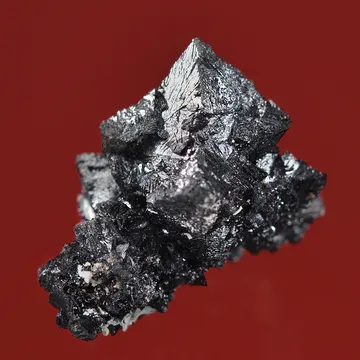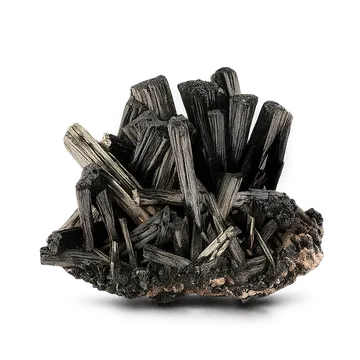
Manganite from Wessels Mine, South Africa, with steel-gray blades and platy botryoids; a rare, desirable hydrothermal manganese specimen for collectors.
Key facts
Wessels Mine is one of the great mineralogical names of the Kalahari Manganese Field, but manganite from Wessels occupies a more specialized place than the mine’s famous sugilite, ettringite, inesite, hausmannite, and rare silicates. It is not a common show species there. When good Wessels manganite appears, it tends to be memorable precisely because it is unexpected: metallic gray-black blades, platy clusters, botryoidal crusts, and chisel-like aggregates emerging from a deposit better known to collectors for brightly colored manganese silicates and carbonates.

Photo: Wikimedia Commons
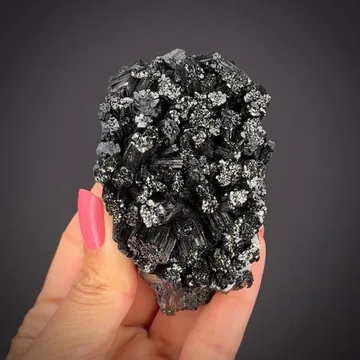
The best Wessels manganite is visually different from the old European manganite standard. Classic Ilfeld manganite is typically robust, prismatic, and historically imposing; Wessels material often has a sharper, more bladed and platy character. Fine pieces can look almost hematite-like at first glance, with steel-gray to silver-black metallic reflections and splintery, stiletto-like crystal groups rather than stout blocky prisms. Other specimens show rich botryoidal manganite, their surfaces sparkling with innumerable rounded gray-black domes, or a black manganite matrix supporting calcite, hausmannite, rhodochrosite, or rarer late-stage species.
Geologically, these specimens belong to the extraordinary hydrothermally modified manganese ores of the northern Kalahari Manganese Field. Wessels-type ore formed where sedimentary Mamatwan-type manganese ore was upgraded by hydrothermal alteration along fault systems. That alteration leached silica and carbon dioxide from the ore, oxidized manganese-bearing carbonates to manganese oxides and oxyhydroxides, and produced a remarkably diverse suite of well-crystallized minerals. In specimen terms, this means manganite at Wessels is not merely “ore mineral on matrix”; it is part of one of the world’s most intricate manganese hydrothermal systems.

Photo: Wikimedia Commons
Collectors look for three things first: luster, crystal definition, and evidence that the piece is genuinely Wessels rather than a more ordinary manganese-oxide specimen carrying a prestigious label. The most desirable examples show lustrous, distinct manganite blades or prisms rather than dull massive ore; complete terminations are important because manganite cleaves and chips readily. Provenance matters more than usual. A number of the better-known pieces on the market trace to older dealer stocks and collections, especially material associated with Charlie Key and later collections that preserved those specimens when they were still regarded as unusual side products from a mine famous for other minerals.
Search for specimens: View all manganite specimens from Wessels Mine, South Africa
Wessels Mine lies near Hotazel in the Northern Cape Province of South Africa, within the Joe Morolong Local Municipality and the John Taolo Gaetsewe District Municipality. It is part of the Kalahari Manganese Field, the immense Paleoproterozoic manganese province northwest of Kuruman. In specimen labels the locality is often shortened to “Wessels Mine, Hotazel, Kalahari Manganese Field,” but the full modern administrative locality is useful when matching recent Mindat and operational references.
The ore is hosted in the Hotazel Formation of the Transvaal Supergroup’s Griqualand West succession. The manganese beds are part of a chemical sedimentary sequence of manganese formation, hematite-rich lutite, and banded iron formation. At Wessels, the key geological overprint is hydrothermal: normal faults acted as fluid conduits, and the original lower-grade Mamatwan-type ore was converted locally into high-grade Wessels-type ore. This upgrading created an oxide-rich manganese assemblage and opened the mineralogical stage for the rare silicates, carbonates, sulfates, and oxides that have made the mine famous.
Mining at Wessels began in May 1973. Unlike the nearby open-cut Mamatwan mine, Wessels is an underground operation, worked roughly 270–300 meters below surface by mechanized bord-and-pillar, or room-and-pillar, methods through vertical and incline or decline shaft access. Today it forms part of the Hotazel Manganese Mines operation associated with South32’s South Africa Manganese business; the mine remains an industrial manganese producer, not a collecting site.
That distinction matters for collectors. Wessels is not a public dig locality. Specimens come out incidentally through mining, from mine-related access, from dealer purchases, and from older collections. The best manganite pieces are not tied to a single widely publicized modern pocket in the way some Kalahari rhodochrosite or ettringite finds are. Instead, they appear episodically: a small group here, a preserved older stock there, a specimen released from a specialist collection years after the find. This uneven supply is part of the reason Wessels manganite can be surprisingly difficult to obtain despite the mine sitting in one of the world’s most manganese-rich districts.
Notable Wessels mineral discoveries extend far beyond manganite. The mine is a type locality for multiple species and has yielded a long list of rare and exotic minerals, including wesselsite, vonbezingite, poldervaartite, scottyite, lavinskyite, cairncrossite, and others. That broader mineralogical fame can sometimes overshadow manganite, but it also gives good manganite pieces added context: they come from the same hydrothermal system responsible for one of the most species-rich manganese localities known to collectors.
Wessels manganite is manganese oxyhydroxide, MnO(OH), and the best specimens show the species’ characteristic metallic to submetallic luster in a distinctly Kalahari habit. Crystal color is typically steel gray, dark metallic gray, iron-black, or silver-black. Fresh crystal faces can be bright enough to flash under a hand light; less fresh areas are velvety black, dull gray-black, or coated by fine manganese oxides.
Crystal habits vary. Some Wessels pieces consist of bladed, intergrown crystals, with individual blades around 1–2 cm on documented specimens and larger aggregates forming showy miniature to small-cabinet pieces. Others show elongated prisms in sprays or splaying bundles, sometimes described as flower-like or rose-like. A particularly unusual Wessels style consists of platy or tabular metallic blades that resemble hematite more than classic manganite. Botryoidal manganite is also documented, with rounded domes from a few millimeters to nearly 1 cm across covering matrix plates and pocket surfaces.
Typical specimen sizes range from thumbnails and toenails to miniatures, with occasional small-cabinet pieces. Fine crystals are often judged at the aggregate level rather than as isolated perfect individuals: a 3–5 cm cluster of lustrous, complete blades can be more important than a larger but dull or damaged ore specimen. Small-cabinet plates of botryoidal material are visually effective, but for advanced species collectors the premium generally goes to sharp, crystallized manganite with visible terminations.
Associations are one of the pleasures of Wessels material. Calcite is common, including pale pink manganese-bearing calcite that may fluoresce. Hausmannite can sit directly on manganite matrix, producing a complex black-on-black association where form and luster distinguish the species. Rhodochrosite occurs on or with manganite-rich matrix in some specimens, and manganite also appears as crusts or matrix for later-stage Wessels species, including bultfonteinite and olmiite in certain combination pieces. Andradite, hematite, quartz, braunite, and other manganese oxides and silicates belong to the broader Wessels assemblage and may occur on related matrix.
Quality is determined by freshness and architecture. The best Wessels manganite has clean metallic luster, visible individual crystal form, and minimal bruising on blade edges or terminations. A specimen with complete, separated blades and a natural display face will outrank a larger but massive-looking piece. For botryoidal specimens, look for sparkle, even coverage, and a sculptural surface rather than flat black crust. On combination pieces, contrast matters: black manganite with pale calcite, pink rhodochrosite, or sharp hausmannite can be far more attractive than manganite alone.
Wessels manganite is not common in good specimen quality. The mine is a giant manganese producer, but good crystallized manganite is a scarce collector byproduct. This is the central paradox of the locality: manganese is abundant, while display-quality manganite is not. Fine pieces tend to appear from old collections, dealer stock dispersals, and the occasional auction rather than as a steady modern supply.
Condition is the principal buying concern. Manganite has cleavage and can be brittle or splintery, especially in thin bladed groups. Edge chipping, broken blade tips, pocket-wall bruising, and sawed backs are common. Sawing does not necessarily condemn a Wessels specimen, especially if the display face is natural and complete, but it should be disclosed and reflected in price. On botryoidal pieces, check for abrasion on the high points of the domes and for dull, earthy surfaces that may indicate massive manganese oxide rather than crisp manganite.
Authenticity problems are less about sophisticated treatment and more about labeling and identification. No major, well-documented Wessels-specific fake or treatment tradition is associated with manganite. The realistic risks are misidentified black manganese oxides, vague “Kalahari” labels upgraded to Wessels, and confusion with manganite from the N’Chwaning mines or other manganese localities. Strong provenance is valuable: older labels, collection history, dealer records, and association with known Wessels assemblages all strengthen confidence.
Because Wessels is an active underground mine with no public collecting, fresh self-collected material should be viewed skeptically unless the chain of custody is credible. Most serious specimens have passed through miners, mine contacts, South African dealers, or international dealers with established Kalahari sources. Ex Charlie Key, Rob Smith, Gerry Morvell, Brian Kosnar, and similar collection histories recur in documented market examples and can add both confidence and value.
Market availability is thin but not nonexistent. Documented auction examples over the past decade include miniatures and small-cabinet pieces, with prices varying widely depending on sharpness, provenance, and aesthetics. Strong crystallized miniatures can command a premium because they satisfy both species collectors and Kalahari specialists. Botryoidal pieces may be more affordable unless exceptionally lustrous or large, while sharp bladed or tabular groups with old provenance are the pieces most likely to disappear quickly into advanced collections.
The most revealing story around Wessels manganite is not a dramatic mine-pocket tale but a market story: the way a handful of old specimens changed collectors’ sense of what the locality could produce. For years, many collectors thought of Wessels in terms of sugilite, inesite, ettringite, hausmannite, and the long roll call of exotic silicates. Manganite seemed almost too obvious to be exciting in a manganese mine, and yet the good pieces were scarce enough that experienced dealers could go years without handling one.
That scarcity becomes vivid in the repeated appearance of Charlie Key provenance. One documented miniature from the Key stock was described as an elegant cluster of unusual, thick, blocky manganite crystals “splaying like a flower,” complete on three sides and sawed flat on the back. Another later market example, also tied to Charlie Key, had elongated bladed crystals fanning out in slightly separated growths, the aggregate measuring about 3–4 cm long. The comment attached to that specimen is telling: the dealer noted that the piece came from a one-time find decades earlier and that the district “doesn’t produce much Manganite of specimen caliber.” In a field famous for manganese, that is precisely the kind of contradiction collectors remember.
A small 2025 auction piece sharpened the picture further. It was only a toenail, 3.3 x 2.7 x 2.4 cm, but its habit was striking: highly lustrous metallic gray-black blades to 2.6 cm forming a foliated, rose-like group with minor calcite. The description emphasized how unlike old Ilfeld manganite it looked. Instead of heavy prismatic crystals, it carried thin tabular blades with a hematite-like presence. The specimen had passed from Charlie Key to Brian Kosnar, a compact chain of provenance that helped explain why such an uncommon Wessels style had survived in fine condition.
The botryoidal side of Wessels manganite has its own appeal. A documented small-cabinet specimen, 8.4 x 5.0 x 4.0 cm, carried both a surface and side pocket covered by sparkling gray-black manganite botryoids. The largest rounded forms were nearly 1 cm, while most were only 2–4 mm. The description compared the surface to a “rolling sea of deep gray jewels,” an apt phrase for the glittering, granular look that separates a lively botryoidal manganite from a dull manganese-oxide crust.
Wessels manganite also appears as a quiet stage for other minerals. In one Fall 2004 find, a sculptural manganite crust carried sprays of white bultfonteinite needles and sharp brown-sugar olmiite prisms; one olmiite crystal reached about 8 mm. The manganite was not the named prize of the find, but it was the black architectural base that made the later minerals stand out. This is often how Wessels manganite behaves in collections: sometimes the main actor, sometimes the stage, but always part of the mine’s complex hydrothermal theater.