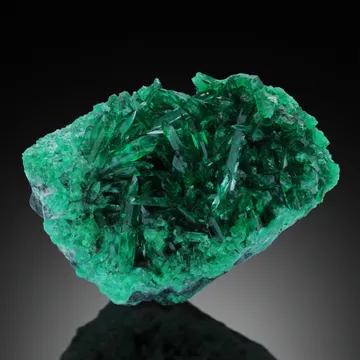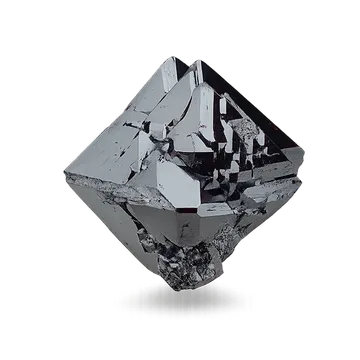
Tsumeb cuprite — Namibia's famed copper-lead-zinc-silver deposit yields wine-red to cherry-red crystals with brilliant luster, often on calcite or smithsonite.
Key facts
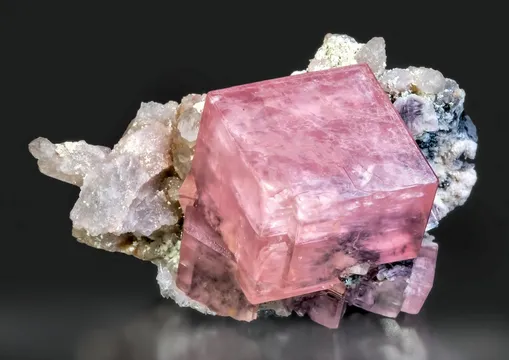
Tsumeb cuprite is a collector’s mineral with a very particular personality: not the oversized gem-octahedra of Onganja, and not the modern red-on-green fireworks of Milpillas, but old, deep, complex, and unmistakably Tsumeb. Its best specimens show wine-red to cochineal-red crystals with a hard, brilliant luster, often poised on pale calcite, dolomite, smithsonite, or native-copper-rich ore. Under strong light the finest crystals wake up with translucent cherry-red edges; in normal cabinet lighting many appear almost black-red, a look that suits the deposit’s heavy, polymetallic character.

Photo: Wikimedia Commons
The locality matters as much as the species. Tsumeb was a copper-lead-zinc-silver pipe orebody hosted by dolomitized carbonate rocks of the Otavi Mountainland, and its fame rests on a remarkable combination: metal-rich primary ore and a deep, unusually effective groundwater “plumbing system.” Oxidizing fluids penetrated the orebody not just near surface but at great depth, producing three oxidation zones and a mineralogical suite of extraordinary complexity. Cuprite, Cu2O, belongs to that supergene story. It was not a mere rarity at Tsumeb; it occurred through much of the deposit, sometimes as commercially meaningful massive ore and, more importantly for collectors, as sharp crystals, cavernous dodecahedral forms, and delicate acicular chalcotrichite.
The visual range is broad. Some Tsumeb pieces are dense ore specimens dusted with sparkling red microcrystals. Others are refined miniatures with sharp cubo-octahedral crystals on pale carbonate matrix. Rare top-end pieces carry crystals approaching several centimeters, with published records noting exceptional crystals to 50 mm from the third oxidation zone. Tsumeb also produced fine chalcotrichite—silky, hair-like cuprite—especially memorable when crimson needles lie across white smithsonite and calcite, or when tiny red hairs are enclosed in calcite or cerussite and tint those minerals orange to red.
Historically, cuprite sits inside the larger Tsumeb legend. The outcrop was the “Green Hill,” worked for copper before European commercial mining, then transformed in the twentieth century into one of the world’s essential mineral localities. Serious collectors prize Tsumeb cuprite for its provenance, association, luster, crystal complexity, and old-mine context. A specimen does not need to be large to be important here; a well-composed miniature with sharp red crystals on dolomite or calcite can carry more locality character than a larger but anonymous massive piece.

Photo: Wikimedia Commons
Search for specimens: View all cuprite specimens from Tsumeb, Namibia
The Tsumeb Mine, also known in later usage as the Ongopolo Mine, lies at the town of Tsumeb in the Oshikoto Region of northern Namibia. The orebody was an irregular, pipe-like copper-lead-zinc-silver deposit cutting through Neoproterozoic carbonate rocks of the Otavi Group, specifically within the upper part of the Tsumeb Subgroup. Its geometry was not a simple vein or stratiform sheet: the mineralized structure extended downward for roughly 1700 meters, with elliptical to attenuated plan shapes, breccia zones, massive sulfide veins, sandstone and dolomite breccias, and a complicated internal architecture that changed markedly from level to level.
That complexity explains why Tsumeb specimens often look so distinctive. The primary ore assemblage included copper, lead, zinc, arsenic, germanium, gallium, cadmium, silver, and other elements in a geochemically rich system. The chief hypogene ore minerals included bornite, chalcocite, tennantite, enargite in upper levels, galena, and sphalerite. Later oxidation remobilized those metals into a dazzling secondary suite. Cuprite formed as a supergene copper oxide in the oxidation zones, especially where copper sulfides and native copper were altered in open spaces, breccias, and carbonate-rich ore.
Tsumeb’s three oxidation zones are central to understanding its cuprite. The first oxidation zone extended from surface to about 11 Level, with oxide minerals diminishing below that into the 11–15 Level interval. The second oxidation zone lay much deeper, roughly from 24 to 35 Level, centered near the North Break Horizon around 29 Level. A third oxidation zone appeared still deeper, from about 42 Level downward. Cuprite is documented from all three zones, which is one reason Tsumeb pieces vary so strongly in habit and association.
The earliest mining history begins before formal European development. The copper-stained outcrop was known as the Green Hill, and local African mining and copper trading predated commercial operations. European attention intensified in the 1890s; trial shafts were begun in 1900 by Otavi Minen und Eisenbahn Gesellschaft, and full-scale commercial production began in 1906 after a railway connection made large-scale ore movement practical. Mining started in the open pit and shallow workings, then moved underground as near-surface ore was exhausted.
The mine’s operating life spanned most of the twentieth century, interrupted by world wars and economic downturns. By the outbreak of World War II, workings had reached about 670 meters below surface at 22 Level. Postwar mining resumed in 1947 under Tsumeb Corporation Limited and advanced into deeper ground, encountering the second oxidation zone at roughly 810 meters depth, then later the third oxidation zone at about 1380 meters. By the mid-1990s, the deepest workings reached about 1700 meters below surface at 48 Level.
Commercial mining effectively ended in 1996. The proximate end was dramatic: during a period of labor conflict, management access to the mine was denied, pumps were switched off, and the workings flooded rapidly. Some small-scale work in the upper levels continued for a time, and a short-lived specimen-mining effort operated between 1998 and 2002, but Tsumeb is no longer a producing collector locality in the ordinary sense. Fine cuprite specimens now come from old mine production, old dealer stocks, and the release of private collections.
Collecting access should be considered closed and historical. The mine is not a casual field-collecting site, and Namibian mineral collecting and export are regulated. Private collectors and researchers need appropriate Ministry of Mines and Energy documentation for collected or purchased material, and commercial export requires additional permitting. For most collectors, legitimate acquisition means buying from established dealers or collections with credible old labels, invoices, or documented chain of ownership.
Notable cuprite occurrences within the mine include massive cuprite ore on 3 Level in the upper part of the first oxidation zone; cuprite with aragonite between 7 and 11 levels; fine chalcotrichite on 12 Level near the base of the first oxidation zone; cavernous dark crystals described from 35 Level; and exceptional crystals from 44 Level in the third oxidation zone. These level references are not collector trivia: they help separate styles of Tsumeb cuprite and add real provenance value when supported by old labels.
Tsumeb cuprite is cubic in crystal system and occurs in several habits. The most familiar collector crystals are modified combinations of cube, octahedron, and dodecahedron. Pure, simple cubes or simple octahedra are less typical than modified forms; many crystals show octahedral modifications on cubic or dodecahedral forms, giving them a complex, beveled, architectural look. Sharp cubo-octahedra, dodecahedra with tiny octahedral faces, and skeletal or cavernous crystals are especially characteristic.
Color ranges from ruby-red and cochineal-red to deep wine-red, maroon, and black-red. The best crystals show bright internal red flashes at edges or in transmitted light, while more massive or heavily included crystals may appear dark and submetallic. Luster is a major quality factor: fine Tsumeb cuprite can be brilliant to almost adamantine, and even small crystals may sparkle intensely across a matrix face.
Size varies widely. Crystals to about 5 mm are relatively abundant by Tsumeb standards, especially on rich ore and carbonate matrix. Crystals of 10–15 mm are much more desirable and may show the cavernous, dodecahedral character described from deeper levels. Crystals around 30 mm are rare, and the largest reported Tsumeb crystals, reaching 50 mm from the third oxidation zone, are exceptional. For most collectors, a sharp, lustrous 5–15 mm crystal on good matrix is already a meaningful Tsumeb cuprite.
Chalcotrichite, the hair-like variety of cuprite, is one of the locality’s most delicate expressions. At Tsumeb it can form silky red mats and fine acicular needles with calcite, dolomite, smithsonite, and copper. Some calcite and cerussite specimens owe their orange or red coloration to included chalcotrichite hairs. These pieces appeal to specialists because the visual effect is entirely different from blocky cuprite crystals: soft, fibrous, velvety, and easily damaged.
Associations are unusually important. Tsumeb cuprite is known with calcite, dolomite, aragonite, smithsonite, cerussite, chalcocite, native copper, malachite, mimetite, azurite, dioptase, duftite, conichalcite, wulfenite, quartz, goethite, and other species. The most commercially recognizable combinations are red cuprite on pale calcite or dolomite, cuprite with native copper, cuprite with malachite, and cuprite with smithsonite. Mimetite and cerussite associations add strong Tsumeb flavor, especially when the specimen has an old label or a known mine level.
Pseudomorphism adds another layer. Cuprite is reported as a common pseudomorph after native copper at Tsumeb, while malachite can occur as a common partial replacement after cuprite. Rare replacements after cuprite by conichalcite or plancheite are also reported. This means that some Tsumeb copper-oxide specimens are not straightforward “one mineral on matrix” pieces but records of sequential alteration: native copper to cuprite, cuprite to malachite or other secondary minerals, with remnants of earlier stages preserved in broken surfaces or cores.
Quality in Tsumeb cuprite is judged by a combination of mineralogical and aesthetic traits. The strongest examples have sharp form, high luster, visible red translucency, clean contrast against pale or green matrix, and minimal edge wear. Locality character counts heavily: a small, elegant crystal group with calcite, dolomite, smithsonite, malachite, or native copper may be more desirable than a larger dark mass lacking crystal definition. Provenance also matters. Specimens tied to old Tsumeb collections, historic dealers, or specific levels have a premium beyond their visual appeal.
Tsumeb cuprite occupies a middle ground in availability: it is not obscure, but truly fine examples are not common. Massive ore specimens and small red crystal druses appear with some regularity from old collections. Sharp, lustrous, well-composed miniatures with crystals over 1 cm are much harder to buy, and large, gemmy, damage-free crystals from Tsumeb are rare enough to attract specialist attention whenever they surface.
Recent market examples show the spread. Modest matrix specimens with millimeter-scale crystals may sell in the low hundreds. Attractive small cabinets and miniatures with rich coverage, good luster, or strong carbonate contrast can reach four figures. Highly crystallized miniatures with intense maroon-red, modified crystals, green malachite accents, old provenance, or unusually good condition can climb substantially higher. Tsumeb’s name carries weight, but condition and aesthetics remain decisive.
The main authenticity concern is not a widespread documented treatment problem but misattribution, repair, and over-description. Cuprite is a classic copper-oxidation mineral from many localities, and dark red crystals on carbonate matrix can be difficult to assign without provenance. Tsumeb pieces should make sense in association: calcite, dolomite, smithsonite, malachite, native copper, mimetite, cerussite, and complex copper-lead-zinc assemblages are all plausible; a suspiciously generic “Tsumeb” label on an uncharacteristic specimen should be treated cautiously.
Repairs are a real issue in high-end cuprite generally, and Tsumeb is no exception. Cuprite is brittle and relatively soft, so prominent corners and edges chip readily. Single large crystals should be examined under magnification for glued contacts, filled fractures, repaired tips, and suspiciously glossy resin in cracks. Backlighting can exaggerate red transparency, so judge color both in normal cabinet light and with strong transmitted or raking light. A crystal that glows beautifully at the edge but is nearly black in ordinary display may still be excellent, but it should be priced honestly.
Chalcotrichite requires special caution. The needles are extremely fragile; flattened mats, dusty surfaces, missing fibers, or fibers crushed against old cotton are common condition problems. Never clean chalcotrichite with water pressure, ultrasonic cleaning, compressed air, or aggressive brushing. Even on blocky cuprite, avoid ultrasonic cleaners and acids. Acid treatment can damage associated calcite, dolomite, smithsonite, malachite, and copper minerals, and may alter the specimen’s surface character.
For storage, give Tsumeb cuprite individual space. It can scratch softer neighbors such as calcite, but it is itself vulnerable to abrasion and chipping. Handle matrix, not crystals. A custom base or well-fitted box is worth using for sharp miniatures, and old labels should be preserved with the specimen. For Tsumeb, a label is not an accessory; it is part of the mineralogical evidence.
Before Tsumeb was a mine name on specimen labels, it was the Green Hill. The copper-stained outcrop rose from the Otavi Mountainland as a visible promise of metal, and local African miners had already learned to win copper from it. European explorers in the 1880s encountered people transporting and trading copper ores and roughly smelted metal, then traced those goods back to Otjisume, remembered as “the place of the frog.” “Tsumeb” is said to be a corruption of that Herero name, attached to an outcrop whose green copper minerals made it look alive long before geologists gave the deposit its formal language.
In January 1893, the British mining engineer Mathew Rogers reached the Green Hill on behalf of the South West Africa Company. His reaction still reads like the beginning of a mineral-collecting legend: “I have never seen such a sight as was presented before my view at Soomep,” he wrote, adding that he doubted he would ever see another like it. Rogers was not looking at a display case. He was standing before the exposed top of what would become one of the world’s greatest mineral localities, a pipe of copper, lead, zinc, silver, arsenic, germanium, cadmium, and other elements waiting to be opened level by level.
Commercial development did not happen instantly. The German company Otavi Minen und Eisenbahn Gesellschaft began with two trial shafts in 1900, but full-scale production had to wait until 1906, when a dedicated railway made it possible to move ore from the interior to the coast. Mining began in the open pit and shallow workings. As the surface ore was exhausted, the operation went underground, and Tsumeb’s collector story deepened along with the mine.
One of the first people to recognize the specimen potential was not standing underground with a collecting bag but handling ore samples in Germany. Around 1900, a large sample of Tsumeb ore was sent to Germany for metallurgical testing. Wilhelm Maucher, working with the material at the Bergakademie in Freiberg, noticed well-crystallized secondary minerals in the test ore and preserved them. That small act—saving crystals from what had been shipped as ore—belongs in every serious Tsumeb narrative. The mine would later be famous for display specimens, but its specimen culture began in part with someone refusing to treat beautiful ore as merely ore.
The interwar years added a human archive to the geological one. Senior OMEG figures such as F. W. Kegel, W. Klein, W. Thometzek, and a shift boss named Keller assembled major Tsumeb collections. Wilhelm Klein’s collection is especially important because he recorded mine levels for his specimens. That habit matters enormously for cuprite. When a Tsumeb cuprite can be tied to 12 Level, 35 Level, 44 Level, or another documented part of the mine, it becomes more than a red copper oxide: it becomes a coordinate in the vertical history of the pipe.
A particularly vivid cuprite survivor from this world is Klein specimen number 807, now in the Harvard collection as MGMH 126820. It is a 95 mm cabinet specimen of chalcotrichite from 12 Level in the first oxidation zone: silky, bright red acicular cuprite on a cavernous matrix of off-white smithsonite and colorless rhombohedral calcite. Some of the calcite crystals are lightly included by chalcotrichite hairs. The piece is not famous because it is enormous or gemmy in the modern sense; it is famous because it preserves a fragile, level-documented style of Tsumeb cuprite that could easily have been destroyed by mining, handling, or a century of careless storage.
As the mine deepened, expectations kept being overturned. After the first oxidation zone, miners and geologists expected more primary sulfide ore, and they did find it. But in the postwar period, deep workings entered a second oxidation zone beginning around 810 meters below surface near 26 Level. Later, in the 1980s, another surprise arrived: a third oxidation zone from about 1380 meters depth, around 42 Level and below. For cuprite collectors this matters directly. Tsumeb cuprite was not restricted to the old near-surface oxide cap. It followed the mine downward into deep oxidized environments, producing documented crystals from 44 Level and adding another chapter to a mineral that many deposits form only near the surface.
The end of the mine was abrupt and almost cinematic. By the mid-1990s the workings reached about 1700 meters below surface at 48 Level, but high mining and pumping costs, low metal prices, and labor conflict pressed the operation toward closure. In mid-1996, striking miners denied management access to the mine site. The pumps were switched off. Water rose rapidly through the workings. A century of levels, pockets, and specimen ground passed out of reach, leaving collectors with what had already been saved.