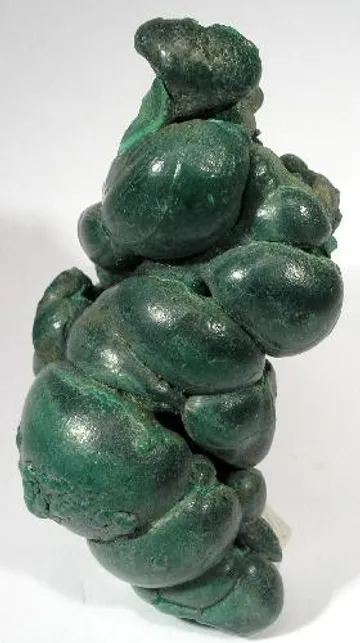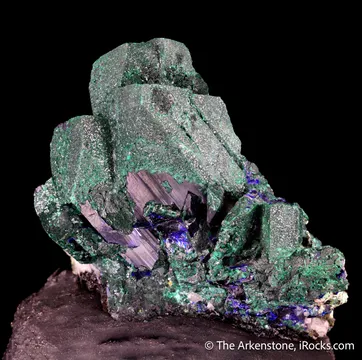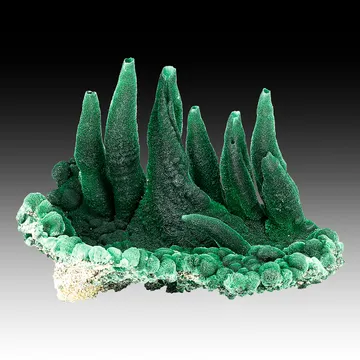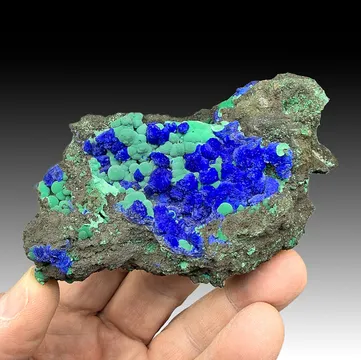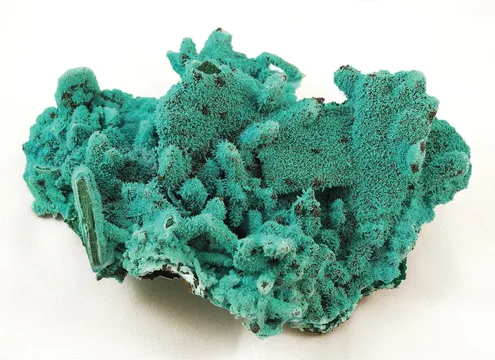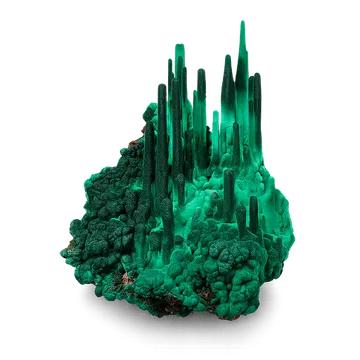
Malachite from Katanga Copper Crescent, DR Congo — velvety stalactites, fibrous sprays, and crisp botryoids; notable for surface life and precise locality.
Key facts
Malachite from the Katanga Copper Crescent is not merely “Congo malachite” in the lapidary sense. For collectors, the name covers one of the world’s great families of secondary copper specimens: velvety stalactites, shimmering fibrous sprays, botryoidal masses with rolling surfaces, banded slices from thick stalactitic growths, and rarer crystallized pieces whose needles and blades flash with cat’s-eye chatoyancy under a moving light.

Photo: Wikimedia Commons
The geology explains the abundance and the variety. The Katanga Copper Crescent is part of the Central African Copperbelt, a Neoproterozoic sediment-hosted copper-cobalt province developed in Katangan Supergroup rocks. Primary copper sulfides in the Roan Group and related ore horizons were oxidized and remobilized during long weathering episodes. In carbonate-rich host rocks, copper-bearing groundwater met carbonate ions released from dolostone and limestone, and malachite precipitated in cavities, fractures, breccias, and karstic voids. In siliciclastic rocks it can appear as impregnation following bedding; in open cavities it becomes the collector’s material: laminated crusts, botryoids, “velvet” surfaces, and speleothem-like stalactites.

Photo: Wikimedia Commons
The Crescent’s most desirable malachites are judged less by size alone than by surface life. A top Katanga specimen should have movement: silky radial fibers that brighten and darken as the specimen turns, rounded stalactites with undamaged tips, crisp botryoidal sculpture, or sharp acicular growth rather than dull massive ore. Collectors also look for locality precision. “Katanga” is a broad historic label, and many older specimens entered the market before mine-level documentation was consistently preserved. Pieces labeled to Star of the Congo, Kasompi, Mashamba West, Luishia, Musonoi, Lupoto, Lukuni, or other named Crescent mines carry more mineralogical interest than anonymous “Congo” material, provided the attribution is credible.
Search for specimens: View all malachite specimens from Katanga Copper Crescent, DR Congo
The Katanga Copper Crescent lies across the historic Katanga mining region of southeastern Democratic Republic of the Congo, chiefly in today’s Haut-Katanga and Lualaba provinces. It is the Congolese portion of the Central African Copperbelt, famous for copper, cobalt, uranium, and a remarkable suite of secondary minerals. In mineral-collection terms, “Katanga Copper Crescent” is best treated as a regional collecting locality that includes numerous mines and districts rather than a single pit.
The primary ore system is sediment-hosted stratabound copper-cobalt mineralization in the Katangan Supergroup, especially Roan Group units. The common collector minerals of the oxide zone record the weathering of earlier sulfides: malachite, chrysocolla, cuprite, heterogenite, azurite, pseudomalachite, and a long list of copper, cobalt, vanadium, selenium, phosphate, sulfate, and uranium minerals. Mindat’s regional listing records more than two hundred valid minerals for the Katanga Copper Crescent, including many type-locality species, which is why malachite specimens from this region so often sit in the middle of a wider mineralogical story.
Malachite’s richest specimen forms developed where oxidation and groundwater circulation intersected open space. Dissolution cavities in carbonate rocks acted as traps. Some cavities were narrow enough to make crusts and linings; others allowed hanging and pendant forms to grow into speleothem-like stalactites. The best specimens are therefore not random lumps of ore but the visible architecture of a supergene system: copper leached from sulfides, transported downward, and fixed again as carbonate in voids, fractures, and karstic pockets.
Important malachite-producing localities within the Crescent include Star of the Congo, also known as L’Etoile du Congo or Kalukuluku, near Lubumbashi; Kasompi Mine in the Swambo area; Mashamba West in the Kolwezi district; Luishia in the Kambove area; Musonoi near Kolwezi; and other mines such as Lupoto and Lukuni that appear repeatedly in collector discussions of fine stalactitic and fibrous material. Mashamba West began as an opencast mine in 1978 and became famous not only for malachite but also for cobalt-bearing calcite, cuprite, baryte, metatyuyamunite, carnotite, vésigniéite, kolwezite, and spherocobaltite. Musonoi is mineralogically broader still, with important copper, cobalt, selenium, and uranium species in addition to malachite.
Collecting access has changed sharply over time. Older waves of specimens came out when pits, dumps, and inactive workings were easier for local miners to enter. Modern industrial ownership, security restrictions, and active copper-cobalt production have made direct collecting by visitors unrealistic at many named sites. Today most specimens reach collectors through Congolese miners, local trading networks, older dealer stocks, and international mineral dealers. As a result, specimen labels should be read with care: “Katanga” may be accurate but imprecise; “Star of Congo” or “Mashamba West” may be meaningful, but only when supported by old labels, trusted dealer provenance, or a distinctive assemblage consistent with the mine.
Notable finds range from common decorator-grade botryoidal malachite to very fine mineral specimens. Star of the Congo is especially celebrated among collectors for abundant and varied botryoidal and stalactitic malachite, including material with chrysocolla. Kasompi produced memorable chatoyant pieces with hundreds of intergrown, curving needle-like sprays. Mashamba West is associated with “primary” style malachite crystals, malachite pseudomorphs after baryte, and associations with cuprite, baryte, cobalt-bearing calcite, and other oxide-zone minerals.
The classic color is saturated green, but good Katanga material spans a wide range: dark bottle-green, forest-green, bright emerald, pale mint, bluish green when chrysocolla is involved, and silky light-and-dark bands in cut stalactites. Fresh fibrous surfaces can appear almost metallic in bright light. The best chatoyant specimens show a moving silver-green sheen across radial sprays, especially where fine needles are parallel enough to act like bundles of optical fiber.
Habits are diverse. The most familiar forms are botryoidal and mammillary masses: rounded, grape-like growths that may be smooth, velvety, or sparkling with microcrystals. Stalactitic specimens form as upright or pendant columns, sometimes hollow, sometimes solid, and often covered with nubby botryoidal overgrowth or fine crystalline “velvet.” Stalactites may be a few centimeters long in thumbnail and miniature specimens, but large cabinet pieces with 10–20 cm spires are known; exceptional speleothem-like malachite in the Katanga literature can reach far larger dimensions inside cavities.
Fibrous and acicular malachite is another Katanga strength. Luishia, Kasompi, and several other Crescent mines are known for green needles and silky aggregates. Some pieces form radial rosettes or fan-like sprays, while others are felted mats of hairlike crystals on dark matrix. Mashamba West is especially interesting for more distinctly crystallized “primary” style malachite, described in locality records as dark green crystals rather than simple replacement material.
Banded material is abundant and often lapidary-grade. Cut or polished Katanga malachite may show concentric bulls-eye rings, tube sections, or sweeping curved bands from stalactitic growth. This material is beautiful, but for specimen collectors it sits in a different category from undamaged natural surfaces. A polished slice may be visually superb and highly collectible as lapidary malachite, while a natural, unrepaired stalactite cluster with intact tips and sparkling fiber is judged by mineral-specimen standards.
Associated minerals are a major part of the locality’s appeal. Common and important companions include chrysocolla, heterogenite, cuprite, azurite, pseudomalachite, baryte, quartz, calcite, cobalt-bearing calcite, dolomite, goethite, hematite, chalcocite, chalcopyrite, bornite, and covellite. Musonoi and related Kolwezi-area material can also bring uranium minerals such as torbernite, metatorbernite, cuprosklodowskite, kasolite, uranophane, and other radioactive species into the same collecting universe, so green is not always simply “malachite” in these assemblages.
Quality is determined by luster, form, damage, and credibility. The most desirable pieces have lively fibrous or crystalline surfaces, three-dimensional sculptural form, intact stalactite tips, strong contrast with matrix or associated minerals, and a reliable locality. Dull massive ore, broken stalactites, heavily oiled or repaired surfaces, and vague labels reduce value. For high-end pieces, the difference between ordinary Congo malachite and exceptional Katanga malachite is movement: the specimen should flash, ripple, or glow rather than merely sit green.
The most important caution with Katanga malachite is authenticity, especially for stalactites. Genuine Congolese stalactitic malachite unquestionably exists and includes some of the world’s best examples, but the market has also seen assembled, repaired, and outright fake pieces. Reported problem specimens include broken stalactites reattached with wire or glue, real malachite fragments coated with crushed malachite and resin, and attractive but suspect sparkling surfaces applied to a base. A central hole alone does not prove fakery, because natural stalactites and soda-straw-like formations can be hollow; a wire, a square or artificial-looking central support, resin at attachment points, repeated smooth “fingers,” or a glittering coating that wraps unnaturally around broken edges is far more concerning.
Acetone testing is sometimes mentioned in collector discussions because some resin-bound fakes soften or break down, but it is a destructive test and should not be used casually on a valuable specimen. A safer first pass is visual and mechanical: inspect with magnification for glue lines, resin films, unnatural sparkle, color sitting on top of the surface, repeated growth patterns, or stalactites that emerge from a base with no believable geological transition. A small magnet or metal detector may reveal wire-repaired examples, but absence of metal does not prove natural origin.
Condition issues are common. Malachite is soft, brittle in fibrous forms, and easily bruised. Fine velvet surfaces can lose their sparkle if rubbed. Stalactite tips chip; thin sprays shed fibers; botryoidal skins bruise at high points; old repairs may yellow or detach. Avoid washing fibrous specimens aggressively, and never scrub velvety surfaces. Keep specimens dry, dust with air or a very soft brush only when necessary, and store acicular pieces where fibers cannot touch a lid or neighboring specimen.
Radioactivity is not a property of malachite itself, but Katanga specimens—especially from uranium-bearing mines such as Musonoi, Shinkolobwe-related assemblages, and some Kolwezi-area material—may carry associated uranium minerals. Bright green tablets, yellow crusts, orange-yellow coatings, or unusual radioactive readings should be investigated rather than assumed to be malachite. Collectors who buy mixed Katanga copper-uranium assemblages should use normal radioactive-mineral precautions: label accurately, avoid inhaling dust, keep specimens contained, and measure activity when in doubt.
Market availability is broad but uneven. Small botryoidal and fibrous pieces remain common, and polished malachite from the DRC is widely available. Fine natural stalactites, sharply crystallized “primary” malachite, large undamaged cabinet pieces, and specimens with strong old labels are much scarcer. Named-mine specimens from Star of the Congo, Kasompi, Mashamba West, Luishia, and Musonoi deserve closer attention than generic “Congo” labels, but they also deserve skepticism when the label seems too convenient for the style of the piece.
The most vivid modern story around Katanga malachite is not about a single pocket but about a market controversy. In 2008 and 2009, experienced collectors on Mindat debated Congolese malachite stalactites that looked too perfect, too sparkly, or too conveniently arranged. Some contributors reported examples with copper wire running through the center; others described crushed malachite glued to broken stalactites or matrix. One collector recalled almost being caught with a batch at Tucson before returning them with police help. The discussion became heated because the stakes were real: too much suspicion would condemn genuine specimens, while too much trust would reward fakery.
The useful conclusion was not “all are fake.” Christophe Gobin, a dealer with field experience in Congo, pushed back against blanket dismissal. He wrote that some were fake, but many were real, and that Congolese malachite stalactites were among the best in the world. His explanation of the fakes was more practical than exotic: not laboratory-grown wonders, but broken real malachite, crushed rough, glue, and sometimes wire used as a support. He also gave collectors one of the most memorable bits of market slang in the entire discussion. In Lubumbashi, he said, fake malachites had acquired the local joke-name “Baudouinite,” after one of the people associated with early examples.
Gobin’s field notes also preserve a small map of reputation among the mines. Star of the Congo, in his telling, produced many of the best malachites in both quality and quantity: botryoidal pieces, stalactites, a wide range of greens, and chrysocolla associations. Kasompi had been producing many stalactites on the market in the years just before his comments, though generally darker and not as fine as the best Star of Congo material. Luishia was remembered for “fantastic velvet ones.” Lupoto and Lukuni also belonged to the roster of real producers. That kind of dealer memory matters because many specimens were sold under vague or incorrect labels, and because some Star of Congo material was reportedly passed off as Mashamba West.
One anecdote from the same discussion has the feel of a lost pocket legend. Gobin wrote that Mashamba West was famous for primary malachites, real crystals, great “flowers,” combinations with red gemmy cuprite, light green acicular malachite, and orange baryte. He then added that in 1990 or 1991 his father brought out a 20 cm double-terminated azurite crystal, completely oxidized. A few weeks later, civil war began, the mine flooded, and the pocket, as he put it, remained under a green lake of copper water. Whether the pocket is ever accessible again is almost beside the point; for collectors, it captures the romance and frustration of Katanga—world-class mineralization glimpsed briefly, then hidden by water, politics, and mining reality.