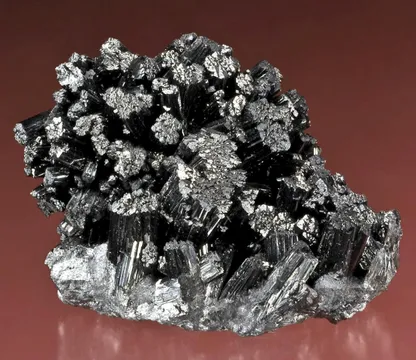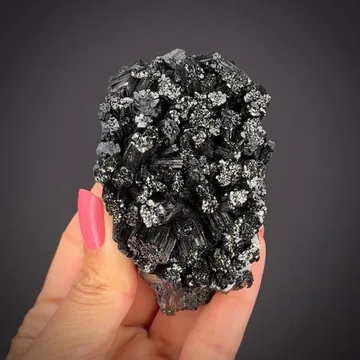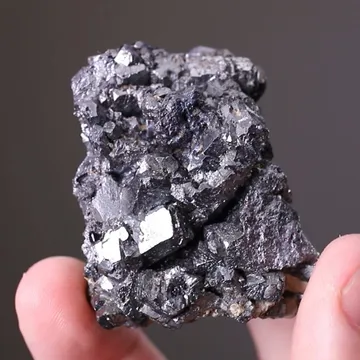
Ilfeld pyrolusite: classic European manganese locality in Thuringia, famed for steel-gray fibrous and acicular crystals, cabinet pieces, and collector appeal.
Key facts
Ilfeld pyrolusite belongs to one of the great old manganese localities of Europe: the manganese deposit west of Ilfeld in the southern Harz, now in Harztor, Nordhausen District, Thuringia. The locality is better known to most collectors as the type locality and classic source for exceptional manganite, but that fame gives Ilfeld pyrolusite much of its character. The best pyrolusite specimens from here are not anonymous black ore. They are old-European cabinet pieces, often with radial, fibrous, acicular, or robust prismatic crystallization, steel-gray to black metallic luster, and the distinctive pedigree of the Ilfeld manganese district.

Photo: Rob Lavinsky, iRocks.com / Wikimedia Commons
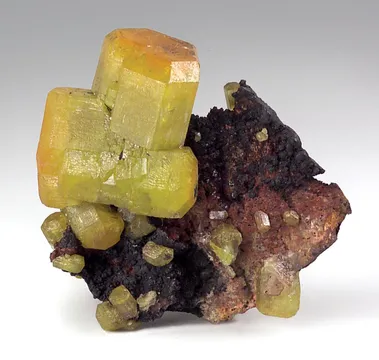
The geological setting is a compact but mineralogically rich hydrothermal manganese-vein district developed in the Permian volcanic rocks of the Ilfeld basin. The manganese ores occur principally in veins cutting Rotliegend volcanic rocks historically called Ilfeld porphyrite, with baryte, calcite, and quartz as important gangue minerals. Pyrolusite, manganite, hausmannite, braunite, rhodochrosite, baryte, calcite, and quartz are among the collector-relevant species, with the broader district also yielding a surprisingly diverse suite of later vanadates, phosphates, carbonates, and rare-earth minerals.
For pyrolusite collectors, the appeal is twofold. First, Ilfeld produced handsome crystallized material: metallic radial sprays, acicular aggregates, compact fibrous masses, and rare sharp crystals reaching about 1 cm in documented specimens. Second, the locality has historical depth. The manganese mines were worked for ore long before mineral collecting became a modern hobby, and classic Ilfeld pieces in old collections often carry 19th-century character: faded labels, compact cabinet sizes, and associations with manganite, baryte, and massive manganese ore.
A good Ilfeld pyrolusite specimen should look unmistakably mineralogical rather than merely industrial. The most desirable examples show coherent radial or shrub-like growths, bright metallic sheen, discernible acicular or prismatic crystal form, and a believable old Ilfeld matrix or association. Pieces with firm provenance, antique labels, or collection history deserve special attention, because collecting at the protected locality is now forbidden and the best material is expected to come from old collections rather than fresh field collecting.
Search for specimens: View all pyrolusite specimens from Ilfeld, Thuringia, Germany
The Ilfeld manganese deposit lies in the southeastern Harz Mountains, about 8 km north of Nordhausen, near the old Braunsteinhaus west of Ilfeld. Historically, “Braunstein” was the miners’ term for brown-black manganese ore, and the Braunsteinhaus was the former mine house serving the district. The best-known collecting and mining ground is around the Kleiner Möncheberg, Harzeburg, Hegersberg, and associated old pits, adits, dumps, and shallow workings.
The deposit is a hydrothermal manganese-vein system related to the Permian volcanic evolution of the Ilfeld basin. The ore veins cut porphyritic volcanic rocks of the Rotliegend sequence; nearby sedimentary rocks include conglomerates and sandstones, but the manganese mineralization of collector interest is tied especially to the fractured volcanic host. The veins are not huge by modern ore standards. Documented guide material for the mining trail gives typical vein lengths of roughly 10–15 m, exceptionally up to about 60 m, with average thicknesses around 0.45–0.60 m. The principal gangue minerals are calcite, quartz, and baryte, and the major manganese minerals include manganite, pyrolusite, and hausmannite.
Mining history at Ilfeld is long and episodic. Manganese ore was probably exploited in some form by the Middle Ages, and one Mindat sublocality, the Silberkopfzeche, records mining since 1525. More systematic mining began in the early 18th century, when the district shifted from simple stone searching, shallow open workings, and small shafts toward more organized underground work and technical mine supervision. Early reports from 1724 and 1725 already describe attempts to rationalize the mining, control chaotic extraction, and replace irregular working with supervised mining practice.
The 18th-century mine economy was strongly driven by demand. When customers needed Braunstein, miners were hired for days or weeks; when sales slowed, they were dismissed. The ore was used in glassmaking and chemical bleaching, and it was shipped beyond the Harz, including to Holland. In the 1760s, records describe wooden barrels, transport by wagon and water routes, and the practical challenge of moving ore from the forested South Harz to distant buyers.
In the 19th century the Ilfeld workings became better organized under mining officials connected with the Büchenberg administration near Elbingerode. Around 1840, falling demand reduced the manganese workforce from about 100 miners to about 20. By 1860 the district still produced about 1,000 centners of manganese ore, sold in three quality grades. In 1872, ore was being extracted from 20 small open pits and one adit. Regular sales, especially to Russia, continued into the 1880s, but competition from larger and richer manganese deposits in the Caucasus, Spain, and India undermined the economics. The first major mining period ended in 1890.
World War I revived the district. Manganese demand brought renewed working in 1916, first by Südharzer Schwerspatwerke Max Döring and then, from 1917, by Pretzschmer and Fitzsching of Dresden, which acquired the Ilfelds Mangan mine field. Even then, mechanization remained modest: hand drills powered by a small compressor, handcarts to the mine house, sorting on a picking bench, and shipment in wooden barrels. Production through 1921 reached 33,110 centners, with the peak year in 1918 at 9,410 centners. Foreign manganese ore returned to the German market after the war, and the Ilfeld manganese mines closed for good on March 31, 1922. The last shift at the Silberkopfzeche is recorded on June 30, 1922.
Collecting access is now the opposite of the old days. The manganese district around the Braunsteinhaus contains protected mining relics, including old dumps, pingen, adits, and near-surface cavities. The area is treated as a cultural-historical mining landscape, and collecting is strictly forbidden. A signed mining-history trail at the Kleiner Möncheberg allows visitors to see the landscape and interpret the old workings, but visitors are expected to remain on the marked path for safety and heritage protection. For collectors, legitimate Ilfeld pyrolusite is therefore old material: historic specimens, old dealer stock, museum deaccessions where legal, and pieces with earlier collection provenance.
Ilfeld pyrolusite ranges from compact fibrous and massive metallic ore to attractive crystallized specimens. The most collectible habit is radial to shrub-like aggregates of acicular crystals: sparkling steel-gray to black needles, tufts, and sprays rising from manganese-oxide matrix or intergrown into compact vein material. Some specimens show radial clusters grown into one another from multiple directions, producing a silky to bronze-metallic sheen when the crystal fibers catch the light.
Rare Ilfeld examples also show sharp, robust crystals to about 1 cm. Such pieces are notable because Ilfeld is overwhelmingly represented in collections by manganite; good primary crystallized pyrolusite is much less frequently encountered. Documented specimens around 7.7 x 6.3 x 2.7 cm have been described with sharp, robust crystals to about 1 cm, and other old cabinet specimens around 7.4 x 5.6 x 4.5 cm show shrub-like aggregates of scintillating acicular crystals on massive manganese ore.
Color is typically black, iron-black, bluish gray, or steel gray, with submetallic to metallic luster. The best surfaces are bright and lively rather than dull, powdery, or soot-like. Some specimens show a fine bronze cast in reflected light, especially where radial fibers overlap in dense aggregates. Massive pieces may display conchoidal fracture and gray veinlets, but such ore-like specimens need either analytical confirmation, strong provenance, or particularly good texture to be more than locality curiosities.
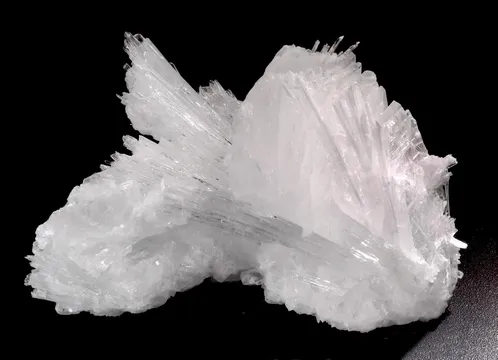
Association is important. Manganite is the dominant historical collector mineral from Ilfeld and is the natural comparison point for pyrolusite from the district. Baryte is a classic gangue mineral, often white to pale and platy, and calcite and quartz are common gangue companions. Hausmannite, braunite, rhodochrosite, sudoite, and other manganese-district minerals are recorded from the broader deposit and sublocalities. On specimens, baryte or manganite association can strengthen locality character, but it can also complicate identification because pyrolusite may occur as alteration or pseudomorphous material after manganite.
The collector should distinguish several Ilfeld “looks.” True crystallized pyrolusite may show primary acicular to prismatic crystals in pockets. Pyrolusite after manganite may retain the elongate, striated, prismatic habit of manganite but have a different surface character and black streak behavior. Compact fibrous masses may be visually appealing but require caution, because historical manganese-oxide labels such as psilomelane, wad, varvicite, and pyrolusite were not always used with modern species precision.
Quality factors are clear. Top Ilfeld pyrolusite has bright metallic luster, three-dimensional radial or acicular crystallization, strong aesthetics for its size, undamaged sprays or terminations, and a credible old locality label. Matrix specimens with contrast, particularly pyrolusite with baryte or recognizable manganese ore matrix, tend to be more desirable than isolated dark lumps. Size matters less than definition: a small cabinet specimen with crisp sparkling acicular growth can be far more important than a larger massive piece.
Ilfeld pyrolusite is not a casual field-collected commodity today. The locality is protected and collecting is forbidden, so market availability depends on old collections, dealer archives, estate material, and specimens that entered the trade before modern restrictions. When a fine Ilfeld pyrolusite appears, its value rests heavily on locality confidence and form. Old labels, collection numbers, historical dealer cards, and previous publication or museum provenance are especially valuable.
No well-documented, locality-specific fake industry is known for Ilfeld pyrolusite, but misidentification is a real concern. Manganese oxides are notoriously difficult in hand specimen, and old labels can be imprecise. A specimen labelled “psilomelane” may prove to be pyrolusite; conversely, a specimen casually labelled pyrolusite may be another manganese oxide. Mindat’s general warning is especially relevant: dendritic black manganese-oxide patterns on rock surfaces are commonly called “pyrolusite,” but properly studied dendrites have not been validated as pyrolusite. For Ilfeld, convincing specimens should be fibrous, acicular, prismatic, massive, or pseudomorphous manganese-oxide material consistent with the vein deposit—not fern-like surface dendrites sold under a fashionable name.
Pseudomorphism after manganite is another authenticity nuance, not necessarily a flaw. Ilfeld is the classic manganite locality, and pyrolusite can occur as alteration after manganite. A specimen may legitimately be pyrolusite while retaining manganite form. The key is disclosure: “pyrolusite after manganite” is a different collecting proposition from “primary pyrolusite crystals,” and the finest primary-looking pyrolusite from Ilfeld is considerably less common.
Condition issues are typical for fibrous and acicular manganese oxides. Crystal sprays can be brittle, edges can be rubbed, and surfaces may lose sparkle through handling, abrasion, dust, or old cleaning attempts. Dense black specimens also hide damage; examine under angled light for broken fibers, flattened tufts, shiny rub marks, and glue or consolidation. Old specimens may have paper fragments glued to the base, which can be a positive provenance clue rather than a problem, but any modern base repairs or reattachments should be disclosed.
On the market, Ilfeld pyrolusite ranges from modest old massive or compact fibrous miniatures to scarce cabinet specimens with excellent radial or acicular crystallization. Dealer and auction descriptions consistently treat rich, well-crystallized Ilfeld pyrolusite as uncommon to rare, especially compared with manganite from the same district. A strong specimen should not be evaluated merely as “black manganese oxide”; it should be judged as a historical locality piece from a closed classic district.
Long before Ilfeld became a name on mineral labels, the black manganese ore had practical magic. One local tradition tells of the “Venetians in the Harz,” strangers said to be searching for gold. The more prosaic explanation is better: Venice, the great medieval center of European glassmaking, needed manganese oxide for the secret of colorless glass. The same dark ore that later gave collectors metallic sprays and black crystals had an industrial life as a glassmaker’s purifier.
The early Ilfeld workings were not orderly mines in the modern sense. Before technical supervision, ore was taken from shallow pits, small shafts, and quarry-like cuts. By August 1724, Oberförster Seibd had seen enough to call for a trained miner. The aim was to secure “beständigen Nutzen für längere Zeiträume” — lasting benefit over longer periods — instead of chaotic extraction. In January 1725, Berg-Inspektor J. G. Sander inspected the Braunstein workings above Ilfeld. He found a district where shafts in hilltops and upper slopes were commonly no more than 10 m deep, water was a constant obstacle, and the deeper shape of the deposit was still largely unknown.
Then came a detail that feels almost theatrical today: in February 1725, a dowser was ordered to walk the veins. The surface traces were marked every 10 Lachters, about 20 m, with stakes. The work focused on the Harzeburg, the Heiligenberger Gang, and the Müncheberg. The best ore shows were on the Heiligenberger Gang and at the Müncheberg, but the mining at Müncheberg was criticized as disorderly. The miners were said not to keep their workings clean; instead, they “würgten den Berg hinter sich” — they “choked the mountain behind them.” It is a wonderfully harsh phrase for the kind of wasteful, unsafe, short-sighted mining that later officials tried to stop.
By 1740 the ore was being mined at four working places, each with about three Zoll of ore thickness. The miners were paid 4 to 6 Gute Groschen per centner of Braunstein, but the apparent wage was not the wage in hand: they had to pay for their own tools and lighting. In 1759, when sales had slowed, only two miners remained. When orders from Holland increased, the administration again intensified work, including plans to drive a tunnel at the Harzeburg to reach ore reserves known in flooded shafts. Some shafts in the 1750s were so narrow that a bucket could not be lowered freely, making hoisting awkward and ventilation worse.
The transport story is almost as vivid as the mining. In 1765, the ore moved in wooden barrels, and the accounts break the journey into hard numbers. Making one barrel and bringing it to the Braunsteinhaus cost 12 Gute Groschen. Moving one barrel from the Braunsteinhaus to Magdeburg cost 3 Reichstaler 12 Gute Groschen. From Magdeburg to Hamburg cost another Reichstaler; from Hamburg to Rotterdam, 1.1 Reichstaler; and the commission for transporting 12 barrels was 10 Reichstaler. By the time a barrel of Ilfeld Braunstein reached the Netherlands, it cost the receiver about 38 Reichstaler. Winter mattered because local farmers handled much of the hauling. From spring through autumn they were occupied with sowing, tending, and harvest, so Braunstein stocks were moved in winter when there was “guter Schlittenbahn” — good sleigh going — and staged at places such as Trautenstein, Wernigerode, or Cattenstedt.
In 1818, Bergschreiber Preu, based at Büchenberg, was responsible for the South Harz manganese operations. He did not live at Ilfeld full time; he came to the Braunsteinhaus for inspections and to direct the miners. That year, the administration worried about improving ore quality, building a crushing works, and meeting demand from across Germany. Theft was taken seriously. Even taking individual pieces for personal display at home counted as theft and could be punished by immediate dismissal. To a modern collector, that single rule is arresting: a miner pocketing a glittering black crystal for the family mantelpiece could lose his job.
The wages from 1820 are equally concrete. In two weeks, miners averaged 3 Reichstaler 11 Gute Groschen and 9 Pfennige net. From gross earnings came deductions for lighting, powder, tool costs, and tool sharpening. A Hauer earned 6 to 10 Gute Groschen more than a Bohrhauer. The Ilfeld miner worked in a world where black manganese ore might be valuable, demand might be urgent, and yet every candle, drill, and sharpened edge could be counted against his pay.
The fortunes of the district rose and fell with the world market. Around 1840, demand declined enough to reduce the manganese workforce from about 100 men to about 20. In 1860, the district still produced about 1,000 centners, and the ore was sold in three grades at prices from 2/3 to 4 1/2 Taler per centner. Russia bought the good grades for a time. In 1872, Ilfeld was still active in 20 small open pits and one adit. But the world was changing: major manganese deposits in the Caucasus came into production, and Spain and India supplied the German market. By 1890, Ilfeld could not compete.
The last act came with war. In 1916, manganese demand revived the old district. The technology was still simple: hand drilling machines fed by a small compressor, handcarts carrying ore to the mine house, a picking bench for sorting, and wooden barrels for shipment, just as in the 18th century. The renewed work was more intense than in earlier periods. By 1921, the reopened mines had produced 33,110 centners of ore, with 1918 alone yielding 9,410 centners. Then foreign manganese returned to the German market after World War I, and the economics collapsed once more. On March 31, 1922, the Ilfeld Braunstein mines were shut down. The old landscape remained: pits, dumps, adits, scars in the forest, and the specimens that had already made their way into collections.