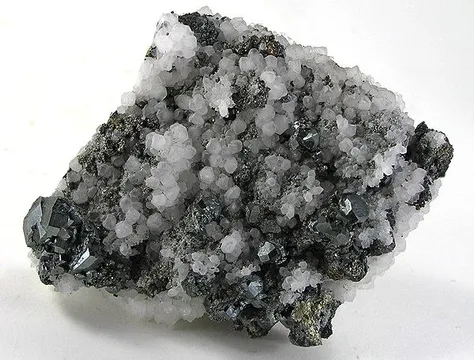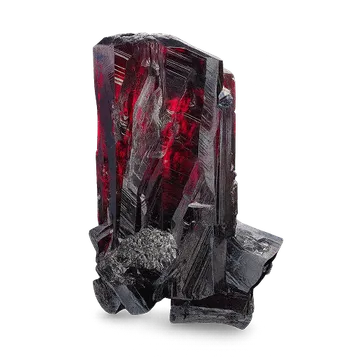
Fresnillo pyrargyrite: dark, lustrous trigonal crystals from steel-black to red backlit; cabinet-quality habit and a key Mexican silver-ore history.
Key facts
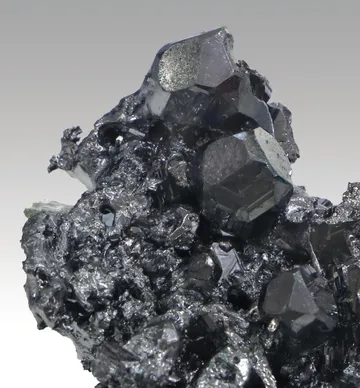
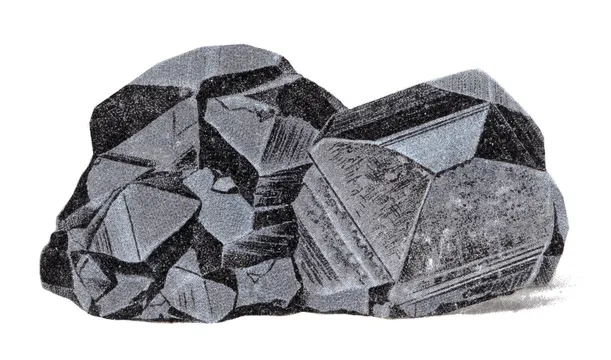
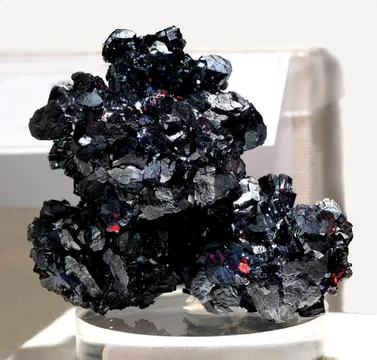
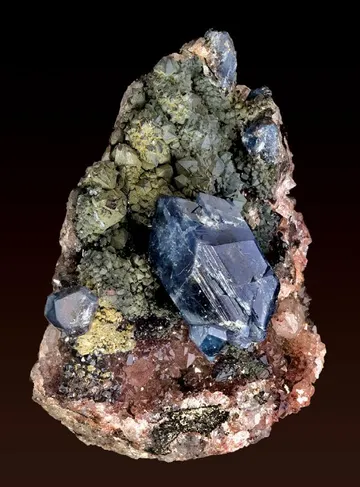
Fresnillo pyrargyrite is one of the defining Mexican “ruby silver” classics: dark, highly lustrous trigonal crystals that can look almost steel-black in reflected light yet glow deep blood-red when backlit. The appeal is not only color. The best Fresnillo pieces have the architecture serious collectors prize—stout six-sided prisms, stepped or flat terminations, striated faces, and compact crystal groups perched on quartz, calcite, or sulfide-rich matrix.

Photo: Wikimedia Commons
The district’s mineralogical setting explains why the specimens are so good. Fresnillo is a long-lived silver-lead-zinc system in which silver occurs not merely as an accessory but as a major ore constituent in sulfosalts and sulfides. Pyrargyrite, Ag3SbS3, belongs here with polybasite, stephanite, acanthite, proustite, tetrahedrite-group minerals, galena, sphalerite, chalcopyrite, pyrite, quartz, and calcite. In the Santo Niño vein—the most studied Fresnillo pyrargyrite setting—pyrargyrite is the dominant sulfosalt in a paragenetic sequence that evolved from Cu-Ag sulfosalt assemblages toward increasingly Ag-rich assemblages and finally acanthite.
Historically, Fresnillo is not just another silver locality. Mining in the area began in the sixteenth century, and the modern Fresnillo mine remains an operating underground silver mine. For collectors, the most exciting chapter came with the post-1970s discovery of rich blind veins, especially the Santo Niño system, where quartz-lined openings and sulfide-rich vein material produced some of the finest pyrargyrite specimens known from Mexico. The combination of world-class silver production, well-documented ore geology, and specimen-quality vug mineralization gives Fresnillo pyrargyrite its special stature: it is both a cabinet mineral and a piece of ore-deposit history.
Search for specimens: View all pyrargyrite specimens from Fresnillo Municipality, Zacatecas, Mexico
Fresnillo lies in central Zacatecas and is one of Mexico’s great silver districts. The principal collector-locality names attached to pyrargyrite specimens include Fresnillo, the Proaño Mine, the San Luis shaft, the San Guillermo vein, the Santo Niño vein, the San Mateo vein, and the Santa Elena mine. Older labels may simply read “Fresnillo, Zacatecas,” while more precise modern labels often identify a shaft, vein, or mine level.
The deposit type is best understood as an intermediate-sulfidation epithermal silver-lead-zinc system, with important veins and, in the broader district, mantos and chimney-style replacement bodies. The epithermal veins are hosted by Mesozoic volcano-sedimentary rocks of the Guerrero terrane and related sedimentary-volcanic units, locally overlain by younger conglomerate and volcanic rocks. Studies of the district describe quartz, calcite, pyrite, sphalerite, galena, pyrargyrite, and arsenopyrite among the principal vein minerals, with silver occurring mainly in sulfosalts and sulfides rather than as simple native-silver masses.
The Santo Niño vein is the best documented pyrargyrite-bearing vein. It is a steep, northeast-trending structure with substantial strike length and vertical extent, hosted by Cretaceous greywackes and shales, mafic volcanic rocks, and Tertiary conglomerate. Published work describes a vein with widths ranging from less than 10 cm to more than 4 m and an average width around 2.5 m. In this setting, pyrargyrite occurs with quartz, calcite, galena, sphalerite, chalcopyrite, pyrite, arsenopyrite, polybasite, stephanite, acanthite, proustite, and tetrahedrite-group minerals.
Mining history is exceptionally long. Fresnillo’s active silver mining tradition reaches back to the mid-1500s, and the modern Fresnillo mine is still an operating underground mine and flotation operation. That continuity matters to collectors: it means that specimens were not simply a short-lived nineteenth-century phenomenon, but emerged across multiple production periods and discoveries, including twentieth-century and later finds from newly developed blind veins.
Collecting access should be understood accordingly. Fresnillo is not a public collecting locality. It is an active, industrial underground mining district, and specimen recovery has historically depended on miners, mine permission, company rules, and the mineral trade. The most desirable pieces in the collector market are typically old-stock, ex-collection, dealer-sourced, or pieces that passed into circulation from earlier working periods. Good documentation—especially a vein, shaft, level, date, or collection history—adds real value.
Fresnillo pyrargyrite is most admired as sharply crystallized, dark metallic to adamantine prisms that reveal red internal color under transmitted light. Reflected-light appearance can be deceptive: a fine crystal may look nearly black, gunmetal-gray, or steel-gray until a strong light behind the specimen exposes the ruby to wine-red body color. The classic collector test is careful backlighting, not prolonged display under strong light.
Crystal habit is commonly prismatic and trigonal, with stout barrel-like crystals, six-sided outlines, stepped faces, and flat to complex terminations. Some Fresnillo crystals are compact, blocky, and highly lustrous; others form clustered groups on quartz or calcite. Fine thumbnail and miniature specimens dominate the collector market, but the district is known for larger crystals and crystal-bearing vug material. Mindat records the San Luis shaft habit as prisms reaching 5 x 5 x 10 cm, while show and dealer descriptions document more typical collector pieces with crystals around 1 cm to several centimeters.
Associations are a major part of identification and aesthetics. Quartz is one of the most common matrix minerals, often as small white prisms lining cavities. Calcite is also frequent. Chalcopyrite may dust pyrargyrite faces as brass-colored microcrystals. Sulfosalt associations can include polybasite, stephanite, miargyrite, proustite, and tetrahedrite-group minerals; ore-mineral associations include acanthite, galena, sphalerite, pyrite, arsenopyrite, and chalcopyrite. These associations are not incidental: they reflect the actual silver-sulfosalt evolution of the veins.
Quality in Fresnillo pyrargyrite depends on four things: luster, form, red transmission, and condition. The best pieces show crisp, complete crystals with bright metallic-adamantine faces and a visible ruby glow through edges or whole crystal sections. Matrix specimens with balanced composition are particularly desirable, especially if the crystals sit cleanly on quartz or calcite and have not been bruised. Freestanding clusters can be dramatic, but their value depends heavily on completeness, because pyrargyrite is soft and brittle.
A locality-specific strength is the range of documented habits. Fresnillo specimens include solid-looking black metallic prisms, gemmier backlit crystals from mid-1990s material, 2006 Judas Shaft material, quartz-associated San Luis shaft pieces, and ore-texture specimens from the Santo Niño vein where pyrargyrite occurs in rich, banded sulfide-carbonate-silica ore. That breadth makes Fresnillo especially attractive to suite builders: one can assemble an aesthetic crystal, a matrix specimen, an ore-texture specimen, and an associated-sulfosalt specimen, all from the same district.
The main authenticity issue is not widespread artificial treatment; it is correct identification and precise locality. Pyrargyrite can be confused visually with proustite, miargyrite, pearceite-polybasite group minerals, acanthite-rich material, and dark silver sulfosalts. For important acquisitions, especially expensive “ruby silver” crystals sold without older provenance, analytical confirmation by Raman spectroscopy, SEM-EDS, or another appropriate method is worthwhile. Fresnillo is a real and famous source, but vague “Fresnillo” labels should be weighed against the specimen’s habit, matrix, associations, and provenance.
No robust, locality-specific pattern of manufactured Fresnillo pyrargyrite fakes appears in the sources reviewed. The more practical concern is mislabeling, overbroad locality attribution, undisclosed repairs, and confusion between pyrargyrite and associated silver minerals. Watch for glued repairs on free-standing clusters, rebuilt terminations, and crystals that have been reset onto unrelated matrix. A loupe examination around contact points and under terminations is essential.
Condition is critical. Pyrargyrite has low hardness, is brittle, and can show bruising on exposed terminations and edges. Bright, mirror-like luster is a premium; dull, etched, or abraded faces reduce desirability unless the piece has unusual size, association, or historical importance. Many older Fresnillo pieces have minor edge wear simply because the mineral is fragile and much material came out of active mining environments.
Light exposure deserves special care. Pyrargyrite is light sensitive: prolonged bright light can darken transparency and reduce the vividness collectors prize. Store important pieces in drawers or dim, UV-filtered cases, and use backlighting only briefly for examination or photography. Avoid sunlight entirely. Cleaning should be conservative: no ultrasonic cleaning, no acids, no hard brushing, and no prolonged soaking. Dust with a soft brush or air bulb; if a brief rinse is unavoidable, dry immediately and gently.
Market availability is intermittent. Lesser thumbnails and study pieces appear from time to time, but high-quality Fresnillo pyrargyrite is not common. Recent dealer and auction records show both modest thumbnails and more expensive, well-crystallized miniatures, with prices varying sharply according to luster, damage, red transmission, size, matrix, and provenance. Fine old-stock pieces from the San Luis shaft, Santo Niño vein, Judas Shaft, or precisely labeled Proaño material deserve special attention.
The most memorable Fresnillo story begins in 1976, when the fabulously rich Santo Niño veins changed the district’s specimen history. Before that discovery, Fresnillo had already been mining for centuries, but the new blind veins were extraordinary: they carried silver grades reported at more than 150 ounces per ton, with much of the silver present as pyrargyrite. Peter Megaw’s famous image of the vein is hard to forget—a rock pick dragged across it left a red streak “like a bleeding wound.”
Those veins were not merely rich ore; they opened cavities. Quartz-lined vugs, from a few centimeters across to walk-in pockets several meters wide and long, were studded with pyrargyrite crystals reportedly reaching 8 cm. For a collector, that is the dream combination: ore-grade silver mineralization and open-space growth. For a mining company, it was something else entirely—valuable silver ore that belonged in the mill, not in specimen flats.
That tension shaped the way Fresnillo specimens reached collections. The mine’s lifeblood was silver production, and removing specimens outside official channels could cost a miner his job. Yet the local mineral trade still saw a steady movement of fine pieces. The result is a classic mining-district paradox: some of Mexico’s greatest pyrargyrites survived precisely because miners recognized beauty in material the crusher would otherwise have destroyed, while an unknown number of equally fine specimens almost certainly disappeared into ore flow unseen.
A second, quieter field episode comes from a 1981 sampling trip organized by A. James Macdonald. A sample from an active stope in the steeply dipping Santo Niño vein, taken 10 m above the 425 level of the Fresnillo mine on September 29, 1981, consisted of a 666.58-gram shard measuring 15 x 7 x 4.5 cm plus six smaller sawn pieces weighing 260.26 grams in total. The specimen was not a sparkling vug piece; it was dense, banded bonanza ore—carbonate, silica, pyrite, and red silver sulfosalts in compact layers only a few millimeters thick. In that kind of rock, the beauty is structural and metallurgical: thin red pyrargyrite-proustite bands enclosed by carbonate-rich gangue, recording the way silver-rich fluids pulsed through the vein.
The district kept changing after the Santo Niño chapter. Starting in 1997, new veins in the western part of the district became important to production, though they were dominated more by acanthite than pyrargyrite. By then, increasing mechanization meant fewer human hands directly encountered the ore faces. For specimen collectors, that matters: the more mechanized the mine, the fewer chances for someone to spot a fragile crystal pocket before blasting, mucking, hauling, and crushing turn it into concentrate.