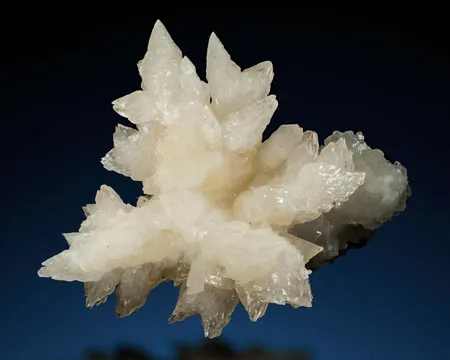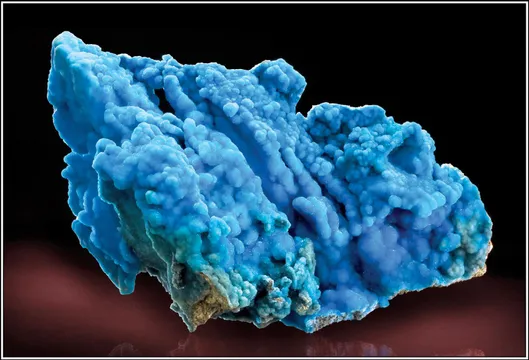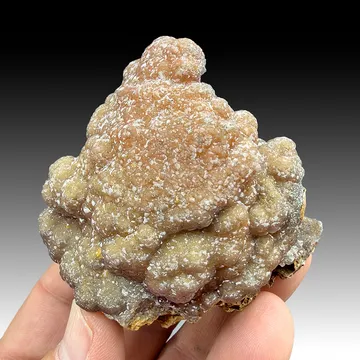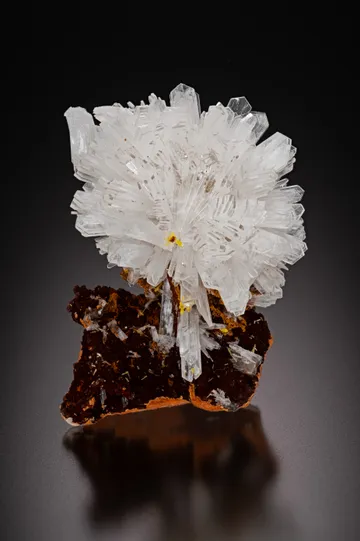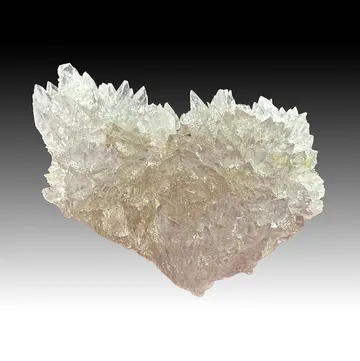
Hemimorphit — Santa Eulalia, Mexiko: glasige, farblose bis getönte Sprays mit scharfen prismatischen Blättern auf Gossan, begehrt für luftige Taschen und lebhaften Glanz.
Key facts
Santa Eulalia-Hemimorphit ist eine der klassischen mexikanischen Ausprägungen der Art: glasig, farblos bis weißes Zink-Silikat in hellen Sprays, Fächern, Propellern und Jackstraw-ähnlichen Clusterstrukturen auf rostigem Gossan. Die feinsten Exemplare besitzen die Knackigkeit, die Sammler sich von kristallisiertem Hemimorphit wünschen — scharfe prismatische Blätter, funkelnder Glanz, translucente Endkappen und einen skulpturalen Kontrast zu ockerbraunen Eisenspaten. In der Hand wirken die besten Stücke überraschend „nass“ glasig; unter einer Vitrine lesen die Sprays unter dem Lampenlicht fast wie gefrorene Brunnen, die aus dem oxidierten Erz wachsen.

Foto: Wikimedia Commons
Der Grund, warum Santa Eulalia eine solch erinnerungswürdige Hemimorphit-Ahnahe liefert, ist in die Architektur des Bezirks geschrieben. Es handelt sich um ein großes Silber-Blei-Zink-Carbonat-Ersetzungssystem, das in Kalkstein und Dolomit liegt, mit tiefer Oxidation, wiederholten Mineralisierungspulsen und reichlich offenem Raum. Diese Bedingungen schufen Hohlräume, Spalte und Ersatzhöhlen, in denen sekundäre Zinkmineralien kristallisieren konnten, statt nur erdige Massen zu bilden. Hemimorphit bildete sich in den oxidierten Teilen des zinkhaltigen Erzes, insbesondere dort, wo zinkreiche Sphalerit-Schichten und Supergene-Zinkzonen von Grundwasser und sauerstoffhaltigen Fluiden angegriffen wurden.
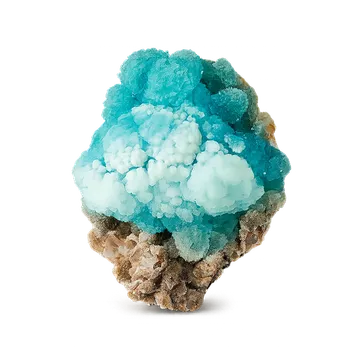
Sammler trennen Hemimorphit aus Santa Eulalia im Allgemeinen in einige visuelle Familien. Die bekanntesten sind weiß bis farblos Sprays aus blattförmigen Kristallen auf Limonit oder Gossan. Farbigere Beispiele zeigen Honig-, Orange-, Rosé- oder Braun-Töne durch Eisenoxid-Streuung oder Einschlüssen, nicht durch den Hemimorphit selbst. Weniger häufig sind botryoidale, blasenartige, blass bläuliche Beschichtungen, und besonders begehrt sind robuste isolierte Blätter oder große freistehende Kristallgruppen aus den Minen Potosí und San Antonio. Die besten Beispiele sind nicht einfach „mexikanischer Hemimorphit“; sie sind erkennbar als Santa Eulalia in ihren luftigen Sprays, eisen-reicher Matrix und dreidimensionaler Kammerwand-Formation.## Gezeigte Exemplare
Santa Eulalia liegt im zentralen Chihuahua, östlich von Chihuahua-Stadt, in der rauen Sierra Santa Eulalia. Das Distrikt wird konventionell in West Camp, Middle Camp und East Camp unterteilt. Für Sammler sind die Bezeichnungen am relevantesten, wie die großen Minen des West Camp, etwa Potosí und Buena Tierra, und die Mine San Antonio im East Camp. Hemimorphitproben sind besonders mit Potosí im West Camp und San Antonio im East Camp assoziiert, obwohl districtsweit übliche Labels auf älteren Stücke vorkommen.
Geologisch gesehen ist Santa Eulalia ein Karbonat-Ersetzungsdepot: Silber-Blei-Zink-Mineralisierung, in kretazische Karbonatgesteine eingebettet, modifiziert durch intrusive Aktivität, Skarnentwicklung, strukturelle Kontrollen und umfangige Oxidation. Der West Camp ist bekannt für massiven Sulfid-Manto- und Kamin-Erzgänge mit lokalen hochgelegenen Eisen-Kalkskarns. Der East Camp wird vom San Antonio-Minengebiet dominiert, mit bilateral zonierten intrusion-kern Skarns und peripheren massiven Sulfidvorkommen. Diese Unterscheidung ist für Sammler keineswegs akademisch: Sie erklärt, warum Etiketten von Potosí und San Antonio verwandte, aber optisch unterschiedliche Teile eines großen, komplexen Erzsystems darstellen können.
Die oxidierten Zonen waren entscheidend für die Probenbildung. Die Frühzeit des Bergbaus folgte reichen nahe der Oberfläche oxidierten Erzen, dominiert von Bleikarbonaten und -sulfaten mit Silberhalogeniden. Später, als der Abbau zu tieferen Sulfidzonen vordrang, setzte sich die Bleisilberproduktion aus Galenit, Sphalerit und verwandten Sulfiden fort. Im San Antonio-Mine erreicht die Oxidation eine hohe, gut definierte Grundwasserlinie auf der 8. Ebene, rund 400 Meter unter der Oberfläche, wo sich eine bemerkenswerte Supergene-Zinkzone entwickelte. Im West Camp ist die Oxidation unregelmäßiger und soll je nach Durchlässigkeit und Dicke der darüberliegenden vulkanischen Gesteine in sehr unterschiedliche Tiefen reichen.
Der Bergbau begann in der Kolonialzeit und dauert, mit Unterbrechungen und wechselnder Schwerpunktsetzung, seit mehr als 300 Jahren an. Das frühe Santa Eulalia war ein Silber-Abbaugebiet; die moderne Produktion betonte ebenfalls Blei und Zink. Die kumulative Ausbeute des Distrikts ist enorm — Berichte sprechen von weit über eine halbe Milliarde Feinunzen Silber und fast sechs Millionen Tonnen Blei und Zink aus seinen Minen. Die Probenrückgewinnung war in den letzten Jahrhunderten besonders wichtig, als Minerale und Händler Mengen von Mikromineralien bis hin zu cavernengroßen Anhäufungen sammelbaren Materials hervorgebracht haben.Sammelzugang sollte als minenbetriebenes, nicht als bloßes Feldsammeln verstanden werden. Santa Eulalia ist ein aktives und historisch industrielles Bergbaugebiet mit unterirdischen Stollen, Privat- oder betrieblich kontrolliertem Eigentum, instabilen oxidierten Zonen und beträchtlichen Sicherheitsrisiken. Für Sammler verfügbare Spezimen gelangen in der Regel durch Bergleute, Händler, alte Sammlungen und Auktionsmaterial zu ihnen statt durch Freizeit-Sammeln. Etiketten mit spezifischer Mine, Camp, Ebene und Sammlungsverlauf erhöhen den echten Wert.
Bemerkenswerte Hemimorphit-Funde, die auf dem Spezimenmarkt dokumentiert sind, umfassen Material aus der Potosí-Mine aus den 1980er Jahren, einen Fund aus den frühen 1990er Jahren, der von Händlern als eine der besseren Perioden für Santa Eulalia-Hemimorphit angesehen wird, einen Fund von Potosí aus 2013 aus den Ebenen 13–17 sowie Material aus San Antonio von der 8. Ebene in Verbindung mit Smithsonit. Spezimen mit genauen Ebenenangaben — wie „16. Ebene, Potosí-Mine“ oder „San Antonio Mine, 8. Ebene“ — sind besonders begehrt, weil so viel älteres Santa Eulalia-Material einfach mit „Santa Eulalia, Chihuahua, Mexiko“ etikettiert wurde.## Eigenschaften von Hemimorphit aus dem Santa Eulalia Mining District, Mexiko
Der klassische Habit ist ein divergierender Spray aus blatt- bis prismatischen Kristallen, üblicherweise weiß, farblos oder leicht cremig, wachsende aus braunem Limonit oder Gossan. Viele Proben zeigen fächerförmige Aggregate, strahlende Rosetten, narrenspießartige Gruppen oder Streckensprengen clusters von überlappenden Blättern. Die Kristalle sind typischerweise glänzend und durchscheinend; bessere Stücke zeigen glassige Abschlüsse und genügend Transparenz an den Rändern, um unter einer Punktlichtquelle stark zu funkeln.
Die meisten sammelbaren Cabinet- und Klein-Cabinet-Beispiele haben einzelne Kristalle im Millimeter- bis niedrigen Zentimeterbereich. Ein guter durchschnittlicher Spray kann Blätter von ca. 6 mm bis 1,1 cm haben. Bessere Proben zeigen häufig Kristalle von ca. 1,8 bis 2,7 cm. Herausragende Stücke aus Santa Eulalia besitzen dokumentierte Kristalle von ca. 3,3 bis 4,7 cm, und seltenes großes Potosí-Material wurde mit einem markanten Blatt von bis zu 8,4 cm beschrieben. Freistehende, isolierte, nahezu zwei Zoll große Kristalle sind für das Mit-Gebiet unüblich, da many Santa Eulalia Kristalle eher in miteinander verwachsenen Fächern und clusterartigen Sprays statt als solitary aufrechte Prismen wachsen.
Die Farbe ist ein wichtiger Hinweis auf den Fundort. Feiner Santa Eulalia Hemimorphit ist gewöhnlich weiß bis farblos, manchmal durch Eisenoxide zu Honig, orange-braun, rosenrot oder dunkler braun erwärmt. Diese Farben sind häufig Überzüge, Einschlüsse oder Staubungen im Zusammenhang mit Limonit, Hämatit oder anderen Eisenoxiden, nicht eine starke Körperfarbe im Hemimorphit. Einige Proben weisen einen roten oder pinken Funken aus eingeschlossenem Hämatit auf. Blass bläulicher botryoidaler Hemimorphit aus dem Distrikt existiert und ist deutlich seltener, aber leuchtend elektrisch-blau sollte mit Vorsicht behandelt werden, sofern nicht durch starke Provenienz- und Prüfungsnachweise gestützt.
Assoziierte Mineralien umfassen Kalkgen, Smithsonit, Mimetit, Limonit, Hämatit, Goethit und andere Oxidationszonenarten. San Antonio-Proben können mit der charakteristischen Smithsonit des Distrikts auftreten, einschließlich bläulich-grüner Reiskorn-Smithsonit mit farblos-hemimorphit-Sprays. Potosí-Proben können Hemimorphit mit Kalkgen, Mimetit, Eisenoxiden oder honigfarbigen sekundären Kalkgen-Beschichtungen zeigen; einige Kalkgen auf Hemimorphit wurden mit blassgelber Fluoreszenz vermerkt.
Qualität bei Santa Eulalia Hemimorphit wird zuerst architektonisch beurteilt. Ein feines Exemplar sollte eine offene, dreidimensionale Spray-Geometrie haben, statt einer flachen Matte aus zerbrochenen Blättern. Glanz sollte glasartig sein, nicht kreidig. Die Kristalle sollten scharf sein, mit sichtbaren Abschlüssen und geringem Kantenschliff. Guter Kontrast zwischen weißem Hemimorphit und rötlich-braunem Gossan ist sehr wünschenswert, ebenso eine ausgewogene Komposition, die sich natürlich zeigt, ohne Stütze. Eisenflecken können den Wert entweder erhöhen oder verringern: eine leichte Honig- oder Rosenstaubung kann Wärme hinzufügen, aber schwere braune Beschichtungen können Transparenz verdecken und es schwieriger machen, Schäden zu bewerten.Die Matrix zählt. Dünne Gossanplatten mit intakten Sprays sind klassisch, aber die besten Ausstellungsstücke haben ausreichend Matrix, um Relief und Kontext zu schaffen, ohne die Kristalle zu überwältigen. Beschnittene Pocket-Wall-Stücke sind häufig, daher sollten Sammler normale periphere Rauheiten von tatsächlichen Kristallschäden unterscheiden. Eine saubere Beschriftung mit Potosí Mine oder San Antonio Mine ist vorzuziehen gegenüber einer breiten Distriktbezeichnung, und eine Mine-Ebene-Bezeichnung ist noch besser.## Collector Notes
Santa Eulalia hemimorphite is available but not common in truly fine quality. Modest small-cabinet specimens appear regularly through dealers and auctions, while large, lustrous, undamaged, well-composed examples with specific mine labels are much scarcer. Recent auction and dealer listings show a broad range: small or modest pieces have sold or listed in the low hundreds of dollars, while stronger examples with unusually large crystals, attractive sprays, or old collection provenance may be priced or valued much higher. As always with classic Mexican secondary minerals, condition and aesthetics can matter more than size alone.
The main authenticity concern is not a documented Santa Eulalia-specific fake, but the broader hemimorphite market problem of dyed blue material. The widely discussed dyed Mexican blue hemimorphite episode involved natural hemimorphite treated with synthetic dye and sold as a dramatic new blue discovery. Because Santa Eulalia’s normal crystallized hemimorphite is white, colorless, iron-tinted, or only rarely pale bluish, any saturated blue “Santa Eulalia” specimen should be examined skeptically. Look for dye concentration in fractures, unusually even color, color bleeding into porous matrix, and suspiciously vivid blue where the species and locality are not known for it.
Locality substitution is another realistic issue. Mexican hemimorphite from Ojuela, Mapimí, Santa Eulalia, and other districts can be superficially similar: white sprays on gossan, bladed crystals, and oxidized zinc associations. A vague “Mexico” label later upgraded to “Santa Eulalia” should not be accepted without supporting evidence. Older handwritten labels, dealer records, collection numbers, or minID documentation are valuable. Specific attributions such as “Potosí Mine, West Camp” or “San Antonio Mine, East Camp” are more meaningful than a district name alone.
Condition is the daily challenge. Hemimorphite is not exceptionally soft, but the Santa Eulalia habit is often delicate: thin blades radiate outward, terminations are exposed, and sprays commonly project from a thin gossan plate. Edge wear around the matrix is normal where a pocket wall was trimmed, but broken crystal tips across the display face reduce value sharply. Check the highest spray tips, the outer fan edges, and any isolated blades. Iron coatings can hide small chips; use side lighting and magnification.
Cleaning should be conservative. The rusty matrix is part of the classic look, and aggressive acid cleaning may remove desirable iron-oxide contrast, destabilize matrix, or affect associated calcite. Avoid soaking uncertain pieces, especially those with calcite, clayey gossan, or friable limonite. Dust removal with a blower, soft brush, or gentle mechanical care is usually safer than chemical treatment.Display-mäßig belohnt Santa Eulalia Hemimorphit gutes Licht. Weiße Sprays können unter diffusem Licht flach wirken, aber unter schräg einfallendem Punktlicht, das die glasigen Prismenseiten trifft, lebendig werden. Gegenlicht kann Transparenz in eisengefärbten Kristallen offenbaren, besonders in Honig- und Rosen Tönen. Da viele Exemplare auf unebenen Gossen sitzen, lohnt sich oft das Anfertigen individueller Ständer für eine bessere Ausrichtung und sichere Handhabung.## Geschichten & Feldnotizen
Santa Eulalias erste große Geschichte ist die, dass ein Mineralbezirk, nicht eine geplante Hauptstadt, eine Stadt aus der Wüste zog. Die Minen in den Bergen waren reich genug, um die Menschen nach früherer Aufgabe wieder anzuziehen, doch Santa Eulalia selbst lag in schwierigem, unwegsamem Gelände, wo eine Expansion problematisch war. Im Jahr 1709 versammelte Gouverneur Antonio de Deza y Ulloa 16 bemerkenswerte Einwohner—Minenarbeiter, Händler, Beamte und Priester—to decide whether the new administrative center should remain in Santa Eulalia or be founded in the nearby valley where the Chuvíscar and Sacramento rivers met. Die Abstimmung ergab genau acht zu acht. Deza y Ulloa brach den Gleichstand zugunsten des Tals, und am 12. Oktober 1709 wurde das neue Real de Minas de San Francisco de Cuéllar gegründet. Diese Siedlung wurde Chihuahua City. In einem ganz realen Sinn wählte Santa Eulalias Erz die Bühne, auf der sich die bürgerliche Geschichte von Chihuahua entfalten würde, während die Minen selbst in den Hügeln verblieben.
Die frühen Silberjahre waren auch Jahre von Arbeitsknappheit, Quecksilberverschuldung, Treibstoffknappheit und harten Verhandlungen zwischen Minenbesitzern, Arbeitern und kolonialen Beamten. Eine Studie der 1730er-Jahre Santa Eulalia Bergbau-Streikaufzeichnungen zeigt, dass zehn Minenarbeiter aus Santa Eulalia und Chihuahua dem Königsschatz 134,5 Quintales Quecksilber über einen Zeitraum von zwei Jahren schuldeten. Mehr als 71 Prozent dieser Schuld konzentrierten sich auf sechs Minenarbeiter, und drei Betreiber—Rosa Ortiz de Campos, Ignacio Alfonso de Riaza und Manuel de San Juan de Santacruz—verantworteten 51 Prozent des geschuldeten Quecksilbers. Diese Zahlen sind kein trockenes Buchhaltungsdepot; sie zeigen, wie stark die Silbermühlen auf Quecksilber-Amalgam angewiesen waren und wie schnell private Bergbauvermögen sich mit königlichem Kredit verflochten.
Der gleiche Streit von 1730 enthüllt die Beschaffenheit eines arbeitenden Bergbaulagers. Arbeitgeber machten sich Sorgen, dass Männer gleichzeitig unter zwei Gönnern angestellt würden. Verordnungen diskutierten das Kennzeichnen von Blei und Silber mit dem eigenen Markenzeichen jedes Miners, die Regulierung des Verkaufs von Holzkohle und Brennholz zum Verhütten, die Beschränkung spekulativer Vorratslagern in Geschäften und Privathäusern sowie die Erzwingung der Lieferung von Salz, Mais, Bohnen und Fleisch in verlässlichere Versorgungskanäle für die Minen. Der Bezirk hatte sogar eine Geschichte des Arbeitsimports aus weiter Ferne: 1716 wurden rund 100 Yaqui-Arbeiter von Sonora zu Santa Eulalias Minen geholt. Hinter dem polierten Hemimorphit in einem modernen Kabinett steht diese ältere Welt aus Quecksilber, Holzkohle, Salzdepots, Schmelzern, Packtrossen und Minenbesitzern, die versuchen, eine Belegschaft in einem abgelegenen Silberlager zusammenzuhalten.Eine spätere Sammelgeschichte gehört den Proben selbst. Die Abbaubetriebe von Santa Eulalia wurden zu einem Labyrinth aus oxidierten Hohlräumen, Sulfid-ersetzten Körpern, Skarnen und alten Hauen. Im letzten Jahrhundert rissen die Bergleute nicht nur gelegentliche Hohlräume auf, sondern Mengen von Proben, groß genug, dass eine moderne mineralogische Übersicht die Produktion von einzelnen Mikromineralien bis hin zu den Inhalten ganzer Höhlen beschrieb. Die besten Hemimorphite des Distrikts sind Produkte dieser Öffnungen: Sprays, die aus Gossan-Fächern gehoben wurden, Kristalle, die aus eisengefärbten Wänden emporragen, und Zink-Silikat-Wachstums, die dem Sprengen, dem Bergbau, dem Zuschneiden, dem Transport und Jahrzehnten des Sammelns standgehalten haben.
Eine solche moderne Sammel-Story ist in Ex-Sammelmaterial sichtbar. Ein Santa Eulalia-Hemimorphit aus der Jack Halpern-Sammlung, katalogisiert als Nr. 970, trug ein altes handschriftliches Etikett mit der Aufschrift „Hemimorphit mit Calcit / Santa Eulalia / Chihuahua / Mexiko“. Das Exemplar selbst war ein Kabinettstück mit Sprays dünner weißer Klingen und verstreutem Calcit auf Gossan. Seine Auktionsbeschreibung betonte Halperns Blick für „Farbe, Qualität und Stil/Aesthetics“, was genau die Linse ist, durch die Santa Eulalia-Hemimorphite bewertet werden sollte. Diese Stücke sind nicht nur chemische Vertreter von Zn4Si2O7(OH)2·H2O; sie sind kleine Kompositionen im Gleichgewicht, Licht und Mineralgeschichte.## Mineralogische Aufzeichnungen & Publikationen
“Hemimorphit (klassische Lokalität)” — Mineralauctions.com / The Arkenstone — Kurzes Auktionsvideo eines Santa Eulalia-Hemimorphits aus der Jack Halpern Sammlung, zeigt die dreidimensionale Sprühstruktur, die von Standbildern oft flach wirkt.
“Hemimorphit (klassische Lokalität)” — Mineral Auctions Eintrag — Auktionsseite mit Standbildern, Abmessungen, Herkunft, Gebotsrekord und Beschreibung eines Cabinet-Santa Eulalia-Hemimorphits mit Calcit.## Weiteres Lesen & Externe Links
Mindat: Santa Eulalia Mining District, Aquiles Serdán Municipality, Chihuahua, Mexico — Bestes Online-Lokalitätenverzeichnis für Santa Eulalia Minen, Artenlisten, Referenzen und Fotos.
Mindat: Hemimorphit aus dem Santa Eulalia Mining District — Arten-Lokalitätseintrag für Hemimorphit im Santa Eulalia Distrikt.
Mindat: Potosí Mine, West Camp, Santa Eulalia Mining District — Lokalfseite für eine der Schlüsselminen von Santa Eulalia, die auf Hemimorphit-Etiketten vertreten ist.
Mindat: San Antonio Mine, East Camp, Santa Eulalia Mining District — Lokalfseite für die East Camp Mine, berühmt für klassische Santa Eulalia-Exemplarsammlungen.
Rock & Gem: „De Colores: Santa Eulalia, Chihuahua“ — Sammlerfreundlicher Überblick über Santa Eulalia als mexikanische karbonatische Ersatzmineral-Classic.
New Mexico Bureau of Geology: Peter K.M. Megaw, „Mineralogy of the Santa Eulalia Mining District, Chihuahua, Mexico“ — Kurze, hochwertige technische Zusammenfassung der Geologie, Produktion, Oxidation und Musterminerale des Distrikts.
Mineral Auctions: Hemimorphit aus der Potosí Mine, West Camp — Nützliche Marktdaten für Potosí-Hemimorphit mit Kristallgröße, Herkunft und Verkaufsinformationen.
Mineral Auctions: Hemimorphit aus der San Antonio Mine, East Camp — Aktuelles Markbeispiel für San Antonio-Hemimorphit mit spezifischer Minenattribuierung und Größenangaben.
Rock & Gem: „Gefärbter Hemimorphit-Kristall: Erkennung von Fälschungen“ — Wichtiger warnender Beitrag über gefärbten blauen Hemimorphit im breiteren mexikanischen Mustermarktm.
Rock & Gem: „Calamine: Jenseits eines Antiallerg-Minerals“ — Nützlicher Hintergrund zu Hemimorphit, Calamin-Begriffen und dem Problem des gefärbten blauen Hemimorphits.