Amethyst
 Quartz
 Fluorite
 Tourmaline
 Malachite
 Azurite
 Rhodochrosite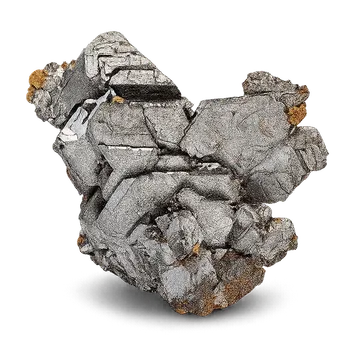
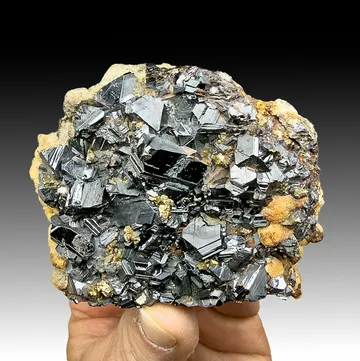
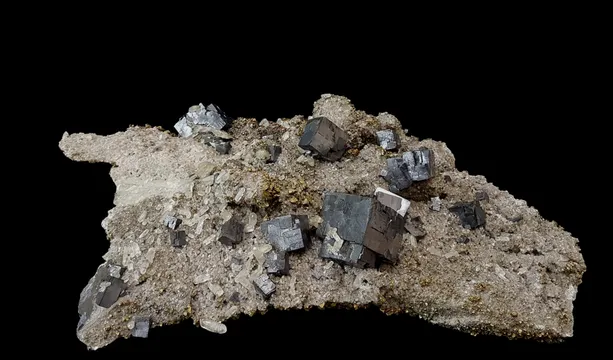
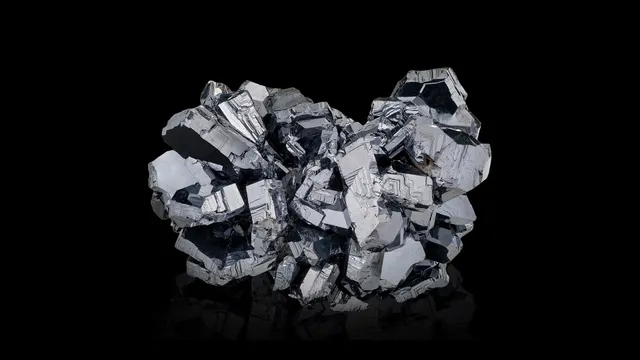
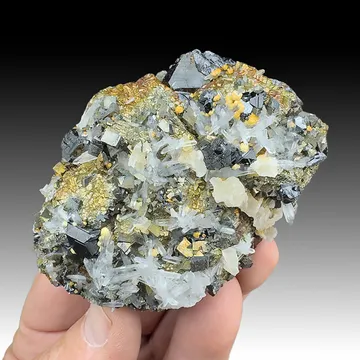
Galena from the Trepča Stari Trg Mine has the look serious collectors associate with the great Balkan sulfide localities: bright metallic lead-gray crystals set among black sphalerite, brassy pyrrhotite or pyrite, pale to pinkish carbonates, and sharp quartz. The best pieces are not simply “galena specimens” in isolation; they are miniature cross-sections of Trepča’s skarn and carbonate-replacement system, with galena acting as the heavy, reflective anchor in complex, sculptural associations.

Photo: Rob Lavinsky, iRocks.com / Wikimedia Commons
The mine’s reputation rests on two overlapping strengths. First, Trepča was a major lead-zinc-silver producer, with galena as one of its principal ore minerals. Second, it produced collector-grade crystal groups in a richly varied mineralogical setting: galena with Fe-rich black sphalerite, pyrite, pyrrhotite, arsenopyrite, quartz, calcite, dolomite, rhodochrosite, siderite, boulangerite, bournonite and other sulfides and sulfosalts. This is why a good Trepča galena often has more visual movement than a simple cube-on-matrix specimen from a more monotonous lead deposit.
The most distinctive galena habit documented from Stari Trg is the unusual six- and twelve-edged star-like morphology formed by oriented growth of galena on pyrrhotite. These are not ordinary cubic galenas and not merely damaged or corroded forms; they were studied crystallographically as intergrown galena individuals whose orientation reflects the symmetry of the pyrrhotite substrate. On published examples, the star-like galena crystals reached about 2 cm, on a hand specimen measuring 3.5 x 9 x 5 cm. Such pieces are rare, technical, and immediately recognizable to collectors who know the locality.
Most collectible Trepča galena, however, is valued for association and balance rather than strangeness alone. Lustrous cuboctahedral galena on quartz, galena tucked between pseudohexagonal pyrrhotite plates, galena with black sphalerite and pale calcite, and galena on drusy rhodochrosite all represent the locality well. The palette is classic: silver-gray PbS against black ZnS, brass-yellow Fe sulfides, white calcite, smoky or colorless quartz, and occasional pink to brownish-pink manganese-bearing carbonates.
Historically, Stari Trg is one of the great names of European mining and specimen collecting. The mine lies in the Trepča valley near Stari Trg/Stantërg, about 8–9 km east to northeast of Mitrovica, and has long been treated in mineralogical literature under the Stari Trg name even where modern administrative usage favors Stan Terg or Trepča. Its 20th-century history runs from British-controlled development through Yugoslav industrial expansion, the upheavals of the late 1980s and 1990s, wartime closure and flooding, and reopening in 2005. For collectors, that long industrial life matters: it explains both the large historic flow of specimens and the uneven, sometimes episodic availability of fresher material.
Search for specimens: View all galena specimens from Trepča Stari Trg Mine, Kosovo
The Stari Trg Mine is the central mine of the Trepča complex, in the Trepča valley near Stari Trg village, close to Mitrovica in northern Kosovo. The locality appears in mineral collections and older literature under several names: Stari Trg Mine, Stan Terg Mine, Trepča Stan Terg, Staritrg, and historically Trepča, Stari Trg. For specimen labels, “Trepča Stari Trg Mine, Mitrovica District, Kosovo” remains the clearest collector format.
Geologically, the deposit is best understood as a Pb-Zn-Ag skarn and carbonate-replacement system developed in recrystallized Upper Triassic limestone and related carbonate rocks. BRGM’s 2007–2008 work describes the broader district as a carbonate-replacement deposit with features of a polymetallic root zone of an eroded low-sulfidation epithermal system. The ore occurs as manto-style bodies and mineralized skarns within the Stari Trg carbonate sequence, concentrated around a structurally important anticline and an Oligo-Miocene volcanic conduit with associated breccia. The same structural trap that made Stari Trg a major orebody also helped produce its collector specimens: open spaces, breccias, carbonate gangue, and sulfide-rich zones where galena could crystallize with sphalerite, pyrrhotite, pyrite, quartz and carbonates.
The principal ore minerals are galena, sphalerite, pyrite and minor chalcopyrite, with pyrrhotite, arsenopyrite and numerous accessory sulfosalts and Bi-bearing phases in the broader paragenesis. In the skarn zone, ilvaite, hedenbergite, actinolite, garnet and magnetite are important rock-forming and ore-associated minerals. In the hydrothermal and carbonate-rich assemblages, collectors encounter calcite, rhodochrosite, dolomite, ankerite, siderite, quartz and sulfides. This is the foundation of Trepča’s specimen style: sulfides are rarely alone; they are framed by carbonates and quartz.
Modern industrial development began in the 1920s. In 1926, Radomir Pašić sold the exclusive rights to exploit Stari Trg to Selection Trust Ltd., which established Trepca Mines Ltd. By 1935, Trepca Mines Ltd. was reported as a profitable lead and silver mining, smelting and refining enterprise and accounted for 91 percent of Kosovo’s lead-zinc ore output. After World War II, the mine and broader combine expanded under Yugoslav management into a large industrial system. Employment and production grew through the socialist period, though later sources describe declining productivity, difficult financing, and falling ore grades by the 1980s.
The late 1980s and 1990s are central to the mine’s modern story. Stari Trg was not only an ore source but also a political flashpoint. Major labor unrest began in 1988, and in February 1989 roughly 1,300 Albanian workers at Stari Trg struck and marched toward Pristina. The mine and combine then suffered from political conflict, labor disruption, financial collapse and under-maintenance. During the Kosovo war of 1998–1999, the mine was closed; published locality summaries describe destroyed smelters and a flooded mine. Stari Trg reopened in 2005, when officials expected an initial output of about 20,000 tonnes of lead and zinc mineral per month.
Collecting access should be regarded as restricted. This is an active industrial mine, not a casual collecting locality. Specimens reaching collectors have come through mine production, older collections, dealer inventories, miners’ or local channels, and occasional post-reopening flows. “Visit Trepça” and related heritage efforts promote guided access to the industrial history and museum context of the mine, but underground visitor access is not the same as permission to collect. For collectors, the practical route is the specimen market, with careful attention to provenance and old labels.
Notable finds include world-class pyrrhotite and pyrite-after-pyrrhotite groups with galena, Fe-rich sphalerite and carbonates; galena-quartz specimens with large metallic crystals; galena on rhodochrosite; galena with arsenopyrite and boulangerite; and the rare star-like galena crystals grown in orientation on pyrrhotite. The mine’s mineral diversity is unusually high for a collector locality: Mindat lists 79 valid minerals for the Trepča Mine locality, and the Mineralogical Record article on Stari Trg notes more than 60 mineral species identified from the deposit.
Trepča galena is typically metallic lead-gray to silver-gray, with bright luster on fresh crystal faces and a darker, slightly gunmetal appearance where faces are coated, contacted, or naturally dulled. The most familiar crystals are cubes and cuboctahedra, often sharp enough to show clean geometry but commonly modified by octahedral faces, stepped growth, edge development, or complex face texture. Fine pieces may show bright, reflective faces against a darker matrix of sphalerite or pyrrhotite.
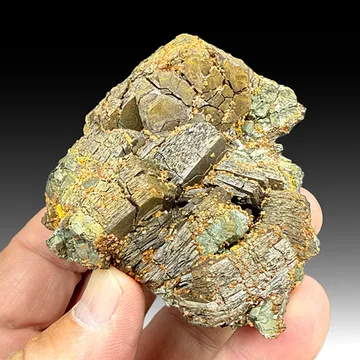
The strongest visual specimens are association pieces. Galena commonly appears with black, lustrous, Fe-rich sphalerite; brassy to bronze pyrrhotite; pyrite, including pyrite pseudomorphs and epimorphs after pyrrhotite; arsenopyrite; quartz; calcite; dolomite; siderite; rhodochrosite; boulangerite; chalcopyrite; and bournonite. The most “Trepča-looking” pieces often combine at least three of these: for example, galena plus sphalerite plus calcite, or galena plus pyrrhotite plus quartz, or galena with pyrite-after-pyrrhotite and manganese-bearing carbonate.
Size ranges are broad. Small cabinet pieces with galena crystals in the 5–15 mm range are common enough on the market, especially where galena is a supporting mineral in sphalerite, pyrite, pyrrhotite, calcite or quartz specimens. Better cabinet and large-cabinet specimens can carry galena crystals several centimeters across, especially on quartz or sulfide matrix. Published and dealer-described examples include 6 cm-class hand specimens with galena, quartz and calcite; 7 cm association pieces with galena, pyrite, rhodochrosite, calcite and sphalerite; and larger display pieces where galena is one part of a multi-mineral sulfide cluster. The rare star-like galenas described from Stari Trg reached about 2 cm and are desirable less for size than for crystallographic character.
The star-like habit deserves special attention. In the studied Stari Trg specimen, six- and twelve-edged galena crystals sat on a pyrrhotite base with arsenopyrite, Fe-rich sphalerite, pyrite, rhombohedral carbonate, quartz and boulangerite. The galena individuals show octahedral habit with small cubic faces, but their intergrowth creates a star-like morphology. The key relationship is oriented growth of galena on pyrrhotite, with galena individuals rotated by 60 degrees relative to one another, reflecting the symmetry of the pyrrhotite substrate. For collectors, this means true star-like Trepča galena should be examined as an epitaxial association, not merely as an odd “twin” or a broken cluster.
Quality is judged on several locality-specific factors:
Trepča galena is not rare as a locality species, but top-quality examples are selective. The market regularly offers Trepča association pieces containing galena, especially with calcite, sphalerite, quartz, pyrite or pyrrhotite. What is less common is a specimen where galena is the visual star: large, lustrous, well-formed crystals in excellent condition, on an attractive and balanced matrix, with unmistakable Stari Trg associations. True star-like galena groups from Stari Trg are rare and should be treated as a specialized subcategory.
The most common authenticity issue is not synthetic galena; it is vague or inflated locality attribution. Trepča is used loosely in the marketplace, sometimes for anything from the broader Trepča complex or even for visually similar Balkan sulfide assemblages. A precise label should distinguish Stari Trg/Stan Terg from other Kosovo localities. Old Yugoslav labels may say “Trepča, Yugoslavia,” “Stari Trg,” “Stan Trg,” “Stan Terg,” “Kosovska Mitrovica,” or “Serbia” in older political-geographic usage. Those labels can be historically legitimate, but they should be interpreted carefully rather than “corrected” too aggressively.
I know of no well-documented, locality-specific fake galena problem centered on Trepča Stari Trg. General galena fakes and alterations do exist in the mineral trade, especially glued galena fragments in artificial geodes, enhanced surfaces, and composite specimens. These are not characteristic Trepča products, but the usual checks apply: look for unnatural glue lines, mismatched matrix, broken-and-reseated crystals, suspiciously uniform “sparkle,” and galena pieces placed into cavities or onto matrices that do not fit the known Trepča paragenesis. A credible Trepča galena should make geological sense with sphalerite, pyrite, pyrrhotite, quartz, calcite, rhodochrosite, dolomite, siderite, arsenopyrite, boulangerite, chalcopyrite or related sulfide-carbonate assemblages.
Condition is a more important practical concern than outright fakery. Galena has perfect cubic cleavage and low hardness, so bruised corners, flattened contact points, edge chips and cleaved faces are common. Pyrrhotite and pyrite-associated pieces can also show oxidation issues, especially if stored in damp conditions. Trepča pyrrhotite may be attractive but should be kept dry, stable and away from high humidity; associated marcasite or pyrite pseudomorphs also deserve caution. Carbonates such as calcite and rhodochrosite can be scratched or etched by acid cleaning, so overly bright or oddly fresh carbonate surfaces should prompt careful inspection.
Handling is straightforward but should be disciplined. Galena is PbS, the primary ore of lead. It is not dangerous to display under normal conditions, but collectors should wash hands after handling, avoid creating dust, and keep specimens away from children who might handle them carelessly. Do not use aggressive cleaning methods that abrade galena or produce particulate lead-bearing dust.
For value, the sweet spot is cabinet-size association specimens with good visual contrast and minimal damage. Small galena-bearing Trepča pieces can remain affordable because the locality produced large quantities of sulfide material. Fine old pieces with balanced composition, sharp galena crystals, excellent sphalerite or pyrrhotite, and strong provenance move into a higher tier. Star-like galena, large lustrous galena-on-quartz, and historically labeled old-collection specimens are the pieces to watch closely.
The most memorable Trepča galena story begins not with a spectacular pocket but with a crystallographic puzzle. A large hand specimen from Stari Trg carried six- and twelve-edged star-like galena crystals lying on pyrrhotite. Around them were arsenopyrite, Fe-rich sphalerite, pyrite, rhombohedral carbonate, quartz and boulangerite—the sort of dense, metallic association that makes Trepča specimens feel almost overbuilt. The galena stars were only up to about 2 cm, yet they were important enough to merit a focused study.
At first glance, the stars looked like they might be ordinary spinel-law-style twins, the kind of explanation a collector might reach for when faced with repeated metallic arms. But the geometry did not behave that simply. The researchers found that the galena individuals were oriented on pyrrhotite, with one pair of galena cubic faces parallel to the basal pinacoid of pyrrhotite and another pair parallel to pyrrhotite prism faces. Because pyrrhotite imposed three possible orientations, the galena individuals were rotated by 60 degrees relative to one another. The result was a star-shaped galena object that records, in miniature, the symmetry of the mineral it grew on. For a collector, that is the difference between an odd-looking galena and a locality signature.
The human history of Stari Trg is just as intense. Modern Trepča began with a business deal in 1926, when Radomir Pašić sold the exclusive rights to mineral exploitation at Stari Trg to Selection Trust Ltd. The British company then established Trepca Mines Ltd. Within less than a decade, the enterprise was powerful: in 1935 it reported a profit of £200,000 and accounted for 91 percent of Kosovo’s lead-zinc ore output. The same ore system that gives collectors galena, sphalerite and pyrrhotite combinations was already driving a major industrial economy built around lead, zinc, silver and smelting.
By the late Yugoslav period, Trepča had become far more than a mine. It was a sprawling “big system” of mines, factories and assets: Stari Trg, Kišnica, Kopaonik, Novo Brdo and Ajvalija, plus battery, paint, munitions, jewelry, galvanizing and other industrial operations. At its height, employment reached 22,885 workers in 1988. Yet the figures tell a harder story underneath the scale. The same historical report notes that Stari Trg had reached peak ore production in 1939 and that Trepča’s later expansion was accompanied by declining productivity, heavy dependence on external funding, and mounting financial strain.
Then the mine became a political stage. In May 1988 a major strike broke out at Stari Trg. In February 1989, about 1,300 Albanian workers took part in an eight-hour strike, followed by a miners’ march toward Pristina. The consequences were severe: some miners were dismissed or arrested, others left in solidarity. From 1989 to 1991, Trepča employment fell by 57 percent, from 13,261 to 5,720. At the end of 1990, the Stari Trg mining collective had only 700 workers left, and a historical account states that merely ten of them were actually miners. That single number—ten miners left in the flagship mining collective—captures the collapse more sharply than any broad phrase could.
The 1990s brought financial and operational breakdown. By the end of 1991, Trepča owed around 115 million euros to banks, was in arrears to suppliers and workers, and had unpaid electricity bills. In May 1993, Trepča manager Krsta Jovanović reportedly warned that raw materials, input materials and spare parts were exhausted and that the whole complex might have to stop unless the government supplied more funds. Stari Trg produced only three months in 1994. The mine that had once fed a vast industrial system had become a symbol of everything unstable around it.
After the Kosovo war of 1998–1999, Stari Trg was closed and flooded. Its reopening in 2005 was therefore more than a technical event. Radio Free Europe reported on August 22, 2005 that the mine had reopened for the first time since the end of the 1998–1999 conflict, with officials expecting about 20,000 tonnes of lead and zinc mineral per month in the first phase. For collectors, the reopening helped explain why post-2005 Trepča material reappeared on the market, though the old classics from pre-war and Yugoslav-era collections remain especially desirable.