






Trepča Stari Trg Mine, Kosovo — Pyrrhotite with bronze plates and pseudo-hex crystals; famed for pyrite and galena pseudomorphs and its deep collector locality…
Key facts
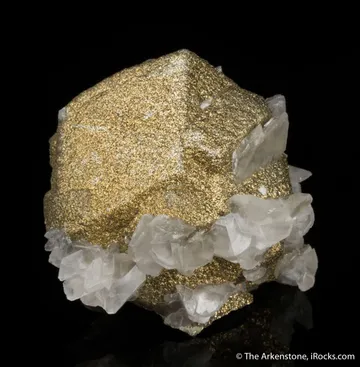
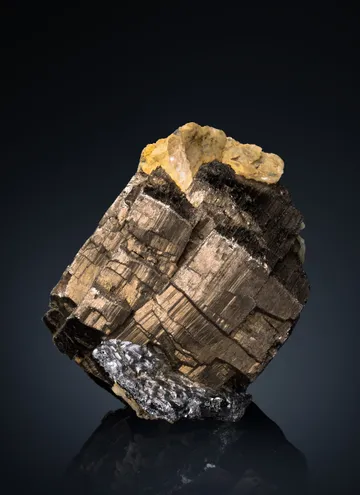
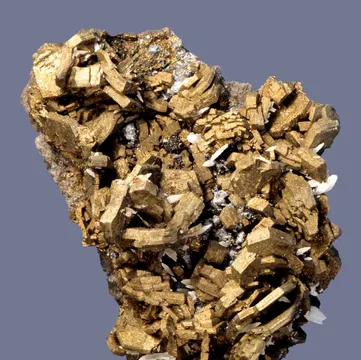
Pyrrhotite from the Trepča Stari Trg Mine is one of the great European expressions of the species: bronze to yellow-brown metallic plates, pseudo-hexagonal crystals, lamellar stacks, and sculptural groups that look less like ordinary sulfide ore than hammered sheets of old brass. Collectors prize Trepča material for its combination of mineralogical character and display presence. The best examples show sharp tabular crystals or stacked rosettes rising from black sphalerite, bright galena, quartz, calcite, siderite, dolomite, rhodochrosite, or pyrite. The locality is also famous for pyrite and galena pseudomorphs after pyrrhotite, so the outline of the original pyrrhotite crystal is often preserved even where the chemistry has changed.

Photo: James St. John via Wikimedia Commons
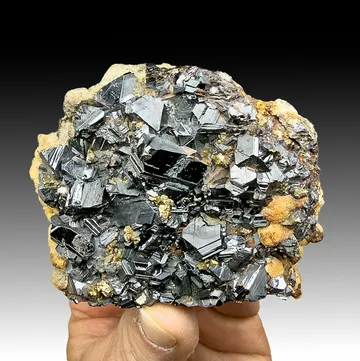
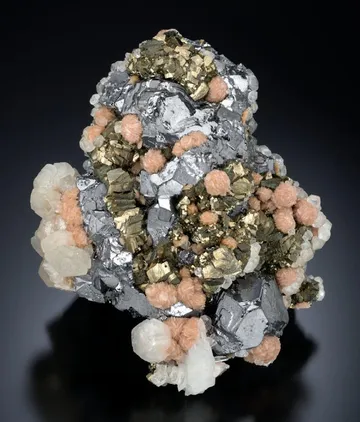
The visual signature is distinctive. Trepča pyrrhotite is not usually a clean, isolated, single-crystal mineral in the way a textbook crystal might be; it is a locality mineral with context. It belongs to a dense Pb-Zn-Ag skarn and hydrothermal system, where sulfides and carbonates competed for space in open cavities and replacement zones. That is why a good Trepča pyrrhotite specimen often reads as an entire mineralogical paragraph: bronze pyrrhotite plates, black sphalerite, steel-gray galena, white or colorless calcite, drusy quartz, and occasional arsenopyrite or siderite. This is precisely what gives the locality its depth for serious collectors.

Photo: Rob Lavinsky via Wikimedia Commons
Geologically, the mine sits in the Trepča ore belt of the Vardar-zone metallogenic province. The Stari Trg deposit is classically described as a Pb-Zn-Ag skarn and carbonate-replacement system hosted mainly by recrystallized Upper Triassic limestone near schists and Tertiary volcanic rocks. Mineralization was shaped by magmatic-hydrothermal fluids, skarn formation, later open-system hydrothermal activity, and a phreatomagmatic breccia pipe that played an important role in the ore-forming history. Pyrrhotite belongs to the high-temperature sulfide story of the mine, alongside pyrite, arsenopyrite, sphalerite, galena, chalcopyrite, marcasite, magnetite, ilvaite, quartz, and carbonates.
Historically, Trepča is much more than a specimen locality. Mining in the district reaches back to the medieval Balkans; modern industrial mining began under British ownership in the late 1920s and early 1930s; the mine later became one of the major lead-zinc-silver producers of the former Yugoslavia. For collectors, however, the most important legacy is the remarkable flow of cabinet minerals that reached European and international markets: galena, sphalerite, pyrite, arsenopyrite, rhodochrosite, calcite, ludlamite, vivianite, boulangerite, bournonite, and, centrally, pyrrhotite and pseudomorphs after it.
The collector’s ideal is a sharp, bronze, pseudo-hexagonal pyrrhotite crystal or cluster with clean display geometry and lively contrast. Fine pieces may show stacked tabular crystals with striated or lamellar edges, sometimes resembling a pile of thin metallic wafers. The color should be warm bronze to yellow-brown rather than dull gray or rusty. Matrix is not a defect when it strengthens the composition: black sphalerite, glassy quartz, bright galena, or pale calcite can lift a Trepča pyrrhotite specimen from merely good to unmistakably classic.
Search for specimens: View all pyrrhotite specimens from Trepča Stari Trg Mine, Kosovo
The Trepča Stari Trg Mine, also written Stan Terg, Stan Trg, or historically Stari Trg, is the central mine of the Trepča complex near Mitrovica in northern Kosovo. Older specimen labels may use Yugoslavia, Serbia, Kosovska Mitrovica, Trepça, Trepca, Stari Trg, Stan Trg, or Stan Terg; all of these label traditions appear in the specimen record, and careful collectors should preserve them rather than “modernize” them away.
The deposit is a polymetallic Pb-Zn-Ag system developed in and around recrystallized limestone, schist contacts, volcanic rocks, skarns, carbonate-replacement bodies, veins, and breccias. The main orebodies are described as mantos, large veins, columns, and stockwork-like zones. Skarn minerals include garnet, hedenbergite, ilvaite, actinolite, magnetite, pyrite, pyrrhotite, chalcopyrite, sphalerite, and galena. Later hydrothermal stages introduced multiple generations of sulfides and sulfosalts with quartz and Fe-Mn-Ca-Mg carbonates.
A key feature of the mine’s geology is the phreatomagmatic breccia pipe near the limestone-schist contact. It is not simply a dramatic structural feature; it mattered to ore formation. Research on the deposit shows that brecciation helped change the system from a more closed lithostatic regime to a more open hydrostatic one, promoting retrograde skarn alteration and sulfide deposition. That context helps explain why Trepča can produce such complex specimens: ore deposition was not one simple event but a multi-stage system of skarn growth, brecciation, hydrothermal replacement, sulfide precipitation, carbonate growth, and later overprinting.
Mining in the district is ancient. Medieval exploitation centered on silver-bearing ores, and the name Stari Trg itself carries the sense of “old market” or “old place” in South Slavic usage. Modern industrial development began when mineral rights at Stari Trg were acquired in the 1920s by British interests connected with Selection Trust. Trepča Mines Ltd. was established in 1927; the Stari Trg mine was opened; a flotation plant was built at Zvečan and connected to the mine by an overhead cable system; and ore processing began in 1930. Lead and silver smelting capacity at Zvečan was built at the end of the 1930s and completed around 1940.
The mine’s modern production history is inseparable from the political history of Kosovo and the former Yugoslavia. Stari Trg was a major industrial asset through much of the 20th century, but production declined in the late socialist period, was disrupted by labor and political conflict in the late 1980s and 1990s, and the mine was closed during the Kosovo war of 1998–1999. Accounts of the postwar period describe the mine as having flooded before reopening in the 2000s. For the mineral collector, this means that Trepča pyrrhotite on the market comes from several generations: older Yugoslav-era material, classic 1970s and 1980s finds, post-reopening production and recovery, and redistributed old collections.
Collecting access should be regarded as industrial and controlled, not casual field collecting. Stari Trg is an underground ore mine, and specimens traditionally reached collectors through miners, mine geologists, local collections, dealers, museum exchanges, and later secondary market dispersals. The best material is not the product of surface collecting on dumps by visitors; it is usually mine-recovered specimen ore from underground workings. Serious buyers should value provenance notes such as level, find period, old Yugoslav labels, dealer history, or collection pedigree when available.
Notable finds include world-class pyrrhotite crystals, pyrite pseudomorphs after pyrrhotite, galena growths oriented on pyrrhotite, and rich sulfide-carbonate combination specimens. Mindat records the pyrrhotite occurrence as “world renowned” and describes the habit as hexagonal tablets and towers to many centimeters. Dealer and collection records repeatedly describe pseudo-hexagonal crystals in the 2–3 cm range, larger cabinet groups, and pyrite pseudomorphs retaining the pyrrhotite outline. One documented Stari Trg specimen in the literature carries unusual six- and twelve-edged star-like galena crystals grown on pyrrhotite, showing that pyrrhotite at Trepča was not merely an ore mineral but a crystallographic substrate for later mineral growth.
Trepča pyrrhotite is best known for tabular, pseudo-hexagonal crystals, stacked plate groups, rosettes, and “towers” of bronze metallic crystals. The formula is Fe1-xS, and the species’ non-stoichiometric iron deficiency is part of what gives pyrrhotite its magnetic behavior. In hand specimen, however, the locality character is mostly visual: bronze, yellow-brown, or brassy-brown metallic plates with striated faces and lamellar edges. On fresh, high-quality examples, the luster can be bright and silky; on older or poorly stored specimens, surfaces may darken, dull, or show oxidation.
Crystal sizes vary widely. Small plates and clusters in the 1–3 cm range are common enough in specimen commerce to define the classic look. Fine cabinet specimens can carry larger individual groups, and Mindat’s locality description notes crystals to many centimeters. Larger plates and rosette-like aggregates become increasingly condition-sensitive, because pyrrhotite breaks and bruises more readily than quartz or calcite and because the thin tabular edges show damage plainly.
Associations are one of the locality’s strengths. The most common companions seen in photo and specimen records are pyrite, sphalerite, calcite, quartz, galena, arsenopyrite, rhodochrosite, dolomite, siderite, chalcopyrite, boulangerite, hedenbergite, bournonite, and plumosite. Sphalerite is often black and lustrous; galena may occur as cubes, modified crystals, or oriented growths; calcite can be clear, white, or nail-head; quartz may be drusy or prismatic; siderite and dolomite provide carbonate texture and color. The best Trepča pieces use these associations aesthetically rather than merely carrying them as labels.
One important collecting distinction is between true pyrrhotite and pseudomorphs after pyrrhotite. Trepča is famous for both. True pyrrhotite should show the warm bronze pyrrhotite color, the proper metallic luster, and often some magnetic response. Pyrite after pyrrhotite preserves the pseudo-hexagonal or bladed form but changes the color and surface to brighter brassy pyrite. Galena pseudomorphs or oriented galena overgrowths after pyrrhotite may preserve the geometry while presenting a lead-gray or silvery surface. These are not “lesser” specimens when accurately identified; in fact, Trepča pseudomorphs after pyrrhotite are a major collecting category in their own right. The problem arises only when a pseudomorph is sold carelessly as unaltered pyrrhotite.
Quality factors for Trepča pyrrhotite are straightforward but strict. Look first for crystal definition: clean pseudo-hexagonal outlines, distinct plates, and crisp edges. Then look for luster and color: bronze and lively is better than flat, gray, or oxidized. Third, judge the composition. A pyrrhotite plate on black sphalerite with a few bright galena cubes or pale calcites is usually more desirable than an indistinct sulfide mass, even if the latter is larger. Fourth, examine condition with magnification. Chipped plate edges, rubbed high points, repaired matrix, and oxidation blooms can all reduce value sharply.
The finest examples have the unmistakable Trepča balance: not simply “a pyrrhotite,” but a sulfide association from one of Europe’s great polymetallic mines, with enough crystallographic clarity to stand beside Dalnegorsk, Huanzala, and other classic pyrrhotite localities while still looking entirely its own.
There are no well-documented, locality-specific manufactured fakes of Trepča pyrrhotite that dominate the market. The main authenticity issue is misidentification rather than fabrication. Trepča has produced abundant pyrite pseudomorphs after pyrrhotite, and these are sometimes shortened in listings to “pyrrhotite” even when the visible mineral is pyrite retaining the old pyrrhotite habit. Conversely, some mixed specimens legitimately contain both pyrrhotite and pyrite after pyrrhotite. A careful label should say what is actually present: pyrrhotite, pyrite after pyrrhotite, galena after pyrrhotite, or a combination.
A small magnet can be useful, but it should be used gently. Pyrrhotite is commonly magnetic to some degree, but crystal form, oxidation, intergrowths, and replacement can complicate a simple yes-or-no test. Do not drag a strong magnet across a valuable specimen; the plates and associated minerals can be fragile, and the test is diagnostic only in context. Color and habit are also important. Trepča pyrrhotite is usually warmer and browner than bright pyrite, while pyrite pseudomorphs tend to be sharper brassy yellow and may show pyritic sparkle on surfaces that still preserve pyrrhotite geometry.
Condition is a serious issue. Pyrrhotite is a reactive iron sulfide and can tarnish or oxidize in humid, unstable environments. Trepča specimens should be kept dry, away from temperature swings, and ideally in a cabinet or box with stable low humidity. Watch for powdery oxidation products, fresh rusty areas, sour odor, or progressive dulling. Many old Trepča pieces remain stable for decades, but poor storage can harm them. Specimens with marcasite or fine-grained pyrite associates deserve extra caution, because those sulfides can also deteriorate.
Mechanical damage is equally common. The tabular crystals can chip along edges; stacked lamellae can bruise; and mixed sulfide-carbonate matrix can be brittle. Old mining and trimming damage is not unusual on larger cabinet specimens. A little edge chatter may be acceptable on a dramatic old piece, but a collector should distinguish natural etching or growth roughness from actual breakage. Natural etched surfaces are part of the locality’s texture; fresh metallic scars and flattened high points are damage.
Rarity is best understood by level of quality. Trepča pyrrhotite as a species-locality combination is not rare: examples appear regularly from old collections, dealer inventories, auctions, and marketplace listings. Sharp, lustrous, well-composed pyrrhotite with strong bronze color is much scarcer. Large cabinet groups with fine aesthetics, minimal damage, and good provenance are genuinely desirable. Pyrite pseudomorphs after pyrrhotite are also available, but the best sculptural pseudomorph plates and rosettes have their own collector following and should not be treated as a budget substitute for pyrrhotite.
Market availability remains healthy but uneven. Small to medium specimens and old stock pieces appear periodically, often labeled from Trepča, Stari Trg, Stan Terg, or former Yugoslavia. Cabinet specimens with strong aesthetics and multiple species associations can command a premium, especially when they show bright pseudo-hexagonal crystals, classic black sphalerite contrast, or old collection pedigree. For EarthWonders buyers, the strongest purchase is an accurately labeled, visually balanced specimen with honest condition notes and enough locality detail to preserve the history of the mine.
In the late 1920s, Trepča’s modern story began as a very British mining venture in a deeply old Balkan mining landscape. In 1926, Radomir Pašić, son of former Yugoslav Prime Minister Nikola Pašić, sold exclusive exploration rights at Stari Trg to Selection Trust Ltd. of London. On 9 September 1927 those rights were vested into Trepča Mines Ltd. The company opened the Stari Trg mine, built the Zvečan flotation works several kilometers away, and connected mine to plant by an overhead cable system. By September 1930 the flotation plant was processing ore. By 1935 the mine was reporting a £200,000 profit. This was not a marginal curiosity; it was a highly organized industrial mine built around an orebody already old in regional memory.
The name itself carries a small documentary ghost. “Stan Terg” and “Stan Trg” appear on many labels, but the older place-name is Stari Trg. Later accounts describe Stan Trg as a misreading or bureaucratic deformation of Stari Trg, and collectors still encounter all of the spellings. A specimen label reading “Trepca, Stan Terg, Yugoslavia” is therefore not an error to be erased; it is a fossil of the mine’s administrative and political history.
The most dramatic human episode attached to the mine came in February 1989. About 1,300 Albanian miners at Stari Trg began an underground hunger strike on 20 February and remained below ground for eight days. Contemporary and later accounts place them hundreds of meters underground; one detailed economic history gives about 1,300 workers at 600 meters, while other commemorative accounts describe the strike occurring 600 to 800 meters underground. The strike became a defining event in Kosovo’s late Yugoslav history. It was not an abstract protest staged in a city square; it unfolded inside the same underground system that produced the pyrrhotite, sphalerite, galena, and pyrite specimens now sitting in cabinets around the world.
The mine’s later years were equally turbulent. Production declined through the late 1980s and 1990s. The Kosovo war brought closure in 1998–1999, and accounts of the period describe the mine as flooded before reopening in the 2000s. That interruption matters to collectors because it separates older Yugoslav-era material from later pieces and from specimens redistributed through old European collections. A Trepča pyrrhotite with an old label is not just “old stock”; it may belong to a vanished period of mine access, specimen recovery, and institutional exchange.
There is also a quieter scientific story in the pyrrhotite itself. A published study of star-like galena crystals from Stari Trg describes six- and twelve-edged galena forms lying on a base of pyrrhotite. The crystals looked superficially like spinel-law twins, but detailed work showed a different explanation: oriented growth of galena on pyrrhotite. The hand specimen measured 3.5 x 9 x 5 cm, and the associated minerals included arsenopyrite, Fe-rich sphalerite, pyrite, carbonate, quartz, and boulangerite. That small specimen captured the essence of Trepča mineralogy: crystallography, overgrowth, sulfide complexity, and aesthetic oddity all locked into one piece of ore.
_1_(18696978520).jpg)
