






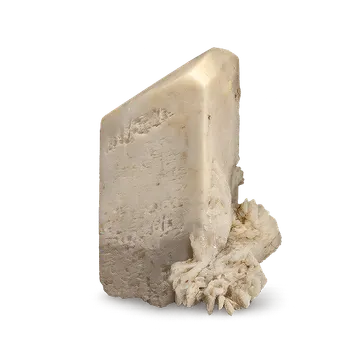
Paprok feldspar, Nuristan, Afghanistan — albite cleavelandite and microcline in a rare lithium pegmatite, with tourmaline and topaz; prized by collectors.
Key facts
Paprok feldspar is not a collector classic because it usually appears as a single, isolated feldspar crystal. Its fame rests on something more architectural: snow-white albite, most often in the platy cleavelandite habit, forming the airy matrix around Paprok’s gem elbaite, smoky quartz, topaz, spodumene, lepidolite, beryl, and rare phosphates. In the best specimens the feldspar is not background at all; it is the stage. Bright, pearly cleavelandite blades make the pinks, greens, blues, and purples of Paprok tourmaline look even more electric, while blockier microcline gives certain cabinet pieces the massive pegmatitic structure that serious collectors expect from a highly fractionated lithium pegmatite.

Photo: Géry Parent / Wikimedia Commons
Mineralogically, Paprok sits in one of the great rare-element pegmatite terrains of the Hindu Kush. The deposit belongs to the LCT pegmatite family: lithium-cesium-tantalum systems genetically tied to fertile, two-mica granites and enriched in lithium, beryllium, boron, phosphorous, fluorine, tantalum, niobium, tin, rubidium, and cesium. That chemistry explains the Paprok look. Albite and microcline are not incidental gangue; they are part of the same fractionated system that produced spodumene, lepidolite, elbaite, beryl, pollucite, microlite-group minerals, tantalite-(Mn), stibiotantalite, hambergite, hydroxylherderite, beryllonite, väyrynenite, and viitaniemiite.

Photo: Géry Parent / Wikimedia Commons
For feldspar collectors, Paprok is primarily a locality for albite var. cleavelandite and microcline in combination specimens. The most desirable pieces show crisp, bright, undamaged cleavelandite rosettes or sheaves supporting gemmy tourmaline, smoky quartz, topaz, spodumene, or beryl. The best feldspar has a fresh white to faintly creamy color, satiny to vitreous luster, and a composition that frames the associated species without looking muddy, crushed, or artificially reconstructed.
Paprok also has scientific importance beyond aesthetics. Its “watermelon” tourmalines have been studied for chemical zoning, fluorine-rich elbaite, inclusions, and Raman-spectroscopic features. Feldspar appears in that broader story as a key part of the pegmatite assemblage and as a textural marker of late-stage albitization, pocket growth, and rare-element concentration. In practical collector terms: when the feldspar is sharp, clean, and well balanced, the whole specimen usually feels unmistakably Paprok.
Search for specimens: View all feldspar specimens from Paprok, Nuristan, Afghanistan
Paprok is a gem-bearing pegmatite field in Kamdesh District, Nuristan Province, northeastern Afghanistan. The locality has also appeared in the literature and mineral trade under spellings such as Papruk Mine and Paprowk Mine. The workings lie in rugged Hindu Kush terrain south of Paprok village, in the Kéhi Dara Valley area, and the mine name is best understood as a group of workings rather than one neat, single shaft. Reported workings include Me Tunnel Madan, KAL Tunnel Madan, GUL Tunnel Madan, and Al Madan, with “madan” used locally for a mine or working.
The feldspar-bearing pegmatites are gem-bearing rare-metal granitic pegmatites hosted in Late Triassic slate and related metamorphic rocks. Regionally, they form part of the Nuristan rare-metal pegmatite province, where rare-element pegmatites are spatially and genetically linked to Oligocene two-mica granites of the Alingar intrusive complex. USGS compilations describe the Nuristan pegmatites as primarily LCT-family bodies, enriched in lithium, cesium, tantalum, niobium, beryllium, tin, boron, phosphorous, and fluorine. Paprok itself is listed among pegmatites with spodumene, lepidolite, albite, microcline, polychromic tourmaline, columbite-tantalite, and cassiterite.
The deposit type is therefore best described as a complex, highly fractionated LCT rare-metal and gem pegmatite system, with feldspar expressed mainly as albite, cleavelandite, and microcline. USGS summaries of the broader Paron field record spodumene-microcline-albite and spodumene-albite pegmatites, as well as spodumene-microcline-cleavelandite assemblages with pollucite and tantalite. The economic-geology literature places Paprok in a zone of spodumene dikes and related rare-metal pegmatites; the mineral-specimen trade knows the same rock bodies for gem tourmaline, beryl, spodumene, topaz, quartz, and rare species.
Mining history in this part of Afghanistan is complicated by terrain, politics, and trade routes. Soviet and Afghan geological work in the 1960s and 1970s documented many of the Nuristan rare-metal pegmatites. Western mineral collectors became much more aware of Afghan pegmatite specimens in the late twentieth century, and Paprok’s name became especially important in the 1990s and 2000s as fine elbaite, beryllonite, and rare phosphate specimens entered the international market. The feldspar from these pockets usually traveled as matrix rather than as the headline mineral, which is why many important Paprok feldspar specimens are cataloged under tourmaline, elbaite, beryl, spodumene, topaz, beryllonite, or quartz.
Collecting access is not a casual proposition. The broader Nuristan pegmatite area is mountainous, remote, and served by difficult road and trail networks. Field access has historically involved rough travel, local mining arrangements, and security considerations. For collectors outside Afghanistan, Paprok material is encountered almost entirely through the mineral trade: specimens exported through Afghan and Pakistani dealers, older Western collections, show stock, auction material, and contemporary dealer inventories.
Notable finds from Paprok include fine polychrome and watermelon elbaite, blue and green indicolite-toned tourmaline, beryl including morganite and aquamarine, gem spodumene including green hiddenite-like material and kunzite, smoky quartz, topaz, lepidolite, beryllonite, väyrynenite, viitaniemiite, hambergite, hydroxylherderite, petalite, pollucite, and microlite-group minerals. In nearly all of the most visually memorable combination pieces, feldspar is the white, platy, sparkling framework that makes the locality instantly recognizable.
Paprok feldspar appears principally as albite, commonly the cleavelandite variety, and as microcline. Albite has the formula NaAlSi3O8, while microcline has the formula KAlSi3O8. In cabinet specimens, the albite is usually white to cream and forms platy, bladed, rosette-like, sheaf-like, or layered aggregates. These cleavelandite masses may wrap around tourmaline, line the base of a specimen, or form an open, snowy nest for quartz, spodumene, topaz, or beryl. The most attractive examples have a crisp lamellar texture, fine sparkle, and an unbruised, fresh surface.
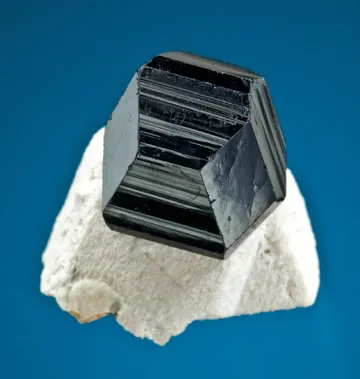
Microcline from Paprok is less often the named selling point, but it matters in the best structural specimens. It may appear as blocky, pale feldspar crystals or massive pegmatitic forms associated with albite, lepidolite, tourmaline, and quartz. A documented cabinet specimen from Paprok on Mindat includes microcline, tourmaline, elbaite, lepidolite, albite, and cleavelandite; its description notes a well-formed microcline crystal with pointed terminations, cleavelandite rising from the rear of the specimen, and multiple terminated tourmalines framed by feldspar and lepidolite.
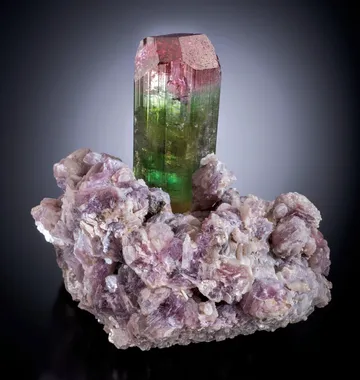
The classic Paprok color arrangement is white feldspar against colored lithium pegmatite minerals. Pink, red, green, blue-green, blue-capped, and watermelon-zoned elbaite are the most famous partners. Smoky quartz gives darker contrast; lepidolite adds lavender flakes and clusters; topaz may appear as colorless, glassy crystals; spodumene provides green, pink, or lilac blades; beryl may appear as morganite, aquamarine, or goshenite. The feldspar’s role is compositional as much as mineralogical: it creates the pale, open, crystalline base that makes the colored species read cleanly.
Typical sizes vary widely. Small thumbnails may show only a few millimeters of cleavelandite attached to a tourmaline. Miniatures and small-cabinet pieces commonly show feldspar beds several centimeters across, with individual albite blades from tiny scales to centimeter-scale plates. Large cabinet specimens can be substantial, especially when tourmaline, quartz, and feldspar form a sculptural matrix. Published and dealer-documented examples range from small 3–6 cm tourmaline-on-albite pieces to large Paprok combination specimens exceeding 10 cm and weighing hundreds of grams or more. The feldspar itself is rarely marketed by exact blade length; collectors judge it by freshness, completeness, and how successfully it supports the whole specimen.
Quality in Paprok feldspar is driven by five factors:
Brightness and freshness. Snowy white cleavelandite with a clean pearly sparkle is far preferable to stained, dull, iron-browned, clay-coated, or crushed feldspar.
Integrity of the blades. Cleavelandite is thin and cleavage-prone. Broken blade tips, bruised rosettes, and abraded edges quickly lower the aesthetic grade.
Architecture. The best feldspar is not a lump. It rises, curls, fans, or frames the associated crystals, creating depth and movement.
Association. Albite with gem elbaite is the Paprok standard, but combinations with smoky quartz, topaz, spodumene, lepidolite, morganite, aquamarine, beryllonite, or rare phosphates can be equally important.
Natural junctions. Fine Paprok matrix specimens should show convincing growth relationships: tourmaline emerging naturally from cleavelandite, feldspar wrapped around the base, quartz intergrown rather than merely glued in place, and no suspiciously glossy seams at contacts.
The finest Paprok feldspar specimens are therefore not necessarily the largest. A small, perfectly fresh cleavelandite rosette with a gemmy pink-green elbaite can be more desirable than a larger cabinet piece with crushed feldspar and repaired crystals. For advanced collectors, Paprok feldspar is a study in matrix quality: the white albite either elevates the specimen into a world-class pegmatite composition or quietly exposes every chip, repair, and awkward contact.
Paprok feldspar is most often collected as part of combination specimens, and that has consequences for both authenticity and value. A specimen labeled “feldspar from Paprok” should normally be examined as an albite, cleavelandite, or microcline combination piece, not as a generic feldspar crystal. The strongest locality indicators are the total assemblage: white cleavelandite with Paprok-style elbaite, lepidolite, smoky quartz, topaz, spodumene, beryl, or rare pegmatite minerals.
Specific, well-documented feldspar fakes from Paprok are not prominent in the published mineralogical record. The more realistic concern is specimen construction, repair, and restoration. Afghan and Pakistan pegmatite matrix specimens are often pocket-broken, and tourmaline crystals may detach from feldspar or quartz during extraction. Reattachments, rebuilt matrix contacts, and repaired terminations are therefore common enough that serious collectors should assume they need to inspect carefully. Dealer descriptions of Paprok and Paprok-area tourmaline-on-albite pieces sometimes disclose repairs, restored tips, or uncertainty about whether termination bevels have been modified.
Look especially at the contact between colored crystals and the cleavelandite base. Glue seams may appear as unnaturally glossy lines, dark wet-looking cracks, dust-free gaps, or slight misalignment between a crystal and the pocket texture. Under longwave UV, some adhesives fluoresce. Under magnification, watch for feldspar chips stuck into glue, powdered feldspar used as fill, or contacts that lack the small intergrown albite blades expected from natural growth. A repaired tourmaline on original feldspar matrix may still be highly collectible, but it must be priced and described accordingly.
Condition problems in the feldspar itself are common. Albite cleavelandite has perfect cleavage and a thin bladed habit, so it bruises easily. Even gentle shipping can snap blade edges or shed small plates. Microcline is tougher in bulk but still has feldspar cleavage; damaged corners, cleaved faces, and abrasions on exposed terminations are frequent. White feldspar also shows dirt and iron staining readily. Cleaning should be conservative: soft brush, distilled water when appropriate, and avoidance of ultrasonic cleaners, steam, thermal shock, or aggressive chemical treatment, especially when the specimen also carries tourmaline, lepidolite, beryl, spodumene, topaz, phosphates, or repaired contacts.
Rarity depends on what is being counted. Small bits of Paprok albite matrix are common in the trade because so many tourmalines and pegmatite specimens carry feldspar. Fine, undamaged, aesthetic cleavelandite as the dominant visual element is much scarcer. Microcline as a well-formed, display-quality Paprok crystal with associated tourmaline and cleavelandite is also decidedly less common than simple tourmaline-on-white-matrix pieces. Large, unrepaired, sculptural specimens with fresh feldspar and gem crystals are rare and expensive.
Market availability remains best for combination specimens. Contemporary listings and archived sales show Paprok albite and cleavelandite most often attached to elbaite, smoky quartz, lepidolite, beryl, or topaz. Prices span a broad range: modest small pieces, four-figure fine miniatures and small cabinets, and five-figure elite matrix combinations when the associated tourmaline or beryl is exceptional. Pure feldspar-only Paprok pieces are much less visible, and when feldspar is the primary interest, experienced collectors often buy an “elbaite with albite” or “spodumene with cleavelandite” specimen because that is how the material is normally cataloged.
_1.jpg)

