Dolomite from Tsumeb, Namibia — a diverse carbonate with hollow casts, epimorphs, and color variety, prized for paragenesis, display, and collectibility.
Key facts
Dolomite from Tsumeb is not the loudest mineral from this legendary mine; azurite, dioptase, cerussite, mimetite and smithsonite usually seize the spotlight first. But for serious collectors, Tsumeb dolomite is one of the mine’s quiet signatures: a carbonate that can be matrix, gangue, pseudomorph, color accent, crystallized crust, paragenetic clue and display species all at once.
The Tsumeb Mine sits in the Otavi Mountainland of northern Namibia, where an extraordinary lead-copper-zinc-silver orebody developed in a deeply karstified carbonate sequence. Dolomite matters here in two ways. First, dolostone forms much of the host stratigraphy: the ore pipe cut through and interacted with thick Neoproterozoic carbonate rocks of the Otavi Group. Second, crystallized dolomite grew repeatedly in the open spaces, fractures, breccias and oxidation zones of the deposit, producing collectable specimens in white, cream, tan, brown, greenish, bluish-green, pink and lilac tones.
What distinguishes Tsumeb dolomite is not a single “look,” but a range of looks that only this mine seems to have made so naturally. Collectors prize cream to white rhombohedral crusts beneath dioptase, cuprite, wulfenite, malachite, duftite, calcite and sulfides; pink to lilac cobalt-bearing dolomite; zinc- and lead-bearing dolomite; and above all the strange hollow dolomite casts and epimorphs after calcite and other earlier minerals. These casts can appear as shell-like plates, cavernous crusts, hollow scalenohedral forms, ropey peach-colored skins, or delicate lattices where the original carbonate dissolved away and left dolomite as the surviving architecture.
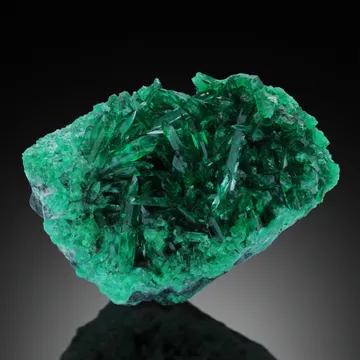
At Tsumeb, dolomite is also a color stage for other minerals. Emerald dioptase on pale dolomite, red cuprite flanked by ivory dolomite, green duftite on silky cream dolomite, or wulfenite scattered across carbonate crusts can be far more compelling than dolomite alone. The best pieces combine texture, contrast and provenance: pearly or satin luster, crisp rhombohedral or saddle-shaped form, minimal bruising, and an old label tying the specimen to the mine’s productive years.
Search for specimens: View all dolomite specimens from Tsumeb, Namibia
The classic locality is the Tsumeb Mine, also known historically as the Tsumcorp Mine or Ongopolo Mine, at Tsumeb in the Oshikoto Region of northern Namibia. The deposit was a polymetallic lead-copper-zinc-silver orebody enriched in arsenic, cadmium, gallium, germanium and silver, set within a thick carbonate platform succession of the Otavi Group. The host rocks include stromatolitic, algal and oolitic dolomites and limestones with shale or mudstone horizons; the orebody itself formed an irregular, steep, pipe-like structure that transgressed roughly 1,700 meters of the upper Tsumeb Subgroup dolomites.
Geologically, Tsumeb is best understood as a mineralized karst-breccia pipe modified by deformation, hydrothermal alteration and deep oxidation. The pipe included feldspathic sandstone, sandstone breccia and dolomite breccia; open spaces were filled or replaced by hypogene calcite, quartz and carbonate-quartz gangue. The surrounding dolostone was not simply passive wall rock. Permeable horizons, solution collapse breccias and the famous North Break Zone helped channel water through the system, and this “plumbing” is central to why Tsumeb developed not one but three oxidation zones. Those oxidation zones are a major reason that so many unusual secondary minerals—and so many complex dolomite associations—formed.
The first oxidation zone extended downward from the surface into the upper workings. The second oxidation zone, beginning far deeper, was centered around the intersection of the North Break horizon with the ore pipe in the 24 to 35 Level interval and was crucial for many of Tsumeb’s most celebrated modern specimens. A third oxidation zone was later recognized from the deep levels, below roughly 42 Level. Dolomite is recorded from all three oxidation zones, from sulphide ores, and from the country-rock dolostone stratigraphy. It occurs as rock-forming dolomite in the host sequence, as hypogene carbonate gangue, and as supergene crystallized material.
Mining history is inseparable from collecting history at Tsumeb. African people worked copper from the surface expression of the deposit before European mining. Commercial development began under the Otavi Minen und Eisenbahn Gesellschaft, with trial shafts in 1900 and full-scale production after the construction of a railway from the coast. Production began in the early twentieth century, was interrupted by the world wars and economic downturns, resumed strongly after 1947 under Tsumeb Corporation Limited, and ceased as a major mining operation in the mid-1990s. By closure, the workings had reached about 1,700 meters below surface and 48 Level.
For collectors, access today is not a field-collecting opportunity in the ordinary sense. The mine is closed as a specimen-producing underground locality, and the great material now circulates through old collections, dealer inventories, museum holdings and occasional estate dispersals. Tsumeb specimens remain visible in institutional collections and in Tsumeb’s modern mineral museum displays, but new collector production from the mine is not a meaningful source of supply. The relevant “production periods” for fine dolomite specimens are therefore historical: early open-pit and upper-level material, mid-century and second-oxidation-zone material, and late deep-level discoveries, rather than ongoing collecting.
Notable dolomite-related finds include pink cobalt-bearing dolomite crusts, zinc- and lead-bearing dolomite documented in mineralogical studies, dolomite with dioptase, dolomite with cuprite, dolomite with wulfenite, and especially the dolomite casts after calcite and other minerals. Some of these casts are thin, lightweight, hollow and surprisingly sculptural; others are cabinet-sized plates with the morphology of vanished calcite preserved on one side and later drusy dolomite, calcite, duftite, malachite, mimetite or wulfenite on the other.
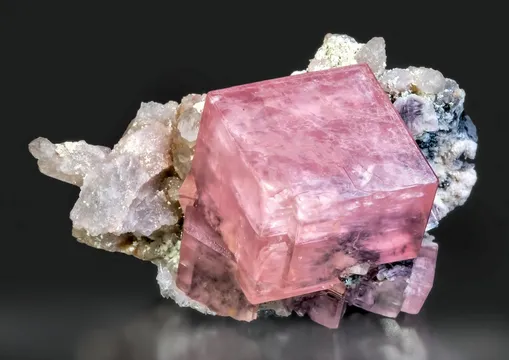
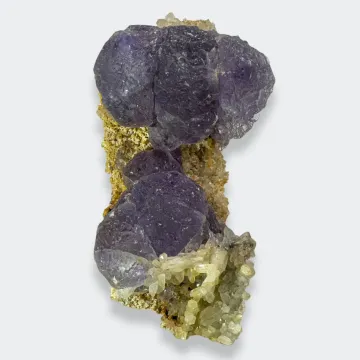
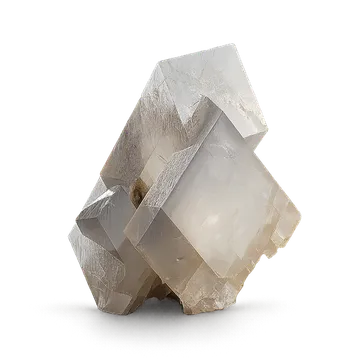
Tsumeb dolomite most commonly appears as crusts of small rhombohedral crystals. The standard palette is white to cream, tan, buff or reddish-brown, but Tsumeb adds important color variants: pink to lilac material associated with cobalt and manganese, greenish to bluish-green colors influenced by copper or zinc, and iron-stained peach to brown surfaces where oxidation has affected the carbonate. Some specimens show pearly or silky luster rather than bright glassy sparkle; others are scintillating druses of fine rhombs.
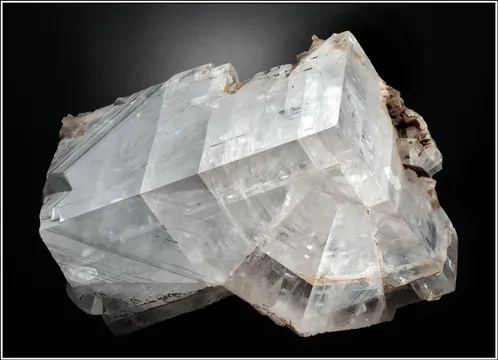
Crystal habits range from sharp rhombohedra to saddle-shaped crystals and curved-face rhombs with rough or matte surfaces. Fine dolomite at Tsumeb is often textural rather than large-crystal material. Many attractive specimens are small cabinet or miniature pieces where the dolomite forms a coherent crust, shell, mound or plate. Individual dolomite crystals may be tiny, but the aggregate can carry the whole specimen through color, sheen and sculptural form.
The casts and epimorphs are the locality’s most distinctive dolomite habit. These formed when dolomite grew as a coating or shell over earlier crystals—commonly calcite, though other precursors are reported or suspected—and the earlier mineral later dissolved away. The result may be a hollow plate, a cavernous crust, a shell with angular molds on the underside, or a thin skin preserving the shape of vanished rhombs or scalenohedra. In better examples, the exterior and interior tell different stories: smooth or ropey outer surfaces, concave interiors stamped by former crystal faces, secondary drusy dolomite, and late microcrystals of other Tsumeb species.
Color-bearing dolomite is especially desirable. Pink to lilac cobalt-bearing material has the greatest immediate cabinet appeal, especially when the color is uniform and the luster is pearly. Greenish cuprian or zinc-bearing dolomite is scarcer and often more subtle, but it can be highly distinctive in cast form. Zincian and plumbian dolomite from Tsumeb is of mineralogical importance as well as collector interest, because analyses showed significant substitution of zinc and lead in some material.
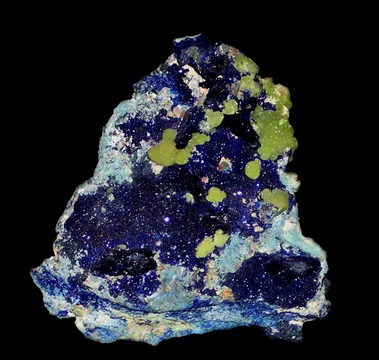
Associated minerals are one of the great reasons to collect Tsumeb dolomite. Verified and commonly encountered associations include calcite, quartz, dioptase, duftite, malachite, mimetite, wulfenite, cuprite, cerussite, smithsonite, tennantite, galena, sphalerite, chalcopyrite, goethite, mottramite, rosasite, conichalcite, willemite and azurite. A pale dolomite crust beneath emerald dioptase is among the most recognizable Tsumeb aesthetics. Ivory dolomite beside red cuprite can be equally strong, while green duftite or conichalcite on cream or pink dolomite gives the small cabinet collector some of the finest color contrast the mine produced.
Quality depends on what kind of dolomite specimen is being judged. For crystallized crusts, collectors look for even color, bright or pearly luster, visible rhombohedral texture, clean coverage, and strong contrast with associated minerals. For cobalt-bearing material, saturation and uniformity of pink or lilac color matter. For casts and epimorphs, the premium factors are completeness, thin undamaged shells, clear evidence of the precursor morphology, three-dimensional form, and attractive secondary mineralization. A cast that is merely odd is less valuable than one that is odd, legible and beautiful.
Condition is especially important. Dolomite has perfect rhombohedral cleavage and modest hardness, so exposed edges, saddle tips and hollow cast rims are easily bruised. On Tsumeb casts, small broken windows may help prove hollowness, but obvious crushing, missing shell margins, heavy glue, sawed bases that interrupt the form, or dull acid-etched surfaces reduce desirability. Old labels and collection history can lift a specimen substantially, particularly because the mine is no longer producing and because many Tsumeb dolomites were historically treated as matrix rather than as primary collector pieces.
Tsumeb dolomite rewards close looking. Many specimens that appear at first to be “just matrix” are actually mineralogical records: dolomite before calcite, dolomite after calcite, dolomite beneath dioptase, dolomite with micro-arsenates, or dolomite acting as a late carbonate skin over earlier ore and oxidation assemblages. A hand lens is essential. The best surfaces often reveal tiny rhombs, zoned crusts, minute green arsenates, or molded undersides that are invisible in a quick cabinet glance.
The main authenticity issue is not a well-documented trade in dyed or fabricated Tsumeb dolomite, but misidentification and weak provenance. Tsumeb dolomite can be visually confused with calcite and smithsonite, especially when the material is white, cream, tan or botryoidal. Some dealer descriptions use “dolomite cast,” “epimorph,” “perimorph,” “pseudomorph,” and “cast after calcite” loosely; the most reliable examples show real morphological evidence of the precursor, such as angular carbonate molds or preserved scalenohedral/rhombohedral form. When the precursor is not obvious, “dolomite cast after unknown mineral” is more honest than a confident but unsupported calcite assignment.
Cobalt-bearing dolomite should also be treated carefully. Pink color alone does not prove cobalt; manganese and iron-related color effects may complicate the picture, and Tsumeb is chemically complex enough that visual identification is never the same as analysis. For high-priced pink material, especially if sold as cobaltoan dolomite rather than simply pink dolomite, provenance and, ideally, analytical support add confidence.
Condition issues are common. Hollow casts are light, thin and fragile; their rims can be chipped, their backs may be broken, and their shell-like plates can flex or crack under pressure. Dolomite crystals on matrix often show bruised edges or a dull “rubbed” look where the high points of rhombs have been abraded. Associated minerals introduce their own vulnerabilities: dioptase can chip, cerussite can bruise, wulfenite can cleave, and malachite or duftite microcrusts can be knocked from exposed surfaces.
Cleaning should be conservative. Dolomite is a carbonate and will react with acid more slowly than calcite, but acid cleaning can still etch, dull or undercut surfaces and may damage associated carbonates, arsenates or copper minerals. Avoid ultrasonic cleaners on casts and delicate combination pieces. Dust with air or a soft brush; if water is used, keep it brief, dry thoroughly, and consider the stability of associated species before wet cleaning.
Market availability is steady but not abundant. Tsumeb dolomite appears in dealer stocks, auctions and old collections, often as combinations rather than as single-species dolomite. Attractive miniatures and small cabinets with calcite, duftite, cuprite or dioptase still surface, while top pink cobalt-bearing examples, exceptional casts, and high-contrast dioptase-on-dolomite specimens are much more competitive. Because Tsumeb is no longer an active specimen source, old labels, named collections, and documented purchase histories carry real weight.
Before there was a mine, there was the Green Hill. African miners had already worked copper from the mineralized outcrop long before European development, and traders carried copper ore and rough smelted metal away from the place known as Otjisume, “the place of the frog.” The name Tsumeb itself is generally treated as a corruption of that Herero name. The image is irresistible: a copper-stained carbonate hill in the Otavi country, green enough and strange enough to enter both trade and legend before it entered mineralogical literature.
In January 1893, the British mining engineer Mathew Rogers arrived at the Green Hill while investigating deposits for the South West Africa Company. His reaction has become one of the great sentences in Tsumeb lore: “I have never seen such a sight as was presented before my view at Soomep, (sic.) and I very much doubt if I shall ever see such another in any other locality.” For collectors who know what later came out of the mine—dioptase on pale carbonate, glassy azurite, cerussite snowflakes, mimetite, smithsonite, and the dolomite casts—Rogers’ astonishment reads less like exaggeration than prophecy.
The first serious commercial work was not glamorous. OMEG began with trial shafts in 1900, and full production had to wait for a railway from the coast. Ore first came from an open pit and shallow workings, then from increasingly elaborate underground infrastructure as the surface riches were depleted. Yet even the practical business of testing ore created a collecting story. A large sample sent to Germany in 1900 for metallurgical work passed through the hands of Wilhelm Maucher at the Bergakademie in Freiberg. Maucher recognized that the test material contained well-crystallized secondary minerals, saved specimens, and later wrote the first detailed mineralogical description of the Tsumeb ore. In other words, even before Tsumeb became a collector’s Mecca, its specimens were announcing themselves from the laboratory bench.
The mine kept surprising the people who thought they understood it. After World War II, operations resumed under Tsumeb Corporation Limited and pushed deeper. The expectation would have been more primary sulphide ore, but the workings instead encountered a second oxidation zone at great depth, beginning around 810 meters below surface. That discovery changed the modern collector’s view of Tsumeb. The second oxidation zone yielded many minerals new to science and fed the late-1960s through 1980s flow of superb dioptase. Charlie Key, one of the great dealers associated with Tsumeb, estimated that the value of Tsumeb dioptase specimens exceeded the value of all other mineral species from the mine combined.
Dolomite was woven through these discoveries as both a mineral and a mold-maker. In the casts, Tsumeb produced one of the strangest carbonate tricks in the collector world: dolomite shells left behind after the mineral beneath them disappeared. A good cast can look impossible in the hand. It may have the visual weight of a solid plate but the physical lightness of a husk; a broken edge may reveal that the “crystal” form is only a skin. Some preserve the geometry of earlier calcite so clearly that the underside reads like a negative print. Others are ambiguous, preserving only a cavernous, lace-like memory of something that was once there and is now gone.
One old upper-level cobaltoan dolomite cast from the Al Kidwell Collection, acquired from Adi Blignaut in 1960, was described as a large triangular hollow cavernous crust, 17.0 x 12.8 x 10.3 cm, with pastel-pink dolomite after flattened calcite crystals. Its exterior had a silky sheen and, when tapped with a fingernail, even gave a metallic “ding.” The interior told a second chapter: sparkly drusy cobaltoan dolomite overgrowing the inner casts. That is the fascination of Tsumeb dolomite in miniature—the specimen is not merely a crystal but a sequence of events preserved as texture.
Another cabinet-sized cast, 94 x 78 x 20 mm, showed two generations of calcite recorded in dolomite. Earlier triangular nail-head calcite crystals, up to about 1.2 cm on edge, were replaced by smoother fine-grained dolomite, while a later equilateral triangular rim was recorded by radial fibrous dolomite and micro-rhombohedral infill. The underside developed extended, almost stalactitic hollow edges, making a pendular network. Such pieces are why Tsumeb dolomite can become a specialist collection in itself: the pleasure lies in reading the vanished minerals through the surviving shell.
The closing chapter of Tsumeb’s mining life was abrupt. By the mid-1990s, the workings had reached 48 Level and about 1,700 meters below surface. High mining and pumping costs, low metal prices and deteriorating labor relations converged. In mid-1996, when striking miners denied management access to the site, the pumps were switched off and the mine flooded rapidly. Small-scale work continued for a time, and there was a short-lived attempt at mining specifically for specimens between 1998 and 2002, but the great underground source had effectively passed into history. Today, when a fine dolomite cast or dioptase-on-dolomite specimen appears, it carries that finality: there is no expectation that another pocket will simply be opened next month.
Hurlbut, C. S., Jr. (1957). “Zincian and plumbian dolomite from Tsumeb, South-West Africa.” American Mineralogist, 42, 798–803. A key analytical paper documenting zinc- and lead-bearing dolomite from Tsumeb.
Wilson, W. E. and Pinch, W. W. (1977). “Tsumeb, Namibia: Minerals: a Descriptive List.” The Mineralogical Record, 8(3), 17–37. The classic descriptive mineral list from the famous 1977 Tsumeb issue of The Mineralogical Record.
Lombaard, A. F., Günzel, A., Innes, J. and Krüger, T. L. (1986). “The Tsumeb lead-copper-zinc-silver deposit, South West Africa/Namibia.” In Mineral Deposits of Southern Africa, Geological Society of South Africa, vol. 2, 1761–1787. The standard geological treatment of the orebody, repeatedly cited in later Tsumeb work.
Southwood, M. and Robison, J. (2016). “Dolomite ‘Casts’ and Epimorphs From Tsumeb, Namibia.” Rocks & Minerals, 91(4), 334–345. The essential publication for understanding Tsumeb dolomite casts, epimorphs and related terminology.
Bowell, R. J. (2014). “Hydrogeochemistry of the Tsumeb Deposit: Implications for Arsenate Mineral Stability.” Reviews in Mineralogy and Geochemistry, 79, 589–627. A technical discussion of the water-rock chemistry behind Tsumeb’s extraordinary secondary mineral assemblages.
Garavelli, C. L., Vurro, F. and Fioravanti, G. C. (1982). “Minrecordite, a new mineral from Tsumeb.” The Mineralogical Record, 13, 131–136. Describes minrecordite, CaZn(CO3)2, a rare dolomite-group mineral discovered from Tsumeb material.
Tsumeb Mine Notebook — Dolomite species entry. A modern curated reference summarizing Tsumeb dolomite’s composition, abundance, distribution, paragenesis, colors, associations and pseudomorph records.
Tsumeb Mine Notebook — Dolomite after calcite (?) specimen TSNB444. A documented 95 mm peach-colored dolomite epimorphous shell, now in Geoscience Australia, useful for comparing cast textures and precursor evidence.
Mindat — Dolomite from Tsumeb Mine, Oshikoto Region, Namibia. Occurrence record with photo-based associations and locality data for dolomite at Tsumeb.
Tsumeb Mine Notebook — Dolomite — The best single online starting point for Tsumeb dolomite mineralogy, associations and pseudomorph notes.
Tsumeb Mine Notebook — Geology — Clive King’s clear geological introduction to the pipe, oxidation zones, North Break Zone and host dolostone setting.
Tsumeb Mine Notebook — History — A concise, richly detailed account of the Green Hill, mine development, named pockets, deep oxidation zones and closure.
Mindat — Dolomite from Tsumeb Mine — Photo-rich occurrence page useful for comparing associations and specimen appearances.
Mindat — Tsumeb Mine locality page — Broad locality reference for the mine’s mineral list, aliases, geography and related records.
Rocks & Minerals — Dolomite “Casts” and Epimorphs From Tsumeb, Namibia — The key specialist article on Tsumeb’s dolomite casts.
Tsumeb Mineralogic & Mining Museum — Visitor-facing museum resource for Tsumeb mining history, mineral displays and local interpretation.
Britannica — Tsumeb — General background on the town, mining history and regional setting.