Mogok Danburite, Myanmar — thumbnail-to-miniature, transparent to pale golden crystals with glassy luster; locality-specific provenance and sublocalities.
Key facts
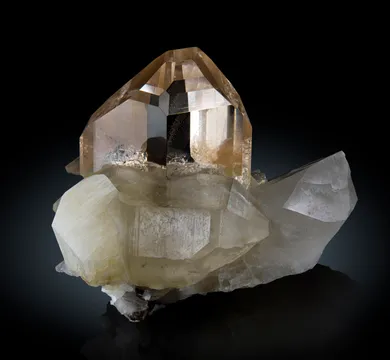
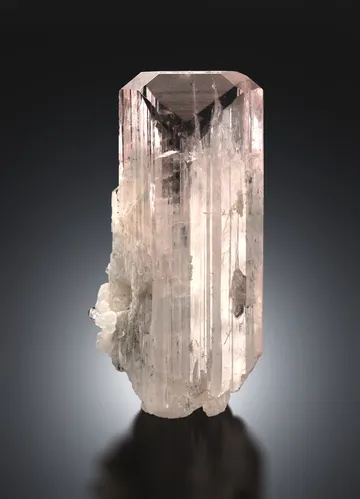
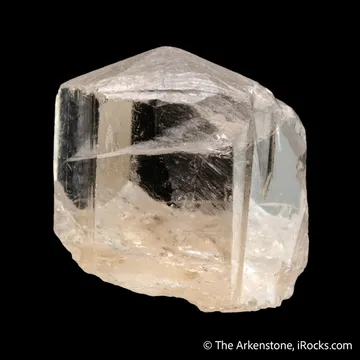
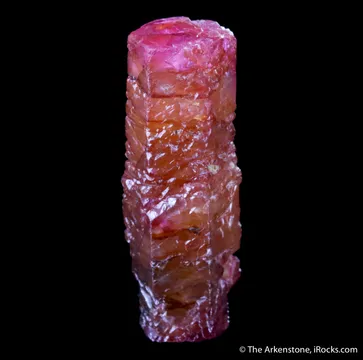
Danburite from Mogok Township is a connoisseur’s mineral: not the mass-market colorless material familiar from Mexico, but a rarer Mogok expression with a warm, gemmy personality. The best crystals are transparent to near water-clear, often in colorless, pale straw-yellow, light golden, champagne, or golden-amber tones. In fine examples the attraction is not only color but a very “clean” architectural look: sharply prismatic orthorhombic crystals, glassy luster, bright terminations, and enough internal clarity to make even small thumbnails feel gem-grade.

Photo: Wikimedia Commons / Rob Lavinsky, iRocks.com
Mogok is, of course, better known for ruby, sapphire, spinel, painite, and other legendary gem species, but danburite belongs naturally in that broader mineralogical story. The township sits within the Mogok Metamorphic Belt, a high-grade terrain of marbles, gneisses, syenites, charnockites, granites, and pegmatitic bodies. Gem gravels derived from weathered marble host much of the classic ruby-and-spinel production, while pegmatitic and boron-rich associations account for a different suite: topaz, tourmaline, aquamarine, rare borates and borosilicates, and danburite.
For collectors, Mogok danburite stands apart because it is both attractive and genuinely locality-specific. Fine pieces are not normally large; the best crystals tend to be thumbnails to miniatures, and many are valued less by mass than by sharpness, luster, transparency, and verified provenance. A clean, complete, golden crystal from a named Mogok sublocality can have far more collector importance than a larger but anonymous “Burma” crystal. Labels naming Le-U-le-taw, Sakangyi, Ohn-bin-ywe-htwet, Le-U-thet-kachan, or the Dattaw area deserve special attention, especially when backed by old dealer labels or a chain of collection history.

Photo: Wikimedia Commons / Rob Lavinsky, iRocks.com
The locality has also produced one of the more memorable Mogok danburite curiosities: a pseudomorphic specimen described as topaz over danburite after topaz, with the danburite replacement reportedly confirmed by X-ray diffraction. That kind of complex paragenesis is exactly what makes Mogok more than a gem field. It is a mineralogical province where marble-hosted gems, pegmatites, hydrothermal overprints, and repeated fluid events produced specimens that repay close study.
Search for specimens: View all danburite specimens from Mogok Township, Myanmar
Mogok Township lies in the Mandalay Region of Myanmar, north of Mandalay, and surrounds the town of Mogok at roughly 1,170 m elevation. In mineral-collecting literature the broader district is often called the Mogok Stone Tract or Mogok Valley, though specimen labels vary widely between “Mogok,” “Mogok Valley,” “Mandalay Division,” “Burma,” and modern Myanmar administrative names.
The danburite occurrences are best understood as part of Mogok’s mixed metamorphic-and-pegmatitic gem system. Ruby, sapphire, and spinel are associated with high-grade marbles and marble-derived alluvial gravels, while danburite is recorded from pegmatitic and gem-gravel environments within the same township. Mindat records danburite for Mogok Township broadly and for several more precise sublocalities, including Le-U-le-taw, Le-U-thet-kachan, Ohn-bin-ywe-htwet, Dattaw-pyant and Dattaw-chaung, Dattaw-mid, Htan-yan-sho, Ohngaing, Pyant Gyi, Shwe-pyi-aye, Yebu, Yebu-thapanbin-kyar, and Sakangyi.
Le-U-le-taw is one of the key named localities for collector danburite. It is described as a mining area extending from northeast to southwest across a considerable tract, with elevations a little above 1,100 m. Its alluvium has yielded cabochon- and facet-grade rubies, often over 5 ct, and it is specifically noted for bicolored tourmaline, moonstone, quartz, topaz, danburite, small star rubies, and spinel. The Le-U-le-taw mines are recorded as having closed in September 2001, a date that matters because many good danburite crystals on the market today are older pieces rather than recent production.
Sakangyi, in the Kyauk-Pyat-That area of Mogok Township, is another important name. Specimen records show multiple danburite photographs and a specific Sakangyi pegmatite association. Older Mogok labels sometimes give only “Mogok, Burma,” but crystals from Sakangyi and the Le-U area have circulated through major collections and dealer stocks for years, which is why a more exact sublocality can add real value.
Mining history in Mogok is dominated by gemstones, especially ruby and sapphire. The broader region has been mined since at least the nineteenth century, and its fame rests on both primary marble-hosted workings and secondary alluvial deposits. Danburite appears as a secondary prize in that economy: a collector and gem species recovered alongside more commercially dominant stones. It was never the reason Mogok was famous, but it is one of the minerals that shows how diverse the Stone Tract really is.
Collecting access should be treated as effectively closed to casual collectors. Mogok has long been a controlled gem-mining region, and since 2024 the township has also been affected by severe conflict and shifting military control. Any newly offered specimen should be considered through that lens: documented older provenance is especially desirable, and responsible buyers should scrutinize both legality and source history.
Mogok danburite is typically valued for transparency and warm color rather than size. The finest pieces are clean, lustrous prisms in the thumbnail to miniature range. Documented examples include crystals around 2.1 cm, 2.3 cm, and 3.3 cm, and a small-cabinet pseudomorphic specimen measuring 8.4 x 2.8 x 2.2 cm. Fine loose gem material is also known: the GIA Edward J. Gübelin Collection includes a 25.30 ct cushion-cut danburite from Mogok, Kyatpyin, described as transparent and light very slightly grayish yellow-green.
The most characteristic colors are colorless, pale yellow, straw-yellow, champagne, light golden, and golden-amber. Bright, saturated color is not the normal expectation. A faint golden body color, combined with gem clarity and a sharp termination, is much more typical of the best collector material. Some Mogok danburite rough has been described in gemological teaching sources as pleasing straw-yellow to golden, which matches the appearance of the most desirable crystals.
Crystal habit is generally prismatic, with the clean, straight-edged architecture expected of orthorhombic danburite. The best crystals have smooth, lustrous faces and glassy terminations; some are complete all around except at the point of attachment. Etched examples also occur, retaining prismatic form but with surface textures from late-stage solution activity. Doubly terminated crystals are scarce and desirable when undamaged. Skeletal lower sections and contacted growth areas have been reported on amber Mogok material, but a sharp, undamaged termination can still make such a piece important.
Associated minerals depend strongly on sublocality. At Le-U-le-taw the recorded suite includes albite, cancrinite, chrysoberyl, corundum including ruby and star ruby, elbaite, microcline, moonstone, pargasite, quartz, sillimanite, spinel, topaz, and tourmaline. In broader Mogok Township, danburite belongs to a much larger gem-mineral environment that includes corundum, spinel, forsterite, phlogopite, graphite, scapolite, tourmaline, beryl, topaz, and rare boron-bearing species.
Quality is judged by a narrow set of collector criteria. The most important are verified Mogok provenance, color, transparency, luster, termination, lack of bruising, and freedom from distracting veils or fractures. Because danburite has poor to indistinct cleavage but is brittle, edge and tip preservation matter. A crystal with a clean termination, no obvious glue or repair, and an old Mogok or Le-U-le-taw label should be taken seriously even if it is only a few centimeters long.
The most unusual Mogok danburite form is the topaz-danburite pseudomorph association: danburite after topaz, later overcoated by a second generation of topaz. Such a specimen is not merely a curiosity; it points to changing fluid chemistry in the pegmatitic system, with replacement followed by renewed topaz deposition. For advanced collectors, that kind of paragenetic evidence can be more compelling than a simple isolated crystal.
The chief authenticity issue is locality, not species. Danburite itself is straightforward to identify by standard mineralogical and gemological properties, but “Mogok” has strong market cachet and is easily over-applied. Many Burmese or Myanmar minerals have historically been labeled broadly, and some specimens from adjacent districts or neighboring gem fields may appear in the trade under the more famous Mogok name. A specimen labeled only “Burma” or “Mogok” is less secure than one tied to Le-U-le-taw, Sakangyi, Ohn-bin-ywe-htwet, Dattaw, or another recorded sublocality.
There are no well-documented, Mogok-specific danburite fakes that dominate the market, but the usual specimen concerns apply: glued repairs at the base, polished or re-cut terminations, misattributed locality, and vague “old collection” claims without labels. Because fine Mogok pieces are relatively scarce, unusually perfect large crystals with weak provenance deserve caution. Compare color and habit against documented Mogok examples: most are modest in size, pale to golden, and prismatic rather than huge, thick, flawless display crystals.
Treatments are not a major commercial issue for danburite in the way they are for topaz, sapphire, or quartz. Danburite is generally sold untreated, though irradiation experiments and color changes in danburite are discussed in gemological sources. For Mogok specimens, the more practical concern is whether a crystal has been repaired, stabilized, or misrepresented as an older locality piece. In faceted stones, a reputable lab report is useful if the stone is expensive or if origin is claimed as Mogok.
Condition is important. Danburite’s hardness of 7 to 7.5 makes it durable enough for handling, but crystals are brittle and terminations bruise. Many Mogok crystals have minor veils, internal fractures, contact areas, or etched surfaces. These are not automatically faults; they may be normal for the locality. The premium goes to pieces that combine gem clarity with sharp natural faces and an undamaged termination.
Rarity is real. Mogok danburite appears intermittently in dealer inventories and auctions, but not in the steady quantities seen from prolific danburite localities such as Charcas, Mexico. Recent auction records show small Le-U-le-taw crystals and crystal sets circulating from older collections, including pieces from the Bill Larson collection. High-end examples can command strong prices when they combine color, clarity, and locality. At the same time, small colorless crystals may sell more modestly if they lack strong aesthetics or precise provenance.
Current availability is constrained by more than geology. Mogok’s gem trade has been heavily disrupted by conflict since 2024, and fresh production is uncertain. For serious collectors, the safest and most desirable route is documented older material from established dealers, auctions, or collections, ideally with original labels.
One of the best Mogok danburite stories is locked inside a single strange crystal: a topaz over danburite after topaz from Mogok. At first glance it reads as topaz, the familiar pegmatite mineral, but the description attached to the specimen tells a more complicated sequence. The original topaz crystal was replaced by danburite, a transformation reportedly confirmed by X-ray diffraction at Caltech. Then, after that replacement, a second generation of topaz coated the old crystal form. The result is a mineralogical palimpsest: topaz shape, danburite substance, topaz skin.
The specimen is small-cabinet size, 8.4 x 2.8 x 2.2 cm, and was photographed by Rob Lavinsky from the noted Mogok suite of Bill Larson. Its caption calls it “a bizarre specimen,” and for once the adjective is earned. It is the kind of piece that makes Mogok feel less like a single gem deposit and more like a long-running geochemical theater, with one act overprinting another and leaving the earlier scene visible as a phantom.
Bill Larson’s name recurs around good Mogok danburite because many fine Burmese specimens reached Western collectors through dealers and travelers who worked the region before the modern restrictions and conflicts. In 2024, small Le-U-le-taw danburites from the Larson collection appeared in auction listings: one light golden gem crystal measured 2.3 x 0.7 x 0.5 cm and weighed 1.69 g, or 8.45 ct. It closed at $285. Another lot grouped six colorless gem-quality crystals from the same locality, ranging from 3.2 x 1.3 x 1.3 cm down to 1.7 x 0.8 x 0.6 cm, with a total weight of 49.78 g, or 248.90 ct. That lot closed at only $65, a reminder that locality, color, timing, and individual aesthetics can matter more than sheer carat weight in mineral auctions.
A still older auction record captures the other end of the spectrum: a 3.3 x 2.5 x 2.0 cm doubly terminated Mogok danburite described as rich golden-amber, gemmy at the sharp termination, with veils in the lower interior and skeletal or contacted areas near the base. The weight was given as 87.7 ct. The description was enthusiastic, even by dealer standards, calling the material “excellent and very rare” and insisting it was “MUCH, MUCH BETTER IN PERSON.” That is exactly the kind of specimen Mogok danburite collectors hunt for: not huge, not flawless, but golden, sharp, rare, and alive with locality character.