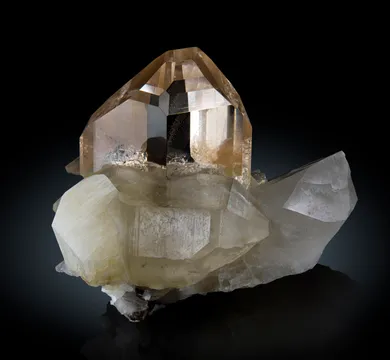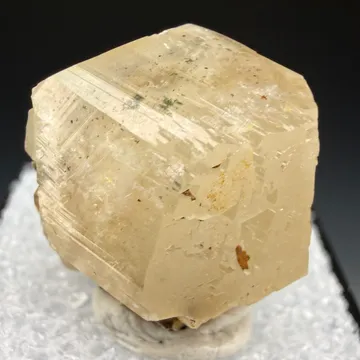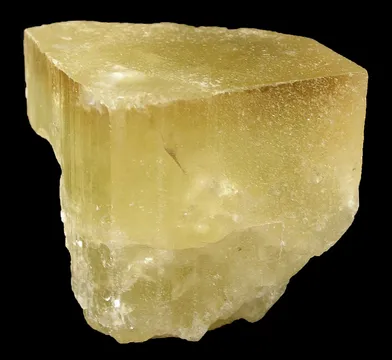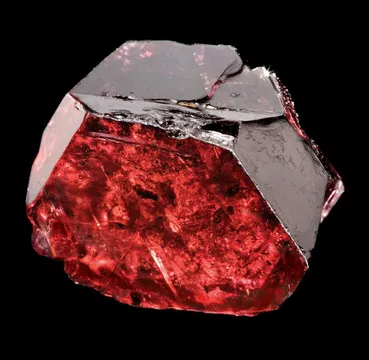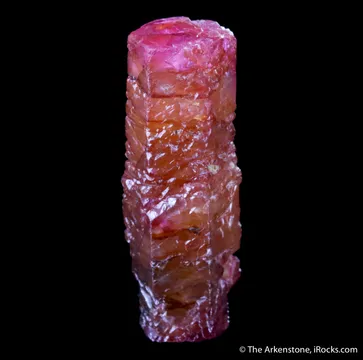
Phenakite from Mogok, Myanmar: colorless, glassy crystals with sharp twinning and drill-bit terminations; provenance from Khetchel–Momeik pegmatites boosts col…
Key facts
Phenakite from the Mogok gem country is one of those deceptively simple minerals that becomes much more interesting the longer one studies it. At first glance, the best crystals look like colorless quartz: transparent, glassy, and prismatic, with bright pyramidal terminations. Under a collector’s loupe, however, the Mogok material reveals its personality—unusually sharp twinning, complex terminations, and the distinctive “drill bit” look that separates these Burmese crystals from the more familiar alpine, Brazilian, Russian, or Coloradoan phenakites.

Photo: Rob Lavinsky, iRocks.com / Wikimedia Commons
The locality story needs careful handling. In older labels and dealer usage, “Mogok” is often used broadly for the greater Mogok Stone Tract and adjacent gem districts, not always for Mogok Township in the strict administrative sense. The most important modern source of sharp, well-formed Burmese phenakite crystals is the Khetchel–Molo–Momeik pegmatite area north-northeast of Mogok, particularly material historically sold as from Mogok, Palelni, or nearby localities. Mindat’s locality notes now make the important point that virtually all well-developed, sharp-edged crystals formerly attributed simply to “Mogok” or Palelni are believed to come from the Phenakite Mine near Khetchel village, except for occasional finds in Mogok Valley alluvials. That distinction matters for labels, provenance, and price.
The geological setting is equally distinctive. These are not the marble-hosted ruby and spinel deposits that made Mogok famous. Phenakite belongs to the pegmatitic side of the district: evolved granitic pegmatites, locally intruding ultramafic to peridotitic country rock, with a beryllium-rich, boron-bearing, rare-element mineral suite. The same pegmatite system has yielded beryl, aquamarine, petalite, pollucite, columbite-(Mn), fluorapatite, lazulite, tourmaline, smoky quartz, and the rare borates and borosilicates that have made the Khetchel–Momeik material scientifically important.
The most celebrated scientific association is perettiite-(Y), a rare Y-Mn-Fe borosilicate discovered as inclusions in gemmy colorless phenakite from the Momeik region north of Mogok. The discovery turned otherwise clear phenakite crystals into tiny mineralogical museums: transparent beryllium silicate hosts containing yellow needles of a new mineral species, together in some examples with tusionite, schorl, columbite-(Mn), albite, fluorapatite, and lazulite.
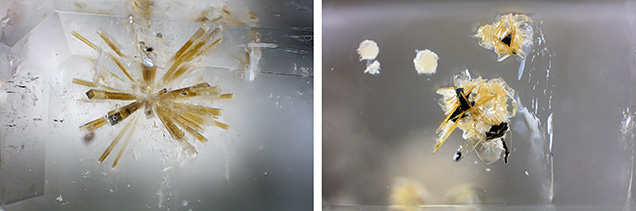
Photo: GIA, Gems & Gemology
For specimen collectors, the ideal Mogok-attributed phenakite is transparent to gemmy, colorless to faintly smoky or straw-tinted, with bright luster, sharp prism faces, an undamaged pyramidal termination, and visible twinning at the termination. Matrix pieces are far rarer than loose singles. Included crystals—especially those with confirmed perettiite-(Y), tusionite, or other identifiable inclusions—belong in a more specialized category, sought as much for their microscopic story as for cabinet aesthetics.
Search for specimens: View all phenakite specimens from Mogok Township, Myanmar
The phrase “phenakite from Mogok” sits at the intersection of three overlapping locality habits: strict administrative geography, gem-trade shorthand, and historical specimen labeling. Mogok Township and the Mogok Valley are in the Mandalay Region and are famous above all for ruby, sapphire, spinel, peridot, and an extraordinary list of rare gems. The sharp colorless phenakite crystals most collectors associate with Mogok, however, are now best understood as chiefly from the Khetchel village area in Molo quarter, Momeik Township, Shan State, north-northeast of Mogok, with older labels often reading Mogok, Palelni, Khetchel, Katchay, or simply Burma.
The deposit type is rare-element granitic pegmatite, not corundum-bearing marble. In the Molo–Momeik area, the pegmatite bodies occur as dykes and pockets intruding peridotite country rock. The gem minerals have been recovered both from primary pegmatite and from alluvial sediments derived from those bodies. This is the environment that produced the colorless phenakite crystals, petalite, pollucite, Cs-rich morganite, aquamarine, hambergite, topaz, tourmaline, quartz, and related rare species.
In the broader Mogok region, pegmatites are part of a larger geological mosaic: high-grade metamorphic rocks of the Mogok Metamorphic Belt, marbles and calc-silicate rocks, granitic intrusions, syenitic bodies, skarns, ultramafic rocks, and secondary gem gravels. The famous ruby and spinel deposits are mainly tied to marble and related metamorphic settings, whereas phenakite belongs to the beryllium-rich pegmatite association. That difference is useful when reading labels: a specimen described as “phenakite from Mogok ruby marble” should raise questions, while a specimen described with pegmatite associates such as feldspar, smoky quartz, albite, tourmaline, petalite, or beryl is geologically more coherent.
Production appears to have been pocket-driven and intermittent. Collector records describe an early “trickle” of sharp twinned crystals reaching the market around 2008, followed by small pockets rather than a single sustained bonanza. Mindat’s modern locality entry for the Phenakite Mine at Khetchel emphasizes that many well-developed crystals long sold under the Mogok or Palelni names are probably from that mine. Occasional phenakite occurrences are also recorded in Mogok Valley alluvials, including Ohngaing, but at least some of these Mogok Valley attributions remain unconfirmed or questioned in current locality databases.
Mining access is not comparable to public collecting localities in North America or Europe. Mogok and adjacent gem districts are active mining and trading areas, historically requiring permissions and local arrangements, with foreigners subject to travel restrictions and purchase/export rules. Recent conflict in and around Mogok has added serious safety, legal, and ethical complications. For collectors, this means provenance should be treated as a paper trail rather than a field-collecting opportunity: old labels, dealer invoices, laboratory reports, and previous collection history carry unusual weight.
Notable finds include gemmy twinned single crystals in the 1–3 cm range, rarer miniature-sized examples, matrix specimens with feldspar and smoky quartz, and included phenakites containing rare borosilicate and borate species. The perettiite-(Y) discovery is the locality’s strongest claim to mineralogical fame beyond aesthetics: only a tiny fraction of a reported stock of roughly 10,000 centimeter-sized phenakite crystals contained perettiite-(Y) inclusions.
The best Mogok-attributed phenakite crystals are typically colorless, water-clear to slightly smoky, and sharply prismatic. The classic habit is a hexagonal-looking prism with pyramidal termination, often twinned in a way that produces reentrant angles, spoked or notched terminations, and the collector nickname “drill bit.” The twinning is not merely a curiosity; it is one of the signature locality traits, especially when the termination is crisp and the prism faces remain bright.
Typical individual crystals seen in the collector market are small: many are under 2 cm, with fine thumbnail examples around 1–2 cm. Documented pieces include crystals in the 9 mm range, 16 × 7 × 7 mm twinned examples, 1.4 × 1.2 × 0.9 cm gemmy crystals, 1.7 cm “drill bit” twins, and larger miniature crystals around 3 cm. A 3.2 × 1.6 × 1.4 cm twinned crystal photographed by Rob Lavinsky has often been reproduced as an exceptional example of the Mogok style. Larger, gemmy, undamaged crystals are genuinely scarce.
Color is usually the quiet end of the phenakite palette: colorless, faint champagne, pale smoky, or slightly straw-tinted. The appeal is not saturation but transparency, luster, and architecture. Internal veils, healed fractures, and tiny mineral inclusions are common enough that a completely glass-clear crystal is notable. Some inclusions are part of the locality’s value rather than a defect, especially if they can be identified as perettiite-(Y), tusionite, schorl, columbite-(Mn), albite, fluorapatite, lazulite, or dravite.
Matrix specimens are less common than loose singles. When present, matrix is generally pegmatitic: feldspar or albite, smoky quartz, quartz, and occasionally associated tourmaline or other pegmatite minerals. A clean phenakite crystal perched naturally on feldspar and smoky quartz is much more desirable than a loose crystal of comparable size, provided the attachment is original and the aesthetics are strong.
The main quality factors are:
Phenakite’s formula is Be2SiO4. It is hard, bright, and deceptively quartz-like, but its higher specific gravity and refractive indices separate it from rock crystal in gemological testing. The approved spelling is phenakite, though older labels and gem-trade descriptions often use phenacite.
The most important authenticity issue is not usually treatment; it is identity and locality. Colorless phenakite can resemble quartz, topaz, goshenite, danburite, and other pale pegmatite gems. The name itself alludes to deception, because early phenakite was mistaken for quartz. For a loose colorless crystal, especially one without a reliable old label, a collector should not rely on appearance alone. Specific gravity, refractive index, optic character, Raman spectroscopy, or a reputable lab report can settle the identification.
For Mogok-attributed phenakite, locality precision deserves special scrutiny. Many specimens were sold historically as “Mogok,” “Burma,” or “Palelni Mine,” while current locality research places most sharp, well-formed crystals at or near the Phenakite Mine by Khetchel village in the Molo area near Momeik. A broad Mogok label is not necessarily fraudulent; it may reflect older trade usage. But a modern high-value specimen should ideally retain both the historical label and the updated locality interpretation.
No systematic treatment market is documented for Mogok phenakite. Heat treatment, irradiation, dyeing, and fracture filling are not normal commercial practices for this material. The more realistic risks are misidentification as phenakite, over-optimistic locality claims, repaired crystals, glued-on matrix, or small edge damage described too gently. Because many crystals are transparent and prismatic, old repairs can be difficult to see without magnification and strong side lighting.
Condition issues are predictable. The crystals are hard, but the sharp terminations and prism edges chip. Slight roughness on a termination edge may be natural pocket contact, intergrowth, or damage; each case must be judged under magnification. The best pieces have crisp faces, no distracting bruises, and no cloudy internal shattering. Matrix pieces should be checked carefully at the contact point, because a fine loose phenakite crystal can be tempting to reattach.
Rarity is uneven. Small loose singles appear periodically, and modest examples are obtainable. Fine gemmy “drill bit” twins, larger miniatures, and matrix specimens are much harder. Included phenakites with confirmed perettiite-(Y) or tusionite are rare enough to be considered specialist pieces; the scientific literature describes perettiite-(Y) in only a very small fraction of a large stock of phenakite crystals.
As of the 2026 market, Mogok/Momeik phenakite is present but sporadic. Recent listings show small Khetchel crystals in the low hundreds of dollars, while better miniature crystals, matrix pieces, and included examples can command substantially more depending on size, aesthetics, documentation, and provenance. The supply is not steady, and older well-labeled pieces from respected collections are increasingly attractive because current access and sourcing from Myanmar are complicated by conflict, sanctions risk, and export due diligence.
U.S. collectors and dealers should also be aware that Myanmar gems carry compliance and ethical considerations beyond mineral identification. The U.S. Treasury sanctioned Myanma Gems Enterprise in 2021, and the gemstone sector remains tied to conflict-risk due diligence. For older specimens already in established collections, careful provenance documentation is especially valuable. For new acquisitions, ask when and how the specimen left Myanmar, whether any sanctioned entity was involved, and whether the seller can provide a clear invoice and locality history.
The most remarkable story attached to this phenakite is almost microscopic. In the Momeik region north of Mogok, a stock of roughly 10,000 centimeter-sized phenakite crystals was examined. Out of that abundance, only 15 were found to contain perettiite-(Y), the new mineral later named for Swiss gemologist Adolf Peretti. The host crystals were not dramatic matrix monsters; they were perfect, gemmy, colorless phenakites from isolated pegmatite pockets. Inside a few of them, yellow needles—some several millimeters long—carried an entirely new species.
That is the kind of rarity that changes how a collector looks at a clear crystal. A transparent phenakite that might otherwise be judged by termination and luster alone becomes a window into a boron-rich pegmatite chemistry strange enough to produce perettiite-(Y), tusionite, columbite-(Mn), lazulite, fluorapatite, albite, and schorl as inclusions. GIA later illustrated the material in photomicrographs: tapered yellow needles gathered like tiny sprays, and tusionite appearing as mica-like yellow plates. In hand specimen, the crystal is still phenakite; under the microscope, it becomes a locality archive.
The larger Mogok landscape has always asked gemologists to work for their evidence. In June 2014, GIA field gemologists Vincent Pardieu and Aaron Palke joined a field expedition into the Mogok mining area. Their work focused on ruby, sapphire, and spinel rather than phenakite, but it gives a useful sense of the terrain and mining culture around the locality name collectors know so well. The team entered hard-rock mines by handmade ladders, ropes, and pulleys; at one point they were 1,200 feet, or 365 meters, below the surface. Pardieu singled out the deep descent into the Kadoke Tad ruby operation as the expedition’s highlight.
Those details matter because “Mogok” is often spoken as if it were a single mine. It is not. It is a mountainous gem world of valleys, markets, temples, marble-hosted ruby and spinel workings, sapphire and peridot localities, and pegmatite bodies that produced rare beryllium minerals. Phenakite’s place in that world is peripheral to ruby fame but central to rare-mineral collectors: a small, bright, colorless crystal from the pegmatitic edge of one of the world’s great gem provinces.
Danisi, R. M., Armbruster, T., Libowitzky, E., Wang, H. A. O., Günther, D., Nagashima, M., Reusser, E., and Bieri, W. (2015), “Perettiite-(Y), Y3+2Mn2+4Fe2+[Si2B8O24], a new mineral from Momeik, Myanmar,” European Journal of Mineralogy, 27(6), 793–803 — Primary description of perettiite-(Y), discovered as inclusions in gemmy phenakite from the Momeik region north of Mogok.
Hyršl, J. (2018), “Perettiite-(Y) and Tusionite Inclusions in Phenakite from Myanmar,” Gems & Gemology, 54(2), 228–229 — Short GIA Micro-World article illustrating perettiite-(Y), tusionite, and “drill bit” phenakite morphology from Khetchel.
Mineralogical Society of America, Handbook of Mineralogy: Perettiite-(Y) — Concise mineral data sheet noting occurrence as inclusions in gemmy phenakite from pockets in granitic pegmatite at Khetchel, Molo area, Momeik, north of Mogok; also records the type material at the Museum of Natural History Bern, Switzerland, specimen 43035.
GRS GemResearch Swisslab: “Perettiite-(Y), A new mineral from Momeik, Myanmar” — Accessible summary of the perettiite-(Y) discovery, including the reported stock of approximately 10,000 phenakite crystals and only 15 containing perettiite-(Y).
Hla Kyi, U., Themelis, T., and Kyaw Thu, “The Pegmatitic Gem Deposits of Molo (Momeik) and Sakhan-Gyi (Mogok)” — Describes the Molo pegmatitic gem deposits, including phenakite, petalite, hambergite, Cs-rich morganite, pollucite, aquamarine, topaz, quartz, and tourmaline recovered from pegmatite dykes and alluvial sediments.
Oh, I.-H., Heo, C.-H., Choi, S.-H., Lee, S., and Cho, S.-J. (2018), “Mineralization in the Pegmatite of Mogok Metamorphic Belt, Myanmar,” Journal of the Mineralogical Society of Korea, 31(3), 183–191 — Regional pegmatite-mineralization paper discussing Momeik-area pegmatite bodies and their rare-element mineral assemblages.
Mindat: Phenakite Mine, Khetchel village, Molo quarter, Momeik Township, Shan State, Myanmar — Key locality record for the source now considered responsible for most sharp, well-developed Burmese phenakite crystals formerly labeled Mogok or Palelni.
Mindat: Phenakite from Ohngaing, Mogok Valley, Mogok Township — Important cautionary locality entry listing the occurrence as unconfirmed/questioned and noting that the crystals probably come from Khetchel village.
“LB-114 - Phenakite - www.iRocks.com,” The Arkenstone - iRocks.com, Vimeo — Short specimen video of a Burmese phenakite from the Bill Larson collection of Burmese minerals.
“GIA Field Gemologists seek Ruby, Sapphire, and Spinel in Mogok, Myanmar,” GIA Staff — Field video and report showing Mogok’s mining environment, including deep underground access by ladders, ropes, and pulleys.
Mindat: Phenakite mineral data — Core mineralogical data for phenakite, including formula, crystal system, hardness, and worldwide localities.
Mindat: Mogok Township, Mandalay Region, Myanmar — Broad locality record for the Mogok Township gem district and its mineral diversity.
Mindat: Mogok Valley, Mogok Township — Locality page for the Mogok Valley, useful for understanding the broader gem district attached to many older labels.
Wikimedia Commons: File:Phenakite-tmu02a.jpg — Freely licensed image and description of a 3.2 × 1.6 × 1.4 cm twinned Mogok phenakite photographed by Rob Lavinsky.
Wikimedia Commons: Category “Minerals of Mogok” — Useful image archive for the broader mineral suite of the Mogok district, including phenakite, petalite, ruby, spinel, danburite, and other species.
GIA: “Blue Sapphires from Mogok, Myanmar: A Gemological Review” — Not a phenakite article, but valuable for the modern geological and mining context of Mogok.
MDPI Minerals: “~25 Ma Ruby Mineralization in the Mogok Stone Tract, Myanmar” — Open-access geological paper summarizing the Mogok Stone Tract, Mogok Metamorphic Belt, and gem-forming geological framework.
U.S. Treasury: “Treasury Sanctions Key Gems Enterprise in Burma” — Official source for the 2021 OFAC designation of Myanma Gems Enterprise, relevant to due diligence for Myanmar gem material.