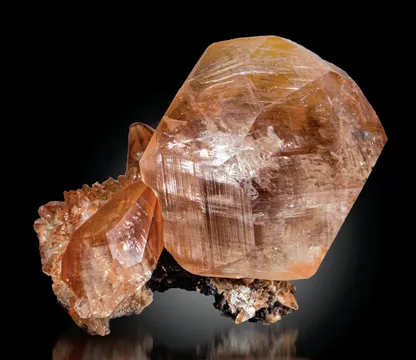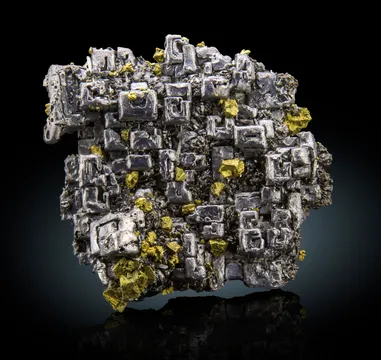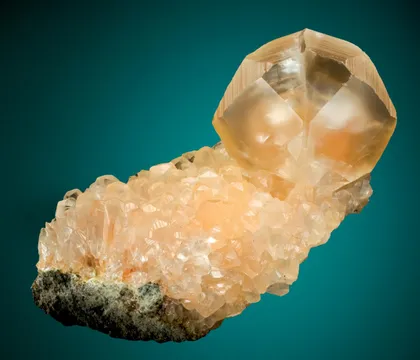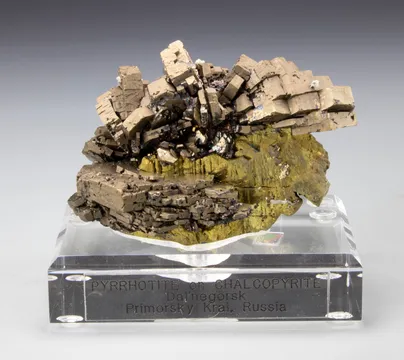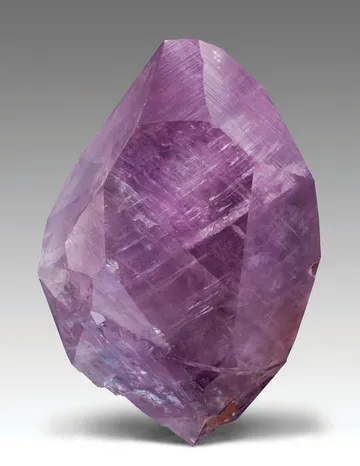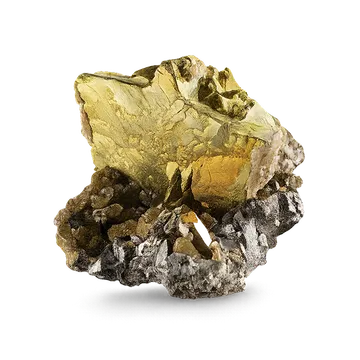
Tonglushan-Chalcopyrit, Daye, China — bräunlich-golden glänzende Kristalle und irisierende Blisterkupferkugeln; eine Skarn-Lokalität, die von Sammlern wegen ihrer Seltenheit und ihres Kontextes geschätzt wird.
Key facts
Tonglushan-Chalcopyrit ist eine moderne chinesische Kupfer-Localität von klassischem Rang, weil sie aus einer Mine stammt, die gleichzeitig ein aktives industrielles Erzvorkommen, ein ernstes Skarn-System und eine der großen archäologischen Kupferstätigkeiten Chinas ist. Für Sammler weckt der Name gewöhnlich zwei sehr unterschiedliche Erscheinungsformen: funkelndes, bräunlich-messingfarbiges Chalcopyrit, das mit den Calciterzen aus dem Daye-Gebiet assoziiert wird, und der viel umstrittenere, unvergessliche „Blisterkupfer“-Habit — abgerundete, metallische, irisierende Chalcopyrit-Kugeln und geknäuelte Bälle, die 2019 auf dem Markt erschienen.
Das Kugelmaterial ist das charakteristische Sammler-Nerd der Lokalität. Feine Exemplare sind kompakte Cluster aus schweren, abgerundeten Chalcopyrit-„Orbs“, üblicherweise blau-grau, violett, bronzen, goldfarben oder subtil regenbogen-irisiert, mit glitzernder Mikrotextur statt der flachen, spiegelhellen Flächen gewöhnlicher Kristalle. Einige sind lose Fließstücke; seltenere Stücke bewahren Kugeln, die an Tonstein- oder Sandstein-artige Matrix angeheftet sind, was entscheidend ist, weil Matrix-Stücke hilft, den Habit zu erklären und für einen ernsthaften Sammler viel überzeugender sind als isolierte lose Kugeln ohne Kontext.
Geologisch ist Tonglushan kein isoliertes Proben-Mäntelchen, sondern Teil eines großen Cu-Fe-Au-Skarnsystems im Edong-Bergbaurevier von Daye, Hubei. Das Erzsystem entwickelte sich dort, wo frühkretazische Einfügungs-Gesteine mit triassischen Karbonat-Gesteinen der Daye-Formation interagierten und skarnartige Assemblagen bildeten, reich an Magnetit, Chalcopyrit, Pyrit, Pyrrhotit, Bornit, Granat, Diopsid, Epidot, Chlorit, Quarz und Calcit. Diese Skarn-Umgebung erklärt, warum Tonglushan-Stücke oft eine dichte, Erzmineral- Erscheinung haben statt der zarten Offene-Verzahnungen vieler alpiner oder karbonathaltiger Chalcopyrite.
Die historische Tiefe der Lokalität verleiht den Exemplar ungewöhnliche kulturelle Resonanz. Die antike Tonglüshan-Bergbau- und Schmelz-Stätte bei Daye bewahrt Bergbaustollen, Holzbalken-Unterstützungen, Öfen, Schlacke und Werkzeuge aus der Zeit vom Westlichen Zhou bis zur Han-Dynastie. Moderne Sammler kaufen daher nicht bloß ein Kupfer(II)-Sulfid aus einer produktiven chinesischen Mine, sondern ein Exemplar aus einer Landschaft, in der Kupfergewinnung mit der tiefen Geschichte der chinesischen Bronze- Metallurgie verbunden ist.
Was Sammler suchen, hängt stark vom Habit ab. Für die Blister-Kupfer-Kugeln zeigen die besten Stücke vollständige, natürlich zusammengehörende Kugeln; abwechslungsreiche, aber harmonische Kugelgrößen; starkes metallisches Funkeln; natürliche irisierende Farbe; minimale Abnutzung an den hohen Stellen; und idealerweise eine erhaltene Matrix oder ein altes, glaubwürdiges Etikett von der frühen Fundstelle 2019. Für Chalcopyrit auf Calcit basiert die Qualität auf dem Kontrast: leuchtend messingfarbene Mikro- Kristalle oder Kristallbeschichtungen, die selektiv auf hellem Calcit platziert sind, insbesondere dort, wo der Chalcopyrit Kanten, Ecken oder frühere Calcit-Formen unter späterem translucentem Calcit-Wachstum betont.## Vorgestellte Exemplare
Specimen suchen: Alle Chalcopyrit-Exemplare aus dem Tonglushan-Minengebiet, China ansehen
Die Tonglushan-Mine befindet sich im Edong-Minenbezirk, Stadtkreis Daye, Huangshi, Province Hubei, China, nahe Daye und im Mittleren–Unteren Yangtse-Fluss-Metallogenesegürtel. Mindat verzeichnet die Mine als aktives Steinbruchabbaugebiet, wobei das Tonglushan Cu-Au-Fe-Deposit auch unter den Schreibweisen Tonglüshan und Tonglvshan bekannt ist.
Das Vorkommen ist ein Skarn-Typ-System aus Cu-Fe-Au, das sich um ein Quarz-Monzodiorit- bis Quarz-Diorit-Intrusionszentrum und dessen Kontaktzonen zu Karbonatgesteinen entwickelt hat. Der Hauptkarbonatträger ist die Untere Trias Daye-Formation, beschrieben in geologischer Literatur als dünn- bis dickgeschichtete Kalksteine und dolomitische Kalksteine mit evaporitischen Komponenten. Die wichtigsten Erzgänge treten nahe den Intrusions-Karbonat-Kontakten auf, wo hydrothermale Fluiden magnesische und kalk-magnesiumhaltige Skarne erzeugten. Tonglushan ist nicht nur ein „Chalcopyrit-Mine“ im Sammlungsbegriff; Chalcopyrit ist eines der Erzmineralien in einem viel breiteren Skarn-Assemblage, lokal dominiert von Magnetit und begleitet von Pyrit, Pyrrhotin, Bornit, Hämatit, Molybdänit, Calcit, Quarz, Granat, Diopsid, Epidot, Phlogopit, Amphibol, Chlorit und anderen Veränderungsmineralien.
Veröffentlichte Beschreibungen bezeichnen das Tonglushan-System allgemein als Menge mehrerer Erzgänge. Eine moderne Zusammenfassung nennt 13 Skarn-Erzvorkommen, überwiegend entlang des Kontakts zwischen dem Tonglushan-Quarz-Diorit-Pluton und den Daye-Formations-Karbonaten. Mindats Ortsbeschreibung vermerkt Erzgänge über eine Fläche von grob 2.000 mal 600 Metern, typischerweise faltenförmig (lentikulär), mit einzelnen Gängen von einigen Hundert Metern Länge und Dutzenden bis über Hundert Metern Dicke. Dieses Maßstab ist für Sammler relevant, weil die feinsten Chalcopyrit-Exemplare incidental zu einem großen betriebenen Kupfer-Eisen-Gold-Mine vorkommen, nicht das Ergebnis eines kleinen speziellen Sammlungsabbaus.
Die antike Bergbaugeschichte ist ebenso bedeutsam. Der Tonglushan-Altert Kupferbergbau- und Schmelzstandort wurde während moderner Tagebaubergbau entdeckt und von den 1970er bis in die 1980er Jahre archäologisch ausgegraben. Quellen berichten von Hunderten alten Schächten und Sohlen, Holzkonstruktionen, Schmelzöfen, Schlackenhaufen und mehr als 1.000 freigelegten Werkzeugen und Utensilien. Die alten Arbeiten reichen von der Westlichen Zhou- bis zur Han-Dynastie, und der Ort wird als einer der frühesten, größten und am besten erhaltenen Kupferbergbau- und Schmelzreste Chinas beschrieben. Der moderne Mineneingang und die archäologisch-museale Landschaft gehören zum gleichen kupferführenden Bezirk, weshalb Tonglushan-Exemplare eine Ortsgeschichte tragen, die weit über ihre mineralische Ästhetik hinausgeht.Der Sammelzugang sollte als geschlossen betrachtet werden, es sei denn, es liegt eine ausdrückliche Genehmigung vom Bergwerk und allen relevanten Behörden vor. Tonglushan ist ein aktives Industriebergwerk, und das archäologische Gebiet ist als Kulturerbe geschützt. Moderne Sammlungsstücke für Sammler erreichten den Markt durch Bergleute, Händler und Sammlungslose; es ist kein gelegentlicher Feldsammelpunk. Das bessere Material der Chalcopyrit-Sphäre scheint aus einer kurzlebigen Fundstelle um Ende 2018 bis Anfang 2019 stammt zu sein, wobei einige Quellen die Marktzugänglichkeit ab Januar 2019 und bessere Lose durch das Frühjahr jenes Jahres beschreiben. Spätere Angebote sind typischerweise Wiederverkaufstücke oder Proben, die aus früheren Händlerbeständen verstreut wurden, statt Belege für eine kontinuierliche Probenlieferung.
Zu den bemerkenswerten Funden gehören die Chalcopyrit-Kugelcluster von 2019; chalcopyrit-beschichtete Chalcocit-Djurleit-Stücke aus früheren Daye/Tonglushan-Funden; und späterer Calcitstücke, bei denen mikrokristallines Chalcopyrit Calcitflächen, -Kanten oder frühere Skalenhedra durch späteres Wachstum sichtbar macht. Tonglushan ist auch gut durch Calcit, Malachit, Azurit, Chalcocit, native Kupfer, Pyrit und andere Kupfer-Skarnarten vertreten, aber Chalcopyrit bleibt eines der Mineralien, die eng mit der Erzidentität des Bergwerks verbunden sind.## Eigenschaften von Chalkopyrit aus dem Tonglushan-Mine, China
Die markanteste Chalkopyrit-Gewohnheit aus Tonglushan ist die abgerundete Blisterkupfer-Form. Diese Proben sind keine gewöhnlichen botryoidalen Krusten; die besten stellen diskrete, dichte, metallische Kugeln oder Kugelcluster dar, von denen einige wie Trauben oder verschmolzene Blasen zusammengewachsen sind. Einzelne Sphären können etwa 1 bis 2 Zentimeter groß sein bei bemerkenswerten Miniaturlichtungen, während größere Exemplare Kabinettgröße erreichen können, wenn mehrere Kugeln natürlich miteinander verkittet sind. Einige Händler- und MinID-Aufzeichnungen dokumentieren Cluster im Bereich von 5 Zentimetern, während indexierte Markteinträge größere Blisterkupfer-Beispiele von etwa 7 bis 10 Zentimetern verzeichneten.
Die Farbe gehört zu den großen Reizen. Frischer Chalkopyrit ist messinggelb, aber Tonglushan-Sphärenproben zeigen oft blau-graue, violette, bronzene, goldene, grünliche oder gemischte irisierende Oberflächen. Die besten Stücke besitzen eine funkelnde, mikrosatinate Haut statt eines flachen künstlichen Regenbogenglanzes. Die Oberfläche kann uneben, kraterförmig, porös oder subtil körnig sein, und diese Textur ist Teil des Reizes der Habit. Stücke, die zu gleichmäßig poliert, zu perfekt sphärisch oder zu birnenförmig wirken, verdienen eine besondere Prüfung.
Interne Studien des Kugelmaterials haben die Habit noch interessanter gemacht. Die Smithsonian-Untersuchung des Exemplar NMNH C7858 bestätigte Chalkopyrit durch Raman-Spektroskopie und Kupfer-Eisen-Sulfid durch EDS, mit porösen Chalkopyriträndern und Inneren, die 10–100 Mikrometer Kupfer-Eisen-Sulfid-Sphärolungen in einer feineren Matrix enthalten. Die gleiche Studie erwähnte interstitiellen Calciumsulfat und Calciumsulfid, sowie geringe Quarz-, Muskovit- und Natriumfeldspatgehalte. Diese Beobachtungen sind für gewöhnliche Chalkopyritkristalle untypisch und sind ein wesentlicher Grund dafür, dass die Tonglushan-Kugeln Mineralogie-Enthusiasten ebenso wie Sammler weiterhin faszinieren.
Begleitmineralien hängen davon ab, welcher Stil der Probe diskutiert wird. Im Erz- und Skarnkontext ist Chalkopyrit mit Magnetit, Pyrit, Pyrrhotin, Bornit, Hämatit, Molybdänit, Granat, Diopsid, Epidot, Phlogopit, Amphibol, Chlorit, Quarz und Calcit assoziiert. Im Blisterkupfer-Material der Matrixstücke wurden Stücke auf Mudstone oder harten Sandstein-ähnlichen Matrizen beschrieben, mit sulfidhaltigen Rändern oder Zonen um die Bälle. Für Sammlerstücke aus dem weiteren Tonglushan/Daye-Markt kann Chalkopyrit mit Calcit, Chalkodontit, Djurleith, Pyrit und Quarz auftreten.
Chalkopyrit auf Calcit aus Tonglushan ist eine konventionellere, aber dennoch attraktive Stilrichtung. Einige Stücke zeigen messing-goldenen Mikrok Chalkopyritstaub an den Rändern und Ecken komprimierter oder skalenhoher Calcitkristalle. Andere zeigen eine mikrokristalline Chalkopyritschicht auf einer früheren Calcit-Generation, sichtbar unter späteren transluzenten Calcit-“Fenstern“. Diese Objekte sind Ausstellungsstücke zuerst und Erzmuster danach: Ihre Anziehungskraft hängt von Funken, Kontrast und der Art ab, wie Chalkopyrit die Calcit-Architektur betont.Qualität in Tonglushan-Chalcopyrit wird durch Natürlichkeit, Erhaltung und Lokalitätsvertrauen beurteilt. Für Kugelcluster bevorzugen Sammler vollständig verbundene, zusammenhängende Bälle mit minimalem Kontaktschaden, starker aber glaubwürdiger Irideszenz, Oberflächenfunkeln, stabilen Sulfidzustand und vorzugsweise Matrix oder frühere Dokumentation. Bei Chalcopyrit-auf-Calcit achten Sie auf scharfes Calcit, helles metallisches Chalcopyrit, saßen Kontrast und eine Zusammensetzung, bei der das Chalcopyrit visuell absichtlich wirkt, statt bloß staubig.## Collector Notes
Tonglushan-Chalkopyrit-Kugeln sind eine der wenigen modernen Mineralkenntnisse, bei denen Authentizitätsbedenken Teil der Sammelhistorie des Exemplars sind. Als die Kugeln 2019 erstmals auftauchten, vermuteten viele Sammler Fertigung, Beschichtung, Schnitzerei oder künstliche Iriszenz, weil das Habit zu seltsam schien. Händlerseitige Tests bestätigten Chalkopyrit mittels EDS und querschnittsgeschnittenes Material, das nicht geschnitzt war. Die Arbeit des Smithsonian bestätigte später Chalkopyrit und Anhydrit in analysierten Abschnitten und fand zugleich das unerwartete Vorhandensein von Calciumsulfat und Calciumcarbid (Calciumsulfid) in den Kugeln. Mindat merkt inzwischen explizit an, dass Zweifel an der Authentizität der Chalkopyrit-Kugeln aufgekommen sind, während gleichzeitig Chalkopyrit-Var. blistered copper aus Tonglushan als Fundstelle verzeichnet wird.
Die praktische Haltung des Sammlers sollte weder leichtgläubig noch ablehnend sein. Kaufen Sie diese nur als dokumentierte Tonglushan-Chalkopyrit-Kugeln, wenn die Beweisführung glaubwürdig ist: ein Etikett aus dem frühen 2019 oder kurz danach, eine bekannte Händlerquelle, Matrix-Belege, klare Fotos der Oberfläche und keine Anzeichen von Bohren, Polieren, Gießen, Klebernähten, Farbstofftropfen oder gleichförmiger hergestellter Perlengeometrie. Lose Einzelselbstkugeln sind am schwersten zu bewerten; Matrixstücke und natürlich zusammengefügte Cluster wirken überzeugender. Exponierte Kugeln mit einer verdächtig gleichmäßigen Regenbogenhaut sollten sorgfältig untersucht werden, denn Chalkopyrit aus vielen Fundorten wird manchmal säurebehandelt oder chemisch verändert, um „Pfauen“-Farben zu verstärken.
Gebrauchsbedingte Zustandprobleme sind typisch für dichte Sulfidproben, jedoch mit einigen Tonglushan-spezifischen Bedenken. Die Kugeloberflächen können an Hochpunkten abgetragen sein, besonders wenn lose Kugeln aus Taschenboden geschöpft und später in Masse gehandhabt wurden. Clusterkontaktstellen können natürlich sein, aber gebrochene Verbindungen oder wieder angefügte Kugeln sollten unter Vergrößerung geprüft werden. Der Oberflächenglanz lässt sich leicht durch Öl, Hautkontakt oder aggressive Reinigung dämpfen. Vermeiden Sie Ultraschallreinigung, Säuren, Metallbürsten und langes Einweichen. Eine sanfte trockene Bürste oder eine minimale Spülung mit destilliertem Wasser gefolgt von gründlichem Trocknen ist sicherer.
Die Stabilität ist normalerweise besser als bei instabiler Markasit, aber jedes Sulfid enthaltende Pyrit, Pyrrhotin oder feinkörnige Intergrowths verdienen eine vernünftige Lagerung. Halten Sie Tonglushan-Chalkopyrit trocken, fern von starken Feuchtigkeitsschwankungen und nicht in feuchtem Schaum versiegelt. Wenn ein Stück Pyrit oder Pyrrhotin enthält, achten Sie auf Schwefelgeruch, weiße oder gelbe Effloreszenzen, Risse oder Pulverisierung. Für das Kugelmaterial erinnert die Smithsonian-Beobachtung, dass eine freiliegende polierte Fläche nach Monaten in Luft Calciumsulfat-Kristalle bildete, daran, dass frisch geschnittene oder beschädigte Oberflächen sich anders verhalten können als intakte Oberflächen des Exemplars.Rarität ist nuanciert. Chalkopyrit als Erzmineral in Tonglushan ist reichlich vorhanden, doch feine Chalkopyrit-Exemplare sind es nicht. Das 2019er Blisterkupfer-Material scheint eine begrenzte Fundstelle gewesen zu sein, und die besten Cluster- und Matrix-Beispiele sind deutlich seltener als loses Einzelstücke. Die heutige Markverfügbarkeit besteht größtenteils aus älteren Händlervorräten, Wiederverkaufsproben und kleinen Inseraten, verstreut über Mineralien-Marktplätze. Die Preise variieren stark: Kleine lose Stücke oder einfache Kugel-Cluster können zu bescheidenen bis mittleren Preisen erscheinen, während ästhetische, gut dokumentierte Cluster, große Vitrinenexemplare und Matrixstücke deutlich stärkere Sammlerprämien erzielen können.## Geschichten & Feldnotizen
Der Tonglushan-Sphärenfund betreten den Mineralmarkt mit der Art Ungläubigkeit, die normalerweise obviousen Fälschungen vorbehalten ist. Im Januar 2019, so berichten Händler entsprechend in The Mineral Newsletter, begannen die seltsamen Kugeln aus dem Mine zu kommen. Sie waren weder scharfe Kristalle, noch gewöhnliche botryoidale Häute, noch bekannte chinesische Calcit-Kombinationen. Sie waren schwere metallische Kugeln—einzeln, verbunden oder irisierend—aus einer Mine, deren Name wörtlich Grünkupfer evoziert.
Die erste Reaktion war Verdacht. Das Material sah aus wie „eine neue Art, Kupferminerale zu fälschen“, daher wurde eine der größeren gelben Kugeln in Querschnitt geschnitten. Die innere Struktur wurde als normal und radial beschrieben, nicht geschnitzt. Dann kamen EDS-Arbeiten an der University of Arizona, die Chalcopyrit und kein Bornit ergaben, trotz der Erwartung, dass die mehrfarbige Beschichtung Bornit sein könnte. Dieser Punkt war wichtig: Hätte die Irideszenz eine Bornit-Haut über etwas anderem gebildet, wäre das Exemplar eine ganz andere Sammelangelegenheit gewesen.
Die Bergleute lieferten zunächst die einfachen Stücke: Floaters aus dem Boden offener Spalte. Das waren die Kugeln, die sich bereits gelöst hatten. Die wichtigeren Exemplare waren schwerer zu bekommen. Händler berichten, dass Matrixstücke ausdrücklich angefragt wurden und schließlich im vierten und letzten Los erschienen, das im Mai aus Material gewonnen wurde, das im April gesammelt worden war. Diese Matrixexemplare kosten extra, weil sie Werkzeuge, Zeit und Mühe benötigten, um sie vom Dach der letzten Tasche zu entfernen, statt einfach vom Boden aufgesammelt zu werden.
Die Matrix änderte die Geschichte. Anstatt anonymer loser Kugeln zeigten die Stücke Chalcopyrit-Sphären, die an einen fein granulierter Mudstone- oder harte Sandstein-ähnliche Träger angepasst waren, mit einem Rand- oder Übergangsbereich zwischen dem Sulfid und der Matrix. Dr. Peter Megaw, der Stücke in China untersuchte, vermutete, dass Flüssigkeiten den Zement, der den Mudstone zusammenhielt, gelöst haben könnten und die schweren Sulfidkugeln freigesetzt, sodass sie am Boden der Leere „in einem Nest aus losem Sand“ absanken. In diesem Modell verhielt sich die Tasche fast wie einige Edelstein-Taschen in kaolinisiertem Ton: Sobald die tragende Matrix nachgab, setzten sich schwere Kristalle oder Sulfidformen nach unten ab und erzeugten eine Konzentration von Floaters.
Die Bildsprache bleibt im Gedächtnis, weil sie die Entdeckung zu einer mechanischen Szene unter der Erde macht. Stell dir Chalcopyrit vor, der Risse und Hohlräume füllt, sich in Rundformen aufblubbert, wo Platz war, und später Flüssigkeiten die umgebende Mudstone schwächen. Einige Kugeln blieben am Dach oder an den Wänden befestigt. Andere lösten sich, fielen ab und sammelten sich am Boden der Tasche. Die Bergleute schöpften sie dann heraus. Die bestürzende erhaltenen Matrixexemplare sind daher nicht nur schönere Beispiele; sie sind der Beweis, der es einem Sammler ermöglicht, die Tasche rekonstruiert.Der Smithsonian-Abschnitt fügte eine weitere Ebene des Rätsels hinzu. Das National Museum of Natural History erwarb das Exemplar NMNH C7858 beim Tucson-Show der Schmuck- und Mineralienmesse 2019 und begann mit analytischer Arbeit. EDS bestätigte Kupfer-Eisen-Sulfid; Raman bestätigte später Chalkopyrit und Anhydrit in Proben. Doch die Studie fand auch Kalziumsulfat und, noch überraschender, Kalziumsulfid in den Interstizien. Kalziumsulfid ist kein beiläufiges Begleitphasen in normalen Chalkopyrit-Proben; das Smithsonian bemerkte, dass dieses Material besser aus ungewöhnlichen Umgebungen bekannt ist, darunter Meteoriten und seltene natürliche Fundorte mit exotischen Bedingungen. Diese unerwartete innere Chemie ist der Grund, warum Tonglushans Chalkopyrit-Bälle mehr sind als eine hübsche Markt-Neuheit — sie bleiben ein mineralogisches Rätsel, das sorgfältige Dokumentation verdient.## Mineralogische Aufzeichnungen & Publikationen- Mindat-Lokalitätsseite: Tonglushan Mine, Edong Mining District, Daye Co., Huangshi, Hubei, China — Kernlokalitätsreferenz für Koordinaten, Status, Mineralienliste, Geologie, alternative Schreibweisen und bibliografische Referenzen.
Mindat-Vorkommen-Seite: Blistered Copper aus der Tonglushan Mine — Spezifischer Fundort-Eintrag für Chalcopyrit Var. blistered copper am Tonglushan.
Smithsonian National Museum of Natural History, “Curious Chalcopyrite” — Analytische Anmerkung zu NMNH C7858, einschließlich EDS, SEM, Raman-Arbeiten, Chalcopyrit-Bestätigung, poröse Ränder, 10–100 Mikrometer-Sphären, Calciumsulfat und Calciumoxid sulfide.
Zhao, H.; Xie, G.; Wei, K.; Ke, Y. “Mineral compositions and fluid evolution of the Tonglushan skarn Cu–Fe deposit, SE Hubei, east-central China.” International Geology Review 54(7), 737–764. DOI:10.1080/00206814.2011.569418 — Wichtige lagerstättenbezogene Arbeit, die die 13 Skarn-Erzvorkommen, Erze und Gangarten, Verwitterungsstadien, Fluidinclusions und Skarn-Mineralense
Chen, Y.-J.; Chen, H.-Y.; Zaw, K.; Pirajno, F.; Zhang, Z.-J. “Geodynamic settings and tectonic model of skarn gold deposits in China: An overview.” Ore Geology Reviews 31, 139–169. DOI:10.1016/j.oregeorev.2005.01.001 — Regionaler Skarn-Gold-Kontext, der für Tonglushan in mineralogischen Lokalitätsunterlagen zitiert wird.
Pan, Y.; Dong, P. “The Lower Changjiang (Yangzi/Yangtze River) metallogenic belt, east central China: intrusion- and wall rock-hosted Cu–Fe–Au, Mo, Zn, Pb, Ag deposits.” Ore Geology Reviews 15(4). DOI:10.1016/S0169-1368(99)00022-0 — Regionaler metallogenetischer Gürtel-Verweis auf die breitere geologische Provinz, die Tonglushan enthält.
Zhang, F.; Williamson, B. J.; Rollinson, G. K.; Hughes, H. S. R. “A mineralogical investigation into the formation of ore-barren endoskarn: An example from the Tonglushan porphyry system, eastern China.” Ore Geology Reviews 157. DOI:10.1016/j.oregeorev.2023.105441 — Jüngste Studie zur Endoskarn-Entwicklung im Tonglushan-Porphyr-Skarn-System.
Wu, X.; Xie, G.; Xu, J.; Voudouris, P.; Liu, W. “Distribution of Co, Te, Se in porphyry copper systems: A case study of the Tonglvshan deposit, Eastern China.” Ore Geology Reviews 174, 106304. DOI:10.1016/j.oregeorev.2024.106304 — Neueste Spurenelement-Arbeiten relevant zur Sulfidmineralisierung im Tonglvshan/Tonglushan-System.
Zhu, Q.; Xie, G.; Lu, L.; Yan, F.; Cai, H. “Trace element of epidote from the Tonglushan Cu-Fe-Au deposit, eastern China: Implications for exploration indicator foder Skarnmineralisierung.” Ore Geology Reviews 174, 106298. DOI:10.1016/j.oregeorev.2024.106298 — Jüngstes Epidot-Geochemie-Paper direkt mit Tonglushan-Skarnexploration verbunden.
Zhang, S.; Gao, J.-F.; Zhang, H.; Huang, X.-W.; Li, J.; Li, R.; Xu, H. “Revealing the distribution and efficient enrichment of cobalt in a Cu–Au skarn mineralization system.” Ore Geology Reviews 181, 106643. DOI:10.1016/j.oregeorev.2025.106643 — Kürzliches Paper, das die Kobaltdistribution im Tonglushan-Cu-Au-Skarnsystem dokumentiert.
MinID LDU-JUT: Chalcopyrite, Tonglushan Mine — Dokumentierter 5,1 × 3,4 × 3,3 cm großer Chalcopyrit-Kugelminiatur mit Händlernotizen zur Fundstelle 2018–2019.
MinID P1P-VUK: Djurleite und Chalcopyrit, Tonglushan Mine — Dokumentierter 170 × 70 × 50 mm großer Djurleit-Chalcopyrit-Specimen aus Tonglushan, nützlich für die Erscheinungsformen von Chalkosin-Djurleit-Chalcopyrit.
Mario Pauwels Mindat-Galerieeintrag für Tonglushan Chalcopyrite Floater — Fotoaufzeichnungs-Eintrag für einen 5,8 × 4,5 × 3,5 cm großen Chalcopyrit-Floater, beschrieben als Blisterkupfer.## Videos & Media
“Chalcopyrite on Calcite Crystals and Minerals from Daye Copper Mine” — Heritage 1971 — Händler-Video für eine Tonglushan/Daye-Chalcopyrit-auf-Calcit-Präparat aus einer Entdeckung im Oktober 2020.
“キャルコパイライト〖Chalcopyrite〗PEANUTS MINERALS” — PEANUTS MINERALS — Kurzes Präparat-Video eines kleinen Tonglushan-Chalcopyrit-Sphärencluster, nützlich, um die dunkle metallische Oberfläche und die irisierende Farberstrahlung zu sehen.
“Calcite with Pyrite from Tonglüshan Mine, Edong, China” — Fabre Minerals on Vimeo — Videorekordung eines Tonglüshan-Kalcitpräparats aus dem Jahr 2022, die eine frühere Calcit-Phase zeigt, bedeckt von glänzender irisierender mikrokristalliner Chalcopyrit.## Weiteres Lesen & Externe Links
Mindat: Tonglushan Mine locality — Die beste einzelne Lokation-Seite der Datenbank für Mineralienliste, Geologie, Koordinaten und Referenzen.
Mindat: Blistered Copper from Tonglushan Mine — Fokussierte Fundstelle zur Chalkopir-Variante blistered copper.
Smithsonian: Curious Chalcopyrite — Wesentliche analytische Diskussion des 2019er Tonglushan-Chalkopyrit-Sphärenmaterials.
The Mineral Newsletter, June 2023 — Enthält einen angepassten Arkenstone-Artikel mit der bestzugänglichen Erzählung des Finders der Sphere 2019, Matrixstücke und Entstehungsideen.
China Daily / China Services: Tonglushan Ancient Copper Mine Site listed as National Archaeological Site Park — Moderne Erbe-Zusammenfassung des alten Bergbaustandorts und seiner archäologischen Bedeutung.
ChinaCulture: Tonglushan Mining and Smelting Site — Nützlicher kulturhistorischer Hintergrund zu alten Schächten, Öfen, Werkzeugen und Kupferproduktion.
ChinaCulture: Museum of the Former Site of Ancient Tonglüshan Copper Mine — Hintergrund zum Museum, öffentliche Eröffnung und archäologischer Ausgrabungsgeschichte.
ResearchGate: Mineral compositions and fluid evolution of the Tonglushan skarn Cu–Fe deposit — Zugängbare Zusammenfassung und Abbildungen zum großen International Geology Review-Beitrag über Tonglushan-Skarn-Geologie.
Fabre Minerals video page: Calcite with Pyrite from Tonglüshan Mine — Visuelle Referenz für Kalkspat plus mikrokristalline Chalkopyrit-Stil aus Tonglüshan.
Heritage 1971: Chalcopyrite on Calcite from Daye Copper Mine, China — Händlerliste, die Chalkopyrit ausgewählt auf Calcite von Tonglushan/Daye dokumentiert.
Minfind: Chalcopyrite from Tonglushan Mine — Verkaufte Arkenstone-Liste für ein 50 × 40 × 30 mm Tonglushan-Chalkopyritexemplar, nützlich für Markt- und Größenreferenz.