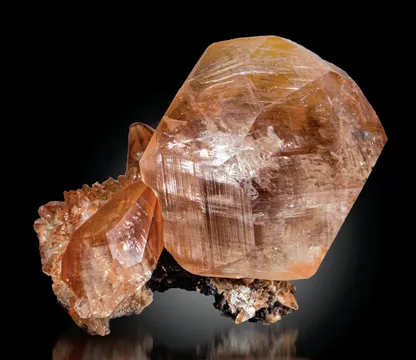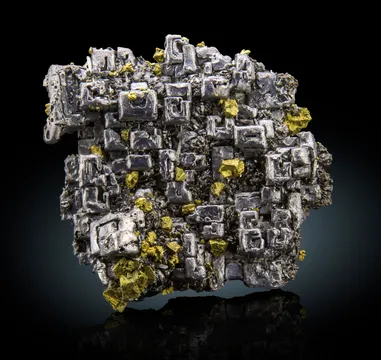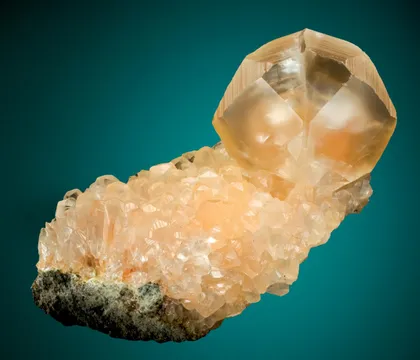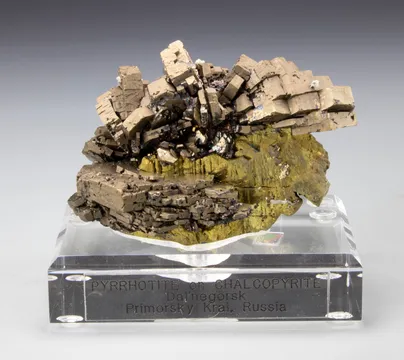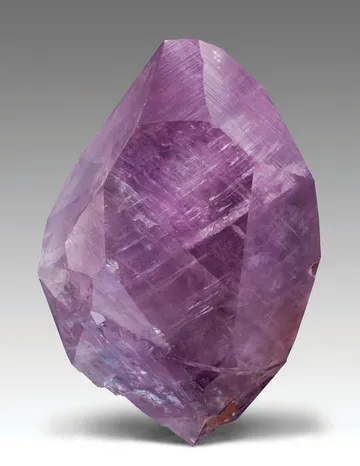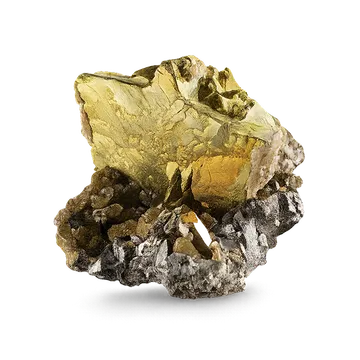
Tonglushan chalcopyrite, Daye, China — brassy crystals and iridescent blister copper spheres; a skarn locality prized by collectors for rarity and context.
Key facts
Tonglushan chalcopyrite is a modern Chinese copper-locality classic because it comes from a mine that is simultaneously an active industrial orebody, a serious skarn system, and one of China’s great archaeological copper sites. For collectors, the name usually evokes two very different looks: sparkling brassy chalcopyrite associated with the Daye-area calcite finds, and the much more controversial, unforgettable “blister copper” habit—rounded, metallic, iridescent chalcopyrite spheres and clustered balls that appeared on the market in 2019.
The sphere material is the locality’s signature collector oddity. Fine examples are compact clusters of heavy, rounded chalcopyrite “orbs,” commonly blue-gray, purple, bronze, gold, or subtly rainbow-iridescent, with glittering micro-texture rather than the flat, mirror-bright faces of ordinary crystals. Some are loose floaters; rarer pieces preserve balls attached to mudstone or sandstone-like matrix, which is crucial because matrix pieces help explain the habit and are far more convincing to a serious collector than isolated loose balls with no context.
Geologically, Tonglushan is not an isolated specimen pocket but part of a large Cu-Fe-Au skarn system in the Edong mining district of Daye, Hubei. The ore system developed where Early Cretaceous intrusive rocks interacted with Triassic carbonate rocks of the Daye Formation, producing skarn assemblages rich in magnetite, chalcopyrite, pyrite, pyrrhotite, bornite, garnet, diopside, epidote, chlorite, quartz, and calcite. That skarn setting explains why Tonglushan pieces often have a dense, ore-mineral feel rather than the delicate open-vein look of many alpine or carbonate-hosted chalcopyrites.
The historical depth of the locality gives the specimens unusual cultural resonance. The ancient Tonglüshan copper mining and smelting site at Daye preserves mining shafts, wooden supports, furnaces, slag, and tools from the Western Zhou through Han periods. Modern collectors are therefore buying not merely a copper sulfide from a productive Chinese mine, but a specimen from a landscape where copper extraction is tied to the deep history of Chinese bronze metallurgy.
What collectors look for depends strongly on the habit. For the blister-copper spheres, the best pieces show complete, naturally joined balls; varied but harmonious sphere sizes; strong metallic sparkle; natural iridescent color; minimal abrasion on the high points; and, ideally, preserved matrix or an old, credible label from the early 2019 find. For chalcopyrite on calcite, quality rests on contrast: bright brassy microcrystals or crystal coatings placed selectively on pale calcite, especially where the chalcopyrite emphasizes edges, corners, or earlier calcite forms beneath later translucent calcite growth.
Search for specimens: View all chalcopyrite specimens from Tonglushan Mine, China
Tonglushan Mine is in the Edong mining district, Daye County-level city, Huangshi, Hubei Province, China, close to Daye and within the Middle–Lower Yangtze River metallogenic belt. Mindat records the mine as an active open-cast mine, with the Tonglushan Cu-Au-Fe deposit also known under the spellings Tonglüshan and Tonglvshan.
The deposit is a skarn-type Cu-Fe-Au system developed around a quartz monzodiorite to quartz-diorite intrusive center and its contacts with carbonate rocks. The principal carbonate host is the Lower Triassic Daye Formation, described in geological work as thin- to thick-bedded limestones and dolomitic limestones with evaporitic components. The main ore bodies occur near intrusive-carbonate contacts, where hydrothermal fluids produced magnesian and calcic-magnesian skarns. Tonglushan is not just a “chalcopyrite mine” in the specimen sense; chalcopyrite is one of the ore minerals in a much broader skarn assemblage dominated locally by magnetite and accompanied by pyrite, pyrrhotite, bornite, hematite, molybdenite, calcite, quartz, garnet, diopside, epidote, phlogopite, amphibole, chlorite, and other alteration minerals.
Published descriptions commonly describe the Tonglushan system as a set of multiple ore bodies. One modern summary gives 13 skarn orebodies mainly along the contact between the Tonglushan quartz-diorite pluton and the Daye Formation carbonates. Mindat’s locality description notes ore bodies over an area of roughly 2,000 by 600 meters, generally lenticular, with individual bodies on the order of hundreds of meters long and tens to more than a hundred meters thick. This scale matters for collectors because the finest chalcopyrite specimens were incidental to a large operating copper-iron-gold mine, not the result of a small specimen-only dig.
The ancient mining story is equally important. The Tonglushan ancient copper mining and smelting site was discovered during modern opencast mining and was excavated archaeologically from the 1970s into the 1980s. Sources describe hundreds of ancient shafts and drifts, wooden support structures, smelting furnaces, slag heaps, and more than 1,000 unearthed tools and utensils. The ancient workings span from Western Zhou through Han times, and the site has been described as among China’s earliest, largest, and best-preserved ancient copper mining and smelting remains. The modern mine entrance and the archaeological-museum landscape are part of the same copper-bearing district, which is why Tonglushan specimens carry a locality story far beyond their mineral aesthetics.
Collecting access should be regarded as closed unless one has explicit permission from the mine and all relevant authorities. Tonglushan is an active industrial mine, and the archaeological area is protected cultural heritage. Modern collector specimens reached the market through miners, dealers, and specimen lots; it is not a casual field-collecting locality. The better chalcopyrite sphere material appears to have come from a short-lived find around late 2018 to early 2019, with some sources describing market availability beginning in January 2019 and better lots obtained through the spring of that year. Later offerings are typically resale pieces or specimens dispersed from earlier dealer inventories, rather than evidence of a continuous specimen supply.
Notable finds include the 2019 chalcopyrite ball clusters; chalcopyrite-coated chalcocite-djurleite pieces from earlier Daye/Tonglushan finds; and later calcite pieces where microcrystalline chalcopyrite highlights calcite faces, edges, or earlier scalenohedra visible through later growth. Tonglushan is also well represented by calcite, malachite, azurite, chalcocite, native copper, pyrite, and other copper skarn species, but chalcopyrite remains one of the minerals most closely tied to the mine’s ore identity.
The most distinctive chalcopyrite habit from Tonglushan is the rounded blister-copper form. These specimens are not ordinary botryoidal crusts; the best are discrete, dense, metallic balls or clusters of balls, some joined like grapes or fused bubbles. Individual spheres may be around 1 to 2 centimeters on notable miniature clusters, while larger specimens can reach cabinet size when multiple balls are naturally cemented together. Some dealer and MinID records document clusters in the 5-centimeter range, while indexed market listings have recorded larger blister-copper examples around 7 to 10 centimeters.
Color is one of the great attractions. Fresh chalcopyrite is brassy yellow, but Tonglushan sphere specimens often show blue-gray, purple, bronze, gold, greenish, or mixed iridescent surfaces. The best pieces have a scintillating, micro-sparkly skin rather than a flat artificial rainbow glare. The surface can be uneven, cratered, porous, or subtly granular, and that texture is part of the habit’s charm. Pieces that look too uniformly polished, too perfectly spherical, or too bead-like deserve extra scrutiny.
Internal studies of the sphere material have made the habit even more interesting. The Smithsonian’s investigation of specimen NMNH C7858 found chalcopyrite confirmed by Raman spectroscopy and copper-iron sulfide by EDS, with porous chalcopyrite rims and interiors containing 10–100 micron copper-iron sulfide spherules in a finer matrix. The same study reported interstitial calcium sulfate and calcium sulfide, plus minor quartz, muscovite, and sodium feldspar. Those observations are not normal for run-of-the-mill chalcopyrite crystals and are a major reason the Tonglushan spheres continue to interest mineralogists as well as collectors.
Associated minerals depend on which style of specimen is under discussion. In ore and skarn context, chalcopyrite is associated with magnetite, pyrite, pyrrhotite, bornite, hematite, molybdenite, garnet, diopside, epidote, phlogopite, amphibole, chlorite, quartz, and calcite. In the blister-copper pocket material, matrix pieces have been described on mudstone or hard sandstone-like matrix, with sulfide-rich rims or zones around the balls. For collector pieces from the broader Tonglushan/Daye market, chalcopyrite may appear with calcite, chalcocite, djurleite, pyrite, and quartz.
Chalcopyrite on calcite from Tonglushan is a more conventional but still attractive style. Some pieces show brassy-gold microchalcopyrite dusting the edges and corners of compressed or scalenohedral calcite crystals. Others display a microcrystalline chalcopyrite layer on an earlier calcite generation, visible beneath later translucent calcite “windows.” These are display specimens first and ore specimens second: their appeal depends on sparkle, contrast, and the way chalcopyrite emphasizes calcite architecture.
Quality in Tonglushan chalcopyrite is judged by naturalness, preservation, and locality confidence. For sphere clusters, collectors favor complete joined balls with minimal contact damage, strong but believable iridescence, surface sparkle, stable sulfide condition, and preferably matrix or early documentation. For chalcopyrite-on-calcite, look for sharp calcite, bright metallic chalcopyrite, clean contrast, and a composition where the chalcopyrite is visually intentional rather than merely dusty.
Tonglushan chalcopyrite spheres are one of the few modern mineral finds where authenticity concerns are part of the specimen’s collecting history. When the 2019 balls first appeared, many collectors suspected fabrication, coating, carving, or artificial iridescence because the habit looked almost too strange. Dealer-side testing reported chalcopyrite by EDS and cross-sectioned material that was not carved. Smithsonian work later confirmed chalcopyrite and anhydrite in analyzed sections, while also finding the unexpected presence of calcium sulfate and calcium sulfide within the spheres. Mindat now explicitly notes that doubt has been raised about the authenticity of the chalcopyrite balls, while also recording chalcopyrite var. blistered copper from Tonglushan as an occurrence.
The practical collector’s position should be neither gullible nor dismissive. Buy these as documented Tonglushan chalcopyrite spheres only when the chain of custody is credible: an early 2019 or shortly thereafter label, a known dealer source, matrix evidence, clear photographs of the surface, and no signs of drilling, polishing, casting, glue seams, dye pools, or uniform manufactured bead geometry. Loose single balls are the hardest to evaluate; matrix pieces and naturally joined clusters are more persuasive. Specimens with a suspiciously even rainbow skin should be examined carefully because chalcopyrite from many localities is sometimes acid-treated or chemically altered to enhance “peacock” colors.
Condition issues are typical for dense sulfide specimens but with some Tonglushan-specific concerns. The sphere surfaces can be abraded on high points, especially if loose balls were scooped from pocket bottoms and later handled in bulk. Cluster contact points may be natural, but broken joins or reattached balls should be checked under magnification. The surface sparkle is easy to dull with oil, skin contact, or aggressive cleaning. Avoid ultrasonic cleaning, acids, metal brushes, and prolonged soaking. A gentle dry brush or minimal distilled-water rinse followed by thorough drying is safer.
Stability is usually better than unstable marcasite, but any sulfide containing pyrite, pyrrhotite, or fine-grained intergrowths deserves sensible storage. Keep Tonglushan chalcopyrite dry, away from strong humidity swings, and not sealed in damp foam. If a piece has pyrite or pyrrhotite present, watch for sulfur odor, white or yellow efflorescence, cracking, or powdering. For the sphere material, the Smithsonian observation that an exposed polished section grew calcium sulfate crystals after months in air is a reminder that freshly cut or damaged surfaces may behave differently from intact specimen surfaces.
Rarity is nuanced. Chalcopyrite as an ore mineral at Tonglushan is abundant, but fine chalcopyrite specimens are not. The 2019 blister-copper material appears to have been a limited find, and the best clusters and matrix examples are substantially scarcer than loose singles. Market availability today consists mostly of older dealer stock, resale specimens, and small listings scattered across mineral marketplaces. Prices vary widely: small loose or simple sphere clusters may appear at modest to mid-level prices, while aesthetic, well-documented clusters, large cabinet examples, and matrix pieces can command much stronger collector premiums.
The Tonglushan sphere find entered the mineral market with the kind of disbelief normally reserved for obvious fakes. In January 2019, according to dealer accounts adapted in The Mineral Newsletter, the strange balls began coming out of the mine. They were not sharp crystals, not ordinary botryoidal crusts, and not familiar Chinese calcite combinations. They were heavy metallic spheres—some loose, some joined, some iridescent—coming from a mine whose name literally evokes green copper.
The first reaction was suspicion. The material looked like it could be “some new way to fake copper minerals,” so one of the larger yellow balls was cross-sectioned. The internal structure was described as normal and radial, not carved. Then came EDS work at the University of Arizona, which returned chalcopyrite and no bornite, despite the expectation that the multicolored coating might be bornite. That point mattered: if the iridescence had been a bornite skin over something else, the specimens would have been a different collecting proposition entirely.
The miners first supplied the easy pieces: floaters from the bottoms of open pockets. Those were the balls that had already broken free. The more important specimens were harder to get. Dealer accounts say matrix pieces were requested specifically, and that they finally appeared in the fourth and final lot, obtained in May from material collected in April. Those matrix specimens cost extra because they took tools, time, and effort to remove from the roof of the last pocket rather than simply being picked up from the bottom.
The matrix changed the story. Instead of anonymous loose balls, the pieces showed chalcopyrite spheres attached to a fine-grained mudstone or hard sandstone-like host, with a rim or transition zone between the sulfide and the matrix. Dr. Peter Megaw, who examined pieces in China, suggested that fluids may have dissolved the cement holding the mudstone together, freeing the heavy sulfide balls so they could fall into the bottom of the void “in a nest of loose sand.” In that model, the pocket behaved almost like some gem pockets in kaolinized clay: once the supporting matrix weakened, heavy crystals or sulfide forms settled downward, producing a concentration of floaters.
The imagery is memorable because it turns the find into a mechanical scene underground. Imagine chalcopyrite filling cracks and cavities, bubbling into rounded forms where space allowed, then later fluids weakening the enclosing mudstone. Some balls stayed attached to the roof or walls. Others popped free, dropped, and accumulated at the bottom of the pocket. Miners then scooped them out. The best surviving matrix specimens are therefore not just prettier examples; they are the evidence that lets a collector reconstruct the pocket.
The Smithsonian chapter added a second layer of mystery. The National Museum of Natural History acquired specimen NMNH C7858 at the 2019 Tucson Gem and Mineral Show and began analytical work. EDS confirmed copper iron sulfide; Raman later confirmed chalcopyrite and anhydrite in sections. But the study also found calcium sulfate and, more surprisingly, calcium sulfide in the interstices. Calcium sulfide is not a casual accessory phase in ordinary chalcopyrite specimens; the Smithsonian noted that such material is better known from unusual environments, including meteorites and rare natural localities with exotic conditions. That unexpected internal chemistry is why Tonglushan’s chalcopyrite balls remain more than a pretty market novelty—they are a mineralogical puzzle still worth careful documentation.