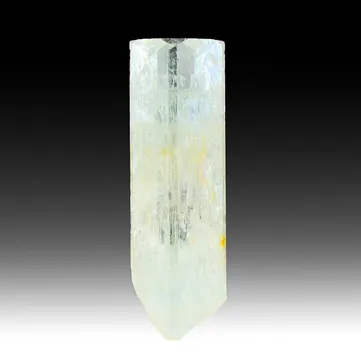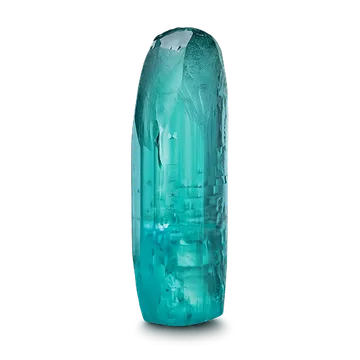
Mt Antero, Colorado, classic alpine aquamarine locale with glassy blue beryl, rare Be-mineral associates, and historic pocket specimens prized by collectors.
Key facts
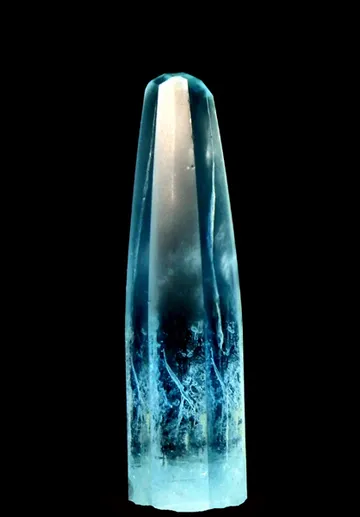
Mt Antero is the classic American mountain for aquamarine: a high, wind-scoured Colorado fourteener where blue beryl occurs in small pegmatites, miarolitic cavities, and related hydrothermal veins in and around the Mount Antero Granite. The best crystals have the unmistakable appeal collectors want from alpine pegmatites: glassy luster, hexagonal form, pale to medium blue color, and the occasional gem-clear termination that seems improbably delicate for a locality above timberline.

Photo: Wikimedia Commons
The locality’s character is inseparable from altitude. Productive ground lies around the upper slopes of Mount Antero and neighboring Mount White, in the Sawatch Range above the Arkansas Valley. Collecting has historically meant working loose, frost-shattered granite, talus, and pocket clay in a place where the weather can turn from bright sun to lightning, hail, or snow in the same day. That alpine setting gives Antero aquamarine much of its romance, but it also explains the locality’s specimen profile: many pieces are singles or repaired pocket fragments rather than broad, undisturbed matrix plates.
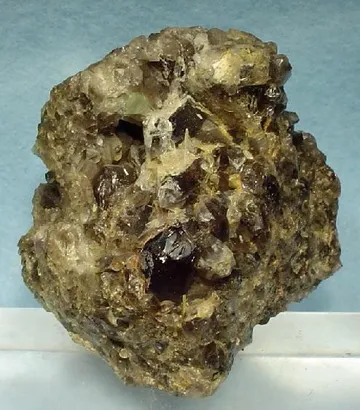
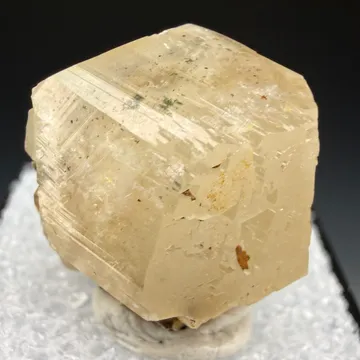
The geological setting is unusually rich in beryllium minerals. Aquamarine is the headline species, but Mt Antero’s reputation rests on a broader Be-mineral suite that includes phenakite and bertrandite, with smoky quartz, clear and milky quartz, albite, microcline, muscovite, fluorite, topaz, garnet, pyrite, calcite, and rarer species reported from the district. In the most collectible pieces, pale blue beryl may sit with smoky quartz and feldspar, or appear in old-time combination specimens with bertrandite. The association of aquamarine with phenakite and bertrandite is one of the features that makes Antero immediately recognizable among American pegmatite localities.
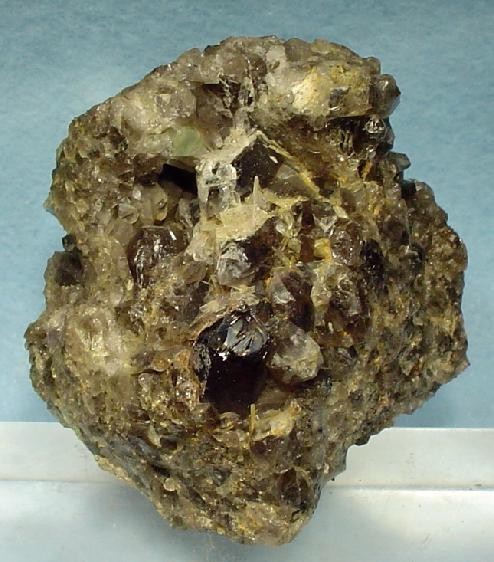
Photo: Wikimedia Commons
Historically, Mt Antero matters far beyond Colorado collecting circles. Mineral specimens have been collected there since the 1880s, and the locality appeared early in American mineralogical literature through work on aquamarine, phenakite, and bertrandite. In the twentieth century it was revisited by field collectors, government geologists, pegmatite specialists, and gem prospectors, and in modern times the mountain became widely known through the discovery and museum display of “Diane’s Pocket,” the reconstructed aquamarine-and-smoky-quartz pocket associated with Steve Brancato’s 2004 find.
The finest Mt Antero aquamarines are not typically huge by international standards, but they have a special desirability for locality collectors. A sharp, lustrous, undamaged, naturally blue Antero crystal with good transparency and reliable provenance is a serious Colorado specimen. Matrix pieces, crystals with documented old collections, and associations with phenakite, bertrandite, smoky quartz, or fluorite command additional interest.
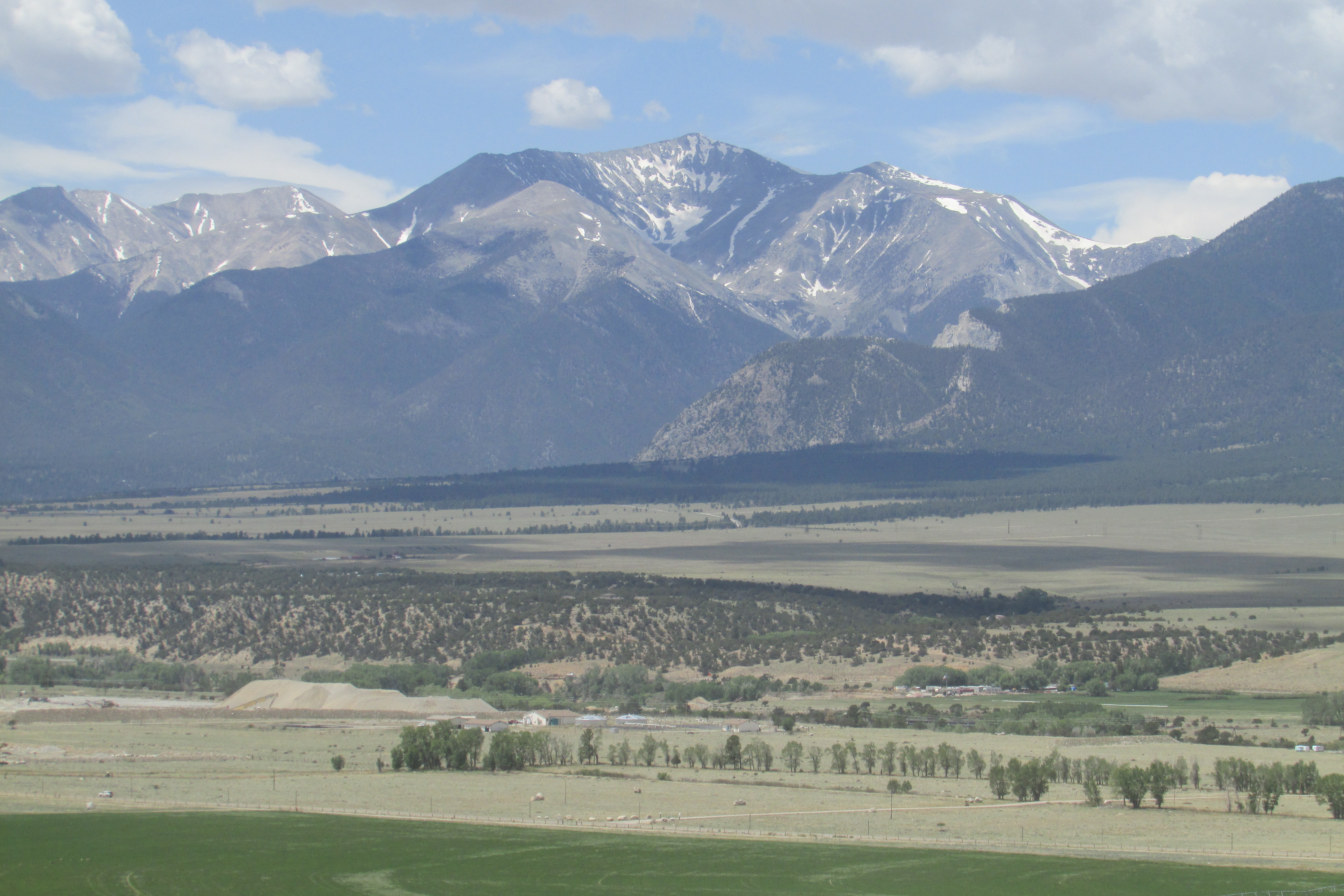
Photo: Wikimedia Commons
Search for specimens: View all aquamarine specimens from Mt Antero, Colorado, USA
Mt Antero rises in Chaffee County, Colorado, in the southern Sawatch Range, within the San Isabel National Forest. It is a fourteener, and the Forest Service describes the mountain as having the highest gem field in the lower 48 states. The collecting area is reached from the Buena Vista–Nathrop side by County Road 162 and the Baldwin Gulch/Mount Antero road system; the Forest Service notes that the road is rocky and rough and requires high-clearance four-wheel drive. Vehicles must stay on designated roads to protect the alpine tundra.
Geologically, the gem deposits are tied to a granitic stock in the Mount Antero–Mount White area. Classic studies describe small beryllium-rich pegmatites and related veins in the granite, with the granite itself related to the larger Mount Princeton batholith. The batholithic rocks include granite and quartz monzonite; the pegmatites and cavities carry microcline, quartz, and hydrothermal beryllium minerals including beryl, phenakite, bertrandite, albite, and fluorite. Modern work refines this further, recognizing evolved granites, the Mount Antero Granite and California leucogranite, aplite dikes, granitic pegmatites, and hydrothermal veins as hosts for colorless beryl, blue beryl, aquamarine, bertrandite, and phenakite.
The deposit style is small-pocket, high-alpine pegmatite and vein mineralization rather than a large commercial gemstone mine. George Switzer’s classic 1939 study emphasized that the pegmatites are generally small, seldom more than about three feet wide and only a few feet in lateral extent, and that many are lenticular, disk-shaped, or cylindrical bodies with sharp contacts in the granite. The best specimen finds have historically come from miarolitic cavities rather than from continuous ore shoots, which explains both the mountain’s fame and its unpredictability.
The oldest documented collecting belongs to the late nineteenth century. E. G. Cross published notes on Mt Antero aquamarine in 1887, describing crystals found a few years earlier by H. A. Wanamaker. S. L. Penfield soon followed with work on phenakite, bertrandite, and the beryllium minerals of Mt Antero. By the early twentieth century, the locality was already known as a source of gem minerals, though its remoteness, weather, and altitude limited regular production.
In the 1930s, Edwin Over, Arthur Montgomery, and George Switzer helped move Antero from collector legend into detailed mineralogical literature. Switzer’s field work in 1938, supported through Harvard’s mineralogical circle, produced a careful study of the granite pegmatites and veins. His classification separated beryl pegmatites, phenakite pegmatites, beryl-phenakite-bertrandite pegmatites, muscovite-quartz veins, phenakite-quartz-fluorite veins, and beryl-quartz-molybdenite veins.
The California mine, southwest of Mount Antero, is a related but distinct part of the district’s beryllium story. There, beryl occurs in a quartz-molybdenite vein in quartz monzonite. The mine was worked on a small scale during World War I for molybdenite, and USGS work later estimated that the exposed vein was roughly 1.5 to 3 feet thick, nearly vertical, and striking about N. 72°–75° E. The California material is important because it shows beryl deposited with molybdenite and because it broadened scientific interest in Antero from gem pockets to beryllium-bearing quartz veins.
Access today requires careful attention to land and claim status. The Forest Service specifically warns that many unpatented mining claims are scattered over the peak, and that rockhounding, prospecting, mining, or even surface collection on those claims without claim-owner permission is illegal. In practice, serious collecting on productive ground is usually a matter of claim ownership, claim-owner permission, organized fee digs, or documented purchases from established miners. The mountain is not a casual “wander and dig anywhere” locality.
Notable modern finds include the 2004 Diane’s Pocket discovery near the summit area, associated with Steve Brancato. A reconstructed portion of that pocket, containing aquamarine with smoky quartz and matrix minerals, is displayed at the Denver Museum of Nature & Science and has become the most widely recognized public face of Mt Antero aquamarine.
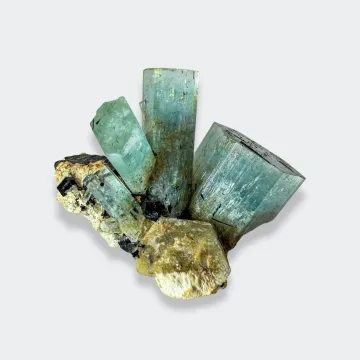
Mt Antero aquamarine is beryl, Be3Al2Si6O18, colored blue to blue-green by iron. The most typical collectible crystals are prismatic hexagonal beryls, often singly terminated, with flat to slightly modified terminations and vertical striations or growth texture on prism faces. Crystals may be complete singles, partial pocket fragments, etched or corroded remnants, or crystals partly attached to quartz, feldspar, mica, or pocket matrix.
Color ranges from very pale blue through greenish blue to medium blue. The best pieces show a clean, cool aquamarine hue rather than grayish or washed-out color. Some crystals grade into nearly colorless goshenite, and individual crystals may show color zoning. Analytical work on Mt Antero beryl has shown that iron is enriched in darker blue zones and comparatively depleted in paler terminated portions, while many crystals preserve growth zoning visible in internal texture and chemistry.
Transparency varies widely. Many crystals are translucent, cloudy, or internally fractured; the finest are gemmy, with clear windows and bright luster. The locality is especially prized when good color, transparency, undamaged form, and documented Antero provenance occur together. Because the pockets are small and the mountain is physically severe, a 2–5 cm sharp crystal can be far more important than its dimensions suggest. Larger crystals are known, but attractive, undamaged, gemmy examples are not common.
Matrix is less common than loose crystals, but it is highly desirable when natural and aesthetically balanced. The best associations include smoky quartz, albite or other feldspar, muscovite, microcline, fluorite, phenakite, and bertrandite. Bertrandite may appear as small, colorless to water-clear blades or laths, sometimes regarded as a late-stage alteration or replacement product related to beryl. Phenakite is a major companion species at the locality and is itself a classic Mt Antero collectible.
The geological environment produced several textural habits collectors should recognize. Some material comes from open cavities and can show clean crystal faces and pocket luster. Other material comes from weathered pocket zones in decomposed granite, where crystals may be freed from clay and loose debris but show abrasion, bruising, or natural etching. A third category consists of vein or greisen-related beryl, including beryl associated with quartz and molybdenite near the California mine; such pieces have a different mineralogical flavor from the classic gem-pocket crystals.
Quality factors for Mt Antero aquamarine are strongly locality-driven. Collectors value:
Mt Antero aquamarine is a locality specimen first and a gemstone second. Fine faceting rough exists, and Colorado aquamarine has been cut into attractive stones, but collectors pay strongest premiums for natural crystals with clear Antero identity. A loose pale blue beryl crystal without a label can be difficult to separate from other beryl localities by eye alone, so provenance matters. Old collection labels, miner documentation, claim names, and purchase history are not just paperwork; they are part of the specimen.
The market contains a range of material. At one end are small pale crystals, crystal fragments, and tumbled or faceted stones sold as Colorado aquamarine. At the other are sharp, lustrous singles; repaired pocket crystals; matrix combinations with smoky quartz or feldspar; and historic specimens from older collections. Serious buyers should distinguish between “Mt Antero style” and documented Mt Antero origin.
No major, locality-specific fake tradition defines the Antero market in the way some famous gem localities have been plagued by systematic forgeries. The more practical concerns are misattribution, repair, reconstruction, and undisclosed treatment. Aquamarine in the gem trade is commonly heat-treated worldwide to improve blue color by reducing greenish tones, so faceted stones or cutting rough sold as Mt Antero should be queried for treatment history. Crystal specimens should be inspected for glued terminations, reattached bases, filled fractures, and mounted fragments.
Reconstruction deserves special mention because the most famous public Mt Antero object, Diane’s Pocket, is displayed as a reconstructed pocket section. Such reconstruction is not automatically deceptive when fully disclosed; in fact, pocket reconstructions can preserve the visual story of a find that naturally came out in pieces. But in the marketplace, the difference between a naturally attached matrix specimen, a repaired specimen, and an artistic reconstruction must be explicit.
Condition issues are common. Antero crystals may show internal crazing, frost damage, etched faces, bruised edges, and broken bases from pocket collapse, talus movement, freeze-thaw cycles, or extraction. Some crystals were recovered from decomposed granite and clay rather than pristine open cavities, and many old pieces were collected under difficult field conditions long before modern specimen-preparation standards. A small, undamaged crystal with strong luster can therefore be more desirable than a larger but battered one.
Rarity is best understood by grade. Small fragments and modest pale crystals are obtainable. Attractive, complete, gemmy crystals are much less common. Significant matrix specimens, old-time pieces, and well-documented crystals from named pockets or important finds are genuinely scarce. Diane’s Pocket-scale material is not representative of routine availability.
For modern collecting, the essential rule is simple: do not dig or collect on claims without permission. The Forest Service’s guidance for Mount Antero is explicit, and the mountain’s productive areas are heavily claimed. Collectors who want self-collected material should pursue legitimate claim-owner arrangements, club trips, fee digs, or purchases directly from miners who can document the source.
The old stories begin with a mountain that did not give up its blue crystals easily. H. A. Wanamaker’s early finds, described in the literature by E. G. Cross in 1887, came from a place that was still remote even by Colorado mining standards. Later accounts describe Wanamaker working summers from a timberline camp and a stone shelter near the summit, using hand tools carried up the mountain. The romance of that image is not sentimental exaggeration: Antero’s gem ground sits in thin air, above timberline, among talus slopes and sudden storms. Before the jeep road, every pound of food, steel, and recovered crystal had to be earned twice—once uphill, once down.
By the 1930s, Mt Antero had become the kind of locality that drew hard-field collectors, not casual tourists. Edwin Over and Arthur Montgomery were among the names that became attached to the mountain’s legend, and Montgomery’s “Storm over Antero” preserved the feel of that collecting era in the very title. Their work sits at the hinge between old-style prospecting and modern mineral collecting: long searches across talus, pocket hints in float, and the constant judgment of whether a seam in decomposed granite might lead to a cavity or merely another sterile split in the rock.
The scientific field season of 1938 gave the locality its classic pegmatite framework. George Switzer worked in the Mount Antero region with Arthur Montgomery and Edwin Over, studying roughly fifteen pegmatites and veins in detail. What he found was not a continuous mineable body but a puzzle of small, isolated, beryllium-rich systems: beryl pegmatites, phenakite pegmatites, beryl-phenakite-bertrandite pegmatites, and hydrothermal veins. The pockets were small enough that the next great find could be only a few feet from nothing at all. That remains the mountain’s logic.
The California mine tells a different Antero story, darker and more metallic. Southwest of Mount Antero, a quartz vein carrying molybdenite and beryl was worked during World War I. P. G. Worcester described rich streaks of molybdenite near the vein walls and vugs scattered through the vein. In the most vivid passages, white quartz crystals up to 12 inches long were found with clear or opaque aquamarine crystals and crystalline molybdenite. Pockets between beryl and quartz could yield 20 or 30 pounds of practically pure molybdenite and molybdite, dug out with a candlestick. It is an extraordinary image: not the clean blue aquamarine crystal of a gem case, but beryl locked into a hard-rock molybdenum vein, part specimen, part strategic mineral.
Then came the road era. In the 1950s, the search for beryllium and the practical needs of miners helped push rough vehicle access up the mountain. That road changed Antero forever. It did not make the crystals easy—the pockets remained scattered and elusive—but it shifted the mountain from a near-expedition locality to one that determined, well-equipped miners and collectors could reach with vehicles, machinery, and short-season logistics. Modern Antero is still severe, but the road made the mountain culturally accessible in a way Wanamaker would not have recognized.
The most famous modern story is Diane’s Pocket. In July 2004, Steve Brancato opened a major smoky quartz-aquamarine pocket near the summit area. Popular accounts describe the moment with almost cinematic neatness: a small sea-blue crystal rolled out and struck him, leading to a much larger cavity. The find ultimately became a reconstructed display associated with the Denver Museum of Nature & Science. Mindat’s photo record describes the display as a reconstructed aquamarine and smoky quartz pocket about one meter high, with the top large aquamarine crystal about 12 cm long. Other public accounts describe the reconstructed pocket section as 37 by 25 inches and containing more than 100 aquamarine and other crystals. Whatever measurement one chooses, Diane’s Pocket is the find that made many non-collectors first understand why people climb, dig, and risk weather on Antero.
The Weather Channel’s Prospectors brought the mountain to a much broader audience from 2013 to 2016. The show followed Colorado miners and repeatedly returned to Antero’s hazards: lightning, rockfall, cave-ins, whiteouts, claim disputes, and the shortness of the mining season. Serious collectors often view reality television with caution, but the show did capture one truth about Antero: this is not a locality where specimens simply sit in a gift-shop tray waiting to be picked up. The crystals come from a working mountain with weather, claims, machinery, families, risk, and a narrow annual window when digging is possible.