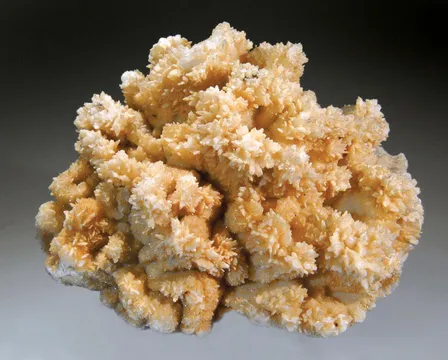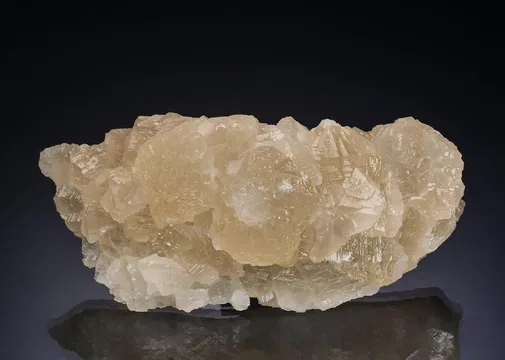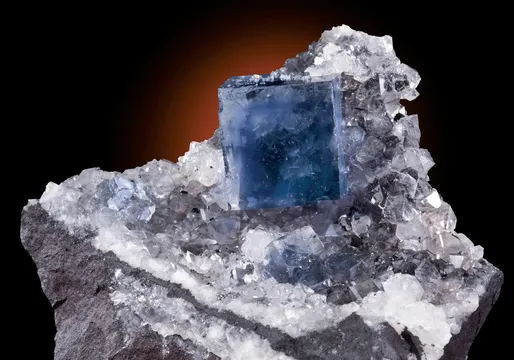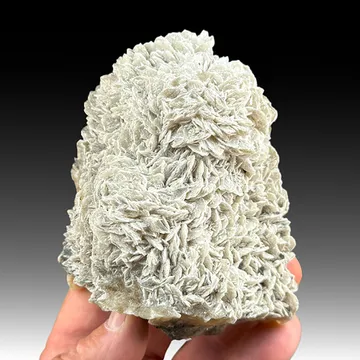
Fallowfield Mine, Hexham, England, a locality for witherite, known for doubly terminated, cyclic-twinned crystals on pale drusy matrix, often with alstonite.
Key facts
Fallowfield Mine is one of the defining localities for collectible witherite. Its best specimens are not merely “good English witherites”; they are among the classic barium-carbonate specimens by which the species is visually understood. The signature look is unmistakable: milky white to colorless, heavy-looking pseudohexagonal pyramids and bipyramids, usually the result of cyclic twinning, rising from pale drusy alstonite or older mine matrix. Fine pieces have a sculptural, architectural presence—stacked frosty pyramids, stepped faces, and sharp terminations that read at a glance as northern English classics.

Photo: Rob Lavinsky / iRocks.com via Wikimedia Commons
The mine lies near Acomb, north of Hexham in Northumberland, in the barium-rich northern Pennine mineral province. Fallowfield began as a lead mine and later became a commercial witherite producer. That dual identity matters to collectors: the best specimens carry the elegance of old lead-mine cabinet pieces, but the mineralogical story is barium carbonate—witherite, alstonite, baryte, and minor barytocalcite—rather than the more familiar fluorite-galena assemblages of many Pennine localities.
Fallowfield’s witherite is especially admired for its crystal form. The most desirable specimens show well-formed, doubly terminated or pyramidal cyclic twins, ideally perched cleanly on matrix rather than embedded in massive carbonate. A thin druse of alstonite is a major bonus, both aesthetically and historically: Fallowfield is one of the classic localities for alstonite, BaCa(CO3)2, and many old specimens display the two rare barium carbonates together. The contrast can be subtle—white on white—but under close viewing the association gives Fallowfield pieces a mineralogical richness that ordinary witherite groups lack.
Historically, the locality sits at a fascinating crossing point between industrial mining and specimen mineralogy. Lead working at Fallowfield is recorded from early times, while crystallized carbonate of barytes from the mine entered scientific and collector circles by the early nineteenth century. By the 1830s Fallowfield was already being described as a source of the finest crystallized witherite then known. Through the nineteenth century, specimens passed through prominent dealers and collections, including material connected with the British Museum, the Natural History Society of Northumbria, the Gilmore dealers of Alston, the Natural History Museum in London, and later private collections built around classic British minerals.
For collectors today, Fallowfield witherite occupies the narrow space between rarity and recognizability. It is not an obscure locality only a specialist would care about; good examples are immediately saleable classic minerals. Yet truly fine specimens—balanced, undamaged, sharply twinned crystals on alstonite, with reliable old provenance—are not common. When a serious example appears, the questions are always the same: are the terminations intact, is the twinning crisp, is the matrix natural and aesthetic, and does the label history support Fallowfield rather than another North Pennine barium locality?
Search for specimens: View all witherite specimens from Fallowfield Mine, Hexham, England
Fallowfield Mine is at Acomb, near Hexham, Northumberland, England, with the locality commonly placed around NY938677 and latitude-longitude near 55.0038, -2.0969. The site is now an overgrown and obscured historic mine locality rather than an active collecting ground. Modern locality records describe the former mine area as largely hidden by a caravan site, and collecting should be treated as private-land access requiring explicit permission.
The deposit was a vein system worked first for lead and later for barium minerals. The main Fallowfield vein is described in mining literature as lying in a strong fault; besides witherite and galena it carried barytocalcite, and some coal was also extracted during the mine’s working life. In the broader North Pennine context, Fallowfield belongs to the barium-mineral belt associated with the Whin Sill region, where baryte, witherite, alstonite, and barytocalcite occur in and around lead-mineralized ground.
Lead mining at Fallowfield is ancient. Local historical sources place lead working at least in the sixteenth century, with later accounts suggesting possible activity from about 1611. Tradition connects Fallowfield lead with Roman Chesters and with the roofing of Hexham Abbey by medieval monks, though those older associations belong more to local historical memory than specimen mineralogy. The mine was active through the seventeenth and eighteenth centuries, suffered flooding in 1734, and was revived when pumping power was installed in the 1760s.
The nineteenth century changed the mine’s identity. As the lead fortunes declined, witherite and barytes working began in 1846. Production records vary slightly by source, but the mine yielded roughly 100,000 tons of witherite in the nineteenth and early twentieth centuries. One mineral-resource account gives just over 100,000 tonnes of witherite between 1855 and 1912, together with more than 11,000 tonnes of lead concentrates. Another detailed specimen-history account gives 98,986 tons recorded for 1855–1912 and estimates about 105,000 tons if early gaps from 1846–1854 are included. Closure dates are reported as 1911, 1912, 1913, or 1914 depending on the source and whether the writer is referring to closure, abandonment, or the cessation of production; in specimen literature, 1912 is the most commonly used endpoint.
Specimen production began to matter well before large-scale witherite mining. A definite early record appears in 1821, when “crystallized carbonate of barytes” from Fallowfield was donated to the Cambridge Philosophical Society. By 1823 the occurrence was being noted in mineralogical literature, and by 1835 Fallowfield was already famous among collectors for crystallized carbonate of barytes. The finest specimens probably came from the upper parts of the vein, where witherite remained abundant above the levels reached by older lead-mining operations.
Today, the mine is a historical and mineralogical locality rather than a practical field-collecting destination. Old labels, museum provenance, and specimen style are therefore central to understanding Fallowfield material. Loose modern dump finds, if any appear, should be treated cautiously unless the collection circumstances are documented, because the accessible remains have been heavily altered, obscured, and restricted for decades.
Fallowfield witherite is best known for pseudohexagonal pyramidal and bipyramidal twins. Although witherite is orthorhombic, repeated twinning gives many crystals an apparent six-sided symmetry. At Fallowfield this habit became iconic: white six-sided pyramids, elongated bipyramids, doubly terminated individuals, and clustered groups with stepped or striated faces.
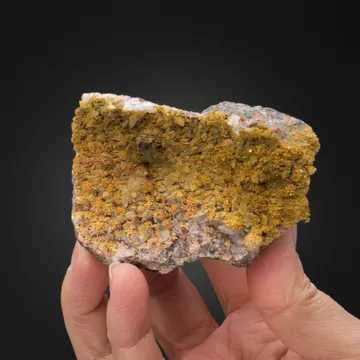
Color is typically white, grayish white, milky, colorless, or faintly translucent. Some specimens have a frosty surface, while higher-quality crystals can show a lustrous, slightly greasy or vitreous sheen. Thin baryte coatings may dull the luster or produce a semi-matt surface. Older descriptions also mention large crystals sometimes coated with white baryte, an alteration or overgrowth that is part of the locality’s natural history rather than a later treatment.
Matrix and associations are especially important. The most desirable Fallowfield pieces show witherite on drusy alstonite, commonly over sandstone, calcite, or altered mine matrix. Alstonite may occur as tiny sharp bipyramidal crystals, often forming a pale crust beneath or around the witherite. Calcite is a known associate, including “dogtooth” calcite on historic material, and galena may occur as small metallic spots. Sphalerite is reported but is not a dominant feature of Fallowfield witherite specimens, unlike some other Pennine barium-carbonate associations. Baryte is common as coatings, platy material, or a related gangue mineral. Barytocalcite is reported from the mine in minor amount.
Crystal size varies widely. Fine miniatures may carry individual witherite crystals of 2–4 cm, which is already enough for a strong Fallowfield specimen if the form is sharp and the condition is good. Documented collector examples include elongated bipyramids around 41 mm, pseudohexagonal pyramids around 45 mm, paired crystals of 3.3 cm, and cabinet specimens with major crystals around 5.5 cm. Nineteenth-century mineralogical descriptions recorded Fallowfield crystals up to 5 inches long. An extraordinary historic specimen offered to the British Museum in 1887 was described as nearly 18 inches long and bearing several crystal styles on pink alstonite and dogtooth calcite.
Quality depends less on sheer size than on architecture. The best pieces have distinct individual twins, visible terminations, and natural placement on matrix. Sharp, upright, doubly terminated crystals on alstonite are particularly prized. Groups of many pyramids can be superb if the crystals are not too crowded or bruised. Dense white masses are historically interesting but less desirable unless the crystal faces are cleanly developed and aesthetically arranged.
Small alstonite crystals can be a quality multiplier. A specimen with sharp witherite on a continuous glittering carpet of alstonite is much more locality-specific than a loose white witherite group without matrix. Conversely, specimens labelled simply “Hexham” or “Northumberland” need scrutiny: Settlingstones and other North Pennine sources also produced witherite, and Fallowfield material should ideally match the characteristic white pyramidal habit and alstonite-bearing matrix or come with credible old provenance.
Fallowfield witherite is a classic, not a commodity specimen. Good examples appear intermittently from old collections, dealers specializing in British minerals, and auction dispersals, but the mine is not producing fresh collector material in any meaningful modern sense. The best specimens now trade as historic classics, often with old labels and long provenance chains.
No recurring, well-documented Fallowfield-specific fake or standard treatment problem is known in the specimen literature. The more realistic authenticity concerns are mislocality, repair, restoration, and composite mounting. Because Fallowfield witherite can resemble material from Settlingstones, Alston Moor, or other North Pennine barium localities, a credible label history is valuable. Specimens on convincing alstonite matrix, especially with old British or museum provenance, are easier to accept than loose white crystals with a modern handwritten locality.
Condition is critical. Witherite is relatively soft, brittle, and cleavable, and the Fallowfield habit concentrates value in the terminations. Small chips to pyramid tips are common enough that they must be expected and priced accordingly, but a sharp undamaged termination makes a noticeable difference. Look carefully along the apex of each pyramid and along the stepped edges of bipyramids. Bright breaks, unnatural glue lines, or matrix contacts at just the “right” angle can indicate repair or reconstruction.
Baryte coatings should not automatically be read as damage. Natural baryte overgrowths and alteration coatings are part of the Fallowfield paragenesis and were described on nineteenth-century specimens. A thin, even coating may reduce sparkle but can strengthen locality character. Heavy dull coatings, however, can obscure crystal definition and reduce display quality.
Alstonite matrix is attractive but fragile. The tiny crystals are easily abraded, and old pieces often show edge wear or rubbed areas. Avoid aggressive cleaning. Do not acid-test display specimens: witherite is a carbonate and contains barium; destructive testing is unnecessary and can damage or contaminate a valuable old specimen. Sensible handling means washing hands after use, keeping specimens away from children and pets, and avoiding dust ingestion.
Market availability is thin at the high end. Recorded recent and semi-recent offerings show the range: small cabinet and miniature examples with crystals around 3 cm can command four-figure prices when well formed, while larger, highly aesthetic specimens with multiple pyramidal twins on alstonite have been offered in the mid- to high-four-figure and five-figure range. Provenance to old collections, museum deaccessions, or named British-mineral collectors can significantly improve desirability.
The oldest Fallowfield story is not a specimen story at all, but a mining one. Long before witherite made the mine famous to collectors, Fallowfield was a lead mine of local importance. The workings flooded in 1734, and eighteenth-century reports describe a mine that had to fight water before it could fight rock. By the 1760s an engine had been built to pump the workings, and the mine revived. A 1766 account described a strong vein, “a yard or more wide” in spar, with ore lying in ribs only 4, 5, or 6 inches wide. That same account recorded production of 1,000 bings—about 400 tons—of lead and 100 miners employed in 1765. In that world, the white barium minerals were not yet collector treasures. They were “cawk,” spar, gangue, the pale mineral body in which the lead ore lay.
By 1769, John Wallis described Fallowfield as exceedingly rich, with steam power pumping out formerly flooded workings and about eighty men employed. It is striking that such an observant eighteenth-century account still did not clearly identify witherite. The mine was rich, the vein was broad, the men were numerous, and the water problem was real—but the mineral that would later make Fallowfield famous to collectors was still hiding in plain sight.
The first unmistakable collector record arrived on 10 December 1821, when the Cambridge Philosophical Society received “Crystallized Carbonate of Barytes from Fallowfield – Northumberland” from R. Lyon, Esq. That small donation marks the moment when Fallowfield witherite steps out of the mine and into the cabinet. Within a few years, Phillips mentioned “Fallowfield mine, Hexam,” and by 1835 the locality had acquired a reputation that any serious collector would recognize: the mine near Hexham was known as the place where the finest crystallized carbonate of barytes had yet been obtained.
The specimen trade followed quickly. In 1838, R. Stokoe and B. Leadbeater presented a considerable number of Fallowfield specimens to the British Museum. In 1847, William Hutton donated witherite and alstonite from Fallowfield to the Natural History Society of Northumbria, whose collection now forms part of the Great North Museum: Hancock. These were not casual curiosities. They were the sort of specimens that fixed Fallowfield in institutional memory.
Then came the great dealer episode. In 1887, Peter Gilmore of Alston offered the British Museum what he called the largest witherite ever found at Fallowfield. His description is wonderfully mineral-dealer precise: nearly 18 inches long, with “large flat toped xls,” pointed crystals, doubly terminated crystals, pink alstonite, and dogtooth calcite. He thought it worth £50 but offered it for £20 “clear of damage.” The museum countered at £15. Gilmore accepted, reportedly to keep the specimen in the country. That exchange says nearly everything about Fallowfield witherite in the late nineteenth century: large enough to astonish, valuable enough to negotiate, and already important enough that its national destination mattered.
One later specimen history has the atmosphere collectors love: a Fallowfield witherite in the Gail and Jim Spann Collection, formerly in the collections of Lindsay Greenbank, Ralph Sutcliffe, Richard Barstow, and the Natural History Museum, London, supplied by Elizabeth Gilmore around 1892. The specimen carried elongated bipyramidal crystals up to 41 mm on drusy alstonite. In a single label chain, it connects an old Alston mineral-dealing family, the Natural History Museum, several major modern British-mineral collectors, and the enduring appeal of Fallowfield’s white twinned pyramids.