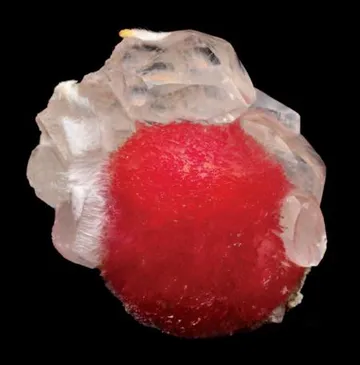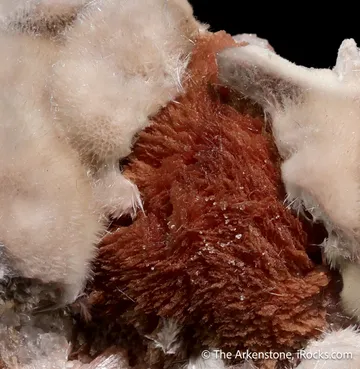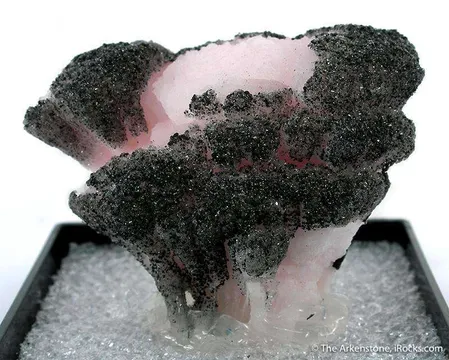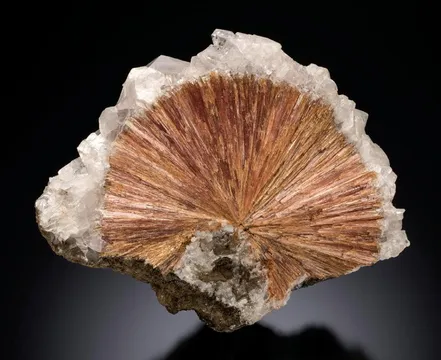
Inesite from Wessels Mine, South Africa - red to salmon-pink translucent blades in fans and drusy plates; prized for color, variety, and the Kalahari locality.
Key facts
Wessels Mine inesite is one of the Kalahari Manganese Field’s most appealing collector species: red to salmon-pink, lustrous, bladed to acicular manganese silicate in stacked fans, radial sprays, hemispherical “balls,” and rich drusy plates. The best pieces have a glow that is difficult to capture in photographs—translucent blades with a silky, chatoyant shimmer when the crystal fibers are densely radial, and a sharper glassy luster when the blades stand free.

Photo: Wikimedia Commons / Rob Lavinsky, iRocks.com
The locality’s reputation rests on more than color. Wessels is an underground manganese mine in the Hotazel area of South Africa’s Northern Cape, within the northern Kalahari Manganese Field. The orebody belongs to the Hotazel Formation, where manganese-rich beds are interbedded with banded iron formation and hematite lutite. The collector minerals for which Wessels is famous formed in the complicated aftermath: hydrothermal alteration upgraded primary manganese ore, opened vugs and fissures, and produced a dense suite of calcium-, manganese-, barium-, strontium-, and boron-bearing species.
For inesite collectors, Wessels matters because it produced multiple recognizable styles rather than a single look. Classic material includes cherry-red and deep salmon sprays from early finds; rounded, translucent hemispheres with silky internal radial structure; richer plates of intergrown bladed crystals; and rarer combination pieces with natrolite, orlymanite, xonotlite, calcite, gypsum, apophyllite, quartz, and datolite. A notable early 1980s pocket is specifically remembered for the most lustrous and most intensely red pieces, and specimens from that style have long carried a premium.

Photo: Wikimedia Commons / Rob Lavinsky, iRocks.com
The finest Wessels inesites are not large by cabinet-mineral standards, but they are visually potent. A 3 cm thumbnail can be a serious specimen if it has saturated cherry color, crisp chisel-shaped blades, and undamaged crystal terminations. Larger miniatures and small-cabinet pieces are judged by the same standard, with additional weight given to complete spherical aggregates, attractive white-on-red contrast with calcite or natrolite, and matrix that makes the specimen look natural rather than merely trimmed.
Search for specimens: View all inesite specimens from Wessels Mine, South Africa
Wessels Mine is a manganese mine near Hotazel in the Joe Morolong Local Municipality, John Taolo Gaetsewe District Municipality, Northern Cape, South Africa. Mindat gives the locality coordinates as 27° 6' 48" S, 22° 51' 15" E, and records the operation as beginning in May 1973. The mine is underground, roughly 300 metres below surface, reached by a vertical shaft and two incline shafts, and worked by a mechanised room-and-pillar, or bord-and-pillar, method.
The broader deposit is part of the Kalahari Manganese Field, a giant Paleoproterozoic manganese province hosted by the Hotazel Formation of the Transvaal Supergroup. In regional terms, Wessels sits in the northern, high-grade portion of the field. The economically important Wessels-type ore is the coarse, shiny, locally vuggy, high-grade manganese ore dominated by hausmannite and braunite-II assemblages, contrasting with the lower-grade, carbonate-rich Mamatwan-type ore farther south.
The geological key for collectors is hydrothermal alteration. Primary manganese-rich sedimentary ore was upgraded and transformed along fault systems, especially north-south and east-west normal faults. That process did more than improve ore grade: it generated open spaces and chemically unusual micro-environments where a remarkably diverse mineral suite could crystallize. Wessels is consequently not just a manganese mine with a few pretty species; it is one of the great locality names in systematic manganese mineralogy.
Access is not casual field-collecting access. Wessels is an active industrial underground mine, operated as part of Hotazel Manganese Mines. Collector specimens historically came out through mine-related recoveries, controlled handling of vug material, and later redistribution through South African collectors, dealers, and older collections. Today, most available inesite specimens are recycled classic pieces, ex-collection material, or specimens dispersed through auctions and dealer inventories rather than fresh, open-access collecting.
The best inesite finds span several periods. Collectors recognize material from the 1970s, an especially valued early 1980s cherry-red pocket, and late-1980s to early-1990s pockets that produced unusual associations, including natrolite-on-inesite and deep cherry-red inesite on orlymanite. A documented Wessels inesite specimen from 1998 shows that attractive material continued to appear after the earliest classic finds, but the locality’s market identity is still strongly tied to older production.
Notable associated finds include inesite with calcite, xonotlite, hydroxyapophyllite-(K), natrolite, datolite, orlymanite, gypsum, quartz, baryte, pectolite, oyelite, thomsonite-Ca, and occasional rhodochrosite. In broader Kalahari context, Wessels is also important for many other collectible and rare species, including ettringite-group minerals, sugilite, sturmanite, xonotlite, kutnohorite, hematite, gaudefroyite, and several type-locality or highly unusual species.
The classic Wessels habit is bladed inesite in stacked, fan-shaped, parallel groups and aggregates. Individual crystals are commonly chisel-shaped, with the blades arranged into sprays, rosettes, hemispheres, and locally compact plates. In fine specimens, the crystal surfaces are lustrous enough to show a wet, glassy gleam; in more fibrous radial aggregates, the luster becomes silky and chatoyant.
Color is the first quality factor. Wessels inesite ranges from pale pink and rose to salmon-red, cherry-red, orange-red, and deep pinkish red. Pale material can be attractive if the crystal form is sharp and the association is strong, but the market strongly favors saturated red and deep salmon-pink. The most coveted early-1980s pocket pieces are remembered as more lustrous and redder than most other Wessels material.
Size varies by style. Thumbnail specimens around 2–3 cm can be excellent if they show sharp, complete sprays. Miniatures in the 4–6 cm range are common enough to be obtainable but still desirable when richly covered. Better small-cabinet pieces around 7–10 cm are much scarcer, especially when they show multiple intact spherical aggregates or strong contrasting associations. Individual crystal blades are often only a few millimetres, but documented Wessels pieces show inesite clusters exceeding 1 cm, spherical aggregates up to several centimetres, and larger matrix plates coated on one or both sides.
Association is central to the locality’s personality. Natrolite gives the most dramatic contrast: white, pearly to sparkly lath-like sprays bursting from rose-red inesite vugs. Calcite may appear as white accents or caps on red hemispheres. Xonotlite can form fibrous white caps or fringes. Hydroxyapophyllite-(K), apophyllite-group crystals, quartz, gypsum, and datolite add glassy or colorless accents. Orlymanite-associated pieces are particularly important because the red inesite may sit on or among tan orlymanite, adding both rarity and locality significance.

A top Wessels inesite should have strong color, crisp bladed form, undamaged exposed terminations, and visible depth in the aggregate rather than a flat fuzzy coating. The best specimens look architectural: fans rise in layers, hemispheres reveal radial internal structure, and contrasting minerals frame the inesite rather than hiding it. Flat plates of broken or rubbed crystals are far less desirable, even if the color is good.
Wessels inesite is a classic rather than a routine commodity. Good small specimens remain available because the locality has been in the mineral market for decades, but top examples from the best pockets are not easily replaced. Specimens with old labels, especially from well-known South African, European, or American collections, deserve extra attention because they often document the collecting period and pocket style.
Condition is the main practical issue. Inesite blades are brittle and many Wessels pieces are composed of dense sprays with numerous exposed tips. Rubbing, edge chipping, and contacted areas are common on old specimens. On matrix pieces, inspect the high points of the fans and the edges of hemispherical clusters. On plates, look for flattened zones where a field of crystals has been abraded. Minor peripheral damage may be acceptable on older Wessels material, but central broken fans or crushed red surfaces materially reduce value.
Color should be evaluated under neutral light. Deep cherry and salmon-red pieces are prized, but some specimens photograph redder than they appear in hand. Conversely, silky radial aggregates can look dull in a single still image but come alive when rotated. If buying remotely, ask for daylight or neutral LED images and, ideally, a short video showing luster.
No well-documented Wessels-specific fake inesite problem emerged in the sources consulted. The more realistic authenticity concern is misidentification or vague locality attribution. Pink manganese silicates from other localities can be confused in casual listings, and inesite has been produced at other important localities, especially the Daye/Fengjiashan area in China and older classic localities such as Broken Hill and Hale Creek. Wessels material is usually recognizable by its Kalahari associations—natrolite, xonotlite, orlymanite, datolite, hydroxyapophyllite-(K), calcite, and the characteristic red bladed sprays—but labels should still be scrutinized.
Treatments are not normally part of the Wessels inesite market. Avoid oiled-looking surfaces, suspiciously uniform red color on matrix, or specimens with red pigment caught in cracks. As with any fibrous or bladed aggregate, aggressive cleaning can leave residues or cause loss of fine terminations, so avoid soaking delicate specimens unless you are certain of the matrix and associated species. Gypsum-associated pieces require particular care because the enclosing or adjoining gypsum is soft and easily scratched.
Market availability is tiered. Modest thumbnails and small miniatures appear periodically and can be attainable for serious collectors. Richly colored, sharply crystallized miniatures and aesthetic matrix pieces are much scarcer. Large cabinet specimens, natrolite-in-inesite combinations, orlymanite-associated examples, and documented early-pocket cherry-red pieces belong in the advanced-collector category.
The Wessels inesite story is partly a story of pockets remembered by their look. One early 1980s pocket became a benchmark because its crystals were not merely pink—they were cherry-red, lustrous, and somewhat gemmy. A thumbnail only 3 x 2.5 x 2 cm from that pocket has been described as coming from the find that yielded the best-quality inesite at these mines. The phrase matters because collectors still recognize that style: more lustrous, more red, and more expensive than ordinary Wessels material.
Another remembered style came from the 1970s. These specimens often appear as red balls or hemispheres, built from radial blades that flash with a silky shimmer when turned. One documented 2.7 x 2.1 x 1.4 cm example from the 1970s find is described as a translucent hemisphere, with a small blade projecting from the side and close examination revealing the radial inesite blades inside. That is exactly the sort of small Wessels specimen that can be easy to underestimate in a case but unforgettable in hand.
The late 1980s produced one of the more distinctive Wessels combinations: deep cherry-red inesite perched on orlymanite. A 5.0 x 4.0 x 3.5 cm miniature was described by Rob Lavinsky from a “small and unique pocket of the late 1980s,” with the note that “Charlie said” it represented a style he had not seen before. The point was not just rarity; the color and translucency differed from other Wessels inesite pockets. For a locality where collectors often sort specimens by subtle pocket character, that kind of eyewitness distinction is valuable.
The natrolite combinations are perhaps the most theatrical. In one large 10.1 x 9.2 x 6.2 cm specimen, stark white natrolite sprays shoot from a vug of inesite, the white blades reaching 3.25 cm and standing against rose-red manganese silicate. The source note emphasizes that natrolite is rare in Wessels and in the Kalahari in general, and that only one pocket of that association in such quality and form was known to the writer, probably from the late 1980s or early 1990s. The best of these pieces have the look of a white mineral fountain erupting from red crystalline walls.
There is also the odd, almost improbable gypsum specimen: acicular inesite enclosed in a water-clear gypsum cleavage fragment, with well-developed gypsum faces and a reverse side carrying gemmy apophyllite nestled with milky and clear quartz. At only 4.2 x 3.6 x 2.0 cm, it is not large, but it captures the strange chemistry of Wessels beautifully—manganese silicate needles suspended in a soft, transparent sulfate window, then apophyllite and quartz appearing as a bonus on the back.