Fuentes de Ebro gypsum - classic locality yielding water-clear, lustrous gypsum crystals on alabaster, with distinctive twinned blades prized by collectors.
Key facts
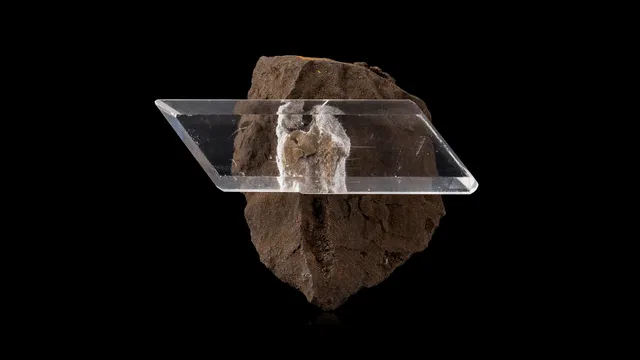
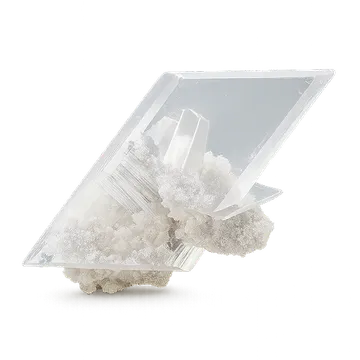
Fuentes de Ebro is one of the classic European localities for cabinet-quality gypsum: not ordinary satin-spar “selenite,” but water-clear, highly lustrous crystals perched on pale alabaster matrix. The finest pieces have the optical delicacy collectors want from gypsum—transparent blades and thick twinned crystals that nearly disappear at certain angles—set against a snow-white to cream, fine-grained gypsum groundmass. That contrast is the signature look: glass on alabaster.

Photo: Wikimedia Commons
The locality lies in the Ebro Basin of Aragón, southeast of Zaragoza, where Miocene evaporitic sediments include usable beds of alabaster—microcrystalline gypsum compact enough for carving, architectural panels, and decorative stone. The collector crystals are a by-product of that alabaster quarrying. They occur in cavities and dissolution openings among alabaster “bolos,” or rounded nodules, and in spaces between alabaster, marls, laminar gypsum, and fibrous gypsum. In the best pockets, later gypsum grew freely into open space, producing transparent, sharply formed crystals rather than massive alabaster.
Historically, the fame of Fuentes de Ebro specimens grew from the early 1980s onward, when exceptional transparent gypsum from the Cerro Patillas area began entering the Spanish and international mineral market. The material was first known to many collectors simply as “gypsum from Zaragoza,” but the most desirable pieces are now tied more precisely to the alabaster quarries around Cerro Patillas and nearby Fuentes de Ebro/Rodén workings. The locality is also important crystallographically: the long, blade-like crystals are not merely simple prisms but distinctive twinned crystals, involving contact and penetration twinning along a (101) plane, a habit described from this locality in the mineralogical literature.
Collectors look first for transparency, then for luster, sharpness, and the survival of delicate terminations. A good Fuentes de Ebro specimen should feel airy, not heavy: a clear upright crystal rising from a pale, sawn or natural alabaster matrix; a small geode lined with colorless crystals; or a group of divergent twinned blades with enough space between crystals that each form can be read. Internal phantoms, usually subtle white to clay-colored growth features, add considerable interest when they outline the twinned structure without clouding the crystal.
Search for specimens: View all gypsum specimens from Fuentes de Ebro, Spain
Fuentes de Ebro is a municipality in Aragón, about 26–27 km from Zaragoza, in the central sector of the Ebro Depression. The collecting locality normally refers not to the town center itself but to the alabaster quarry district south of the village, especially the Cerro Patillas or Patillas Hill area, with related workings around Rodén and the broader Fuentes de Ebro alabaster zone.
Geologically, this is a continental evaporite setting. During the Cenozoic, the Ebro Basin subsided and filled with continental sediments; toward the basin center, detrital deposits pass into marls, carbonates, gypsum, and saline evaporites deposited under endorheic, lacustrine conditions. In the Fuentes de Ebro area, the relevant sequence is Miocene and Quaternary, with a reported thickness of about 30 meters in the alabaster-bearing section and two usable alabaster levels of roughly 1.5 meters each. The current geological mapping of the Fuentes de Ebro sheet shows tabular and nodular gypsum units with red and gray clays, marls, and related evaporitic sediments, matching what collectors see in quarry walls: pale gypsum-rich horizons cut into dry, gullied, steppe-like relief.
The deposit exploited commercially is alabaster: compact, fine-grained gypsum, CaSO4·2H2O. In the quarrymen’s material it occurs as rounded bolos, locally reaching around a meter in diameter, separated by marls, vein-like alabaster, laminar gypsum, and fibrous gypsum. The collector crystals formed in cavities between these bolos or in dissolution openings produced by water moving through and partially corroding the gypsum-alabaster mass. Many cavities are empty, or contain only tiny, tangled crystals; the prized pockets are the exceptional ones in which clear, terminated crystals had room to grow.
Alabaster extraction in Aragón has long cultural importance, with the broader regional industry often described as active since Roman times. Fuentes de Ebro belongs to the modern alabaster belt of the Ebro valley, where the stone has been cut into slabs, blocks, decorative objects, and translucent architectural elements. The mineral-specimen story is much younger. In the early 1980s, collectors and dealers began paying attention to the absolutely transparent crystals from Cerro Patillas. Luis Miguel Fernández, a Zaragoza mineral dealer named in the Bocamina account, carried out systematic exploration and by 1983 was recovering specimens on a larger scale through arrangements with quarry operators. From then on, good pieces moved into Spanish collections and then into the international market.
Access is not a casual collecting matter. These are quarry workings, and active quarries are off-limits without permission for safety reasons. The most tempting places—bases of steep quarry faces, cavities in alabaster levels, and old undercut walls—are also the most hazardous. Historic accounts emphasize that high-quality crystals are closely tied to fresh quarry movement: abandoned faces weather quickly, delicate gypsum loses brilliance, and already-open cavities are usually exhausted. Modern field accounts by collector groups describe the difficulty well: even where alabaster bolos and old cuts are abundant, most cavities are empty, crystal-bearing geodes are irregularly distributed, and good transparent crystals are not something one simply walks up and finds.
Production for specimens has therefore been episodic. The classic market influx belongs especially to the 1980s and early 1990s, with later finds appearing from time to time as quarrying exposed new pockets. Specimens dated 2004 and 2007 are documented in dealer and collector records, and modern quarry and environmental documents show that alabaster extraction in the Fuentes de Ebro area did not simply vanish. But the collector material depends less on total alabaster production than on whether the right levels are opened, whether crystal pockets survive the extraction process, and whether someone with mineralogical interest is present to recover them.
The finest Fuentes de Ebro gypsum is colorless, glassy, and transparent. “Water-clear” is not dealer exaggeration here: the best crystals are nearly invisible against pale backgrounds until their edges catch the light. Luster ranges from bright vitreous on crystal faces to silky or pearly only where cleavage or slight surface disturbance is present. The matrix is usually white to cream alabaster, sometimes granular, sometimes sawn to stabilize or shape the specimen.
Two principal generations of gypsum are important. The earlier generation consists of lenticular crystals, commonly grouped and intergrown in marls between alabaster bolos or in gypsum-rich beds without bolos. These may be cloudy with clay inclusions, corroded by later dissolution, fractured, or occasionally surprisingly clear. The second and more famous generation consists of elongated crystals grown in cavities formed by surface-water infiltration and partial corrosion of the alabaster. These are the classic transparent blades and “Roman sword” forms.
The most characteristic elongated crystals are twinned. They grow in the [101] direction and are described as a combination of contact and penetration twinning along (101), involving two unequally developed individuals. In hand specimen the twinning may be subtle; in some crystals it shows as a re-entrant angle at the termination, while in phantom-bearing crystals the internal ghost outlines reveal that the “single” crystal is really a twinned pair. This is one of the locality’s great collector pleasures: a specimen can be visually simple yet crystallographically sophisticated.
Crystal size varies widely. Many representative specimens have main crystals in the 2–5 cm range, often on matrix pieces from thumbnail to cabinet size. Excellent crystals of 5–6 cm are well documented, and classic descriptions refer to transparent, sword-like crystals from the Fuentes de Ebro alabaster quarries reaching about 10 cm. Cavities may reach around 20 cm across, but most such openings either lack good crystals or contain crowded intergrowths rather than clean, isolated display crystals. Museum and dealer records show cabinet specimens with numerous crystals, but the most elegant pieces are often modest miniatures and small cabinets where a few clear crystals stand free.
The typical color is colorless to white. Clay inclusions can produce pale phantoms, cloudy zones, or warmer tones, and some lower-grade pieces show milky to orange-tinged areas. Manganese oxides are reported only rarely, sometimes as inclusions. Epsomite is an occasional associated sulfate in the locality, but specimen collectors should think of Fuentes de Ebro primarily as a gypsum-on-gypsum locality: selenite crystals, lenticular gypsum, fibrous or laminar gypsum, and alabaster, with marl and clay as the sedimentary host.
Aesthetic quality is judged by several locality-specific factors. The first is transparency: the most desirable crystals have open “windows” with minimal clay, cracks, or dissolution haze. The second is luster and preservation of surface gloss, because exposed gypsum weathers quickly and careless cleaning can dull it. The third is form: sharp twinned crystals, broad blades, near-biterminated crystals, divergent groups, and crystals with visible phantoms all command attention. The fourth is matrix. A clean, pale alabaster base is not incidental; it is part of the locality identity and gives the transparent crystals the visual stage they need.
Fluorescence is another notable feature. Many Fuentes de Ebro selenite specimens fluoresce under ultraviolet light, with collector reports describing strong responses under longwave and shortwave UV and, in some examples, noticeable phosphorescence after the lamp is removed. Not every specimen should be assumed to perform equally, but a documented UV response can add interest, especially when the specimen remains visually strong in normal light.
Fuentes de Ebro gypsum is delicate even by gypsum standards. The mineral has perfect cleavage, low hardness, and a tendency for crystals to detach from alabaster matrix if shocked. Examine terminations and edges carefully: tiny chips on sword-like points, cleaved faces masquerading as natural terminations, and scuffed luster are common condition issues. A specimen can still be desirable with minor edge wear, but truly undamaged, upright, water-clear crystals are much scarcer than the number of locality labels might suggest.
The matrix deserves equal scrutiny. Because alabaster is soft, specimens from the locality were often prepared by sawing rather than by hammering. A sawn base or back is normal and not a defect if disclosed or obvious; it can even be preferable, because sawing reduces the risk of knocking crystals loose. What matters is whether the crystal-to-matrix contact is natural and stable. Look for glue at the base of crystals, planar breaks across blades, misaligned growth lines, glossy adhesive in recesses, or unnatural contact points. A UV lamp may help reveal some modern adhesives, though it should not be treated as a foolproof test because the gypsum itself may fluoresce.
There is no widely known “Fuentes de Ebro fake style” in the sense of a recurring manufactured imitation tied to the locality. The more realistic authenticity concerns are repairs, reattachments, over-cleaning, and vague locality labels. Older pieces may be labeled simply “Zaragoza,” “Roden,” “Cerro Patillas,” or “Alabaster quarries, Fuentes de Ebro.” Those names can all appear in legitimate collecting history, but better labels specify the alabaster quarries, Cerro Patillas or Fuentes de Ebro, Zaragoza, Aragón, Spain. Be cautious with broad “Spanish selenite” labels if the specimen lacks the distinctive alabaster matrix, transparent twinned form, or credible provenance.
Cleaning is risky. Gypsum is water-soluble enough that prolonged soaking, aggressive chemical cleaning, or abrasive brushing can reduce luster and soften fine surface features. The best specimens are those that came from closed or protected cavities with little clay attached. If clay is present, patient mechanical cleaning under magnification is safer than wet treatment, and even then one should accept some matrix sediment rather than sacrifice the glassy surface that gives the locality its value.
Market availability is uneven. Small pieces and lower-grade geodes appear periodically from Spanish and European dealers, sometimes at accessible prices. Good miniatures with sharp, clear crystals on alabaster are less common. Top 1980s-style specimens—large, thick, transparent, lustrous, undamaged crystals on attractive matrix—are genuinely scarce and can sell for serious cabinet-specimen prices. A recent auction example from an old 1980s find, with a 6 cm transparent crystal on snow-white gypsum matrix, closed in the thousands of dollars, while modest contemporary retail pieces and small open geodes can sell for far less. In this locality, price follows a steep curve: a small increase in size, clarity, and condition can move a specimen from inexpensive reference piece to high-end classic.
For display, keep Fuentes de Ebro gypsum away from water, high humidity swings, and handling. Dust is best managed with a blower, not a brush. Store and ship with particular care around upright blades: these crystals often look robust in photographs but can separate cleanly along cleavage or at the matrix contact. A good Fuentes de Ebro specimen should be treated less like a common evaporite and more like a fragile glass sculpture that happens to have grown in a Spanish alabaster quarry.
The classic story begins in the early 1980s, when the gypsum crystals of Fuentes de Ebro were still not the established Spanish classics they are today. The Bocamina account describes how people began noticing completely transparent gypsum crystals associated with fibrous gypsum and alabaster around Cerro Patillas, 3 or 4 km south of the town. Luis Miguel Fernández, a mineral dealer from Zaragoza, then made the decisive move: he explored the area systematically and, by 1983, began obtaining specimens on a large scale through an agreement with a quarry operator. What emerged was startling enough to travel fast—transparent, brilliantly lustrous gypsum crystals from an otherwise industrial alabaster district. At first, their precise origin was not widely publicized. In 1988, the material was still often being spoken of simply as “the gypsums of Zaragoza,” with the early commercialization surrounded by a certain secrecy.
The quarry landscape itself is part of the story. South of Fuentes de Ebro, beyond the irrigated town and its Ebro valley farmland, the ground rises into pale, dry gypsum hills. Around Patillas, quarry faces expose the alabaster levels in cuts and benches. The Bocamina description places the productive sector in an area of roughly 6 square kilometers, with the Patillas summit around 340 m and the surrounding plain around 270 m. Nearby Rodén also has important alabaster workings, and some large geodes can be seen there, but many were reported empty. The productive crystal pockets were never evenly distributed; months of quarrying might pass with no significant concentration of crystals, then a productive zone could suddenly yield thousands of specimens if the quarry advance cut the right cavities.
The recovery of good crystals required a different touch from normal quarry work. Alabaster extraction was industrial: bulldozers with ripping teeth loosened the ground, front loaders moved the material, and bolos were cleaned and trucked for sawing. But the mineral specimens were fragile. The crystals detached easily from matrix, and hammer work could ruin them. Collectors learned to exploit the softness of the alabaster itself: rather than breaking a specimen out brutally, they could saw the matrix. Bocamina preserves a wonderful sensory detail from the quarry: when blows landed near a pocket with multiple gypsum crystals, the crystals vibrated with a high, tuning-fork-like sound—an “agudo diapasón.” It is a perfect image for this locality: a hard, dusty quarry face giving away the presence of glass-clear crystals by sound.
Field collecting accounts from later years are more sobering. A 2019 excursion by the Harridunak group captures the modern collector’s dilemma. Their party knew the fame of the Fuentes de Ebro “swords,” but they also knew not to attempt the locality in summer; the bare hills visible from the motorway toward Barcelona promised punishing heat. May was chosen as the sensible compromise: not summer, not the muddy season after heavy rains. On the first evening, with hammers restless in their packs, several collectors went to nearby gypsum quarries and found little in the way of crystals, though some cylindrical alabaster fragments—“vestiges of a better past”—filled bags.
The next day, hope rose when the group visited ground where there had recently been earth movement. Freshly disturbed quarry material is always the collector’s dream at Fuentes de Ebro, because old faces weather and empty quickly. But despite effort, they found no meaningful geode zone. Later, near Cerro Patillas, the mood changed for a moment: beside the road, in a pile of bolos, they found a small geode with a decent gypsum crystal in the middle. It was exactly the sort of clue collectors remember. Then the locality reasserted its difficulty. The surrounding hills showed enormous vertical cuts exposing the alabaster layers and evidence of intense past extraction, but there was little sign of recent movement. Without fresh quarrying, the chance of finding untouched pockets dropped sharply.
On the final morning of that trip, guided by members of the Asociación Mineralógica Aragonesa, the collectors went to an abandoned working where good gypsum had been found in the past. The level with alabaster bolos was visible near the ground, and everyone’s effort focused there. The work was not easy. The “pelotas” of alabaster were difficult to free from the wall, and most of the white tunnels piercing them were empty. A few muted specimens appeared, and some crystals of acceptable size, but the transparent crystals were generally small. The disappointment was softened by the Aragón collectors, who shared better gypsum specimens found there in earlier times. It is a very Fuentes de Ebro ending: the locality gives just enough to keep hope alive, while reminding every visitor that the great pieces came from a particular conjunction of quarry movement, permission, timing, and luck.