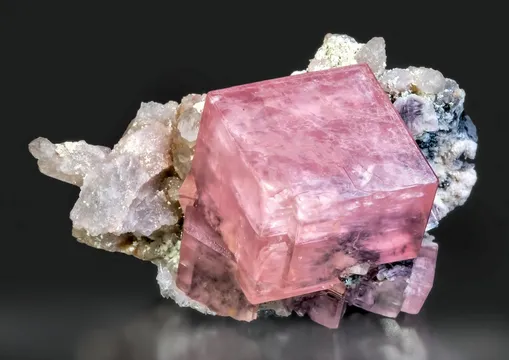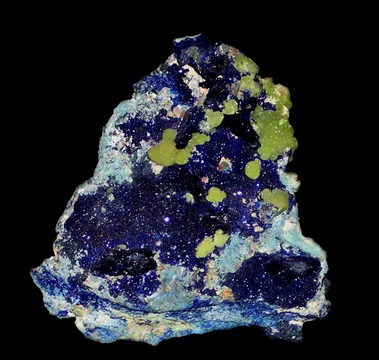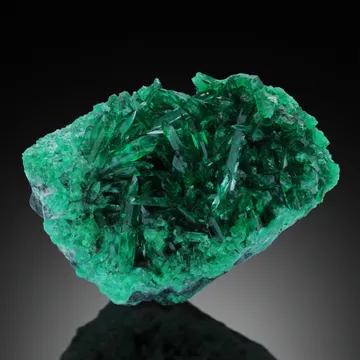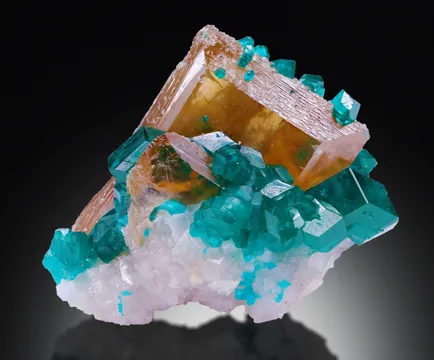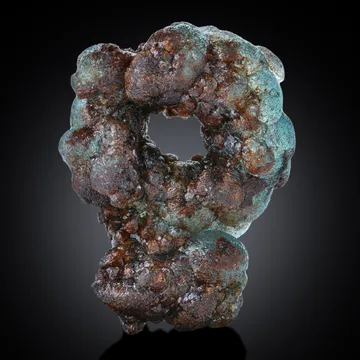
Duftite from Tsumeb, Namibia - olive to bright-green arsenate, famed for texture and paragenesis; the type locality boosts its collecting appeal.
Key facts
Duftite is one of Tsumeb’s signature green arsenates: not usually the showiest mineral on the specimen, but often the mineral that makes a specimen unmistakably Tsumeb. Its formula, PbCu(AsO4)(OH), tells the story of the deposit in miniature: lead, copper, arsenic, oxygen, and water working through a deeply oxidized polymetallic ore pipe. At Tsumeb it occurs as olive, grey-green, dark green, and occasionally vivid bright-green crusts and microcrystalline druses, commonly acting as a color engine for combinations with cerussite, calcite, wulfenite, malachite, mimetite, dioptase, dolomite, quartz, and adamite.
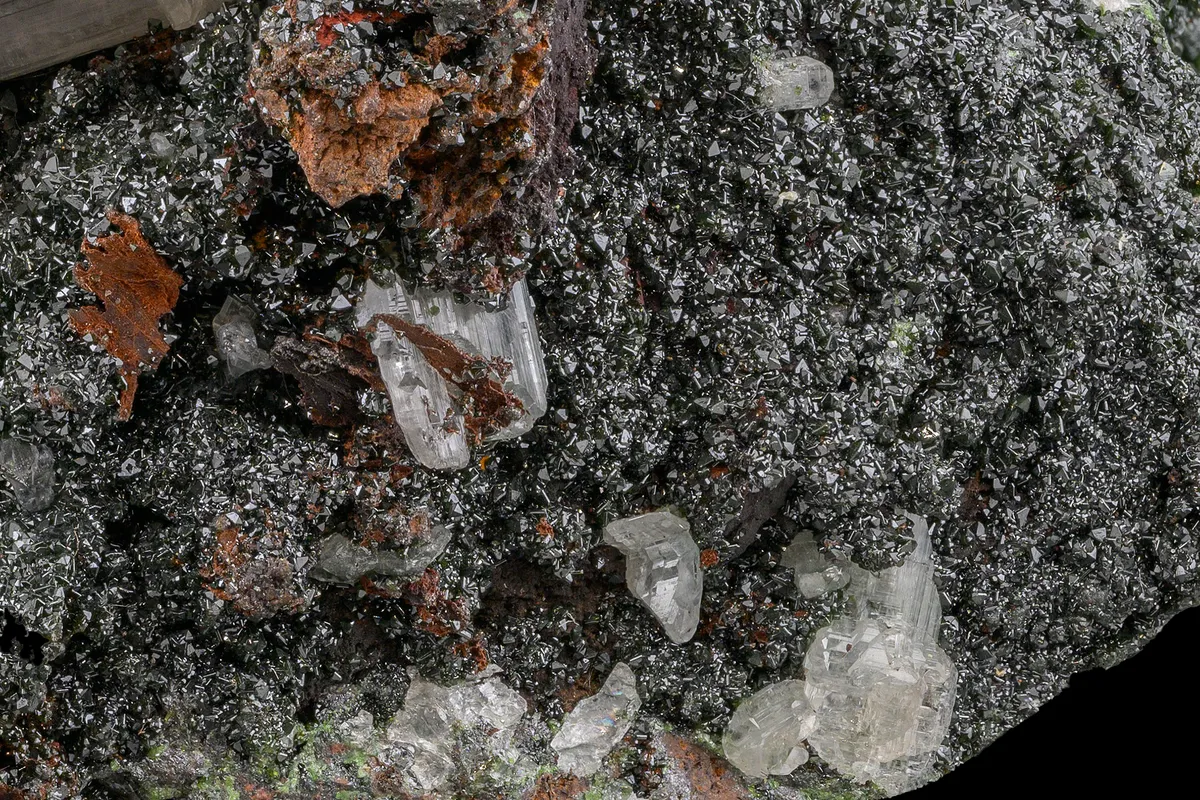
Photo: Tsumeb Mineralogical Network
Tsumeb is the type locality for duftite. The species was described from Tsumeb material studied by Otto Pufahl and published in 1920, based on olive-green mammillary crusts that resembled bayldonite or olivenite but gave a different composition. The name honors G. Duft of the Otavi mining organization, one of the figures associated with the early development and scientific promotion of the South West African mining field. The locality connection is therefore not merely aesthetic or commercial: Tsumeb is where duftite entered mineralogy.
The appeal of Tsumeb duftite is in contrast, paragenesis, and texture. A thin olive-green film across smoky cerussite, bright green microcrystals under transparent calcite, dark green saddle-faced crystals on quartz, or replacement forms after wulfenite can be more collectible than a massive patch of duftite alone. Serious collectors look for well-documented level or zone information, clean associations, strong color contrast, and, whenever possible, analytical confidence distinguishing duftite from conichalcite, mottramite, bayldonite, or arsentsumebite.

Photo: Wikimedia Commons
The mine’s fame rests on a rare combination of chemistry and plumbing. The Tsumeb orebody was a steep, pipe-like, carbonate-hosted lead-copper-zinc-silver deposit in the Otavi Mountainland, enriched in arsenic and other minor elements. Oxidizing waters penetrated not just the upper workings but also deep second and third oxidation zones, generating a mineralogical landscape of exceptional complexity. Duftite is part of that deep oxidation story, present through all three oxidation zones and most admired when it appears as a precise green punctuation mark in complex Tsumeb assemblages.

Photo: Wikimedia Commons
Search for specimens: View all duftite specimens from Tsumeb, Namibia
The Tsumeb Mine lies at Tsumeb in Namibia’s Oshikoto Region, within the Otavi Mountainland. Its mineralization is hosted by Neoproterozoic Otavi Group carbonate rocks, particularly dolomite and limestone sequences of the Tsumeb Subgroup. The orebody was a steeply plunging, pipe-like structure rather than a simple vein or bedded replacement. In cross-section it was roughly elliptical and highly variable from level to level, shaped by brecciation, folding, dissolution, and later mineralization.
The mine produced copper, lead, zinc, silver, cadmium, germanium, arsenic, and related metals from a polymetallic sulfide body. Primary ore minerals included galena, sphalerite, bornite, chalcocite, tennantite, and enargite, with later supergene alteration producing the secondary minerals that made Tsumeb legendary. Duftite belongs to this supergene assemblage. It formed where lead- and copper-bearing solutions interacted with arsenate-rich oxidizing conditions, particularly in carbonate cavities, breccias, veins, and open spaces that allowed repeated mineralizing events.
The first oxidation zone extended from the surface into the upper mine. Below it, Tsumeb surprised geologists by yielding a second oxidation zone beginning around the 26 Level, roughly 810 meters below surface, and later a third oxidation zone from about the 42 Level, roughly 1,380 meters down. Duftite was recorded in all three oxidation zones. That distribution matters to collectors because the finest duftite was reported from the third oxidation zone, including blackish-green prismatic sprays on quartz, olive-green elongated crystals with adamite from the 43 Level, and blocky crystals with malachite, also from the 43 Level.
Mining history at Tsumeb began with African copper working at the “Green Hill,” the oxidized surface expression of the deposit. European interest intensified in the 1880s and 1890s; Mathew Rogers inspected the deposit in January 1893 and wrote that he had never seen anything like the sight before him at “Soomep.” German mining company OMEG began development with trial shafts in 1900, and full commercial production began in 1906 after railway construction made large-scale shipment possible.
Early mining used an open pit and shallow shafts, then moved underground as the surface ore was exhausted. The mine grew into one of the world’s great specimen sources, with major discoveries of azurite, cerussite, dioptase, mimetite, smithsonite, wulfenite, calcite, and a remarkable list of rare arsenates and germanates. Tsumeb’s great specimen era extended through much of the twentieth century, with important finds from the upper levels, the second oxidation zone in the late 1960s through 1980s, and the third oxidation zone into the late 1980s and early 1990s.
Large-scale mining ceased in the mid-1990s. The mine had reached workings around 1,700 meters below surface, and rising pumping costs, difficult economics, and labor problems culminated in flooding after access to the site was interrupted during a strike in 1996. Small-scale upper-level work continued briefly, and there was a short-lived attempt at specimen mining from 1998 to 2002. For collectors today, Tsumeb duftite is almost entirely an old-mine and old-collection material; new production from the original mine is not a meaningful source.
Tsumeb duftite ranges from olive green to grey-green, dark green, blackish green, and bright green. Much of it is crustose, mammillary, sub-botryoidal, drusy, or finely granular. It commonly forms thin to thick coatings over matrix or earlier minerals, especially on cerussite, calcite, dolomite, quartz, and wulfenite-bearing assemblages. In the best examples, a layer of duftite gives the specimen a speckled or sugary surface under magnification, with individual crystals providing sparkle rather than large freestanding form.
Distinct crystals are less common but important. Documented Tsumeb crystals are typically tiny, often around 1 mm or less, with exceptional crystals reported to 3 mm and outstanding third-zone prismatic sprays reported to 5 mm. Keller noted the tendency toward curved, saddle-shaped faces, a useful visual clue when examining sharp magnified material. The finest crystallized duftite is not judged only by size; luster, isolation, undamaged terminations, contrast with matrix, and association often matter more.
Associations are central to Tsumeb duftite. Classic pairings include duftite with cerussite, calcite, dolomite, mimetite, malachite, wulfenite, quartz, dioptase, smithsonite, adamite, and mottramite. The mineral also occurs with a broader Tsumeb suite including anglesite, azurite, bayldonite, beudantite, conichalcite, cuprite, descloizite, dundasite, goethite, hematite, hydrocerussite, minrecordite, olivenite, plancheite, rosasite, tsumcorite, willemite, zincgartrellite, and zincolivenite. Many of these associations are not merely decorative: they help place the specimen within the mine’s paragenetic sequence.
The most desirable cabinet pieces are usually not “duftite specimens” in the narrow sense, but Tsumeb combinations in which duftite contributes a strong, diagnostic green. Examples include bright green microcrystalline duftite coating smoky cerussite; transparent or grey calcite crystals on a duftite-rich surface; duftite-stippled wulfenite or wulfenite pseudomorphs; and small, dark, well-formed crystals on pale quartz or dolomite. Clean contrast is prized: green against colorless calcite, green on smoky cerussite, or green beside yellow-orange wulfenite is much more compelling than a dull, massive olive crust without relief.
Pseudomorphs and replacement textures add a second layer of interest. Duftite from Tsumeb has been reported as pseudomorphs after azurite, dolomite, enargite, mimetite, tennantite, and wulfenite, all considered rare. Duftite after wulfenite is the best-known of these and has received dedicated treatment in the literature. These pieces are evaluated by how clearly the original crystal habit is preserved: tabular wulfenite outlines, square plates, or blade clusters replaced or coated by green duftite are far more important than amorphous green coverage.
The duftite-conichalcite relationship is one of the most important technical issues for Tsumeb collectors. Tsumeb material spans a wide compositional range between lead-dominant duftite and calcium-rich compositions related to conichalcite. Older labels may use “duftite-alpha” or “duftite-beta.” The latter is not a valid mineral species; it represents intermediate compositions in the duftite-conichalcite series rather than a distinct polymorph. In the absence of analysis, visual identification can be unreliable, especially where green crusts lack measurable crystals.
The principal authenticity issue with Tsumeb duftite is not a famous treatment or a well-established fake industry; it is identification. Green microcrystalline arsenates and vanadates at Tsumeb are notoriously easy to mislabel. Duftite can resemble conichalcite, mottramite, bayldonite, and arsentsumebite, and older labels may carry obsolete names such as “duftite-beta.” Serious collectors should value analytical labels, old mine labels with reliable associations, and specimens from well-documented collections. When composition matters, EDS, WDS, XRD, or equivalent analytical work is preferable to visual assignment.
Association helps but does not prove identity. Duftite is commonly found with other lead-bearing species such as cerussite and wulfenite, whereas conichalcite is more likely in lead-poor calcite or dolomite settings; however, Tsumeb is too chemically complex for that rule to be absolute. A prudent label for unanalyzed ambiguous material may read “duftite/conichalcite series” rather than forcing a false certainty.
Condition is usually a question of scale. Most Tsumeb duftite occurs as microcrystalline coatings, so abrasion, rubbing, greasy handling, or overcleaning can flatten the sparkle that makes the mineral attractive. On calcite or cerussite combinations, the associated minerals may be more vulnerable than the duftite: cerussite can chip, calcite can bruise or cleave, and delicate wulfenite plates or pseudomorphs can lose edges. Examine high points, exposed corners, and the contact between green coatings and host crystals.
Cleaning should be conservative. Avoid acids: many Tsumeb duftite specimens depend on calcite, dolomite, cerussite, or other carbonate minerals for their structure and visual character. Mechanical cleaning can also remove the very microcrystals that define the specimen. As a lead-copper arsenate, duftite should be handled with normal mineral-safety discipline: wash hands after handling, avoid dust generation, and do not use it for lapidary, elixir, or other practices that abrade or ingest material.
Rarity depends on format. Duftite as a species from Tsumeb is very common, but fine crystallized duftite, duftite pseudomorphs after wulfenite, and display-quality combinations with sharp contrast are much scarcer. The best pieces are usually judged within the language of Tsumeb combinations rather than as single-species showpieces. A thumbnail with bright green duftite under glassy calcite may be more satisfying than a larger, duller hand specimen; a well-formed pseudomorph may outrank a broader but featureless crust.
Market availability is steady but finite. Since the mine is closed and flooded, available specimens come from old collections, dealer inventories, estate material, and occasional dispersals. Affordable examples with duftite as a green accessory are not difficult to encounter, especially calcite-duftite, cerussite-duftite, and mixed Tsumeb matrix pieces. High-end material consists of older, well-provenanced combinations, rare pseudomorphs, aesthetic wulfenite or cerussite associations, and specimens with documented level information such as 43 Level third oxidation zone material.
Duftite’s first story is not a glittering pocket tale, but a detective story in early Tsumeb mineralogy. The original material was not a suite of proud, measurable crystals. Pufahl was looking at olive-green mammillary crusts, visually close enough to bayldonite or olivenite to invite confusion. Chemistry broke the spell: the analyses showed a lead-copper arsenate distinct from those look-alikes. In 1920, the mineral was named duftite for G. Duft of OMEG, anchoring the species permanently to Tsumeb. A year earlier, Biehl had apparently analyzed the same mineral and used the provisional name “parabayldonite,” but his 1919 dissertation remained unpublished and did not carry the mineral into common usage. Tsumeb’s type mineral was therefore born from the sort of misidentification problem that still follows collectors today: the green mineral looked familiar, but it was not what it seemed.
The second story is the “duftite problem,” a thoroughly Tsumeb kind of problem: part mineralogy, part metallurgy, part mine economics. Guillemin separated lead-rich duftite from calcium-bearing “beta” material in 1956, and that distinction became more than academic in the 1970s and 1980s. At Tsumeb, those compositions accounted for a meaningful proportion of the lead, and to a lesser extent the copper, in certain ores. They also behaved differently during flotation in the concentrator. Former Tsumeb Corporation mineralogist John Innes encouraged technical and academic study because the question had practical consequences underground and in the plant, not just on specimen labels. Later work by Jambor, Owens, and Dutrizac showed that “beta-duftite” was better understood as part of the duftite-conichalcite series, and structural work by Kharisun, Taylor, Bevan, and Pring explained why the material was not a simple, neatly ordered polymorph. What began as a label on green arsenate crusts became a case study in how ore processing, crystal chemistry, and collector nomenclature can collide.
Tsumeb itself supplied the setting for these puzzles on a scale almost absurdly grand. The mine began at the “Green Hill,” the oxidized surface of the orebody, where African miners had long worked copper before European prospectors traced the material back to Otjisume. When Mathew Rogers reached the site in January 1893, he wrote that he had never seen such a sight and doubted he ever would again. The phrase fits the later specimen history just as well as the outcrop: as the mine deepened from open pit to underground workings, it repeatedly revealed mineral zones that should not have existed in such abundance and depth.
One of the most consequential surprises came after World War II. Mining resumed in 1947 under Tsumeb Corporation Limited, and deeper workings reached a second oxidation zone beginning around 26 Level, approximately 810 meters below surface. Later, in the 1980s, an even deeper third oxidation zone appeared from about 42 Level, roughly 1,380 meters down. That third zone produced some of the finest duftite known: blackish-green prismatic sprays to 5 mm on quartz, olive-green elongated crystals with adamite from 43 Level, and blocky 2 mm crystals with malachite, also from 43 Level. For a species usually content to provide green crusts and microdruses, these third-zone crystals are the kind of detail that make Tsumeb collectors lean closer to the case.
The wulfenite pseudomorphs add a more visual story. Tsumeb wulfenite itself is famous, but after the molybdate plates formed, some later chemical episodes replaced or coated them with new minerals. Duftite after wulfenite is among the best-known of these transformations. In strong examples, the collector sees the ghost of a tabular wulfenite crystal: square outlines, plates, or blades that now carry green duftite instead of original yellow to orange wulfenite. Bruce Cairncross illustrated this phenomenon in his 2019 “Connoisseur’s Choice” article, including examples in which green duftite or duftite-mottramite material preserves the architecture of earlier wulfenite. These are not merely green specimens; they are records of mineral replacement written in crystal shape.