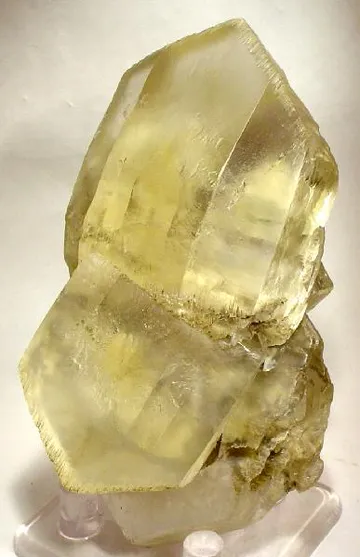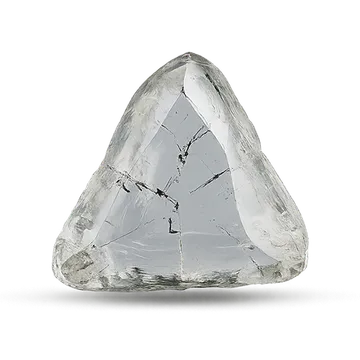
Diavik Mine, Canada — renowned diamond locality yielding natural rough with bright octahedra, etched surfaces, coatings, and macles, prized by collectors.
Key facts
Diamond from Diavik Mine occupies a special place in modern mineral collecting: it is one of the few great twenty-first-century diamond localities whose rough crystals can be tied to a precisely documented Arctic kimberlite mine, a short production window, and a well-studied population of natural diamond forms. The appeal is not only gemological. For the collector of natural crystals, Diavik is a locality of bright octahedra, etched resorbed forms, macles, coated stones, pale yellow and brown crystals, and the occasional extraordinary large rough whose story could only have happened in a mine built into Lac de Gras.

Photo: Wikimedia Commons / Planet Labs, Inc.
The mine worked four diamond-bearing kimberlite pipes—A154 North, A154 South, A418, and A21—clustered on and beneath East Island in Lac de Gras, Northwest Territories. The setting is visually unforgettable: a compact industrial island amid dark tundra water, with engineered dikes holding back the lake so that open pits and later underground workings could follow kimberlite bodies originally lying beneath the lake. In mineralogical terms, the diamonds are xenocrysts: crystals formed far earlier in the deep lithospheric mantle of the Slave craton and later carried upward by much younger kimberlite eruptions.
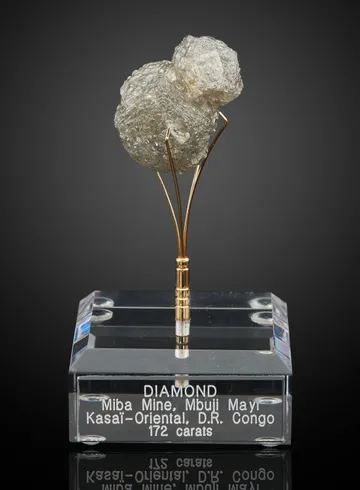
For serious collectors, the “Diavik look” is anchored by natural rough rather than cut stones. GIA’s study of Diavik production found gem-quality single-crystal diamonds dominated by octahedral forms, with varying degrees of resorption toward dodecahedral outlines; coated crystals, macles, cubes, hopper-like resorbed cubes, and irregular forms are all part of the locality’s texture. The collector interest lies in that balance: enough gem quality to give Diavik crystals exceptional brightness, but enough natural surface history—etching, coating, twinning, and resorption—to make the best uncut pieces mineral specimens rather than anonymous diamond rough.
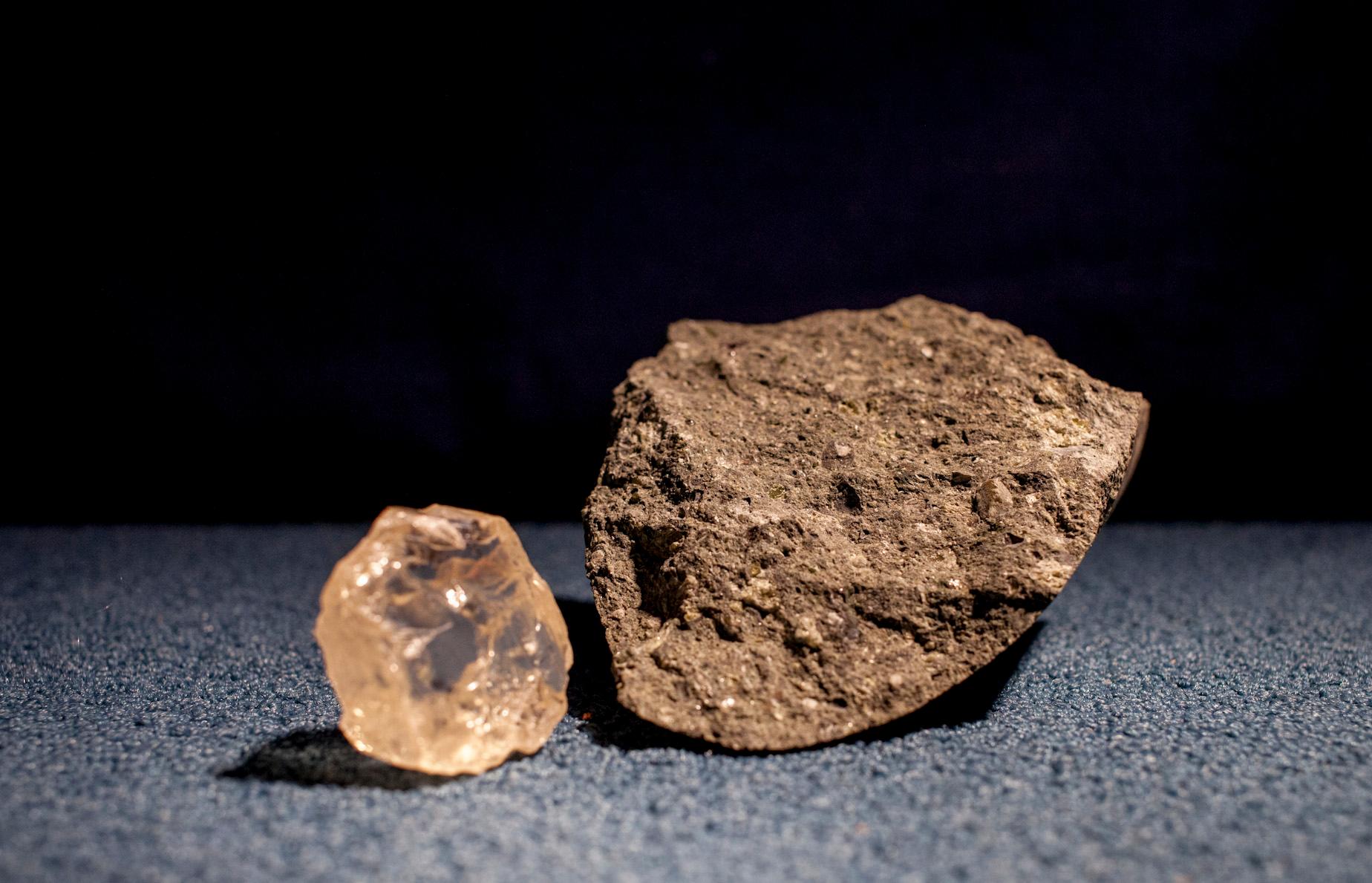
Photo: Smithsonian Magazine
Historically, Diavik helped confirm Canada’s arrival as a major diamond producer. Mining began in 2003 and ended in March 2026 after more than 150 million carats of rough diamonds had been produced. Its production was primarily white gem-quality material, but the mine also became famous for rare yellows and for the Diavik Foxfire, the 187.63–187.7 carat rough discovered in 2015 and later displayed at the Smithsonian as North America’s largest known uncut gem-quality diamond.
Collectors should look for specimens with credible mine provenance, natural crystal faces, minimal breakage, and an intact growth-and-resorption story. Diavik pieces that show sharp octahedral geometry, frosted or etched faces, complete macles, visible coatings over gem interiors, or rare yellow body color are especially desirable. As production has now ceased, the locality is no longer simply “current Canadian mine material”; it is a closed modern classic.
Search for specimens: View all diamond specimens from Diavik Mine, Canada
Diavik Mine is located on East Island in Lac de Gras, Northwest Territories, roughly 300 km northeast of Yellowknife and about 220 km south of the Arctic Circle. The mine lies within the Lac de Gras kimberlite field of the Slave craton, one of the world’s best-known modern diamond provinces. The surrounding bedrock is Archean granite and gneiss of the Canadian Shield, with younger metasedimentary rocks and Proterozoic diabase dikes cutting the district. Glaciation stripped and scoured the landscape, leaving a low-relief tundra of lakes, till, boulders, and exposed ancient rock.
The deposit type is classic cratonic kimberlite-hosted diamond. Kimberlite magmas rose rapidly through the cool, thick lithospheric mantle keel beneath the Slave craton and entrained diamonds, mantle xenoliths, and indicator minerals on the way to the surface. At Diavik, the kimberlite eruptions are geologically young compared with the diamonds themselves: studies place the Diavik kimberlite emplacement at about 55 million years ago, whereas some diamonds from the Slave craton record Archean ages on the order of billions of years. The result is a striking time contrast: diamonds formed deep in an ancient mantle environment, then transported upward by much later volcanic events.
The mine’s four ore bodies—A154 North, A154 South, A418, and A21—were all beneath Lac de Gras or immediately beside its shoreline. This made Diavik an engineering as well as a geological landmark. To mine the pipes, the operators constructed dikes, dewatered enclosed areas of the lake, mined open pits, and later moved underground. The A154 and A418 pipes supplied the early mine life; A21 became the fourth pipe brought into production, first as an open-pit addition and later through underground development below the previously mined A21 pit.
Exploration history is unusually vivid. Indicator minerals were first found on the Diavik property in 1994 near the A21 anomaly, but the nearby anomaly that became A154 South was drilled first. A drill core reportedly broke open to reveal a 2.5 carat diamond crystal—an extraordinary discovery in a random core section, given how sparsely even economic kimberlite carries visible diamonds. By 1995, four diamond-bearing kimberlite pipes had been outlined beneath Lac de Gras, and bulk sampling followed. Between 1996 and 1997, large-diameter drilling and underground tunneling beneath Lac de Gras recovered thousands of tonnes of kimberlite from A154 South and A418; the recovered diamonds proved the pipes had the grade and value needed for a mine.
Mining began in 2003. Open-pit mining and underground mining were both used over Diavik’s life, and by 2012 the operation had completed the transition to underground mining for the three pipes then being exploited. A21 open-pit development was later added, and in October 2024 Rio Tinto announced commercial production from Phase 1 of A21 underground after more than 1,800 m of tunnels had been developed to access the orebody. Diavik’s final production was celebrated on March 26, 2026, after 23 years of operation and more than 150 million carats of rough diamonds.
Collecting access is not comparable to a classic open mineral locality. Diavik was a high-security commercial diamond mine in a remote Arctic environment, with worker access by aircraft and heavy supplies dependent on winter logistics. Rough diamonds entered the market through mine sales, cutting pipelines, branding programs, and later secondary dealers, not through collector field collecting. Any specimen represented as Diavik rough should therefore be judged by documentation, seller credibility, and a chain of custody consistent with mined Canadian diamond material.
Notable finds include the 187.63–187.7 carat Diavik Foxfire, recovered in 2015, and a 158.20 carat gem-quality yellow diamond announced in 2025. The yellow stone was described by Rio Tinto as one of the largest gem-quality yellow diamonds ever discovered in Canada and one of only five Diavik yellow diamonds over 100 carats in the mine’s 22-year history at that time. Since Diavik’s production was overwhelmingly white gem-quality diamond, with rare yellow diamonds making up less than one percent of production, large yellow rough from the mine is a genuinely exceptional subcategory.
Diavik diamonds are best known to collectors as bright, largely gem-quality natural crystals whose morphology records both growth and later mantle or kimberlite-transport modification. In GIA’s detailed study of 326 gem-quality single-crystal Diavik rough diamonds in the 1.20–1.80 carat range, the population was dominated by octahedral forms. Well-developed octahedra with little or no resorption made up a strong majority of the study suite, while strongly resorbed dodecahedral forms, cubes, resorbed cube “hopper” forms, macles, twinned crystals, irregular stones, and coated crystals were also documented.
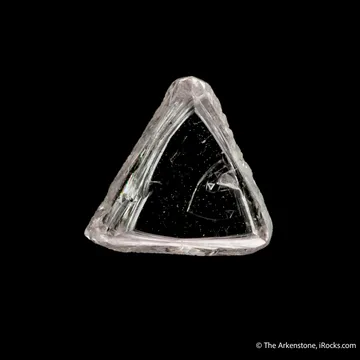
The most collectible Diavik crystals show a clear natural geometry: sharp or slightly softened octahedral faces, triangular growth features, etched surfaces, or twinning planes that make the specimen legible as a diamond crystal rather than simply a parcel stone. Macles are of special interest when complete and undamaged, particularly if the twinning gives the stone a thin, shield-like profile. Coated crystals—light or dark fibrous diamond surrounding a gem-quality interior—are another significant Diavik habit. Broken coatings and strongly etched surfaces suggest that many crystals experienced more complex surface histories than a clean octahedron alone would imply.
Color ranges from colorless and near-colorless through pale yellow, brown, gray, and rare pinkish tones. GIA’s characterized suite included D-to-Z range diamonds, brown stones, a small number of yellow stones, gray stones, and one pinkish crystal. The scientific color causes are correspondingly varied: pale yellow is linked with “cape” absorption features, brown with vacancy-cluster absorption and plastic deformation, and pinkish hues with deformation-related bands. Most Diavik rough observed in laboratory study showed blue fluorescence under DiamondView imaging, with rare green fluorescence in some hopper-like resorbed cubes.
The mine’s production is celebrated commercially for white gem-quality diamonds, but collector-grade rough is not limited to the whitest stones. A perfectly natural, frosted, resorbed brown octahedron may be far more interesting as a mineral specimen than a water-clear cleavage fragment. The best Diavik specimens balance transparency, crystal completeness, surface character, and reliable provenance. A lightly yellow octahedron with etched faces, a well-formed macle, or a coated crystal with a visible gemmy interior can carry more locality character than a small, clean, nondescript fragment.
Typical collector specimens are small. Diavik was not historically known for very large diamonds, even though it produced a few famous exceptions. Scientific and gemological studies often focus on sieve classes of only a few millimeters, and most rough that reaches collectors is in the sub-carat to a few-carat range. Larger natural crystals with documented Diavik provenance are substantially rarer, and large yellow stones are in a different category altogether.
Associated minerals are best understood in two contexts. In the host kimberlite and mantle-derived material, Diavik belongs to the broader Lac de Gras indicator-mineral suite of garnet, chromite, clinopyroxene, olivine, ilmenite, and related mantle xenocrysts. Within the diamonds themselves, mineral inclusions from the A154 South pipe show that most inclusion-bearing diamonds reflect peridotitic mantle sources, with a smaller eclogitic component. Documented inclusions include olivine, Mg-chromite, garnet, Fe-Ni sulfides, clinopyroxene, ferropericlase, and diamond-in-diamond inclusions. For collectors, visible dark inclusions in rough Diavik diamonds are not automatically flaws; when natural and internal, they can be evidence of the mantle environment that makes diamond scientifically valuable.
Quality factors for Diavik specimens differ from those used for cut gems. For a specimen, the hierarchy is provenance first, natural form second, and only then color and clarity. The most desirable pieces have unambiguous natural surfaces, minimal fresh breakage, no polishing, no laser drilling or fracture filling, and a locality trail that plausibly connects the stone to Canadian mine production. Brightness, transparency, attractive body color, fluorescence, and a strong crystal outline add value, but they do not compensate for weak provenance.
The central authenticity issue with Diavik diamond is locality, not species. Diamond itself is easily tested by professional gemological methods, but proving that a loose rough diamond came from Diavik requires documentation. The mine did not operate as a public collecting locality, and rough diamonds were handled through controlled commercial channels. A specimen represented as “Diavik” should ideally be accompanied by mine-to-market documentation, dealer provenance, old collection labels, invoice history, or a credible Canadian-diamond paper trail. A simple verbal claim is not enough for a premium locality price.
Collectors should also separate natural rough specimens from cut Canadian diamonds. Many Canadian diamonds were sold through branding programs emphasizing ethical sourcing and traceability, but a polished stone with Canadian origin is not the same thing as a mineral specimen from Diavik. Conversely, natural Diavik rough may not be gem-perfect; etching, coatings, inclusions, and resorption can be exactly what make it mineralogically interesting.
No Diavik-specific fake “style” is needed to deceive the market: the more common problem is generic natural rough, treated diamond, synthetic diamond, or Canadian-looking parcel material being assigned a desirable mine name without proof. Laboratory-grown diamond is now abundant and must always be considered when buying loose crystals without documentation. Treated natural diamonds—especially irradiated, HPHT-treated, fracture-filled, or laser-drilled stones—are primarily a gem-market concern, but any treatment should be disclosed and generally lowers mineral-specimen desirability unless the specimen is being collected specifically as a treatment example.
Condition deserves close scrutiny. Natural resorption and etching are part of Diavik’s character; fresh chips, cleavage breaks, sawn surfaces, polishing windows, and bruised edges are different. A diamond can survive geologic violence and still suffer unattractive modern damage during recovery, sorting, handling, or mounting. For specimen purposes, prefer intact faces, continuous edges, and natural luster transitions. If a surface is suspiciously flat, glossy, and planar in a way that interrupts natural morphology, examine it as a possible cleavage, saw, or polished surface.
Rarity is changing. During active production, Diavik rough appeared periodically through commercial channels; after March 2026, the mine became a finite locality. Final rough diamonds are expected to continue being polished and sold through Rio Tinto’s customer network during 2026 and beyond, but fresh mine production has ended. Ordinary small Diavik diamonds will remain available in the market for some time because the mine produced more than 150 million carats over its life. Well-documented natural rough specimens, especially attractive octahedra, macles, coated crystals, yellows, and larger crystals, should become progressively harder to replace.
For EarthWonders collectors, the best buying strategy is to treat Diavik as a provenance locality rather than a diamond bargain. Pay for a documented, natural, interesting crystal—not merely for the word “Canadian.” A small but fully natural Diavik octahedron with strong documentation is a better mineral specimen than a larger, poorly documented rough diamond with a romantic Arctic story attached.
The first great Diavik story was not a million-carat production milestone or a museum exhibition, but a drill core. In 1994, indicator minerals had been found near what was then called the A21 anomaly. The team chose to drill the nearby target that became A154 South, and one section of kimberlite core broke open to reveal a 2.5 carat diamond crystal. In a diamond pipe, where the valuable mineral is commonly measured in carats per tonne rather than visible crystals per hand specimen, that was a startling moment. It was the sort of discovery that turns an anomaly on a map into a mineable geological body.
The engineering story at Diavik is equally improbable. The ore bodies lay beneath Lac de Gras, so the mine was built not simply in the Arctic, but into a lake. Dikes had to be constructed, water held back, and pits opened in ground that had previously been lakebed. From the air, the mine became one of the most recognizable diamond operations in the world: two dark circular pits, pale dike walls, roads, waste areas, and processing buildings set in a cold-water mosaic of tundra and rock. The isolation shaped everything. Personnel were flown in and out. Heavy freight depended on the winter road season. In winter, temperatures of –35°C to –40°C were not unusual, and whiteout conditions could halt operations.
The Diavik Foxfire is the locality’s best collector tale because it nearly did not survive. Before 2015, Diavik was known for high-quality diamonds, but not for very large gem crystals. The processing system was built with that expectation: oversize material was more likely to be treated as kimberlite to be crushed than as a valuable diamond. The Foxfire, weighing about 187.6 carats, should have been pulverized. Its survival came down to shape. Because it was unusually flattened and elongated, it slipped through a screen sideways and escaped destruction. A diamond that might have vanished as fragments instead became the largest known uncut gem-quality diamond mined in North America.
When the Foxfire reached the Smithsonian, the stone’s mineralogical personality became as important as its size. Curator Jeffrey Post examined it under ultraviolet light and found that it glowed an intense blue, then continued to phosphoresce after the light was switched off—first in a peachy-orange afterglow and then in a pale white glow lasting far longer than is typical for many diamonds. Museum geologist Mike Wise reportedly reacted with the simple, apt verdict: “That’s wild.” The name Foxfire tied the stone back to the northern sky, referring to an Indigenous description of the aurora borealis as fox tails moving across the Arctic.
In 2025, near the end of Diavik’s life, the mine produced another headline stone: a 158.20 carat gem-quality yellow diamond. Rio Tinto described it as one of the largest gem-quality yellow diamonds ever found in Canada and one of only five Diavik yellow diamonds over 100 carats in the mine’s 22-year history at that point. The contrast is what makes the find memorable. Diavik was primarily a producer of white gem-quality diamonds, and yellow diamonds represented less than one percent of output. Yet just as the mine was approaching closure, it yielded a two-billion-year-old yellow rough large enough to become part of Canadian diamond history.
The final act came in March 2026. After 23 years of operation, Diavik marked its final production. Cabin Radio joined a last underground tour before active mining ceased, recording a slice of the underground workings as the mine moved from extraction into closure. Rio Tinto’s final announcement framed the end as the exhaustion of economic reserves rather than a market retreat: more than 150 million carats had been produced, the four pipes had been mined by open-pit and underground methods, and closure work would continue through 2029 before post-closure monitoring. For collectors, that date matters. Every Diavik crystal now belongs to a closed chapter.