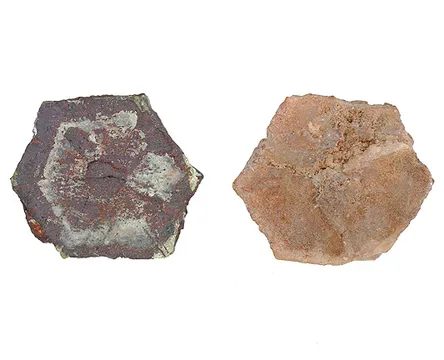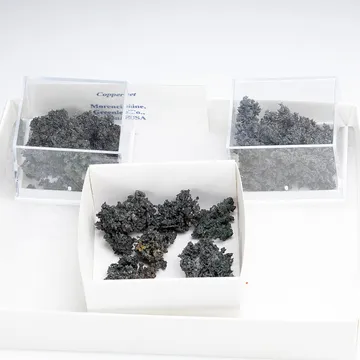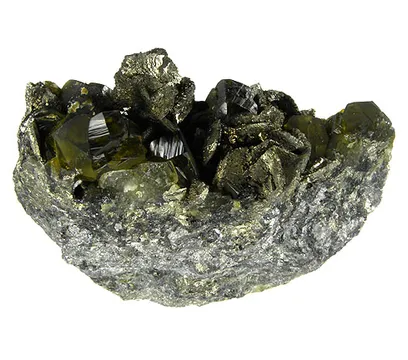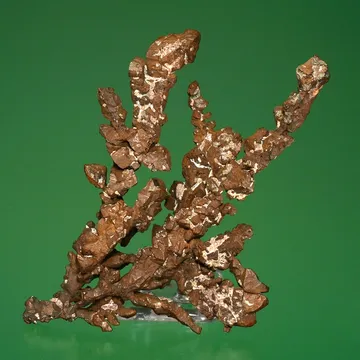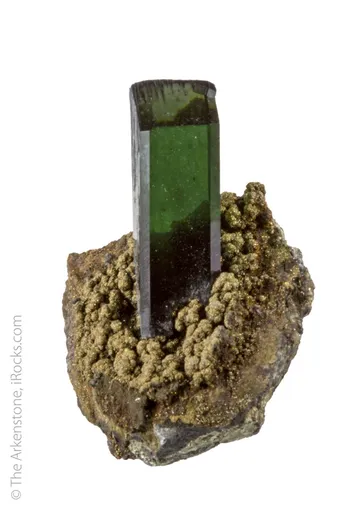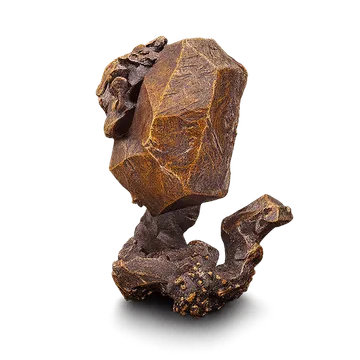
Coro Coro, Bolivien - native Kupfer-Pseudomorphosen nach Aragonit, knackige pseudohexagonale Formen, warme Patina und hoch sammelwürdige, seltene Stücke.
Key facts
Coro Coro ist einer der großen klassischen Fundorte für rohen Kupfer, doch sein Ruhm fußt auf einer Form, die kaum eine andere Kupferfundstelle erreichen kann: Kupfer-Pseudomorphosen nach Calcit-Aragonit. Die besten Stücke bewahren die pseudohäxige, zyklische Zwillingform des ursprünglichen Aragonits als stumpfe Prismen, kompakte „Disco-Kugel“-Cluster oder miteinander verwachsene Floaters, die sich nun in schweres, metallisches Kupfer mit warmer Lachs-, Bronze-, Mahagoni- oder rötlich-brauner Patina verwandelt haben. Viele zeigen Oxidationsüberprägungen roter Cuprit- und grüner Malachit-Färbungen; die feinsten Beispiele balancieren eine scharfe Aragonit-Form mit unverwechselbarer Kupfer-Naturfarbe und Gewicht.

Foto: Mineral Auctions
Die Region ist kein Vorkommen von Adernkupfer im üblichen Sinn. Es handelt sich um ein sedimentgesteuertes Kupfersystem in andinischen Rötelböden: kupferhaltige Sandsteine, Konglomerate, Tonsteine und Schiefer rund um die Stadt Coro Coro, im bolivianischen Altiplano der La Paz-Abteilung. Historisch verglichen Geologen Coro Coro mit dem Kupferland Lake Superior in Michigan, weil beide bedeutende kommerzielle Produzenten von nativen Kupfer waren. Coro Coro hat jedoch seine eigene visuelle Sprache. Anstelle großer Spinell-gezahnter Kristalle und verzweigter „Wendemuster“-Baumstrukturen denken Sammler zuerst an dichte, kleine Aragonit-Ersetzungen — oft von der Daumen- bis Miniaturgröße —, deren mineralogischer Trick darin besteht, dass Kupfer, ein isometrisches Elements, die äußere Form eines orthorhombischen Carbonat-Zwillings geerbt hat.
Für Sammler ist Coro Coro Kupfer am besten, wenn die Pseudomorphose aus der Ferne sofort erkennbar ist: ein vollständiger Floater, klare pseudohäxige Geometrie, gute Kupferfarbe, minimale Abrundung und genügend Oberflächenoxidation, um Charakter zu verleihen, ohne die Form zu verstecken. Stücke mit zugeordneter Cuprit-, Malachit-, Chrysokoll- oder Restaragonit-Verwandtschaft können besonders lehrreich sein, aber scharfe Form ist die bevorzugte Qualität. Größere Exemplare sind viel seltener als kleine Daumenstücke, und wirklich scharfe größere Stücke sind außergewöhnlich.
Specimens suchen: Alle Kupferproben aus Coro Coro, Bolivien ansehen
Coro Coro liegt in der Provinz Pacajes, Abteilung La Paz, im westlichen Bolivien, auf dem hohen Altiplano knapp über 13.000 Fuß Höhe. Das Bergbaugebiet zentriert sich um den Ort, mit Förderstellen historisch auf den umliegenden Hügeln und Kämmen entwickelt, insbesondere nahe Cerro Corocoro und entlang der wichtigsten strukturellen Brüche des Distrikts. Ältere Literatur verwendet die Schreibweisen Corocoro, Coro-Coro und Coro Coro austauschbar; moderne Mineralendatenbanken ordnen den Ort in der Regel als Coro Coro, Pacajes Province, La Paz, Bolivien ein.
Geologisch gesehen ist das Distrikt ein klassisches sediment-untertäutes Kupfersystem in tertiären roten Gesteinen. Die ältere Bergbauliteratur teilte die Trägermaterialien in die Formationen Vetas und Ramos ein: Die Vetas ist sandiger und stärker conglomeratisch, die Ramos stärker schalig und gypsitisch. Moderne Übersichten beziehen im Distrikt auch die Ballivian- und Caquiaviri-Formationen. Reines Kupfer und Chalkozit treten als Ersatz- und Eindringlinge in permeablen Schichten auf, insbesondere in Sandsteinen und kieshaltigen Horizonten, während Kupfer auch Bruchflächen und Lagerungsebenen als Blätter und baumartige Formen ausfüllt, die historisch als Charque bezeichnet wurden. Im Reinkupfer-Erz kommt Kupfer gewöhnlich als winzige Körner und Flocken in hellen bis grünlichen Sandsteinen vor, doch die Sammlerstücke, die den Ort berühmt gemacht haben, sind die Aragonit-Pseudomorphosen, die disseminiert in Ramos-ähnlichen Schichten und in einigen Erz-Horizonten vorkommen.
Die Bergbaugeschichte ist tief. Indigene Völker und koloniale Arbeiter nutzten die oxidierten Kupfer-Ausbisse, einschließlich grüner Kupferminerale, als Pigment und als Kupferquelle. Während der Kolonialzeit lieferte Kupfer aus Coro Coro die Münzprägung in Potosí. Im Jahr 1781 wurden die Betriebe durch revolutionäre Unruhen und durch die praktische Schwierigkeit der Verarbeitung der metallischen Reinkupfer-Erze unterhalb der oxidierten Ausläufer unterbrochen. Eine neue Phase begann um ca. 1830, als Claudio Rivero begann, die Reinkupfer-Erze zu bearbeiten; auch reines Silber wurde aufgefunden, und der Distrikt rückte wieder in den Fokus der Aufmerksamkeit.
In der Mitte des neunzehnten Jahrhunderts hatte sich Coro Coro zu einem bedeutenden Kupferproduzenten entwickelt. Die Produktion wurde in Begriffen von Barrilla beschrieben, einem Reinkupferkonzentrat aus dem metallischen Erz. Später ging das Distrikt in eine noch stärker konsolidierte Unternehmensführung über: Die Compañía Corocoro de Bolivia wurde 1873 gegründet, und Corocoro United Copper Mines, Ltd. folgte 1909. Der Abschluss der Arica–La Paz-Eisenbahn 1912 transformierte die Logistik. Vor dem Bahnzugang wurden Kupferkonzentrate per Maultier, Lama, Esel, Karren, Flussschiff, Seeschiff, Eisenbahn und Schiff transportiert – eine Transportkette, die nur hochwertige Rezkupferkonzentrate lohnenswert machte. Nach dem Bahnzugang und der Mühlenverbesserungen gewann schlickozyt-reiches Sulfid-Erz zunehmend an Bedeutung.In den frühen zwanziger Jahren verlagerte sich die Bergbaugeschichte des Bezirks von einer dominiert durch Native-Copper-Bergbau zu einer gemischten und später zunehmend sulfidsorientierten. Bis 1919 betrug die Produktion etwa 9 Millionen Pfund Kupfer, wobei mehr als vier Fünftel aus Sulfid-Erz und weniger als ein Fünftel aus Native-Copper-Erz stammten. Die San Francisco-, Guaychuni-, Guallatiri Grande-, Guallatiri Chico- und Libertad-Mühlen gehörten zur Geschichte der Native-Copper-Konzentration, und die alten Beschreibungen des Zerkleinerns, Jigs, Tabletts und der Sonnen-Trocknung von Barrilla vermitteln einen anschaulichen Eindruck des Ausmaßes.
Modernes Coro Coro ist kein beiläufiger Sammelort. Es war eine staatliche Bergbautätigkeit, die auf die Kupferkathodeproduktion ausgerichtet war, und spätere Produktionsberichte betreffen industrielles Kupfer, nicht Spezimen-Gewinnung. Spezimen-geeignete Pseudomorphosen zirkulierten stark durch alte Minenkanäle und Händlerbestände, insbesondere aus älteren Funden; feine Stücke von heute werden am ehesten aus alten Sammlungen, Auktionsarchiven und lang gehaltenen Händlerbeständen gesammelt statt durch leichten neuen Sammelzugang.## Eigenschaften von Kupfer aus Coro Coro, Bolivien
Der charakteristische Typ ist natives Kupfer, das pseudomorph nach Aragonit ist, insbesondere pseudohäshomogene Aragonittwinns. Gute Beispiele erscheinen als sechseckige Prismen, kompakte Cluster oder runde „Disco-Kugeln“ Treibstücke, zusammengesetzt aus mehreren ersetzten Aragonit-Einheiten. Der Begriff „hexagonal“ in der Sammlersprache beschreibt die äußere Aragonit-Zwillingsform; das ersetzende Mineral ist natives Kupfer, Cu, nicht ein hexagonales Kupferkristall. Diese Diskrepanz zwischen Chemie und Form ist genau das, was den Fundort so begehrt macht.
Die Farbe variiert von frischem kupfernem Lachsrosé bis Bronze, Schokoladenbraun, rötlichbraun und schwarzrot, wo Cuprite stark vertreten ist. Malachit fügt grüne Filme, Flecken und Nahtlinien hinzu; Chrysokolla kann blaugrüne Verfärbungen geben; Cuprite kann rote bis rötlich-schwarze Überzüge und Flecken bilden. Die besten Sammlerstücke bewahren genügend metallisches Kupferfarbton, um nicht wie undifferenzierte Verfärbungsstücke auszusehen, aber genug natürliche Patina, um Alterung und Oxidationsgeschichte zu demonstrieren.
Die Größe ist in der Regel moderat. Viele klassische Pseudomorphosen sind Daumengrößen von etwa 1–3 cm. Miniaturen im Bereich von 3–4 cm existieren, aber scharfe größere Treibstücke sind deutlich seltener; mit zunehmender Größe wird die Form oft rund, verzogen, unvollständig oder stark verändert. Platten und arboreszente Bruchfüllungen von native Kupfer können größer sein als die Pseudomorphosen, erreichen manchmal kleine-Kabinett-Größen, aber sie gehören zu einer anderen Sammel-Kategorie und sind bei der berühmten Coro Coro-Pseudomorph-Stil-Diagnose deutlich weniger aussagekräftig.
Die primären assoziierten Minerale für Sammlerexemplare umfassen Aragonit, Cuprite, Malachit, Chrysokolla, Connellite, Gypsum, Chalcophyllite, Sampleit, Tenorit, Azurit, Chalcocit, Domeykit, Baryt, Celestin, Calcit und Native Silber im weiteren Bezirk. Davon sind Aragonit, Cuprite, Malachit, Chrysokolla, Connellite und Gypsum die Verbindungen, die am häufigsten relevant sind, wenn Kupferexemplare bewertet werden.
Die Qualität hängt zuerst von der Form ab. Ein erstklassiges Coro Coro Kupfer-Pseudomorph sollte eine erkennbaren Aragonit-Geometrie zeigen: flache oder leicht keilförmige Flächen, klare pseudohäxige Umrisse, scharfe Kanten und eine komplette All-around-Treibstück-Präsentation, wenn möglich. Auch die Ersetzer-Qualität ist wichtig. Manche Stücke behalten Aragonit-Kerne, Hohlräume oder unregelmäßige Flecken unveränderter Carbonate; das ist wissenschaftlich interessant und kann in einem „Vorher-Nachher“-Kontext wünschenswert sein, aber der Markt belohnt in der Regel dichte, überwiegend kupferner Ersatzstücke mit starker Form und attraktiver Patina. Beschädigungen werden streng bewertet, weil die Form der entscheidende Anziehungspunkt des Prächens ist: Absplitterungen am Rand oder eine gerissene Fläche können den Reiz der Pseudomorphose erheblich mindern.## Collector Notes
Coro-Coro-Kupfer-Pseudomorphosen sind so verbreitet, dass die meisten ernsthaften Kupfer-Sammler irgendwann ein Exemplar erhalten können, aber feine Exemplare sind nicht häufig. Der Markt enthält viele kleine, runde, teilweise ersetzte oder stark veränderte Stücke; scharfe, vollständige Floaters mit starkem Kupferfarbton sind die Exemplare, die schnell verschwinden. Alte Etiketten und dokumentierte Sammlungs-Historie erhöhen den realen Wert, besonders weil viel von dem besten Material vor Jahrzehnten zirkuliert zu haben scheint.
Die Hauptauthentizitätsbedenken bestehen nicht in einer gut dokumentierten Epidemie von Coro-Coro-spezifischen Fälschungen, sondern im breiteren Problem künstlicher kupferfarbener Pseudomorphosen und behandelter Karbonatkristalle im Mineralienhandel. Künstliche „Kupfer nach Aragonit“ oder Malachit-ähnliche Pseudomorphosen wurden durch chemische Behandlung von Karbonatkristallen hergestellt. Für Coro Coro sind gute Provenienz, korrekte Ortsangabe-Stil, natürliches Gewicht, kohärente Oxidation und glaubwürdige Oberflächenstruktur wichtig. Seien Sie misstrauisch gegenüber unnatürlich hellen, frisch aufgalvanisierten Kupferfilmen, verdächtig gleichmäßigen Beschichtungen, weichen oder kreidigen Karbonatformen mit nur oberflächlicher Kupferfärbung und Stücken ohne glaubwürdige Alter-Herkunft-Geschichte, wenn sie als Spitzenklassiker angeboten werden.
Zustandsprobleme sind häufig. Kupfer ist weich, Aragonit-Pseudomorphosenformen sind randempfindlich, und viele Stücke wurden aus schlecht verfestigtem Sediment geborgen, gewaschen, gehandhabt und wiederholt gehandelt. Rundungen an Flächen, gequetschte Prismenkanten, kleine Chips und erdige Rückstände sind normal. Grüne Verfärbungen können attraktiv sein, aber dicker Malachit oder Chrysokoll können verbergen, ob die zugrunde liegende Pseudomorphose scharf ist oder lediglich klumpig. Kupfer-(I)-oxid-beschichtungen können schön sein, aber schwarz verfärbte, körnige oder korrodierte Beschichtungen vermindern die visuelle Klarheit, wenn sie die Aragonitform verdecken.
Die Reinigung sollte konservativ erfolgen. Die natürliche Patina gehört zur Identität dieser Exemplare, und aggressives Aufhellen kann ein echtes Stück verdächtig aussehen lassen. Vermeiden Sie Polieren, starke Säurereinigung und jeden Versuch, Malachit oder Kupferkieselheit willkürlich abzubauen. Eine gute Coro-Coro-Pseudomorphose sollte alt, metallisch und mineralogisch kohärent wirken – nicht wie ein neu kupferbeschichtetes dekoratives Objekt.
Die Marktkosten sind zeitweise. Kleine Beispiele erscheinen regelmäßig bei Händlern und in Auktionsarchiven, oft im Miniaturbereich. Größere, schärfere „Disco-Kugel“-Cluster, gepaarte Aragonit- und Kupfer-Vorher/Nacher-Paare und Stücke mit bemerkenswerter alter Provenienz erzielen einen Aufschlag. Freies natives Kupferblech und baumförmige Formen aus dem Distrikt sind weniger ikonisch als die Pseudomorphosen, können aber interessant sein, insbesondere wenn sie mit Kupfer(I)-oxid, Malachit oder sichtbaren kristallisierten Kupfern verbunden sind.## Stories & Field Notes
Bevor die Eisenbahn kam, reiste Kupfer aus Coro Coro einen Weg, der wie ein Geography-Unterricht in Härte klingt. Konzentrate verließen das Distriktgebiet per Lama, Esel, Maultier oder Wagen nach Nazacara am Río Desaguadero, etwa 45 km entfernt. Von dort brachten Dampfer mit geringem Auftrieb oder Bargen grob 100-Tonnen-Ladungen weitere 65 km nach Guaqui am Titicacasee. Das Kupfer überquerte dann den See nach Puno, wurde per Bahn in Richtung Küste nach Mollendo transportiert und erneut auf Bargen und Ozeanpferde-Schiffe verladen, die nach Europa oder in die Vereinigten Staaten bestimmten. Jede Verladung war bedeutsam, denn das einzige Material, das die Frachtkosten tragen konnte, war Hochgrad-Nativkupfer-Konzentrate. Die 1912 eröffnete Arica–La Paz-Eisenbahn veränderte die gesamte Wirtschaft des Distrikts: Ein 6 km langer Ast nach Taracora brachte Bahnverkehr zu den Konzentrationswerken, und die alte Tier- und Seenkette wich dem direkten Bahntransport nach Arica.
Die Silber-Episode des Distrikts war kurz, aber dramatisch. In der Buen Pastor-Veta erzeugten Silbererze so viel Aufregung, dass Schächte und Tunnel sich rasch vervielfachten, nur um zu beweisen, dass die arbeitsfähige Silberzone begrenzt war. Die Mine wurde mit etwas Erfolg abgebaut, dann während der Revolution von 1859 aufgegeben und überflutet. Alte Berichte erwähnen, dass Silber zuerst in einer Tiefe von ca. 20 m angetroffen wurde, abwechselnd mit Kupfer, sodass an einem Ort ein Metall dominierte und in der Nähe das andere. Über rund 60 m Tiefe hinweg wurde das Erz beschrieben, das achtmal so viel Silber wie Kupfer enthielt. Das reichste Material soll 2.400 Unzen Silber pro Tonne enthalten haben, während mittelqualitatives Erz durch Amalgamation 700 bis 1.200 Unzen ergab. Es ist eine erstaunliche Passage in einem Distrikt, der eher für Native Copper bekannt ist: Für einen Moment verhielt sich Coro Coro fast wie eine der bolivianischen Silbergeschichten.
Die Pseudomorph-Minen der späten zwanzigsten Jahrhunderts im Sammlerzeitalter waren keine romantischen Höhlen funkelnden Kupfers. Alfredo Petrov berichtet aus einem Besuch in den 1990er Jahren, der-intimer und aufschlussreicher ist: Bergleute bearbeiteten kurze Stollen mit Pickel und Schaufeln in schlecht verfestigtem Sandstein und Mudstone, und schoben dann einige hundert Meter mit Schubkarren zu einem Bach, um den Schlamm wegzuwaschen. Die Pseudomorphs selbst waren Erz, das in Tausenden in einigen kleinen Gebieten abgebaut wurde, aber die Exemplare, die Sammler wollten – gut geformt, weitgehend ersetzt und attraktiv – machten nur einen winzigen Bruchteil dessen aus, was herauskam. Die Frauen der Bergleute spielten eine Schlüsselrolle in der Exemplar-Wirtschaft: Sie selektierten die besser aussehenden Stücke und verkauften sie an anreisende Händler. Diese kleine Anekdote erklärt, warum so viele Coro Coro-Pseudomorphien auf dem Markt handverlesen wirken: Jemand aus dem Bergwerk hatte die Mineralproben bereits von der Kupfer-Lager abgetrennt.## Mineralogische Aufzeichnungen & Publikationen- Joseph T. Singewald Jr. und Edward W. Berry, The Geology of the Corocoro Copper District of Bolivia, Johns Hopkins Press, 1922. Fundamentale Monografie mit Distriktgeschichte, Stratigraphie, Erzbeschreibungen, Transportlogistik, Bergbauaktivitäten und der klassischen Diskussion von Kupfer-Pseudomorphosen nach Aragonit. (biodiversitylibrary.org)
Adrien Berton, „The Corocoro Copper District of Bolivia,“ American Institute of Mining, Metallurgical, and Petroleum Engineers, 1936. Knapp technischer Aufsatz, der die Stellung Coro Coros unterstreicht, zusammen mit dem Lake Superior als einer der bedeutenden kommerziellen Erzdistikte für natives Kupfer und den Produktionkontext für natives Kupfer darlegt. (onemine.org)
U.S. Geological Survey und Servicio Geológico de Bolivia, Geology and Mineral Resources of the Altiplano and Cordillera Occidental, Bolivia, USGS Bulletin 1975, 1992. Regionale Referenz für Mineralvorkommen im Altiplano, einschließlich sedimentär-haltiger Kupferlagerstätten und Coro Coro-Gebieten. (usgs.gov)
Mindat.org Lokaleintrag für Coro Coro, Pacajes Provinz, La Paz, Bolivien. Nützlich zur aktuellen Lokalehierarchie, alternativen Namen, Mineralsammlung, Sublokationen und Foto-/Datenaggregation. (mindat.org)
Mindat.org Fundortangabe für Native Copper aus Coro Coro. Speziell nützlich für das Vorkommen von Native Copper, assoziierte Mineralien basierend auf Foto-Daten und der Pseudomorph-after-Aragonite-Hinweis. (mindat.org)
Mindat „Best Minerals: Copper“ Fundortnotiz von Alfredo Petrov. Wichtige sammlerorientierte Beschreibung des Coro Coro-Pseudomorphie-Bergbaus und der Probenwahl in den 1990er Jahren. (mindat.org)
James St. John, „Native copper pseudomorph after aragonite (Tertiary; Corocoro Copper Mining District, western Bolivia),“ Flickr, 2014. Klar verständliches fotografisch gezeigtes Lehrbeispiel mit Probenmaß, Pseudomorphie-Erklärung und zugehörigem Cuprite und Malachit. (flickr.com)
Mineral Auctions, „Aragonite and Copper pseudomorph after Aragonite (‘before and after set’),“ 2009 Archiv. Bemerkenswertes Händlerarchiv, das gepaarte Aragonit- und Kupfer-Pseudomorphen aus Corocoro zeigt und das Verständnis der ursprünglichen Form versus Ersatz erleichtert. (mineralauctions.com)
Mineral Auctions, „Copper pseudomorph after Aragonite (‘disco ball’),“ 2021 Archiv. Nützliches Marktexemplar eines vollständigen Thumbnail-Floater, Abmessungen, Auktionsresultat und Sammlerherkunft. (mineralauctions.com)## Videos & Media
„Kupfer-Pseudomorph nach Aragonit (großes ‚Floater’-Exemplar)“ — Mineralauctions.com. Kurzes Vimeo-Exemplar-Video von The Arkenstone/Mineral Auctions, das einen Koros Coro Kupfer-gegen Aragonit Floater in der Hand/Video-Präsentation zeigt. (vimeo.com)