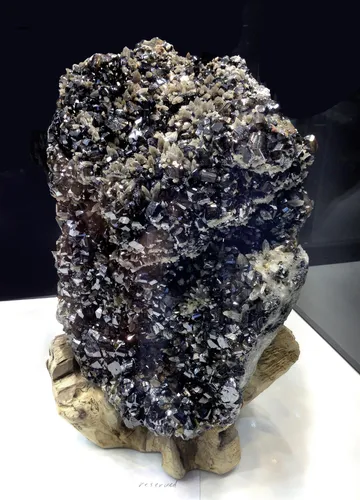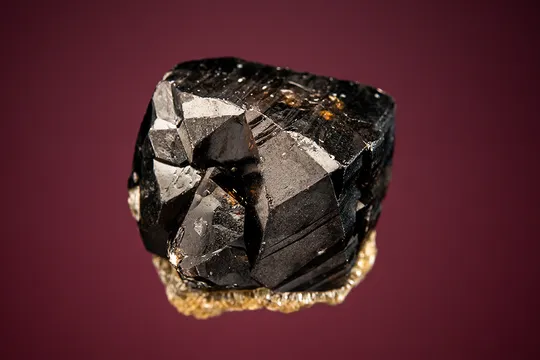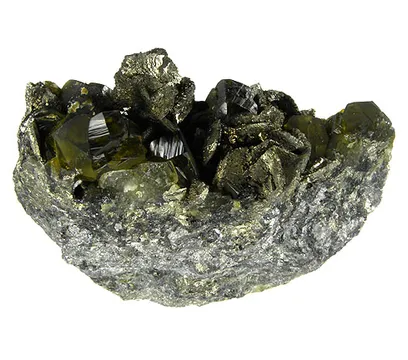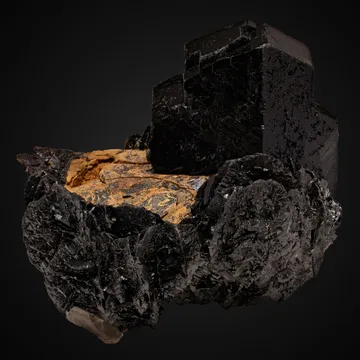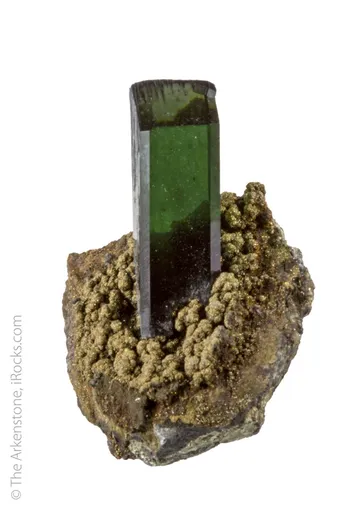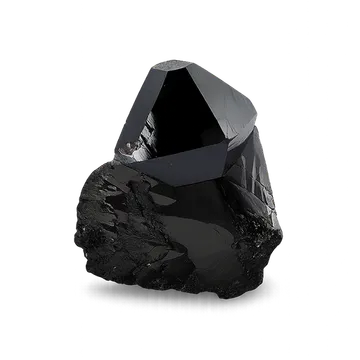
Viloco Mine cassiterite — Bolivia’s essential tin locality, known for dark, mirror-bright crystals and rare transparent, facet-quality specimens.
Key facts
Viloco is one of the essential cassiterite localities: a high-Andean tin mine whose best specimens combine the authority of an ore mineral with the flash, transparency, and form normally reserved for showier gem species. Fine pieces show sharp, highly lustrous brown-black twins, often with amber, honey, or yellow-brown translucency when a strong light is placed behind them. The most desirable examples have crisp cyclic or “spherical” twinning, glassy faces, and enough internal clarity that the crystals stop looking like black tin ore and begin to glow.

Photo: Wikimedia Commons
The mine lies in the Quimsa Cruz–Tres Cruces part of the Cordillera Real, southeast of La Paz, within Bolivia’s famous tin belt. Its collector material is not a pegmatite curiosity but the crystalline expression of a hydrothermal Sn-W-Mo-As vein system around Oligocene granitic intrusions. The Viloco vein field is especially interesting because the district is zoned around the granite: tungsten-arsenic-bismuth-copper assemblages occur close to the intrusive rocks, cassiterite dominates an intermediate tin zone, and zinc-bearing assemblages increase farther out. That zoning helps explain why some Viloco specimens are wonderfully clean cassiterite on quartz, while others carry siderite, tourmaline, arsenopyrite, pyrite, wolframite-group minerals, bismuthinite, and other sulfides.
For collectors, Viloco’s signature is the tension between darkness and light. In ordinary cabinet lighting many specimens read as black, mirror-bright cassiterite. Turn the specimen, or backlight a broken edge or thinner twin, and the same crystals may reveal caramel, honey, golden-brown, or even paler yellow zones. That optical surprise is locality-defining. Viloco is also repeatedly cited as Bolivia’s only tin mine that has occasionally yielded transparent, facet-quality cassiterite; this is a remarkable distinction in a country famed for tin production.

Photo: Wikimedia Commons
Historically, the locality appears under both Viloco and Araca, names that collectors should treat as closely linked for specimen purposes. The mines were discovered at the end of the nineteenth century, were important enough to appear in classic Bolivian tin literature, and remain active through small mining cooperatives. The finest old pieces—especially large, sharp, lustrous twins—are far from common, and the best examples have the character of preserved ore: dense, heavy, tough-looking, but with just enough transparency to remind you that cassiterite is not merely industrial tin oxide, but one of the great oxide species.
Search for specimens: View all cassiterite specimens from Viloco Mine, Bolivia
Viloco Mine, also known in much of the literature and specimen trade as Araca Mine, is in Loayza Province, La Paz Department, Bolivia. It sits southeast of the city of La Paz in the Cordillera Real, in the Tres Cruces or Quimsa Cruz range. Mindat gives coordinates for the locality at approximately 16° 52' 26'' South, 67° 29' 52'' West, though older and broader references to the Viloco-Araca district may vary slightly depending on whether they refer to the mine complex, the settlement, or the broader mining field.
Geologically, Viloco belongs to the Bolivian tin belt and is best described as a zoned peribatholithic hydrothermal vein district related to granitic intrusions. The district is hosted chiefly in Paleozoic metasedimentary rocks—especially black shales, slates, phyllites, and minor quartzites—with veins also found in or near granitic rocks and porphyritic granite dikes. The Quimsa Cruz intrusive complex includes Oligocene granodiorite and monzogranite bodies; published U-Pb zircon ages for related units are about 26.2 ± 0.2 Ma and 25.4 ± 0.2 Ma. These intrusions produced contact metamorphism, including hornfels development, and helped drive the hydrothermal systems that deposited cassiterite and associated ore minerals.
The ore occurs in steep, generally northeast-trending veins. Published field descriptions note vein sets spaced by meters, with vertical and longitudinal continuity locally reaching several hundred meters and widths ranging from millimeters to about 50 cm. The richest collector material comes from drusy vein cavities where euhedral cassiterite crystals lined open space, sometimes with comb texture and, in brecciated zones, cockade textures. This open-space growth is crucial: without it Viloco would be only another tin ore producer; with it, the district produced some of the finest crystallized cassiterite specimens known.
The district’s mineral zoning is one of its most useful geological clues. Veins in or very near the granite are richer in As-W-Bi-Cu assemblages, while tin is strongest at intermediate distances from the intrusive contact, roughly 500 to 2000 meters out in the published model. Farther from the contact, zinc-lead assemblages become more important. The cassiterite-rich tin zone includes classic specimen associations with quartz, siderite, tourmaline, arsenopyrite, pyrite, apatite, wolframite-group minerals, and bismuth minerals; in some tin-domain veins, cassiterite can be the dominant ore mineral.
Mining history at Viloco stretches back to discovery at the end of the nineteenth century. Older literature refers to the workings as the Araca mines, and specimen labels may use either Viloco or Araca. In the early twenty-first century, the district was still being worked by small mining cooperatives, with published descriptions mentioning tens of active galleries over an area of about 30 km2 and more than 250 miners. Mindat records the mine as active, with that status last checked in 2022.
The mine is not a casual collecting locality. It is an active tin mine in a high-altitude Andean district where workings are controlled by mining interests and cooperatives. Specimens that reach the collector market generally come through miners, cooperatives, established dealers, old collections, or secondary-market dispersals. The most desirable examples are not recent tourist finds; many are older specimens, and labels may carry historical locality names, mine sublocalities, or former owners.
Production periods of collector-quality material are not evenly documented, but the record gives useful anchors. Classic specimens are associated with early mining, old collections, and mid-to-late twentieth-century production. One documented specimen carries COMIBOL 1965 provenance. Dealer and collection records also point to significant fine material appearing in limited batches between about 1980 and 1994, and gemological reporting from 2002 notes a German foreign-aid effort that encouraged miners to separate top specimen and gem material instead of sending it directly to the ore stream. That intervention matters: in an operating tin mine, the difference between a world-class cassiterite and crushed concentrate can be a miner recognizing what is in hand.
Viloco cassiterite is SnO2, and the best specimens show the mineral at its most sculptural: compact, sharply twinned crystals with brilliant faces, strong striations, and a deceptively dark body color that often hides translucency. Mindat’s occurrence record lists crystals to 8 cm and twins to 5 cm, though most collector specimens seen on the market are much smaller, commonly thumbnails to small cabinets with individual twins from a few millimeters to a few centimeters. A fine 1 cm cyclic twin on bright quartz is already attractive; a sharp 2–3 cm lustrous twin is serious material; large, undamaged, gemmy twins are elite.
The characteristic colors are dark brown to black in reflected light, with brown, amber, honey-yellow, yellow-brown, or occasionally near-colorless zones visible in transmitted light. Viloco is especially admired for this internal glow. Some crystals appear almost opaque until a strong light catches a broken edge, a corner, or a thinner section of a twin; then the “black” crystal can suddenly become caramel. Gemological descriptions report that rare color-zoned crystals may show brown and light yellowish-brown areas, with lighter color concentrated near the surface. Faceted stones from Viloco are most often light brownish yellow, and bicolored brown and yellowish-brown gems are known.
Crystal habit is dominated by prismatic to pseudo-octahedral cassiterite forms and twinning. Cyclic twinning is particularly important at Viloco, producing rosettes, rounded aggregates, and almost spherical-looking clusters. Some specimens are dense mounds of small, glossy twins; others feature one commanding twinned crystal on quartz or on a leaner ore matrix. Backlit examples can show growth zoning and internal phantoms. Fine faces are usually bright and reflective, and the best pieces have the mirror luster collectors expect from top cassiterite localities.
The usual cabinet associations are quartz, siderite, and tourmaline. Quartz may appear as clear to smoky drusy crystals or as a quartz-rich matrix under cassiterite; siderite forms tan to brown lenticular or compressed rhombs and aggregates; tourmaline may appear in the matrix and also as microscopic inclusions in gemmy cassiterite. Other documented associates include arsenopyrite, pyrite, apatite, ankerite, calcite, marcasite, wolframite-group minerals, bismuthinite, limonite, löllingite, chalcopyrite, pyrrhotite, sphalerite, stannite, magnetite, and native bismuth in the broader district assemblage.
On the microscopic and geochemical side, Viloco cassiterite has been described as nearly pure, with low substitution of Sn by Nb, Ti, Ta, and Fe. A 2013 study reported TiO2 not exceeding 0.8 wt% and local Ta contents around 0.2 wt% in cassiterite. Modern gemological comparison with Chinese Yunling cassiterite has also shown that Viloco material can have broader trace-element ranges, especially for elements such as tantalum, uranium, cobalt, nickel, and titanium. For collectors, these analytical distinctions matter less than the specimen’s look, but for gem origin work they can be important.
Quality is judged by a compact set of locality-specific traits: sharp twinning, luster, translucency under strong light, crystal size, freedom from bruising, attractive placement on quartz or siderite, and credible provenance. A Viloco cassiterite with dark, mirror-bright twins but no transmitted color can still be excellent. A specimen with glassy, amber-brown translucency, sharp cyclic form, and minimal damage is the locality at its best.
Viloco cassiterite is dense, hard, and visually distinctive, but not immune to condition problems. The common issues are edge bruises, cleaved or contacted crystal tips, broken twin terminations, and repaired matrix contacts. Because cassiterite is heavy, clusters can suffer from old collection handling, shipping shocks, or vibration along weaker quartz or siderite contacts. On quartz-rich pieces, look carefully where dark cassiterite crystals meet lighter matrix; old glue, stabilization, or reattached crystals are easiest to miss in shadowed crevices.
No well-documented, locality-specific fake industry for Viloco cassiterite emerged in the sources reviewed. The main authenticity concerns are more ordinary: vague Bolivian locality attribution, overconfident use of the Viloco name for gemmy cassiterite without provenance, undisclosed repairs, and confusion between Viloco and Araca labels. Because Viloco and Araca are used almost interchangeably in the literature and trade, that name variation alone is not a red flag. A label that says “Araca Mine, La Paz, Bolivia” may well belong in the Viloco family. A label that simply says “Bolivia cassiterite,” however, should not automatically be upgraded to Viloco without corroboration.
The growth habit is one of the best authenticity checks. Typical Viloco pieces have lustrous brown-black twins, often cyclic, with quartz and sometimes siderite or tourmaline. Backlighting may reveal honey to yellow-brown translucency. Material that is uniformly black, dull, massive, and lacks distinct twinning may still be cassiterite, but it is not what the locality is famous for. Conversely, unusually pale, clean, faceted cassiterite should be judged as a gem material: confirm refractive and microscopic properties, and be aware that near-colorless cassiterite can be confused with synthetic moissanite in jewelry contexts. Cassiterite’s very high heft is a useful clue in loose stones, and Viloco gems may show veils of two-phase inclusions and, occasionally, tourmaline needles.
Market availability is uneven. Small Viloco thumbnails and miniatures still appear, often as old stock or from dispersed collections. Better small-cabinet specimens with abundant sharp twins and quartz matrix are available but not common. Large, undamaged, highly lustrous, partly gemmy cyclic twins are genuinely scarce and tend to be absorbed quickly by cassiterite specialists, Bolivian-suite collectors, and collectors building systematic displays of major ore-mineral species. Specimens with old labels, documented collection history, or early mine provenance deserve a premium, especially when the crystal quality is strong.
For buying, insist on clear photos under both reflected light and, if the dealer claims translucency, transmitted or backlit conditions. Ask whether crystals are repaired, whether the matrix has been stabilized, and whether any old labels accompany the specimen. Since the finest examples can look nearly black in normal lighting, good photography is not merely cosmetic—it is part of understanding the specimen.
Viloco’s best story is the one repeated, in different forms, every time a collector turns a black cassiterite twin toward a lamp. This was an ore mine first. The district’s reason for being was tin and tungsten production, not cabinet minerals. In that setting, a transparent cassiterite crystal is almost an accident of mercy: the same mineral that could be crushed for tin concentrate instead survived as a gem or specimen. A 2002 gemological note records that, as part of a German foreign-aid project, Viloco miners were instructed to separate top-quality gem and specimen cassiterite rather than process it as ore. That single change in attention helped preserve material that otherwise would have disappeared into the mill.
Jaroslav Hyršl’s 2001 visit to Bolivia gives the gem side of Viloco a concrete scale. He reported seeing hundreds of carats of faceted Viloco cassiterite—an astonishing statement for a mineral most collectors know as dense, dark, and opaque. The same report describes cut stones most commonly as light brownish yellow, with some bicolored brown and yellowish-brown gems. One illustrated center stone weighed 11.77 ct, a substantial size for faceted cassiterite, and the accompanying specimen measured 9 x 7 cm with numerous partly transparent crystals. For a locality famous in mineral cabinets, Viloco also quietly entered the rare-gem world.
The field setting is equally memorable. Published geological work places the mines in the Tres Cruces Range of the Cordillera Real, with many workings at altitudes exceeding 4500 meters. The district covered roughly 30 km2, with tens of galleries active and more than 250 cooperative miners at the time of the 2013 study. That is not a romanticized pocket locality with one lucky vug; it is a high, working Andean tin district where collector crystals are extracted from a functioning mineral economy.
The old specimen record carries its own human trail. One documented 10 cm spherical cassiterite specimen is tied to COMIBOL 1965 and described as very shiny, black, and honey-yellow, a combination that reads like a collector’s shorthand for Viloco itself. Another notable online specimen record describes three small batches of outstanding material from 1980 to 1994, never common, with the example passing through the Ed David Collection. Ed David, science adviser to President Richard Nixon, is an unexpected name to encounter on a Bolivian cassiterite label, but that is how great minerals travel: from cooperative workings high in the Andes, through dealers and specialists, into the cabinets of people whose lives may otherwise have had nothing to do with tin ore.