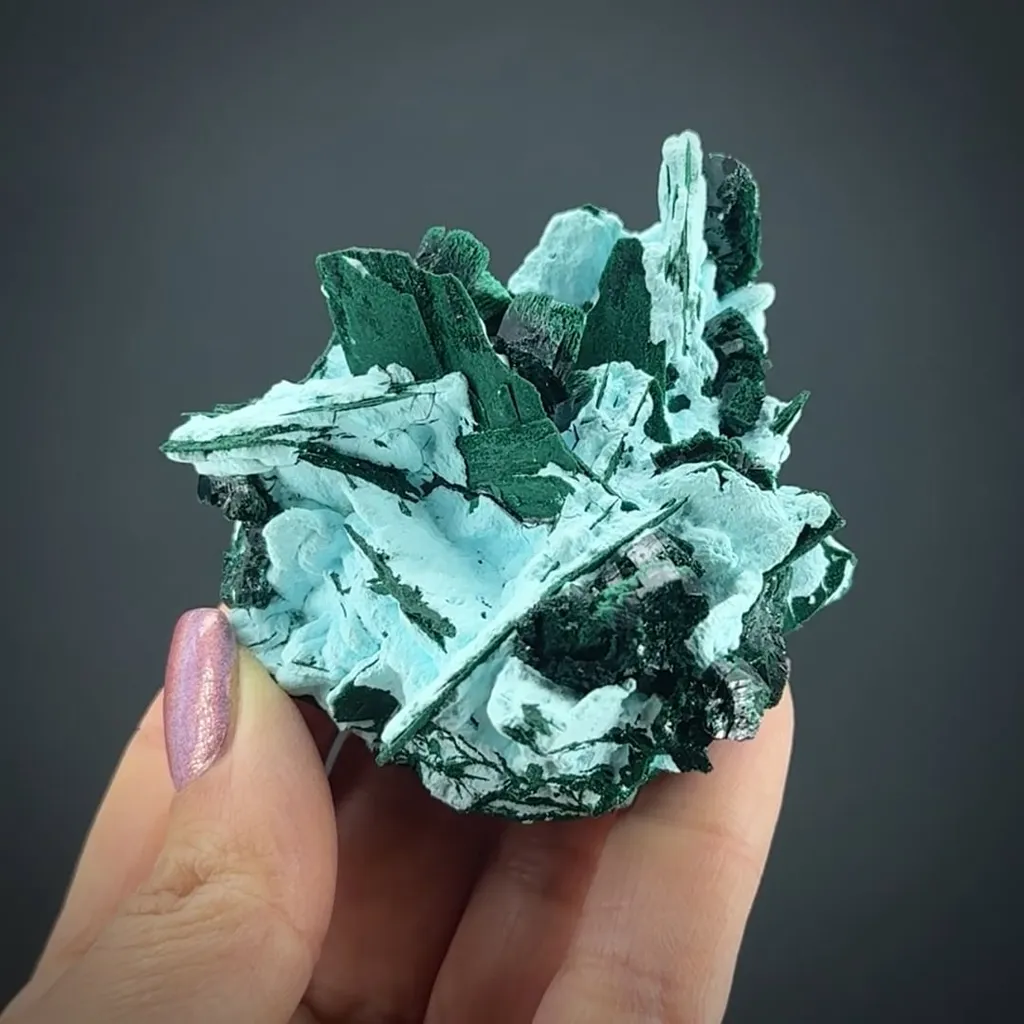
Malachite is found as both primary malachite, meaning that it formed the way you see it as malachite crystals; or as secondary malachite by replacement of a previous mineral, usually another copper species such as azurite or chrysocolla. Here the sharp crystals, in any case, are malachite - but not formed that way originally. Rather, they are replacements (pseudomorphs as we call them) of a previous generation of rhombohedral cobaltian dolomite. Also, these are not only malachite, but a mixture of malachite and kolwezite, according to analysis by our supplier. This specimen also has a few rounded aggregates of malachite and these tufts are simply malachite needles (primary). The malachite, stark and sparkling green, sits atop chrysocolla, which is ALSO a replacement of an earlier mineral species. These were analysed extensively Barcelona dealer Jordi Fabre (shortly before he retired and sold us a large part of his group of them in 2023). It became clear that this was much more interesting! In his own words: New at Sainte-Marie 2023 were specimens that represent, apart from its evident aesthetics and its world novelty, a complete treatise on mineralogy. The complicated sequence of events that produced these specimens is thought to have started with a cobalt-bearing Dolomite (which has since disappeared during the process), followed by successive substitutions in which more copper was added, leaving as a final result Kolwezite-Malachite in pseudomorphic shapes after crystals of the initial cobalt-bearing Dolomite. All of this complexity atop is perched upon a gorgeous carpet of blue: powder blue Chrysocolla pseudomorphs after Baryte, with a stage of Malachite growth, also pseudomorphic after Baryte. The discovery of this morphological and chemical complexity was published in the French magazine Le Règne Minéral (in January 2024).



Comments