Spessartine from Little Three Mine, USA — gem-quality orange garnet on cleavelandite with tourmaline; prized for locality signature and Ramona pegmatite pocket…
Key facts
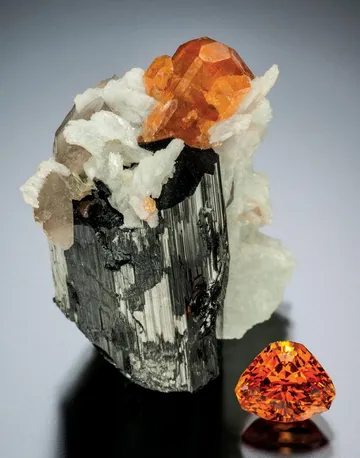
Little Three Mine spessartine is one of the great American pegmatite classics: saturated orange garnet set against white cleavelandite, black schorl, and sometimes smoky quartz. The finest pieces have a look that is immediately recognizable—warm, glowing orange dodecahedral to trapezohedral crystals perched in a graphic, high-contrast San Diego County pegmatite matrix. For collectors, the appeal is not only the color but the entire assemblage: orange spessartine, snowy bladed albite, and jet-black tourmaline in a compact, sculptural pocket specimen.

Photo: Wikimedia Commons
The mine lies in the Ramona pegmatite district of San Diego County, California, within the Peninsular Ranges batholith. The pegmatites are thin, layered pegmatite-aplite dikes intruded into tonalitic and dioritic country rock. Their productive zones are not broad ore bodies but narrow, highly evolved pockets and vuggy, feldspar-rich zones where late fluids concentrated manganese and produced gem-quality spessartine. In the Little Three area, the most celebrated spessartine specimens are tied especially to the Hercules-Spessartine and Spaulding/Swamp dike systems rather than the main topaz-rich Little Three dike itself, a distinction that matters when reading old labels.
Historically, Ramona was the principal world source for fine spessartine for much of the twentieth century. The district’s best production was sporadic, but when the pockets were right they yielded intense orangy yellow to yellowish orange gem rough and some of the most desirable matrix specimens ever found in North America. Estimated facetable production from the district is commonly given as roughly 40,000–50,000 carats, most of it from the Hercules-Spessartine and Spaulding dikes between 1956 and 1994.
What collectors look for is the complete locality signature: a lustrous, transparent to translucent orange garnet, preferably still attached, on cleavelandite with schorl and perhaps smoky quartz. Single loose crystals are desirable, especially if well formed and not over-etched, but the true prize is an unrepaired matrix specimen with the garnet visibly seated in its pocket context. Fine examples are not common; many garnets were corroded in place, damaged during extraction, or cut if they were broken and gemmy enough.
Search for specimens: View all spessartine specimens from Little Three Mine, USA
The Little Three Mine area is in Hatfield Creek valley, about 50 km northeast of metropolitan San Diego and several kilometers east-northeast of Ramona. The mine sits in chaparral country at roughly 580–700 m elevation, where summer heat can be severe and old shallow workings are easily obscured by brush. It is private property; published accounts note that the road access is private and public access is prohibited. Modern ownership has changed from the long Spaulding era, and the Little 3 Mining Company states that the Gregory Family acquired the mine from the Spauldings in 2022.
Geologically, the locality belongs to a northwest-trending belt of Ramona granitic pegmatites roughly 4.5 km long and up to 1.6 km wide. The dikes generally strike northwest and dip gently to moderately west or southwest. The mined pegmatites are thin by world pegmatite standards, commonly less than two meters thick, but they are mineralogically extraordinary. They are layered, with fine-grained aplite below and coarser graphic pegmatite above; the pocket zone occurs near the contact between these units. The aplite contains quartz, sodic plagioclase, K-feldspar, schorl, and almandine-spessartine, while the upper pegmatite is dominated by graphic quartz-perthite intergrowths with schorl, garnet, and muscovite.
Spessartine did not form evenly throughout the mine. The main Little Three dike is famous above all for blue topaz, elbaite, lepidolite, hambergite, boromuscovite, and related pocket minerals. The best spessartine came from adjacent or closely associated spessartine-bearing dikes and claims, especially the Hercules-Spessartine and Spaulding/Swamp systems. This is why labels reading “Little Three Mine” often encompass the broader Little Three property or mine area, including the Hercules pegmatite dike exposed on the property. For specimen documentation, “Little Three Mine area,” “Hercules-Spessartine dike,” “Spessartite mine,” and “Spaulding dike” can all be meaningful rather than interchangeable.
The first pegmatite mining at Ramona began in 1903. The Little Three Mine was discovered in May of that year by H. W. Robb of Escondido and named for Robb and his partners, Dan MacIntosh and Charles F. Schnack, who acquired a 40-acre parcel. The district first attracted attention for tourmaline, topaz, beryl, and other gem pegmatite minerals; near-surface workings at Little Three were considered largely exhausted by 1909. The collapse of the Chinese tourmaline market in 1912 abruptly reduced southern California pegmatite mining, and the district remained comparatively quiet for decades.
The modern spessartine chapter began after Louis Spaulding and Louis Spaulding Jr. established claims in the area in 1947. Intensive mining resumed in the mid-1950s, and the Spaulding family became central to the recovery of Little Three-area gems and mineral specimens. The Spaulding dike was discovered in December 1955 and produced small faceted spessartines at first, then roughly 3,000 carats of faceting rough from 1956 to 1959. Additional production followed in the 1960s and early 1970s, with only a few stones exceeding 6 carats from some early runs.
The Hercules-Spessartine pegmatite has an older and more complex history. The Hercules mine was located in August 1903 on the northwestern part of the dike and yielded a modest early production of spessartine. In the mid-1960s, John Sinkankas and his son worked part of the Hercules. The southern part of the same dike, later called the Spessartite mine, became especially important after Spaulding Jr. expanded an open cut beginning in 1975. This area produced the largest and most memorable Ramona spessartine gems and specimens, including a 72.5 ct piece of rough recovered in August 1987 and cut by Buzz Gray into a 39.63 ct gemstone, the largest cut Ramona spessartine reported in the GIA study.
Most mining was shallow and practical rather than romantic: pegmatite was “peeled” back from exposed hillside dikes using pry bars, small amounts of blasting, and later bulldozer and backhoe work. Once a pocket was encountered, the pace changed. Spessartine-bearing pockets were worked by hand with chisels, ice picks, and wooden sticks, and specimens were cleaned with oxalic acid to remove iron staining. The best specimens were saved; only broken, damaged, or otherwise unsuitable crystals were faceted.
Little Three-area spessartine is manganese-aluminum garnet, Mn3Al2(SiO4)3, but its locality character is more specific than the formula. The best material ranges from light orangy yellow through yellowish orange to deeper brownish orange. The most desirable crystals have a vivid orange glow without becoming too brown or too dark. In cut stones, Ramona material is typically bright orangy yellow to yellowish orange, with few eye-visible inclusions in finer gems.
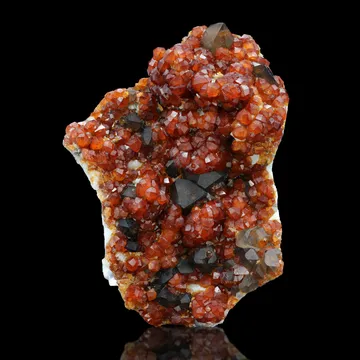
Crystal forms include dodecahedral and trapezohedral faces. On specimens, the crystals may be sharp and lustrous, gently etched, or strongly corroded depending on the pocket environment. Dodecahedral faces can show subtle diamond-shaped growth hillocks; etched crystals may carry countless tiny reflective steps that give a glittering surface. This etched texture is part of the locality’s personality, but it is a double-edged quality factor: mild etching can add sparkle and individuality, while severe corrosion destroys crystal outline, weakens attachment, or reduces the garnet to unusable fragments.
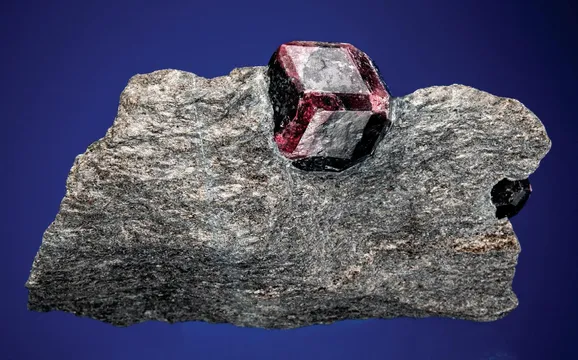
Typical specimen crystals are small, but important examples reach several centimeters. GIA’s study records spessartine crystals from the pockets up to about 3–4 cm, and a Wikimedia-documented small-cabinet specimen shows an approximately one-inch red-orange garnet on albite and schorl. Dealer and auction records commonly show thumbnails and miniatures with crystals from a few millimeters to about 1–2 cm, while matrix specimens with larger, unrepaired crystals are distinctly scarce.
The classic matrix is white cleavelandite, black schorl, and orange spessartine. Smoky quartz may appear on combination specimens, and muscovite is also part of the broader assemblage. The spessartine-bearing pockets and related vuggy feldspar-rich rock may also be associated with quartz, albite, potassium feldspar, schorl, rare pale blue to pink beryl, and rare pink apatite. More specialized mineralogical work on the Little Three pegmatites records foitite, axinite, danburite, muscovite, and rare beryl in the thinner Spessartine and Swamp dikes.
One of the most distinctive host textures is the feldspar-rich, vuggy rock miners called “cottonball spar” or “popcorn rock.” This rock contains small, irregular, corroded cavities and was recognized by miners as a favorable sign for spessartine. In some places, especially in the productive Spessartite open cut, feldspar-rich rock in the center of the pegmatite was altered to a pink clay layer as much as 40 cm thick, with garnets “floating” in it. Farther north along the Hercules part of the same pegmatite, spessartine more commonly formed in pockets with less corrosion, producing cleaner matrix specimens with orange garnet on cleavelandite, schorl, and smoky quartz.
Gemologically, studied Ramona spessartines have refractive indices around 1.799–1.808, with the commercially preferred orangy yellow to yellow-orange stones commonly in the 1.799–1.803 range. Specific gravity values in the GIA study were 4.19–4.26, and the stones were inert to both long-wave and short-wave ultraviolet radiation. Electron microprobe analyses of four representative samples gave spessartine-rich compositions from Sps94.8Alm4.7Gro0.5 to Sps88.8Alm11.0Gro0.2. The color is controlled chiefly by Mn2+ absorption, with Fe2+ contributing the yellow-orange, brownish, and darker modifying tones.
Internal features are useful for gem identification. Studied Ramona spessartines commonly show wavy planes of partially healed fractures, negative crystals, growth patterns, anomalous birefringence, needles or tubes, and linear clouds. Mineral inclusions are relatively rare, but albite and columbite were identified by Raman analysis in the GIA study; possible tiny zircon-like inclusions were also noted but not confirmed in that sample set. Albite inclusions make sense in this locality because the garnet is so often intergrown with cleavelandite.
For specimen quality, the deciding factors are color, transparency, luster, completeness, attachment, and association. A top specimen should show orange spessartine clearly against contrasting matrix, with minimal contact damage and no obvious repair. An etched but complete crystal can be very desirable; a rounded or sugary remnant is less so unless the association is exceptional. Matrix balance matters: a single orange garnet nestled among white cleavelandite blades and black schorl can outrank a larger but isolated and damaged loose crystal.
The main authenticity issue is locality precision. “Little Three Mine” is used broadly in the mineral trade, and spessartine so labeled may actually be from the adjacent Hercules pegmatite dike or the Spessartite portion of the Hercules-Spessartine dike system on the Little Three property. This is not necessarily a fraudulent label; it reflects historical collecting language. For high-end specimens, however, older labels specifying Hercules, Spessartite, Spaulding, or Little Three Mine area are valuable documentation.
The second issue is repair. Fine matrix specimens with large garnets are scarce because many crystals were etched, fractured, or weakened in the pocket. Larger crystals could be so badly corroded that they broke apart or could not be extracted intact. Matrix-bound, unrepaired crystals of notable size are therefore especially prized. Examine the garnet base carefully for adhesive, filled gaps, mismatched luster at the contact, or unnatural positioning on cleavelandite. Repaired specimens can still be collectible, but the repair should be disclosed and priced accordingly.
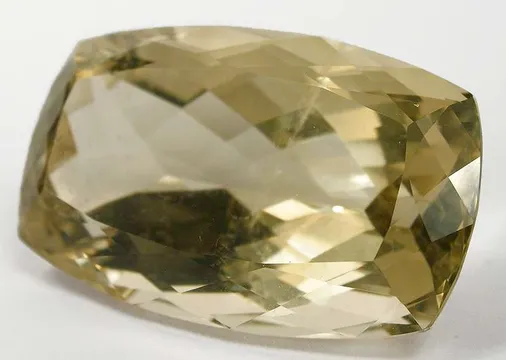
Published gemological work reported no known treatments for natural Ramona spessartine and no known laboratory growth of gem-quality spessartine at the time of that study. For cut stones, the practical concerns are not enhancement but identity and origin: orange grossular, malaya-type garnet, zircon, sphene, topaz, citrine, fire opal, and clinohumite can all overlap visually in the orange gem range, but standard gemological testing separates them readily. For collector specimens, the visual association with cleavelandite and schorl is often strongly diagnostic of the Ramona style, but it is not a substitute for provenance.
Condition issues are common. Expect some etching, surface stepping, internal fractures, and small edge nicks. A slightly etched surface is not automatically damage; it may be natural pocket corrosion and part of the locality aesthetic. What reduces value are crushed edges, broken crystal backs hidden in matrix, repaired attachments, badly dulled surfaces, or crystals reduced to shapeless orange patches. Loose crystals should be assessed all the way around, because a bright display face may conceal a heavily corroded or broken backside.
Fine Little Three-area spessartine is not abundant on the current market. Loose thumbnails and older small specimens appear from time to time, while strong matrix pieces with orange garnet, schorl, and cleavelandite are much harder to acquire. Auction and dealer records show that even modest examples are described as classic and increasingly difficult to find. New ownership and renewed interest at the mine may change availability, but historically significant, older, well-documented specimens from the Spaulding, Sinkankas, Dawson, Fisher/Kureczka, or similar California collections remain especially desirable.
The Little Three story begins with a name that sounds like folklore because part of it became folklore. The formal account credits the May 1903 discovery to H. W. Robb of Escondido, who with Dan MacIntosh and Charles F. Schnack bought a 40-acre parcel from a rancher. A modern mine-history account preserves the more campfire-ready version: three men were looking for a lost cow, found gems on the ground, bought the land, and gave the mine its name. Either way, the early Ramona miners had stumbled into one of the most mineralogically important pegmatite properties in California.
The first boom was brief. By 1909, the near-surface Little Three deposits were considered exhausted. Then, in 1912, the collapse of the Chinese tourmaline market shut down much of southern California pegmatite mining. That single market shock explains why so many San Diego County gem mines show a dramatic early burst and then decades of quiet. At Little Three, the hillside did not give up its best spessartine in that first era; the orange garnet chapter waited for the Spauldings.
Louis Spaulding and Louis Spaulding Jr. re-entered the Ramona story in 1947, and intensive work began in the mid-1950s. Spaulding Jr. eventually became the figure most associated with the district’s later production. The work was intimate, local, and stubborn: shallow open cuts in chaparral hills, exposed pegmatite peeled back from the slope, and pockets finished by hand with small tools after heavy equipment had done its part. In one productive Spessartite open cut, the feldspar-rich center of the pegmatite had altered to a pink clay layer about 40 cm thick. In that clay, Spaulding reported that the garnets were “floating.” It is hard to imagine a more vivid image for a collector: orange garnet crystals suspended in soft pink clay inside a narrow California pegmatite.
John Sinkankas, one of the great names in American gem and mineral literature, also enters the story directly. In 1965–1966, he and his son John William Sinkankas worked part of the Hercules dike. A February 1966 photograph reproduced in the GIA study shows Sinkankas Jr. drilling the pegmatite in preparation for blasting. For collectors who know Sinkankas as an author, that image is a useful corrective: the literature was written by people who knew the sound of steel and the patience required to follow a pocket line.
The largest gem story came in August 1987. Spaulding Jr. recovered a 72.5 ct piece of spessartine rough from the Spessartite mine. Buzz Gray cut it into a 39.63 ct gemstone, later mounted as the center stone of a necklace containing more than 165 carats of Ramona spessartine. That 39.63 ct stone is reported as the largest cut spessartine known from Ramona. For a locality where early Spaulding dike stones were often only 0.5–1.5 ct and where only a few early faceted stones exceeded 6 ct, the 1987 stone is not merely large; it is a statistical outlier with a name-making presence.
In 1993–1994, the Spessartite mine again produced notable stones and specimens. Among the gems from that period was the 27.30 ct cushion-cut spessartine used in “The Light of Ramona,” an objet d’art accented by 62.23 additional carats of Ramona spessartine and 3.81 carats of feldspar. The design echoed garnet’s natural isometric crystal habit and was mounted on a covellite pedestal. It is a distinctly late-twentieth-century mineral-world object: part gem, part sculpture, part homage to a California locality.
The Little Three property also has stories beyond spessartine. In 1976, Spaulding hit the New Spaulding Pocket in the Main dike, a nearly flat pocket about 3 x 3 m and 0.5 m high. In 1991, David London was following a line of small miarolitic pockets along a steep roll in the Main dike. Probing with a screwdriver into shattered pegmatite exactly 90 degrees off the pocket trend, he dug only 20 cm east and broke into what Spaulding named the 1991 London Pocket. That pocket measured about 4 m long, 3 m wide, and 1 m high at its widest vertical dimension. Within the first hour of mining, it yielded microcline crystals to 27 kg, flawless smoky quartz crystals to 9 kg, decimeter-sized dark green tourmaline, centimeter-scale topaz, extraordinary lepidolite clusters, and clear cleavage fragments of hambergite. This was not the spessartine dike, but it shows why the Little Three property became a laboratory as much as a mine.
That scientific dimension is one of the locality’s quiet virtues. Gene Foord loved the Little Three pegmatites, in part because Louis Spaulding Jr. welcomed scientists and helped them collect material and information. The property became a test case for how thin, layered pegmatite-aplite dikes crystallize, how pockets form, and why one dike produces topaz and elbaite while another, nearby, produces orange spessartine. The best specimens are therefore not just beautiful; they are small, portable records of one of the most studied pegmatite systems in North America.