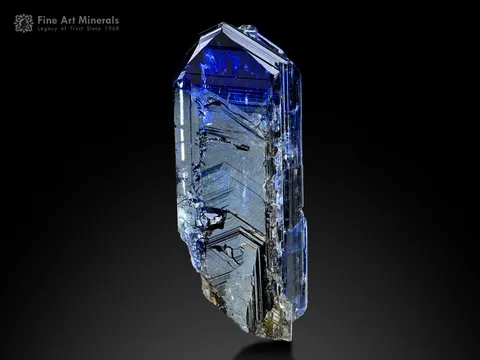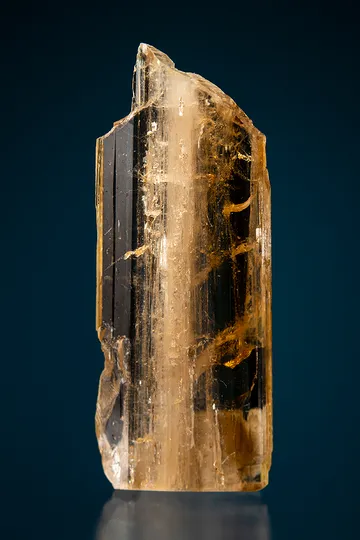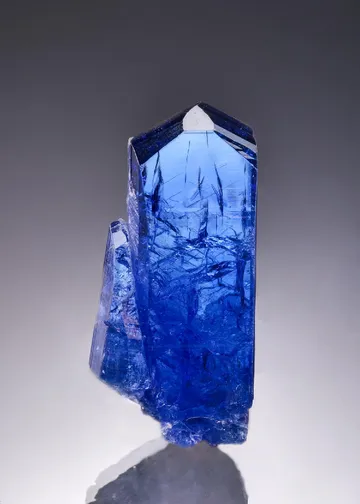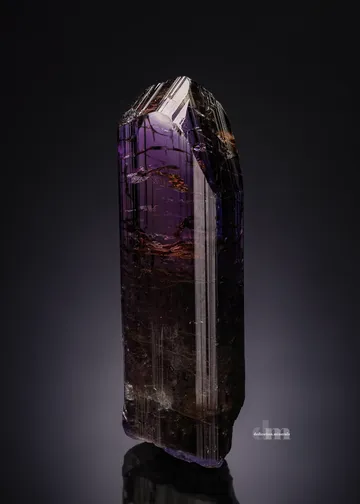
Merelani Hills, Tanzania: Diopside prized for lime-green crystals, glassy clarity, and specimen contrast with graphite; a standout locality for collectors.
Key facts
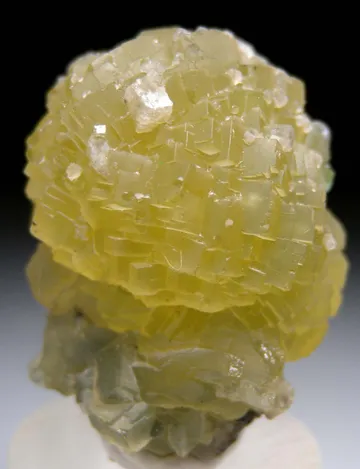
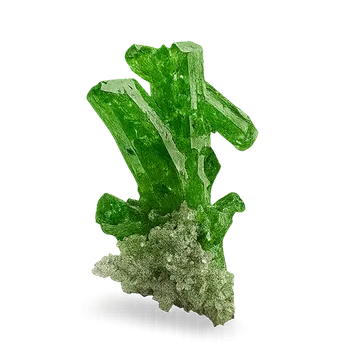
Diopside from the Merelani Hills is the green counterpoint to tanzanite: a sharp, glassy, often lime-to-mint-green pyroxene born in the same graphite-rich gem system that made this corner of northern Tanzania legendary. The finest crystals have an electric freshness that is quite different from the darker, forest-green chrome diopside familiar from Russia and Pakistan. Merelani pieces are frequently lighter, brighter, and more “lit from within,” with yellowish green, mint green, lime green, and chrome-green tones that show especially well when a transparent prism is perched on dull black graphite.

Photo: Wikimedia Commons
The locality’s diopside is collectible because it is not merely a by-product of the tanzanite trade. Merelani has produced specimen-grade diopside with its own visual identity: stout, terminated prismatic crystals; delicate clusters; transparent to translucent gem crystals; and crystals set against graphite, calcite, quartz, tanzanite, tsavorite, tremolite, fluorapatite, prehnite, mesolite, and rare sulfides. In the best pieces the contrast is immediate: bright green silicate on black, metallic graphite, sometimes with the same visual drama that made Merelani tanzanite-on-graphite specimens so coveted.
Geologically, Merelani sits in the Lelatema Mountains in the Mozambique Belt, a deeply metamorphosed Pan-African terrain of graphitic gneisses, calc-silicate rocks, marbles, and complex shear-zone mineralization. The gem pockets are tied to boudinaged pegmatitic veins and hydrothermal fracture fillings cutting brecciated, altered, graphite-bearing gneiss. Diopside is not an accidental accessory here; it belongs to the calc-silicate and hydrothermal assemblage that also hosts vanadium-bearing zoisite, green grossular, graphite, quartz, calcite, tremolite, fluorapatite, and an extraordinary suite of sulfides.
Historically, the collector fame of Merelani diopside gathered force after the early tanzanite decades. Tanzanite had been known from the late 1960s, but serious mineral collectors later realized that the same mine blocks were yielding world-class specimens of species other than zoisite. By the 2000s, gem-quality yellowish green diopside and tremolite from Block D had been examined by GIA, and the December 2007 Karo mine occurrence in Block D brought diopside, graphite, fluorapatite, and associated minerals into the mineralogical literature under the apt phrase “Miracle at Merelani.”
For collectors, the ideal Merelani diopside combines bright color, high luster, intact terminations, visible transparency, and locality-typical associations. A thumbnail may be a single vivid, glassy prism; a miniature may show several diopside crystals rising from graphite; a more advanced cabinet piece may combine diopside with tanzanite, tsavorite, prehnite, or unusual graphite. The best specimens feel unmistakably Merelani: green crystals in a black graphite world.
Search for specimens: View all diopside specimens from Merelani Hills, Tanzania
The Merelani Hills, also spelled Mererani or Mirerani in older and trade usage, lie in the Lelatema Mountains of northern Tanzania, in present-day Simanjiro District, Manyara Region. Older literature commonly places the locality in Arusha Region, reflecting earlier administrative geography and the trade’s long-standing habit of routing Merelani production through Arusha. The mining area is subdivided into the famous A, B, C, and D Blocks, along with named workings such as the D-Block Mine, Samax Mine, Karo mine, Machakecho workings, and Mawaya pit.
The deposit is best understood as a graphite-rich metamorphic and hydrothermal gem system rather than a simple single-vein occurrence. The host rocks are late Proterozoic metasedimentary rocks within the Mozambique Belt, including graphite-bearing gneisses, calc-silicate rocks, crystalline carbonates, quartz-feldspar units, and pegmatitic to hydrothermal veins. Gem-quality tanzanite and green grossular occur mainly in boudinaged pegmatitic veins and hydrothermal fracture fillings. Those fracture fillings pass through brecciated and hydrothermally altered graphite-bearing gneiss and contain a locality-defining association of glass-clear quartz, diopside, zoisite, graphite, and calcite.
Diopside is especially natural in this setting. Calcium and magnesium are abundant in calc-silicate and carbonate-rich rocks, while chromium and vanadium were mobilized in the graphitic metasedimentary sequence and fixed in several green minerals. At Merelani, that chemistry produced not only green diopside but also tsavorite, mint grossular, vanadian tremolite, vanadian phlogopite, karelianite, and vanadium-bearing zoisite. The same system also produced unusually well-crystallized graphite and a remarkable suite of sulfides, including alabandite, wurtzite, pyrite, clausthalite, germanocolusite, merelaniite, and richardsite.
Mining began as shallow and surface-oriented recovery after the discovery of tanzanite in the 1960s, then moved into pits and underground workings as the surface material was exhausted. By the late twentieth century the area had developed into a dense patchwork of formal and artisanal operations. Block C became the better-known mechanized sector through Graphtan, Afgem, and TanzaniteOne, while Blocks B and D remained famous for smaller-scale, more hazardous artisanal workings. Many of the finest collector specimens of diopside, tanzanite, graphite, tremolite, and associated minerals are tied to these actively mined tanzanite blocks rather than to open collecting ground.
Access is not casual. Merelani is an active gem-mining district with mining rights, security controls, government oversight, and serious underground hazards. The mines are not recreational collecting sites. The narrow shafts, deep workings, graphite dust, blasting, unstable ladders, lack of ventilation in some artisanal workings, and the density of claim boundaries make unauthorized visits dangerous and inappropriate. Collector specimens reach the market through miners, local dealers, Arusha gem channels, international dealers, and mineral-show networks rather than through field collecting by visiting collectors.
Important production moments for diopside include the 2005 Block D yellowish green material examined by GIA, additional gem-quality pieces obtained in 2007, and the late-2007 Karo mine occurrence that became famous for graphite, diopside, fluorapatite, and associated minerals. Dealer records and published specimen descriptions also point to notable high-quality chrome-green diopside appearing around 2007, including clusters attributed to the Samax Mine and crystals from the Karo/Block D production. More recent small finds continue to appear, but the supply is intermittent and strongly dependent on tanzanite mining rather than on targeted diopside extraction.
Merelani diopside is a monoclinic pyroxene, CaMgSi2O6, commonly reported from the locality both as ordinary diopside and as chromium-bearing diopside, Ca(Mg,Cr)Si2O6. The most desirable crystals are prismatic and glassy, with stout to elongate forms and clean terminations. One useful field distinction noted in the GIA study is that Merelani diopside tends to show a blockier pyroxene cross-section, whereas visually similar tremolite from the same Block D production can be flatter and more diamond-shaped in cross-section.
Color is the great attraction. Merelani crystals range from pale green and yellowish green through mint, lime, apple green, and richer chrome green. Some are light enough to read almost like peridot or mint grossular; others are darker, more saturated, and closer to classic chrome diopside. GIA’s work on Block D yellowish green samples found that the diopside and associated tremolite owed their color to trace V3+, Cr3+, or both. That vanadium-chromium signature fits the broader Merelani suite, where trace-element coloration also defines tanzanite and tsavorite.
Crystal sizes vary widely, but most collector pieces are small. Fine thumbnail crystals around 1–2 cm are commoner than larger display pieces. A GIA-described Block D diopside crystal was 1.6 cm tall, and cut stones studied from the same material included a 3.39 ct faceted diopside. Dealer and museum-style specimen records show single crystals and clusters in the 2–4 cm range, with exceptional miniatures and small cabinet specimens reaching 5–6 cm across as clusters. Larger transparent, well-terminated, undamaged crystals are much scarcer than small broken gem fragments.
The most characteristic association is graphite. Merelani graphite can occur as platy, metallic, silvery-black crystals and masses, making a dramatic matrix for green diopside. Good specimens may show diopside rooted into graphite plates or dark graphitic gneiss, and the contrast is one of the signature aesthetics of the locality. Calcite and quartz are also common partners. Tanzanite associations are especially desirable because they unite Merelani’s headline species with one of its most attractive secondary species. Tsavorite and diopside together are less common but highly appealing when both colors and crystal forms are distinct.
Tremolite is the most important look-alike and associate. The yellowish green tremolite from Merelani can be so similar in color to diopside that parcels have contained both, and miners or dealers may not separate them unless the crystal habit or analytical data makes the distinction clear. Green grossular, especially mint grossular and tsavorite, can also be confused with diopside in loose crystals or damaged fragments, but garnet lacks diopside’s cleavage and has a different optical character.
One particularly advanced collector feature is merelaniite inclusion. GIA’s 2019 Micro-World report documented gem-quality yellow-green prismatic diopside crystals from Merelani containing dense inclusions of fine merelaniite whiskers. Seven crystals reportedly mined in 2018 ranged from roughly 1 to 5 cm long, and the longest merelaniite whiskers in the largest diopside reached up to 2 cm. Some of those diopside crystals were also associated with graphite, white radiating acicular mesolite, and one transparent blue fluorapatite crystal. Such included pieces are not merely attractive; they are mineralogical micro-world specimens from the type-locality environment of merelaniite.
Quality in Merelani diopside is judged by color first, then crystal integrity, transparency, luster, association, and overall composition. The best crystals are bright and lively rather than muddy, terminated rather than cleaved off, and transparent enough to flash green through the body. Matrix pieces gain value when the graphite is sculptural and stable, not merely a black smear. Associations with tanzanite, tsavorite, fluorapatite, mesolite, prehnite, or well-formed graphite can lift a specimen from “good Merelani diopside” to a true locality piece.
The chief authenticity issue is not a flood of documented fake Merelani diopside; it is misidentification. Published gemological work has shown that yellowish green diopside and yellowish green tremolite from Block D can be nearly identical in color. Blocky pyroxene habit favors diopside, while a flatter, diamond-shaped amphibole cross-section favors tremolite, but visual identification alone is not always enough for loose crystals or broken pieces. Raman spectroscopy, refractive index, specific gravity, and crystal habit are the most reliable ways to separate them.
Confusion with tsavorite and mint grossular is also possible in the trade, especially for isolated green fragments. Diopside has two good cleavages and lower hardness, while grossular garnet is isometric and lacks cleavage. A loose, gemmy green crystal sold as “tsavorite” but showing prismatic pyroxene habit, obvious cleavage, and Merelani-style graphite contact should be viewed carefully. Conversely, a fine green garnet crystal should not be downgraded to diopside simply because both species occur at Merelani.
Treatments are not a major collector issue for Merelani diopside specimens. The green color documented in the scientific literature is natural trace-element color from vanadium and chromium. Faceted chrome diopside in general is rarely treated, and the specimen market values natural crystals, not enhanced material. The more practical concerns are repair, trimming, glued matrix, mislabeled associated species, and over-optimistic use of “chrome” for any green diopside regardless of analytical evidence.
Condition matters intensely because diopside is not a tough mineral. Its Mohs hardness of about 5.5–6.5 and its pyroxene cleavage mean that sharp crystals chip and cleave more readily than garnet or quartz. Look closely at terminations, prism edges, and basal contacts. Many Merelani crystals were recovered during tanzanite mining rather than gentle specimen mining, so contacted ends, internal fractures, edge bruising, and cleaved backs are common. A complete, lustrous, well-terminated crystal with minimal abrasion is much better than a brighter but heavily damaged piece.
Graphite matrix creates its own handling issues. Merelani graphite can be soft, greasy, and prone to rubbing off on fingers or labels. It can also conceal contacts, repairs, or small breaks. Handle specimens by the matrix or base when possible, avoid repeated wiping, and display them where the graphite will not be scraped by acrylic stands. Bright diopside on graphite should be protected from vibration and crowded drawers; the green crystals often project from a softer black base.
Availability is intermittent. Small loose crystals, thumbnails, and modest miniatures appear regularly enough that Merelani diopside is obtainable, but top pieces are not common. The finest 2005–2007-style gemmy green crystals, diopside-on-graphite miniatures, and mixed-species specimens with tanzanite or tsavorite are substantially scarcer. Recent dealer listings show small crystals at accessible prices, while exceptional clusters, large sharp crystals, or specimens with important associations move into serious collector territory quickly.
For a serious collection, prioritize a specimen that says “Merelani” before it says merely “green diopside.” The ideal piece should show one or more of the following: vivid mint-to-lime color, well-formed prismatic habit, graphite matrix, locality associations, or a documented Block D/Karo/Samax provenance. A small, honest, undamaged 1.5 cm crystal on graphite can be more desirable than a larger cleaved fragment with no context.
The first great Merelani story is not about diopside but about the stage on which Merelani diopside would later appear. In January 1967, Jumanne Ngoma was walking through the bush near Kiteto on his way to visit relatives when he noticed blue crystals on the ground. The stones were beautiful, transparent in places, and so unfamiliar that the first buyers he approached did not know what they were. Ngoma later recalled collecting about 5 kg of the material in only a few hours. Encouraged to try the larger gem market in Nairobi, he borrowed money for the bus, showed the parcel to an overseas gem company, and left the 5 kg in exchange for a return ticket worth $5. Decades later, he was still waiting for the answer they had promised him. That parcel was tanzanite; the graphite-rich mine world that grew from it would eventually yield the green diopside specimens collectors now prize.
By 2007, Merelani’s Block D had become a very different world: a maze of shafts, claims, razor wire, graphite dust, and miners chasing gem pockets far below the surface. During an October visit described by Vincent Pardieu, Richard W. Hughes, and companions, the party reached the Kikuyu Mine in Block D, where Nixon Monga, only 24 years old, was managing the mine after his father’s death nine years earlier. In that small compound, sixty miners worked underground in teams of thirty, in six-hour shifts. Monga told the visitors that hardly any stones had been found for two years, even as the tunnels drove deeper.
The descent began with a vertical drop of about 100 meters down a wooden ladder. After that came 200–300 meters of cramped tunnels to the active face. Some passages were no more than a meter high, too low even for crawling on hands and knees; the visitors had to move on their bellies through hot, graphite-laden air. Masks became useless because breathing through them was harder than breathing the dust. At one point, a hole carried cold air from the surface into the workings, and the relief of that air after an hour underground was memorable enough to become the emotional center of the account.
At the face, miners pointed to veins they were following by pyrite and graphite. The visitors saw the logic of Merelani mining stripped bare: hope, danger, and the possibility of a pocket. Hours later, when the party climbed back toward the surface, the ladder became a test of exhaustion. Above ground, miners emerged black with graphite, collapsed, drank water, and prepared to return. One image from that day belongs in every collector’s mind: a graphite-coated miner in Block D sparkling in the sun, his only reward for six hours underground a small fragment of pale green diopside.
A later field visit in 2023 shows how controlled and guarded Merelani had become. Steve Moriarty described driving from Arusha toward Mererani with Suni Marasheki, passing from greener country into semi-arid grassland and then approaching the wall surrounding the tanzanite mining area. Filming was not allowed at the government entrance. Once through, the visitors were escorted by a military minder who climbed into the back seat. In D-Block, each claim had its own walls, and the stories of underground trespass had not disappeared: tunnels could snake into a neighboring claim without the surface boundaries meaning much below.
At Suni’s Natonya Camp, the visitors saw the air-pump generator, miners’ sleeping quarters, the current entrance, and the old original entrance with its steep wooden ladder. Around that old entrance grew a thorny natural defense Suni called “wait a little bit.” The meaning became clear only when someone got caught in it: stop, wait, and untangle yourself from the thorns. The mine itself was said to reach 500–600 meters, just under 2,000 feet. Underground, the visitors saw a pulley system used to pull bags of dirt to the surface, blast holes from earlier work, and the indicator minerals miners use as signs in the rock. The visit ended with the universal Merelani lesson: a few minutes underground can feel adventurous to a visitor, but for the miners it is daily labor.