Diamantina, Brazil — famed alluvial diamonds from Proterozoic conglomerates; rounded octahedra to rhombododecahedra and historic subdistricts that collectors s…
Key facts
Diamantina is one of the great old names in diamond collecting: a Minas Gerais district where diamonds were not merely mined, but helped build a town, a colonial bureaucracy, and a long-running geological argument. The best collector specimens are small in absolute size but large in character—rounded or modified octahedral to rhombododecahedral crystals, often waterworn just enough to show their journey, and occasionally still seated in rusty, quartz-pebble conglomerate. That last form, diamond on or in conglomerate, is the locality’s most specimen-worthy expression: the contrast of adamantine faces against iron-stained gravel is far more evocative than a loose parcel stone.

Photo: Wikimedia Commons / Géry Parent
The locality sits in the southern Serra do Espinhaço, a quartzite-and-schist upland whose diamond occurrences are tied to Proterozoic conglomerates and metabreccias of the Espinhaço succession, then repeatedly reworked into lateritic, colluvial, terrace, and modern stream deposits. That is the essential collecting point: Diamantina diamonds are famous alluvial and paleoplacer survivors. Many crystals have been through more than one sedimentary cycle, and their rounded dodecahedral forms, edge wear, iron staining, small chips, and surface etching are not defects so much as part of the locality signature.
The geology is unusually rich for a specimen label. Around Diamantina, diamond-bearing Lower to Middle Proterozoic conglomerates occur along roughly north-south structural lineaments west and southeast of town. The western belt includes the long Quartéis–São João da Chapada–Datas trend; the eastern belt includes workings around Extração and Milho Verde. Classic subdistrict names such as Sopa, Guinda, São João da Chapada, Datas, Campo Sampaio, and Extração matter, because they point to different parts of the same broad mineral province and to subtly different diamond populations and host rocks.
The historical weight is just as important. The settlement first known as Arraial do Tijuco grew in the early 18th century, and by the 1720s diamonds from the region were important enough that the Portuguese Crown built a special administrative world around them. For more than a century, Diamantina and the wider Serro Frio diamond district were among the most consequential diamond-producing areas on earth, bridging the era between the old Indian sources and the later South African fields. The town’s preserved colonial center is now a UNESCO World Heritage site, but the reason collectors care is more tactile: a genuine Diamantina diamond is a mineral specimen with geology, colonial history, and a long garimpo tradition compressed into a few millimeters of carbon.

For serious collectors, the most desirable pieces fall into three groups. First are sharp to only lightly worn crystals with recognizable octahedral, dodecahedral, or transitional morphology. Second are attractive loose rough diamonds with honest surfaces—trigons, ruts, frosting, brown or greenish skin, and natural wear but no suspicious polishing. Third, and scarcest, are matrix specimens: diamond naturally preserved in ferruginous conglomerate or quartz-pebble cement. The third category is the one that demands the most caution, because the value difference between a loose diamond and a diamond convincingly preserved in matrix has always tempted artificial assembly.
Search for specimens: View all diamond specimens from Diamantina, Brazil
Diamantina lies in central Minas Gerais in the southern Serra do Espinhaço, at high elevation in a landscape dominated by quartzites, metasedimentary rocks, iron-stained gravels, and deeply weathered uplands. The diamond occurrences belong to the Southern Espinhaço diamond province rather than to an obvious, preserved kimberlite pipe in the simple South African sense. The collectible diamonds come from a family of deposits: Proterozoic diamond-bearing conglomerates and metabreccias, Cretaceous to Paleogene lateritic surfaces, Pleistocene colluvial deposits, terrace gravels, and active or recent alluvium.
The famous Sopa-Brumadinho Formation is central to the locality’s mineralogical identity. Around Sopa, Guinda, São João da Chapada, Campo Sampaio, Datas, and nearby districts, diamond-bearing rudites include metaconglomerates and quartzitic breccias that have been interpreted in different ways over the last century. One school emphasizes a more distal source, with diamonds ultimately derived from cratonic mantle rocks to the west and delivered into the Espinhaço basin as sedimentary cargo. Another emphasizes proximal sources, especially the volcanic-breccia character of some Campo Sampaio material and the concentration of larger stones in districts such as Extração and São João da Chapada. The collector does not need to choose a side to appreciate the specimens, but the debate explains why labels such as “Sopa,” “Guinda,” “São João da Chapada,” “Extração,” and “Diamantina district” are not interchangeable trivia; they carry geological meaning.
The surface deposits are equally important. Lateritic diamond deposits in the region are associated with high, old planation surfaces, while colluvial deposits—also at similar elevations—formed through different and much younger processes. In practice, this means that a diamond sold simply as “Diamantina” may have come from old conglomerate, from a lateritic mantle, from slope wash, or from stream gravel that has reconcentrated older sources. This is one reason exact mine provenance is often difficult to reconstruct for older parcels and estate specimens.
Mining history begins in the early 18th century, when the settlement of Arraial do Tijuco developed in what became the diamond district. Diamonds were being found around the region by about 1720, and the Portuguese Crown officially recognized and intervened in the deposits in 1729–1730. A special diamond administration followed: the Demarcação Diamantina, the Intendência dos Diamantes, private contract periods, and later the Real Extração dos Diamantes. The Crown’s concern was not academic. Brazilian diamonds were abundant enough to depress prices in Europe, and colonial authorities repeatedly tried to control production, smuggling, and trade.
The administrative history shaped the town. Tijuco remained closely tied to Crown control, became a vila only after Brazilian independence, and later took the name Diamantina. The preserved urban center—the narrow streets, stone paving, whitewashed and brightly trimmed houses, churches, and diamond-era buildings—survives in part because the mining economy declined after richer South African diamond deposits transformed the world market in the 19th century. That decline is a loss for production history but a gift for cultural history: Diamantina’s colonial fabric was not erased by later boomtown rebuilding.
Collecting access today should be treated as highly restricted. The classic diamond areas include private lands, old garimpo workings, regulated mineral rights, protected cultural landscapes, and potentially active or abandoned mining ground. Brazil’s mineral resources are subject to federal regulation, and diamond extraction or commercial recovery is not the same thing as casual rockhounding. For collectors outside the region, the practical route is the specimen market: old collections, reputable Brazilian dealers, estate parcels, and well-documented specimens with labels that record the district or subdistrict as precisely as possible.
Notable finds from the wider Southern Espinhaço province include rare large stones, with historical and oral-record studies documenting a few gems over 100 carats. In the Diamantina municipality, the districts of Extração and São João da Chapada–Campo Sampaio are especially important in discussions of larger stones and possible proximal sources. Such diamonds are not typical collector pieces. The usual collectible Diamantina crystal is small, and that smallness is part of the locality’s pattern rather than a sign of inferiority.
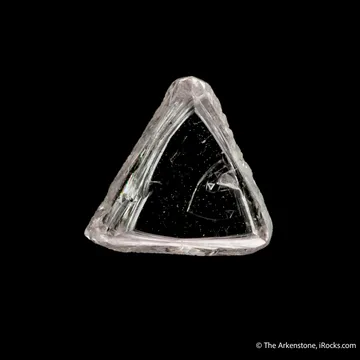
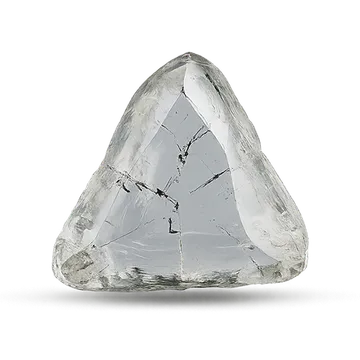
Diamantina diamonds are most often appreciated as natural rough crystals rather than as cut gems. The classic habits are rhombododecahedral, octahedral, and transitional forms between the two. Many are rounded or “resorbed,” with softened edges and curved faces; others preserve clearer octahedral geometry. Surface features can include trigons, frosting, iron staining, small percussion marks, ruts, and chips from sedimentary transport. In the old literature, such surface marks were sometimes treated simply as damage; for locality collectors, they are among the most useful clues that a stone has lived in the Espinhaço sedimentary system.
Representative studies of Espinhaço diamond populations found that large crystals over 1 carat are rare, forming less than 1% of sampled individuals; intact crystals predominate strongly; rhombododecahedral, octahedral, and transitional habits dominate; polycrystalline aggregates are nearly absent; obvious macroinclusions are uncommon; and gem-quality stones form a high proportion of the population. That combination—small, commonly intact, often gemmy, and morphologically recognizable—is the essence of the Diamantina collector aesthetic.
Color ranges from colorless and grayish to pale yellow, champagne, brown, and smoky tones. Greenish skins or stains are possible in Minas Gerais diamondiferous sedimentary deposits, and collectors should distinguish a natural green radiation skin or surface stain from the body color of the diamond. Many Diamantina stones are not dramatic “fancy color” diamonds in the jewelry sense; their beauty is subtler, coming from luster, form, and geological texture.
The most desirable crystal surfaces are natural and readable. A good Diamantina diamond may show smooth rounded dodecahedral faces, triangular octahedral remnants, frosted or etched areas, or small natural pits. Excessively bright, polished-looking surfaces on a supposed rough specimen deserve scrutiny unless the piece is explicitly sold as polished or partially polished. Likewise, a perfectly clean, sharp, colorless loose octahedron with no convincing old label is not automatically wrong, but it does not carry the same locality confidence as a specimen with documented Diamantina provenance.
Matrix specimens are the great prize and the great problem. Natural examples show diamond embedded in or emerging from iron-stained conglomerate, commonly with rounded quartz pebbles and ferruginous cement. The matrix may be rusty brown to ocher, and the diamond may be only a few millimeters across. A good matrix piece should look geologically integrated: the crystal should sit in a natural pocket or be partly enclosed, with no halo of modern adhesive, no suspiciously neat drilled seat, and no mismatch between the diamond and the surrounding cement.
Associated minerals and regional companions include quartz, hematite, goethite, rutile, anatase, brookite, magnetite, zircon, monazite-(Ce), xenotime-(Y), and native gold, with other recorded Diamantina minerals including chrysoberyl, corundum, kyanite, lazulite, tourmaline-group minerals, plumbogummite, gorceixite, and pyrite. Not every listed mineral is a direct paragenetic companion of diamond; many belong to the broader Diamantina mineral district. For diamond collectors, the most relevant associations are ferruginous quartz-pebble conglomerate, iron oxides, resistant heavy minerals, and the suite of minerals concentrated in old gravels.
Quality factors for Diamantina specimens are different from faceted-diamond grading. The most important are provenance, natural crystal form, surface integrity, size, color appeal, and, if present, matrix credibility. A small crystal in unquestionably natural conglomerate can be far more important as a mineral specimen than a larger loose rough stone with no paper trail. Old labels from respected Brazilian dealers or established collections add real value. So do sublocality names: Sopa, Guinda, São João da Chapada, Extração, Datas, and Campo Sampaio are more informative than a bare “Brazil.”
The chief authenticity issue is not whether the carbon is diamond—thermal testers, Raman spectroscopy, and experienced gemological examination can answer that—but whether the diamond genuinely comes from Diamantina, and whether a matrix specimen is naturally in matrix. Brazilian diamonds in conglomerate have been debated for years in collector circles because at least some suspect pieces appear to have loose diamonds added to iron-rich conglomerate using glue or artificial cement. A believable Diamantina matrix specimen must therefore be judged as a rock specimen, not merely as a diamond.
For matrix pieces, inspect the contact under magnification. Look for continuous natural cement around the diamond, sediment grains pressed naturally against the crystal, iron staining that continues across the contact, and a seating relationship that makes geological sense. Red flags include a diamond perched on top of the matrix with no enclosure, a glossy or elastic-looking halo, granular material that softens in water, suspicious fluorescence from the contact zone, or an overly convenient diamond set in the most displayable spot on an otherwise ordinary pebble conglomerate. Ultraviolet light and acetone tests are not definitive; some adhesives do not fluoresce strongly or react as expected. For expensive pieces, non-destructive imaging, Raman confirmation of the diamond, and expert examination of the matrix contact are worthwhile.
Loose rough has a different problem: provenance dilution. Diamonds from many Brazilian fields have circulated through cutting, buying, and export networks, and old parcels may be labeled “Minas Gerais,” “Diamantina,” or “Brazil” with varying precision. A loose rough crystal should be bought for its intrinsic mineralogical appeal unless the locality chain is unusually strong. If a seller claims a specific subdistrict, ask what supports that claim: old label, collection history, mine source, or simply dealer tradition.
Treatments are less central for rough mineral specimens than for faceted stones, but they still matter. Irradiation can produce or alter green color in diamond, and green radiation stains on rough diamonds are a known gemological issue. A natural-looking green skin on an old Diamantina crystal should not be automatically dismissed, but it should not be priced as an extraordinary natural-color diamond without laboratory support. Likewise, cleaning, acid treatment of matrix, oiling of fractures, or polishing of a crystal face should be disclosed.
Condition issues are usually part of the story. Small edge chips, abraded corners, frosted faces, and transport marks are common on alluvial diamonds from the district. The distinction is between natural sedimentary wear and recent handling damage. Fresh chips tend to be bright and visually disruptive; old wear is usually softened, stained, or integrated into the crystal surface. On matrix pieces, the conglomerate itself may be fragile, and iron-rich cement can shed grains if mishandled. Avoid aggressive cleaning, soaking, ultrasonic treatment, or acids unless a qualified preparator has evaluated the specimen.
Rarity is strongly format-dependent. Small loose Diamantina diamonds are obtainable, though exact provenance varies. Attractive, well-formed loose crystals with old labels are scarcer. True diamond-in-conglomerate specimens from the Diamantina district are genuinely rare and should be approached with both enthusiasm and skepticism. The best ones are mineral specimens first and diamonds second: they preserve the physical relationship between crystal and deposit, which is exactly what most loose rough has lost.
Long before Diamantina became a UNESCO town of churches, steep streets, and evening music, it was Arraial do Tijuco: a settlement tied to water, gravel, and secrecy. The town grew on a hill in the southern Espinhaço Chain, near streams where diamond washing once took place. The land itself explains the story. Quartzite and schist gave the region its hard, colorful, poor-soiled mountains, while the same geological architecture fed the gravels that made people rich, fearful, and watched.
The first dramatic moment belongs to the 1720s. Diamonds were found in large quantities on slopes and along rivers, especially around the Tijuco stream, a small tributary in the region. The best deposits were rich enough that the Portuguese Crown could not ignore them. In 1731 the Crown recognized the wealth officially and began enclosing it administratively; in 1734 the Intendência dos Diamantes was created, with its headquarters in Tijuco. The district became a colony within the colony, a place where the state tried to measure, tax, license, and restrain the flow of small transparent stones that could disappear in a hand, a sleeve, or a mouth.
The Crown’s anxiety had a market reason. Brazilian production was abundant enough to push down the international price of diamonds. Authorities responded with controls: demarcation, prohibition, capitation taxes, contract systems, inspection, and later direct royal extraction. In 1734 diamond mining was prohibited for a time as officials tried to curb disordered production. In 1740 the contract system began, placing mining in private hands while preserving Crown revenue. In 1771 the system changed again, with the Real Extração dos Diamantes and a more centralized royal monopoly. The regulations did not merely govern mines; they governed movement, commerce, shops, enslaved labor, and the everyday logistics of life in the diamond country.
One of the most vivid controls was the “livro da capa verde,” the green-covered rule book of 1771. Its provisions tightened entry into the demarcated lands, regulated residents and enslaved workers, reduced the number of shops suspected of helping diamonds vanish, and even targeted itinerant commerce by “negras de tabuleiros,” Black women vendors whose trays moved through the same streets and social spaces as rumor, food, money, and contraband. For the collector holding a tiny Diamantina crystal today, it is worth remembering that these stones once generated paperwork, patrols, monopolies, punishment, and elaborate suspicion.
The town’s fabric still carries that world. UNESCO’s evaluation describes Diamantina as an oasis in rocky mountains, a town whose streets adapted to difficult topography rather than imposing a rigid plan. The roads were paved with large flat gray flagstones known as capistranas, introduced in 1877 and named for João Capistrano Bandeira de Melo. The architecture is sober but distinct: white facades with bright trim, narrow deep houses, wooden decorative elements, and churches often with a single side bell tower. Cut stone, so prominent in some other colonial mining towns, is mostly absent except in foundations. The result is a diamond town that does not look like Ouro Preto. It is less gilded, more severe, and in some ways more completely tied to the hard ground beneath it.
Diamantina’s history also has human legends, and the best known is Chica da Silva. She lived in 18th-century Tijuco and became associated with João Fernandes de Oliveira, one of the great diamond contractors. Later memory turned her into myth: a freed woman navigating, and in some tellings overturning, the racial and social hierarchies of a diamond town under Crown control. The factual Chica is more complex than the legend, but the setting is inseparable from diamonds. Her story belongs to a place where the richest men were contractors, where status could be won or performed through access to diamond wealth, and where the official economy depended on enslaved labor while constantly fearing the unrecorded movement of stones.
Another story is geological and much older. For nearly two centuries, geologists argued over where the Espinhaço diamonds actually came from. The diamonds were found in conglomerates, colluvium, laterite, and river gravels, but the primary source rock was elusive. Some researchers looked to hematitic phyllites; others argued for hidden or eroded kimberlitic or lamproitic rocks; still others emphasized distant cratonic sources west of the range. The debate sharpened because the expected mantle indicator minerals were not abundant in the obvious places, and because the diamonds themselves were small, often gemmy, and commonly intact. A diamond from Diamantina is therefore not just a specimen—it is evidence in a long argument about vanished source rocks, sedimentary recycling, and the survival of carbon through deep time.
A particularly memorable modern figure in that geological story is the buyer M. B. Hartmann, cited in the literature as having purchased about 200,000 carats of diamonds from the Diamantina region over six years. That material included diamonds from drainages of the three hydrographic basins of the southern Serra do Espinhaço and from ruditic rocks of the Sopa-Brumadinho Formation. For a mineralogist, that is not just commerce; it is a sampling program in disguise. When researchers compare crystal forms, surface wear, size, and quality across such lots, they are reading the history of transport and source distance stone by stone.
The most collector-specific story is the uneasy fame of diamond-in-conglomerate specimens. They are beautiful, rare, and immediately suspicious. A diamond still lodged in iron-stained Brazilian conglomerate looks almost too good: a hard transparent crystal in the very gravelly rock that explains the deposit. Because of that, collectors have long debated whether some examples were natural or assembled. The caution is deserved. Yet the possibility of fakery does not erase the geological reality of diamond-bearing conglomerates at Diamantina; it only raises the standard of proof. The best pieces invite the viewer to look twice—first with wonder, then with a loupe.