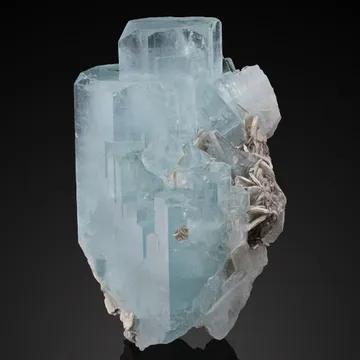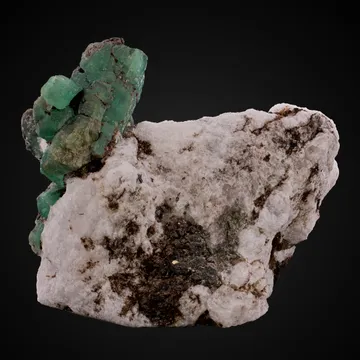
Beryl — iconic mineral with prisms and vivid color varieties (aquamarine, emerald, morganite); prized for crystal form, striking matrix, and collector appeal.
Key facts
Beryl (Be3Al2Si6O18) is one of the marquee species in mineral collecting, famed for its superb crystal form and a spectrum of color varieties driven by trace elements. Its hexagonal prisms are textbook-perfect: six-sided columns with striated faces and flat or pyramidal terminations, often rising from contrasting matrix of white cleavelandite, silvery muscovite, or dark schist. Color varieties include aquamarine (blue), emerald (chromium/vanadium-rich green), heliodor (golden yellow), morganite (pink), and goshenite (colorless). Each has its own aesthetic and market, but all are crystallographically the same species.
Beryl forms primarily in granitic pegmatites (aquamarine, morganite, heliodor, goshenite) and hydrothermal/metamorphic settings (emerald), where it can grow as isolated prisms, radiating groups, or dramatic matrix clusters. Collectors seek everything from elegant, gemmy single crystals to complex matrix compositions pairing beryl with quartz, feldspar, schorl, fluorite, muscovite, or scheelite. With hardness 7.5–8 and bright vitreous luster, fine specimens display brilliantly.
Beryl bridges the worlds of specimen collecting and gemology better than almost any species. Iconic emeralds from Colombia and Zambia have captivated connoisseurs for centuries, while aquamarine from Pakistan, China, Namibia, and the USA offers transparent, sculptural crystals that excel as cabinet display pieces. Morganite and heliodor, though less common as top-tier matrix specimens, supply rich color accents and impressive crystal size from classic pegmatites globally.
Its enduring popularity stems from:
Below are historically and currently important sources for beryl specimens. Each locality is known for a distinctive style—whether emeralds in carbonate matrices or aquamarines on pegmatite feldspars—that has set benchmarks for the species.
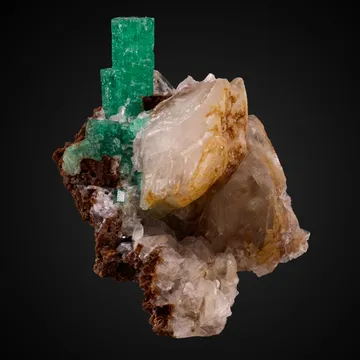
Muzo is the world’s most famous emerald locality. Crystals occur in black shales and carbonates, commonly associated with calcite, dolomite, pyrite, and minor quartz. The best pieces show saturated, velvety green, often in sharp prisms rising from contrasting white calcite. While many crystals are partial or contacted, complete emeralds with good clarity are legendary and command top prices. Occasional rarity includes “trapiche” growth patterns. Collectors prize Muzo for its depth of color, history, and the dramatic gold-on-green aesthetic added by pyrite.
Chivor emeralds often show slightly cooler or bluish-green hues and elegant, elongated prisms, commonly with calcite and pyrite. Classic matrix specimens feature crisp crystals perched on pale carbonate, yielding superb contrast. While fewer than Muzo in number, fine Chivor matrix pieces are highly collectible for their hue and form, and for the mine’s historic gem pedigree dating back to pre-Columbian times.
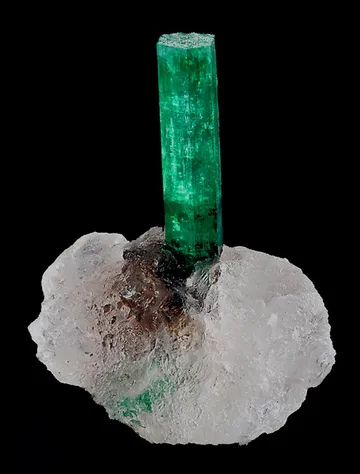
Kagem has become the modern titan of emerald production. Crystals form in quartz-tourmaline veins cutting talc-chlorite and amphibolite host rocks. The best Zambian emeralds display bright, saturated green, often with excellent crystal form and good size. Matrix specimens with quartz and dark host rock provide dramatic display contrast. Availability from recent mining has brought a steady flow of collectible pieces, though top, clean crystals remain scarce and costly.
The Panjshir Valley produces fine emeralds known for rich color and slender, sharply formed crystals. Matrix pieces commonly involve calcite, quartz, and schist, sometimes with pyrite. While production is sporadic, the best Panjshir emeralds can rival or exceed many historical sources for clarity and color. A good Afghan emerald on contrasting matrix is a trophy for any beryl suite.
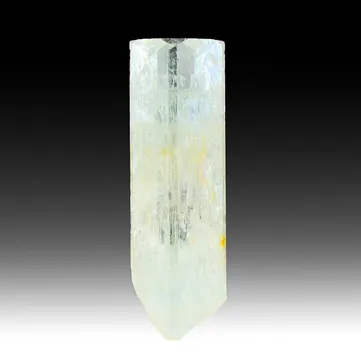
A modern classic for aquamarine, Chumar Bakhoor yields transparent to gemmy blue crystals—often textbook hexagonal prisms with flat terminations—on snow-white cleavelandite, muscovite, and quartz. Occasional associations with fluorite or schorl enhance aesthetics. The best crystals are exceptionally limpid; showy matrix pieces with multiple upright crystals are highly coveted.
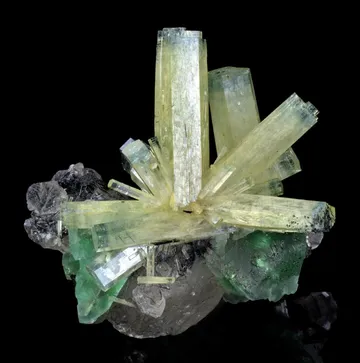
Erongo has produced distinctive aquamarine (and occasional heliodor) in granitic pegmatites, often associated with smoky quartz, feldspar, and schorl. Unique features include etched terminations, complex pyramidal faces, and robust prisms with bright luster. The contrasting matrices and striking forms make Erongo beryls outstanding cabinet display pieces, with a recognizable “Namibian” character.
Colorado’s Mt Antero is the United States’ aquamarine icon. Alpine pockets yield gemmy blue crystals with smoky quartz, albite, and fluorite, often perched in high-altitude cavities. Production is limited and requires arduous fieldwork, so fine, undamaged matrix pieces are scarce and prized. Classic “Antero blue” aquamarine has a clean, cool hue that displays beautifully even without backlighting.
By prioritizing strong color, crisp form, bright luster, and clean condition—ideally on attractive matrix—you can build a beryl suite that spans the species’ remarkable diversity: from the regal greens of Muzo and Kagem to the cool blues of Chumar Bakhoor, Xuebaoding, Erongo, and Mt Antero, and the pastel elegance of Madagascar’s morganites.