Mount Antero beryl is the American collector’s aquamarine with altitude in its bones. The locality sits high above the Arkansas River Valley in Colorado’s Sawatch Range, where light-blue to blue-green beryl occurs in small, Be-rich granitic pegmatites, miarolitic cavities, hydrothermal veins, and related openings in and around the Mount Antero Granite. Few gem localities ask so much of collectors: thin air, talus, lightning, snowfields lingering into summer, and a maze of claimed ground. The reward is a distinctively Colorado aquamarine—often in slender, lustrous hexagonal prisms, sometimes gemmy enough to facet, and at its best paired with smoky quartz, feldspar, muscovite, phenakite, bertrandite, fluorite, and the occasional garnet.
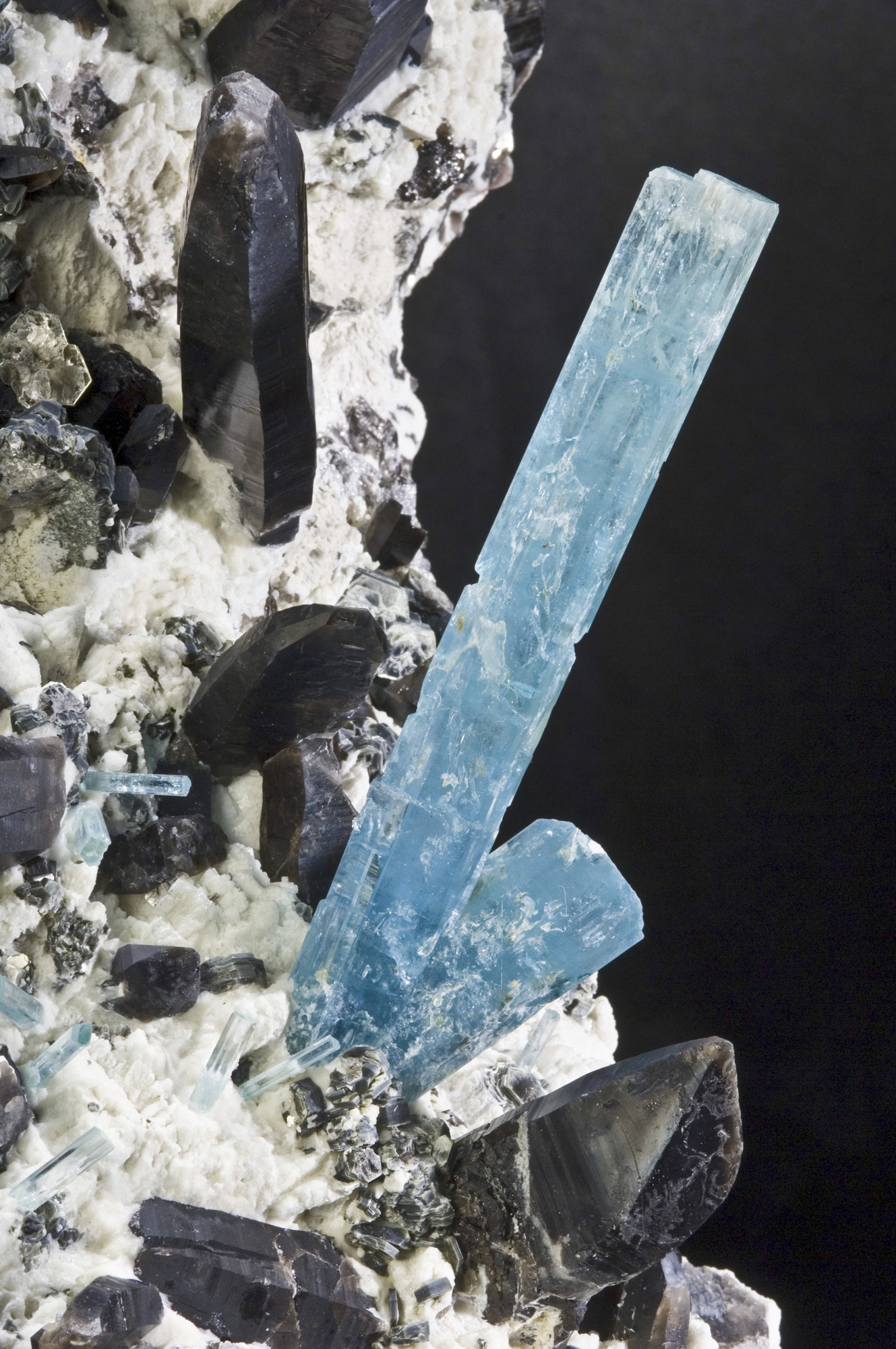
Photo: Colorado Geological Survey
The locality’s appeal is not only mineralogical but cultural. Mount Antero aquamarine helped make aquamarine Colorado’s official state gemstone in 1971, and the mountain has produced specimens important enough to enter major museum displays. The best-known modern example is Diane’s Pocket, discovered in 2004 near the summit area and reconstructed into a dramatic aquamarine-bearing pocket display now associated with the Denver Museum of Nature & Science. It is not a casual loose-crystal tray; it is a theatrical reminder of what an alpine pegmatite pocket can look like when aquamarine, smoky quartz, feldspar, mica, and garnet share the same cavity.
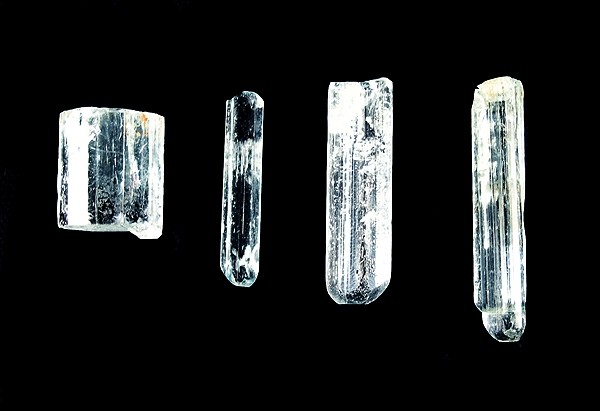
Photo: Wikimedia Commons
Mineralogically, Antero’s beryl is compelling because it spans the continuum from pale, nearly colorless goshenite-like beryl through blue beryl to true aquamarine. Color zoning is part of the locality’s personality: individual crystals may show darker blue portions and paler terminations, reflecting variations in iron and other trace constituents during growth. Collectors prize clean blue prisms with sharp terminations, but locality connoisseurs also value matrix pieces that preserve the original pocket association—especially aquamarine with smoky quartz, bertrandite blades, phenakite, albite or feldspar, and muscovite.
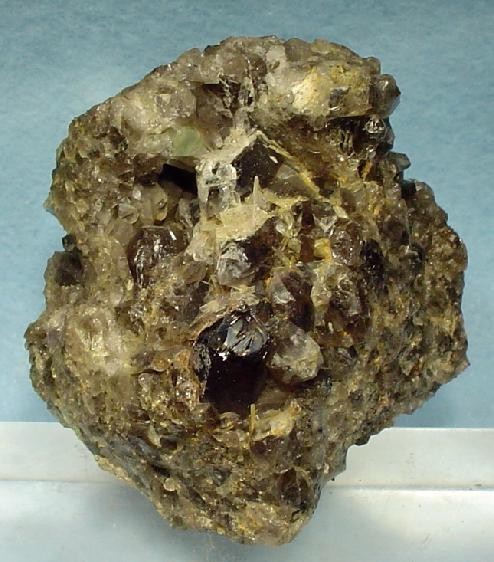
Photo: Wikimedia Commons
The visual signature is usually more alpine and spare than tropical: pale sky-blue prisms, etched or frosted bases, iron-stained pocket clay, dark smoky quartz, white feldspar, and mica. Compared with many Pakistani or Brazilian aquamarines, Mount Antero crystals are commonly smaller and more fragile-looking, but fine examples have a domestic provenance and a geological story that collectors recognize immediately.
Search for specimens: View all beryl specimens from Mount Antero, USA
Mount Antero is in Chaffee County, Colorado, in the Sawatch Range, between the Buena Vista and Salida area. The summit area is above timberline, and the beryllium-bearing mineralization lies mainly on high alpine slopes around Mount Antero and neighboring Mount White. Forest Service information treats Mount Antero as one of the highest gem fields in the lower 48, with an elevation near 14,269 feet and access by a rough high-clearance four-wheel-drive road from the Baldwin Gulch/Mount Antero trailhead.
The deposit is a granitic rare-element pegmatite and vein system. The classic specimen occurrences are small pegmatites and cavities within the Mount Antero Granite and related evolved granitic rocks. The older literature describes the pegmatites as generally small bodies—often only a few feet across—and emphasizes the importance of miarolitic cavities, the open spaces where beryl, smoky quartz, phenakite, bertrandite, fluorite, muscovite, albite, and feldspar crystallized into collectible specimens. The system also includes quartz-rich veins and hydrothermal veins, including beryl-bearing quartz-molybdenite mineralization at the California mine area.
The Mount Antero Granite is part of a younger intrusive suite cutting older rocks of the Princeton batholith region. In collector terms, this matters because the mineralization is not a broad, continuous orebody like a mineable seam; it is a pockety high-level granitic system. A productive pocket can be astonishing, while the next patch of granite may yield little beyond shattered feldspar, smoky quartz, mica, and clay. The best pockets formed where late magmatic and hydrothermal fluids concentrated beryllium, silica, fluorine, alkalis, and water in openings, allowing aquamarine and associated beryllium minerals to grow.
Historically, Mount Antero’s aquamarines entered the mineralogical community in the late nineteenth century, with Nelson D. Wanamaker often credited as the first-known miner of the aquamarines in the 1880s. Early collectors worked the mountain on foot, with base camps near timberline and summer access measured in weeks rather than months. By the 1930s, collectors such as Arthur Montgomery and Edwin Over were recovering specimens that would influence the scientific descriptions of the locality. George Switzer’s 1939 study in American Mineralogist gave the area its classic pegmatite framework and remains essential reading.
A second phase of activity came in the mid-twentieth century, when beryl had strategic interest as a beryllium source. Rough roads were pushed up the mountain, but the pegmatites proved far too small and erratic for conventional commercial beryl mining. That failed industrial promise inadvertently helped later collectors: road access improved, but the deposit remained fundamentally a specimen and gem locality, not a bulk mine.
Modern collecting is dominated by private and unpatented mining claims. Much of the productive aquamarine ground is claimed, and collecting on a claim without permission is illegal. The Forest Service explicitly warns that surface collection on unpatented claims without the claim owner’s permission is considered claim jumping, and that it is the visitor’s responsibility to know whether they are on a claim. Vehicles must remain on designated roads to protect alpine tundra. Any serious field visit requires current land-status research, current road and weather information, and direct permission where claims are involved.
Production has never been steady in an industrial sense. It has come in bursts: an early collecting period in the late 1800s and early 1900s; important 1930s specimen collecting; renewed interest during the beryllium era of the 1940s and 1950s; and a modern gem-and-specimen period beginning in earnest in the late twentieth century and amplified by television, YouTube, and high-profile finds. The 2004 Diane’s Pocket discovery became the locality’s most famous modern event, not because it represented routine production, but because it dramatized the extraordinary pocket potential still present in a mountain that has been worked for well over a century.
Mount Antero beryl is best known as aquamarine, Be3Al2Si6O18, in pale blue, blue-green, and occasionally richer blue tones. Nearly colorless beryl also occurs, and some crystals transition from darker blue zones into paler blue or nearly colorless terminations. The most desirable loose crystals are transparent to gemmy, lustrous, sharply hexagonal prisms with intact terminations. Even small crystals can be excellent if they have strong form, saturated color for the locality, and minimal bruising.
Crystal habit is typically prismatic and hexagonal, often slender rather than thick. Thumbnail and miniature crystals are commonest on the market; fine crystals in the 2–5 cm range are very desirable, and larger, clean, well-terminated crystals are notably scarce. Historical descriptions include aquamarine crystals up to several centimeters long in pocket assemblages, while modern museum and private specimens show that larger crystals and large reconstructed pocket plates can occur under exceptional circumstances.
Matrix specimens are a more complicated but rewarding category. Beryl may occur with smoky quartz, microcline or feldspar, albite, muscovite, fluorite, phenakite, bertrandite, and minor garnet. The finest matrix pieces show a believable alpine pocket architecture: blue beryl standing from white feldspar or quartz, smoky quartz giving contrast, and accessory Be minerals providing locality character. Bertrandite in slender, transparent to whitish blades and phenakite in small clear crystals are especially important associations because they tie the specimen directly to the Be-rich mineral evolution of Antero pockets.
Pocket minerals are often etched, clay-coated, or separated by weathering. Antero pockets can be deeply decomposed by frost action and alpine weathering, so crystals are frequently recovered loose from pocket dirt rather than as pristine, unbroken groups. This is one reason undamaged matrix pieces are much scarcer than loose crystals. It also explains why some major displays are reconstructions: the pocket may have existed as a magnificent mineralized cavity, but the act of discovery and removal often yields individual crystals, pieces of matrix, and broken relationships rather than a single intact geode-like mass.
Quality in Mount Antero aquamarine is judged differently from high-volume commercial gem rough. For specimens, the key factors are provenance, crystal form, termination quality, color strength, transparency, luster, and associated minerals. For cutting rough, clarity and color are paramount, but many collectors prefer crystals left uncut unless the piece is damaged or has poor specimen aesthetics. A small, undamaged, terminated, richly blue Antero crystal can be more collectible than a larger pale shard.
Locality character matters. Fine Mount Antero aquamarine tends toward a cool, natural blue to blue-green rather than the intense treated-looking blue associated with some commercial stones. Many pieces are pale; that is normal. The best examples have a crisp “icy” body with enough blue to read immediately as aquamarine, not merely colorless beryl. Growth zoning, internal veils, healed fractures, frosted bases, and contact marks are common and should be evaluated in the context of pocket recovery rather than automatically treated as defects.
Mount Antero aquamarine is desirable because it combines classic American provenance, high-altitude collecting romance, and genuine gem potential. The market offers everything from small self-collected chips and pale broken crystals to sharp thumbnails, gem rough, faceted stones, and rare matrix combinations. Top specimens with strong color, intact terminations, and documented claim or pocket provenance command a premium, especially when associated with smoky quartz, phenakite, or bertrandite.
The main authenticity issue is not a famous Mount Antero-specific fake tradition, but specimen construction and over-optimistic locality attribution. Loose Antero crystals can be confused with aquamarine from Pakistan, Afghanistan, Brazil, Namibia, or other pegmatite localities if they lack documentation. Matrix pieces should be inspected carefully for glued crystals, added mica or feldspar around bases, suspiciously mismatched luster or color, and glue fluorescence under ultraviolet light. Repairs are not automatically unacceptable, but they should be disclosed.
Reconstruction is part of the Mount Antero conversation because of Diane’s Pocket. That museum-scale display is a reconstructed pocket, not a deceitful fake; the distinction is important. Reconstructing a pocket can be legitimate when disclosed, especially for display and educational purposes. In the commercial specimen market, however, a reconstructed or composed matrix piece should be priced and described differently from an undisturbed pocket specimen.
Condition issues are common. Expect minor edge wear, basal damage, contact marks, etched zones, internal fractures, and pocket-clay residues. Many crystals were freed by freeze-thaw weathering or dug from decomposed granite, so they may have bruised terminations or granular bases. Smoky quartz associations often break away from matrix, and feldspar can be friable. Very clean, lustrous, undamaged crystals with good blue color are much rarer than the broad availability of “Mount Antero aquamarine” might suggest.
For gem buyers, ask whether the stone is represented as natural color and whether it was cut from documented Mount Antero rough. Aquamarine in general can be heated to modify color, but Mount Antero collector demand is strongly tied to natural provenance and crystal identity. A faceted stone without a chain of custody may still be beautiful, but it carries less locality value than a specimen or gem with credible documentation from a known claim, miner, collection, or older label.
The old story begins with Nelson D. Wanamaker, the name that still hovers over early Mount Antero aquamarine. After the discovery of aquamarine high on the mountain in the 1880s, Wanamaker sold crystals to collectors and museums. The physical setting was punishing: a timberline base camp around 11,000 feet, a stone shelter near the summit, and summers spent with only what a man could pack up the mountain—picks, shovels, hammers, bars, food, and nerve. The mining season was short, the air thin, and the storms immediate. Before roads, engines, and online claim maps, the mountain had to be earned one step at a time.
The scientific phase of the locality has its own field-camp flavor. In the summer of 1938, George Switzer spent six weeks in the Mount Antero region with Arthur Montgomery and Edwin Over. Their work was not armchair mineralogy; it was pocket-by-pocket observation above timberline, in frost-shattered granite where clean exposures were rare and the pegmatites were often hidden under a mantle of disintegrated rock. One pocket described from near the summit of White Mountain was a lens-like pegmatite about 12 inches across, with a central cavity extending roughly 4 feet back into a cliff. Microcline crystals reached 10 cm, beryl appeared in green to deep-blue transparent crystals up to 7 cm, and smoky quartz followed in sharp crystals up to 10 cm. The locality’s classic paragenesis—feldspar, beryl, smoky quartz, muscovite, albite, fluorite, alteration, and pocket dirt—was not theoretical. It was read directly off the walls of small alpine cavities.
In the early 1950s, beryl briefly became more than a collector’s prize. Strategic demand for beryllium brought prospectors and rough road-building to the high slopes. The venture did not turn Mount Antero into a conventional beryllium mine; the pegmatites were too erratic, too small, too pockety. But that industrial moment changed the mountain anyway. The road that later generations cursed, loved, widened, rutted, and crawled up in Jeeps owed something to the beryllium era. A later family memory distilled the road-building into four ingredients: “Lots of whiskey, lots of dynamite, lots of fortitude.”
Modern Antero collecting has a blue fever all its own. Sandra Gonzales and her mother Viola Padilla were already part of the mountain before the television rush. On one reported trip, Padilla was 83, riding shotgun while Gonzales drove a Jeep through widened water on the notoriously rough road. The ascent was not scenic in the gentle sense: boulder-strewn track, avalanche debris, deep water, switchbacks, sheer dropoffs, and the aptly named Dead Man’s Curve. Padilla let out a loud “whoo!” as the Jeep blasted through, then summed up the whole enterprise: “this tells you how crazy we are.” Their name for the condition was simpler—rock crazy.
That same 2019 account caught a younger pair, Jason Roys and Ian Schimpfle, in the afterglow of a serious find. On their first Antero dig of that season, they recovered aquamarine they later calculated at 831 carats, estimating a value between $20,000 and $60,000. The crystals sat in a Ziploc bag, close to the chest, at a mosquito-ridden summer camp above 11,000 feet. Gonzales warned that if you “flash things for people,” they go crazy. Schimpfle saw “money signs in their eyes.” Roys had the mountain’s diagnosis ready: “Blue fever.”
Steve Brancato’s Diane’s Pocket story is the modern legend. Brancato began prospecting on Mount Antero in 2002; in 2004 he discovered the pocket named for his mother. The reconstructed specimen later associated with that find measures 37 by 25 inches and contains more than 100 aquamarine and other crystals in a dramatic assemblage of white feldspar, silvery mica, red garnets, and black smoky quartz. The discovery moved beyond the collector underground because it became a museum-scale object, a public icon of what Mount Antero can hide in decomposed granite and pocket clay. Brancato’s own memory of the find was less scientific and more visceral: “the longest sustained buzz” he had ever had.
The same mountain that gives also punishes. In one 2013 field account, Brancato was moving down the broken slopes when he kicked loose rock toward a prospector below and shouted a warning. The mood could turn comic, then deadly, in seconds. Jim Grika, described as an Antero legend with four decades of experience finding blue aquamarine, told of lightning striking his truck. It punched a fist-sized hole in the back, burned beer cans dry, and exploded propane beneath the truck hard enough to lift it five feet. Brancato’s response was pure Antero gallows humor: “The lightning drank your beer?” Grika said he could not hear for six hours and had no peripheral vision for eight.
The weather stories are not decorative; they are part of the mineralogy’s cost. On another descent from a 13,500-foot claim, the sky blackened, thunder tore over the ridges, lightning hit the high ground, and a funnel cloud appeared above Antero. Monsoon rain triggered rock and mudslides. The road became a hazard in both directions: waiting could mean being stranded behind a washout, while going meant trusting a flooded track above dropoffs. The crew chose to descend. Hammers and shovels buzzed in the charged air as they cleared mud and rock from the road. The day’s take was perhaps $400. Brancato called it the “most fun I ever had almost getting killed.”
Not every Antero story belongs to headline pockets and armed claim disputes. A 2017 hand-collecting account with permission from Brian Busse’s claim described a quieter rhythm: a drive to camp at 10,000 feet, tents among the evergreens, then a hike to a 12,000-foot claim that was essentially a rock pile with benches cut into it. The technique was eye training—looking for glass-like glints in wet gravel, surface collecting after rain, learning the difference between common sparkle and the pale hexagonal blue that matters. The author found a 24-carat crystal on the third day, and the party brought home more than 150 carats of gem-quality crystals plus lesser aquamarine, smoky quartz, and other material. That is the small-scale Antero dream: not a museum pocket, not a televised fortune, but a handful of real blue beryl earned at altitude.
 Amethyst
 Quartz
 Fluorite
 Tourmaline
 Malachite
 Azurite
 Rhodochrosite
