Beryl from Panjshir is, in the collector’s eye, emerald: green Be3Al2(Si6O18) from one of the great high-mountain gem districts of Asia. The finest crystals have the bright, saturated, slightly bluish green that makes Panjshir material so often compared with Colombian emerald, but they carry their own personality—zoned hexagonal prisms from a rugged hydrothermal system, commonly with pale cores, darker green rims, etched surfaces, and, in exceptional pieces, sharp crystals still riding on pale carbonate-, quartz-, or feldspar-rich matrix.
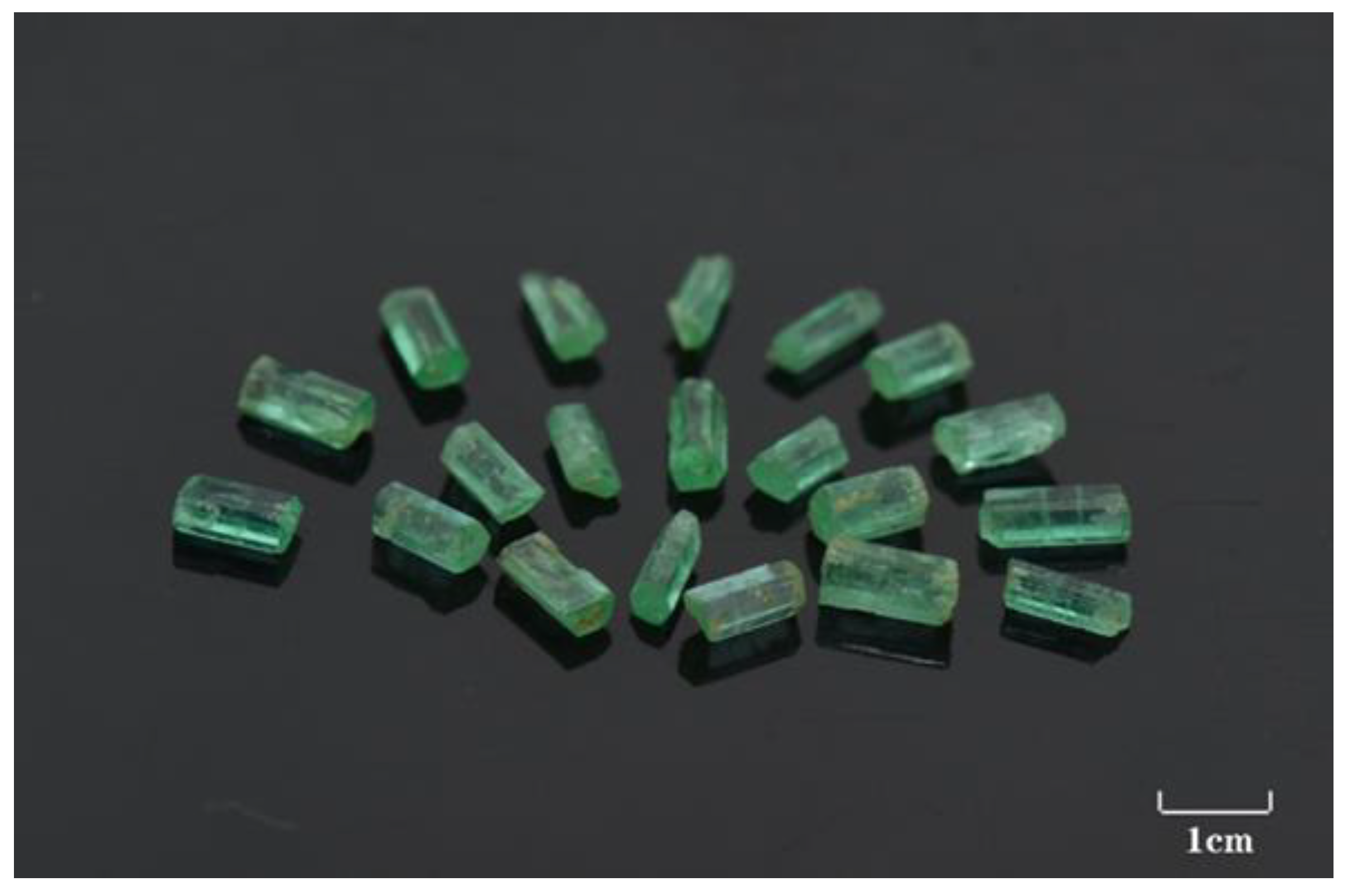
Photo: Peijin Bao / Minerals, MDPI
The locality’s importance comes from an unusual geological meeting. Emerald requires beryllium and chromium or vanadium, elements that ordinarily do not travel together easily. In Panjshir, mineralizing fluids moved through fractured and altered metamorphic rocks along a major tectonic zone in the Hindu Kush, producing emerald-bearing quartz-ankerite veins and veinlet networks. The emerald mines are not ordinary granitic pegmatites; the best-known Panjshir emeralds are vein- and shear-zone material associated with hydrothermal alteration, carbonates, quartz, albite, mica, tourmaline, and pyrite.
For specimen collectors, the great prize is not simply “Afghan emerald” but a crystal that retains geological context. Many fine stones are cut, and much of the production disappears into gem parcels before mineral collectors ever see it. Matrix specimens with complete, lustrous, bright green crystals are therefore especially desirable. Doubly terminated crystals, crystals projecting cleanly from matrix, clusters showing multiple parallel hexagonal prisms, and pieces with readable locality information from Khenj, Buzmal, Mikeni/Dah-Mikeni, Darun, Bakhi, Butak, Rewat, or the broader Khenj emerald area are the specimens serious collectors watch for.
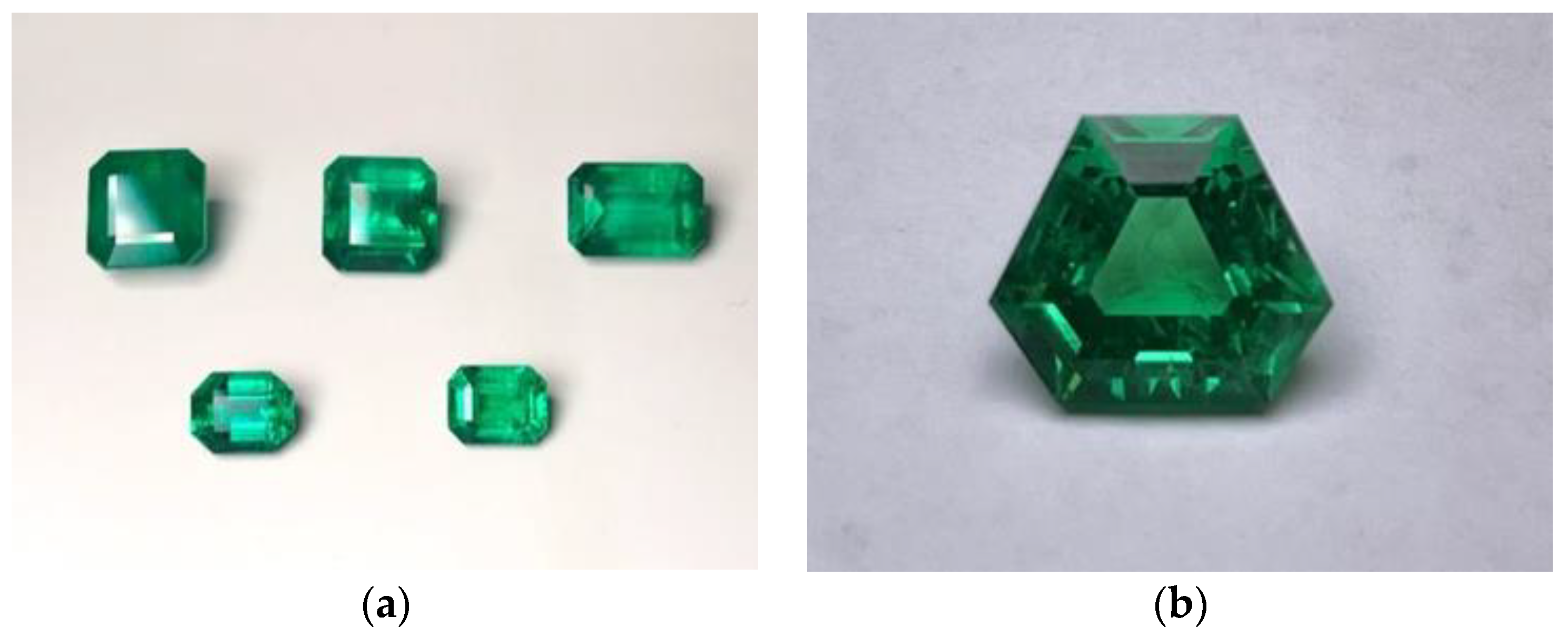
Photo: Peijin Bao / Minerals, MDPI
Historically, Panjshir sits at the crossroads of gem lore and modern conflict geology. Ancient references to “smaragdus” from Bactria cannot be assigned with certainty to Panjshir, but modern analytical work has raised the possibility that at least some historic emeralds from South Asian treasuries came from this region. In the modern trade, Panjshir emeralds became known from the 1970s onward, were studied systematically by Afghan and Russian geologists, and came to broad gemological attention through the 1980s and early 1990s. Since then, the district has supplied both cuttable emerald and, less abundantly, specimen-grade crystals that can stand with the best non-Colombian emerald specimens in major collections.
Search for specimens: View all beryl specimens from Panjshir, Afghanistan
Panjshir Province lies in northeastern Afghanistan in the Hindu Kush, with the emerald district extending along the Panjshir River system northeast of Kabul. The classic mining belt is a narrow zone on the eastern side of the valley, commonly described around Khenj and adjoining areas, with important names including Buzmal, Khenj, Mikeni or Dah-Mikeni, Darkhenj, Darun, Butak, Bakhi, Rewat, Yaknow, and related occurrences. Older gemological work described the known emerald-bearing region as roughly 400 square kilometers, while later locality descriptions and remote-sensing studies focus on a more concentrated mining belt on the south or east side of the river.
The deposit type is best treated as tectonic-metamorphic, hydrothermal emerald mineralization in metamorphic rocks, not as a Panjshir “pegmatite” occurrence. This distinction matters for collectors because Afghanistan is famous for pegmatite beryls—especially aquamarine and other beryl varieties from Nuristan and neighboring provinces—but Panjshir emerald belongs to a different geological story. Emerald-bearing quartz-ankerite veins, quartz-albite veins, and silicified shear zones cut metamorphosed carbonate and schistose rocks. Associated alteration includes albite, muscovite, tourmaline, phlogopite, carbonate, and pyrite, and some of the best material has been reported from veinlet networks cutting metasomatically altered gabbro and metadolomite.
The Panjshir emerald mines are high-elevation workings. Published descriptions place mining at elevations from roughly 2,000 to more than 4,000 meters, with some older accounts emphasizing the severity of access, snow, exposed slopes, and the seasonal nature of work. Winter conditions historically forced miners either to shift to lower workings, where the emeralds were generally poorer, or to sort waste from the higher-elevation mines.
Modern mining has ranged from very small pits and hand-dug tunnels to trenching, open-pit work, and more mechanized surface excavation. Early accounts describe “gophering”—short, irregular tunnels blasted into limestone or other hard wall rock with little systematic planning. Later remote-sensing studies document a shift toward more concentrated activity and more mechanized excavation in some areas. Recent reporting from 2025 and 2026 describes official licensing and auction systems under the current Afghan authorities, including hundreds of registered or licensed mining sites; those figures should be read as reports of administrative activity rather than as a transparent geological inventory.
There is no realistic recreational collecting access in the Panjshir emerald belt. The workings are local, high-mountain mines in a politically sensitive and security-sensitive region. Specimens reach collectors through miners, traders, gem dealers, and international mineral dealers rather than through field collecting by visiting hobbyists. For a serious buyer, the practical “locality access” question is therefore provenance: how specifically a specimen can be tied to Panjshir Province, Khenj District, or a named mine or occurrence.
Notable finds include large rough crystals exceeding 100 carats in early reports, emerald crystals over 50 carats appearing with some regularity in the 1980s–1990s trade, and fine faceted stones above the size normally expected from Afghanistan. Later laboratory work recorded Afghan emerald crystals larger than 120 grams and faceted stones over 85 carats, although most gem-quality faceted Panjshir emeralds are far smaller. For mineral collectors, several documented Mindat and dealer-photo specimens are especially instructive: matrix pieces with emerald crystals measured in centimeters, including examples with crystals 4.3 cm long, 5.8 cm blocky crystals, and one described specimen with an 83 mm elongated crystal on limonite-coated white matrix.
Panjshir emeralds crystallize in the expected hexagonal habit of beryl, usually as prismatic crystals or crystal fragments. Good specimens show sharp to slightly rounded hexagonal columns, flat pinacoidal terminations when preserved, and lengthwise striations or growth textures. Some crystals are transparent to translucent for much of their length; others are strongly included or only translucent at the rims. The most display-worthy mineral specimens are those where the prism form is readable at cabinet distance and the green holds under ordinary light rather than only under strong transmitted light.
Color is a principal attraction. The typical collector-grade range is blue-green to rich emerald green, with the best pieces showing vivid, saturated green comparable in visual appeal to fine Colombian material. Zoning is common and important: many crystals have pale or light blue-green cores and darker green peripheries. In rough crystals this can produce a rimmed appearance; in cut stones it means the cutter must orient for color while avoiding overemphasis of blue or yellow tones. Older cutting observations noted that the best color is often near the outer surface of the crystal, and that some Khenj material can be so dark that it is overcolored, while northern mining areas have tended to yield lighter stones.
Size varies enormously according to whether one is speaking of gem parcels, crystals, or specimen pieces. Study samples may be around 1 cm or less, and most gem-quality faceted Panjshir emeralds encountered in laboratories are under 5 carats. Historical mine accounts describe most crystals as only a few carats, with crystals over 50 carats found periodically and crystals over 100 carats rare. For mineral specimens, a clean, complete, lustrous crystal of even 1–2 cm on matrix is worth attention; a sharp, attractive, several-centimeter crystal on matrix is a significantly more serious object.
Surface character is another Panjshir signature. Some crystals are smooth and lustrous, but others show natural etching, duller surfaces, and irregular growth features. The older GIA study drew special attention to “nodules”—rounded, marble-like emerald bodies within larger Panjshir crystals. Such nodular material was noted as unusually clean relative to the average crystal, and it remains one of the more distinctive reported features of this locality’s rough.
Inclusions are central to both identification and beauty. Panjshir emeralds commonly contain three-phase and multiphase inclusions, including brines, vapor bubbles, and solid daughter minerals. Halite-like cubic solids, probable sylvite, carbonates, and other daughter phases have been documented. Tubular inclusions parallel to the c-axis, tabular inclusions perpendicular to the c-axis, and subhedral inclusions at zone intersections all occur. Later studies emphasize serrated three-phase inclusions and inclusion scenes visually similar enough to Colombian emerald that trace-element and spectroscopic testing may be needed for confident origin calls.
Associated minerals depend on the exact mine and matrix. Quartz is common, and carbonate matrix or vein material is frequent. Reported and observed associations include albite or feldspar, ankerite, calcite, dolomite, phlogopite, muscovite, tourmaline, pyrite, limonite staining, and altered schistose or carbonate host rock. White to buff matrix with emerald prisms gives the strongest color contrast; orange-brown limonite coatings can be visually dramatic if they do not obscure the crystals.
The quality factors for specimens are different from those for faceted emerald. In a cut stone, color, clarity, oiling, cutting, and origin documentation dominate. In a specimen, collectors should weigh crystal completeness, termination, color saturation in reflected light, transparency, luster, matrix contrast, absence of repairs, and locality precision. A cleanly exposed crystal that projects beyond matrix can be more desirable than a heavier but damaged or buried crystal. Rehealed cross-fractures are common enough in Panjshir crystals that they do not automatically disqualify a specimen, but open cracks, glued breaks, concealed repairs, and oil-darkened fractures all require careful inspection.
The first authenticity issue is locality naming. “Afghan emerald” is not as precise as “Panjshir emerald.” Afghanistan has produced emeralds outside the classic Panjshir system, including material discussed from Laghman Province, and the gem trade has sometimes used loose or market-friendly names. A mineral specimen should ideally be labeled at least Panjshir Province, and better still Khenj District or a named mine such as Buzmal, Bakhi, Butak, Darun, Dah-Mikeni, or Rewat when the chain of custody supports it.
The second issue is confusion with Colombian emerald. Panjshir’s best emeralds can look remarkably Colombian, especially in cut stones and especially in newer high-quality production described since 2017. Laboratory work has documented Panjshir material being mislabelled as Colombian in the market. For faceted stones, credible laboratory origin reporting is worth paying for; for mineral specimens, provenance, matrix, growth habit, and dealer reputation matter, but analytical confirmation may still be warranted for expensive pieces.
Treatments are a real concern. Oiling is common in emerald generally, and Panjshir emerald is no exception. Older GIA work described the practice of heating emeralds in oils with refractive indices close to emerald to reduce the visibility of fractures, and later gemological studies found oil-filled fractures in Panjshir samples. Oil in a faceted emerald is not unusual, but it should be disclosed. On a specimen, oil can deepen apparent color, hide fractures, and create misleading luster in cracks. Under magnification, look for filled fissures, flash effects, residues, and any greasy staining on paper or mounting material.
Dyeing and synthetics also belong on the checklist. GIA documented a dyed Panjshir emerald crystal in a parcel purchased in Pakistan and also warned that synthetic emeralds had been detected mixed with natural emeralds in parcels of cut stones. For specimen collectors, the more likely problems are repaired crystals, glued-in crystals on matrix, filled fractures, or over-oiled pieces rather than fully synthetic crystals on natural matrix; still, any high-value emerald on matrix deserves close scrutiny under magnification and, when necessary, professional testing.
Condition issues are typical of emerald but intensified by Panjshir’s mining style. Blasting has historically damaged many crystals. Cross-fractures perpendicular to the c-axis are common, and some crystals show rehealed breaks. A rehealed fracture that is natural and stable can be acceptable, even interesting; a repaired break should affect price and must be disclosed. Terminations are crucial: a bright green prism with a chipped or contacted termination is far less desirable than a complete crystal of slightly lesser size.
Rarity depends strongly on format. Small cut stones and small rough crystals from Panjshir are available in the gem trade. Fine, undamaged, transparent-to-translucent crystals on attractive matrix are much scarcer. Large, complete, well-terminated matrix specimens with strong color are genuinely difficult, because so much fine emerald is cut or sold as gem rough. The best Panjshir mineral specimens combine the saturated color of a gem stone with the architecture of a mineral specimen; that combination is exactly why they command strong competition when they appear.
Market availability has increased and changed over time. Recent reports from Afghanistan describe formal auctions, licensing, and expanded extraction in Panjshir, including newly registered sites and sales of thousands of carats. That does not mean specimen-grade crystals are abundant. Increased mining can bring more rough to market, but it can also accelerate cutting of the best transparent material. For collectors, the most attractive buying opportunities remain older documented specimens, fresh matrix pieces from trusted dealers, and crystals with enough matrix and provenance to separate them from anonymous gem rough.
In the summer of 1990, Gary Bowersox reached Panjshir by a route that reads less like a mine visit than a campaign diary. Foreigners could not simply drive in. The practical approach ran through northern Pakistan, then on by foot, mule, and horse for about 150 miles through land-mine fields and over mountain passes, some reported as high as 14,900 feet. The trip from the Pakistani border near Chitral to Panjshir took him six days. At the end of it were emerald mines that had become, in the language of the time, the economic engine of villages still living in the aftermath of war.
Khenj and Mikeni were compared by Bowersox and his coauthors to western American boom towns. Shops sold mining tools, timber for houses, food, and even familiar soft drinks—Sprite and Pepsi—yet there was no electricity. Candles and oil lamps lit the evenings. The only line to the outside world was a military radio controlled by the local commander, Abdul Mahmood, reserved for emergency and military use. Miners lived up near the workings from Saturday afternoon until Thursday afternoon, then descended to their villages for family and supplies. Their diet at the mines was plain: rice, nan, beans, and tea.
The Buzmal mine, described as the oldest and most dangerous in the valley at that time, was not a single mine in the modern engineered sense. It was a mountain face peppered with dozens of pits and tunnels at about 10,000 feet elevation. Teams chose places to tunnel almost at random. The method was called “gophering”: small, irregular, unsystematic workings driven into the rock. Tunnels might run 30 to 50 yards, then suddenly bend toward another group’s tunnel if emerald had been found there. Blasting was common and poorly controlled. In one unforgettable moment, Bowersox was inside a tunnel when six dynamite blasts from a shaft above shook the passage within minutes.
The economics of a Panjshir mining team were as distinctive as the geology. A typical team consisted of eight miners, but the income could be divided fourteen ways: eight shares for the miners, three for those providing mining equipment, and three for those providing blasting materials. The miners did not draw salaries. They shared the profits of what they found. The social machinery around the stones was the buly, a local meeting where newly mined emeralds were valued, auctioned, and taxed. Disputes over mining rights and shaft ownership went first to village elders; harder cases could move upward to Commander Mahmood and appointed judges in Bazarak.
The Thursday and Monday village meetings were not casual trading sessions. Emeralds were brought to the nearest of three villages—Khenj, Mikeni, or Dest-e-Rewat—where production was evaluated. A tax of 15 percent was collected for the Jamiat-e-Islami party, described at the time as intended for reconstruction of the war-damaged area. Only after that could the emeralds be kept by miners or sold at auction. From there, many moved to Pakistan and then outward into the international market.
One of the most famous early gem-market stories concerns a 36-carat rough Panjshir emerald containing a cleaner internal nodule. From that nodule came several cut stones, including a particularly fine 8.79-carat emerald. The late Eli Livian sold that stone in 1987 for $165,000—$19,000 per carat—a startling figure for a non-Colombian emerald in that era and a marker of how quickly Panjshir material had entered the top tier of gem attention.
Two decades later, another kind of story was being told on camera. In the 2014 film Hidden Gems, a Frenchman named Raphael traveled the 150 kilometers from Kabul to Panjshir through dangerous country to look at the emerald trade. He described strong European demand and saw the possibility of a market that could increase twenty- or thirty-fold. But the film’s picture of the mines was hard-edged: homemade explosives in rough shafts, dangerous working conditions, and a claim that careless extraction could ruin up to 75 percent of the stones. Yama Torabi of Integrity Watch Afghanistan put the loss bluntly: “so much is lost.” For a collector holding a complete Panjshir crystal today, that sentence is worth remembering. Every undamaged specimen is a survivor not only of geological stress, but of the way emerald is actually mined.
 Amethyst
 Quartz
 Fluorite
 Tourmaline
 Malachite
 Azurite
 Rhodochrosite