






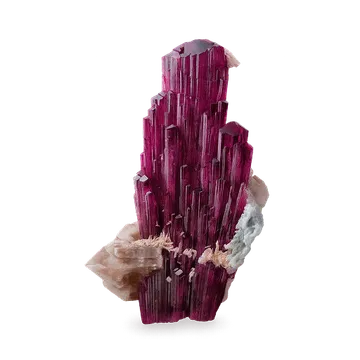
Albite from Paprok, Afghanistan - white to cream cleavelandite blades that highlight tourmaline-rich matrix, prized for locality character and collecting appea…
Key facts
Albite from Paprok is rarely collected as the lone star. Its importance is subtler and, for serious pegmatite collectors, more interesting: it is the snowy architectural matrix that makes many of Paprok’s finest tourmaline, quartz, morganite, hambergite, and rare-phosphate specimens visually work. In its cleavelandite habit, the albite forms white to cream, bladed aggregates, rosettes, and airy sheaves that catch light between the blades and set off the saturated pinks, greens, blues, and smoky grays of the associated gem minerals. A Paprok specimen often reads first as “tourmaline on matrix,” but the matrix is not incidental; the albite gives the piece contrast, elevation, and locality character.
Paprok is a high Himalayan-Hindu Kush pegmatite locality in Nuristan, in the Kamdesh District of northeastern Afghanistan. The locality name has appeared in the literature and trade with several spellings, including Paprok, Papruk, and Paprowk. The pegmatites are gem-bearing lithium-rich bodies, classically described as hosted in Late Triassic slate and associated with the broader Nuristan rare-metal pegmatite province. Albite, including the cleavelandite variety, is part of the essential pegmatite assemblage together with spodumene, microcline, lepidolite, quartz, beryl, and polychrome tourmaline.
The locality’s collector reputation rests most famously on tourmaline: pink, green, blue-capped, watermelon-zoned, and multicolored elbaite crystals that began reaching Western collections in quantity in the late twentieth century. Albite is the bright stage on which those crystals stand. In the best pieces it is not a dull feldspar mass but a lively foundation of bladed, sugary, or flower-like cleavelandite, sometimes wrapping quartz and tourmaline in a way that looks almost arranged. The strongest Paprok albite specimens are therefore judged by the same composition standards collectors apply to the whole pegmatite piece: how the white cleavelandite frames the gem crystal, whether the albite has clean luster rather than a chalky surface, and whether it contributes real sculptural movement.

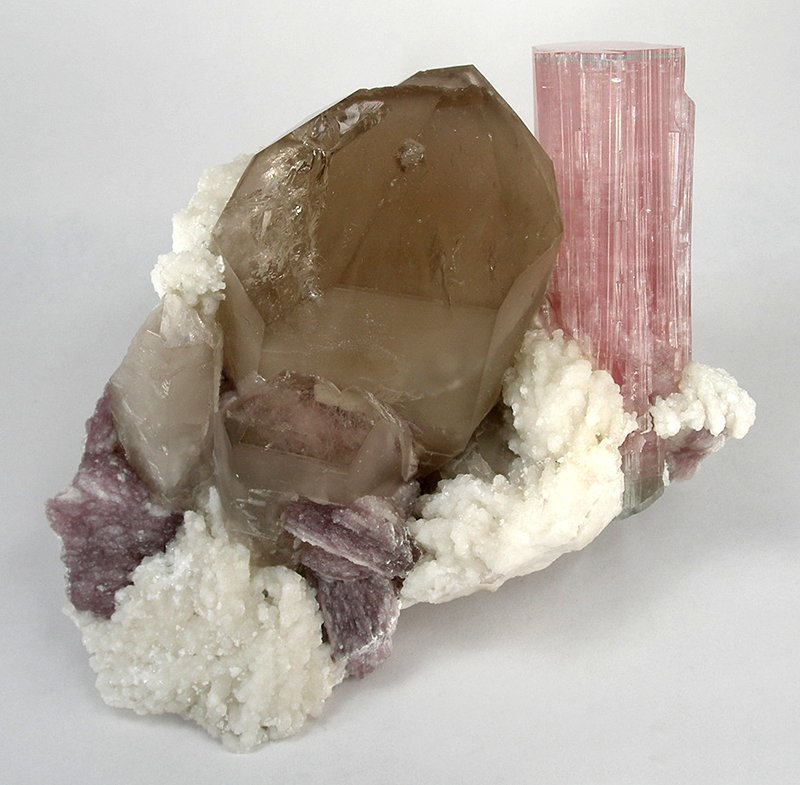
Photo: Wikimedia Commons, Géry Parent
The mineralogical interest of Paprok albite is also tied to fractionation. These are not ordinary feldspar specimens from a simple granitic vein; they belong to a lithium- and boron-rich pegmatite environment capable of producing elbaite, beryllonite, hambergite, hydroxylherderite, pollucite, petalite, stibiotantalite, tantalite-(Mn), väyrynenite, viitaniemiite, and wodginite. In that context, albite records a highly evolved pegmatite system: it is both a major rock-forming component and the delicate late-stage cleavelandite that lines pockets and underpins the gem crystals collectors prize.
Search for specimens: View all albite specimens from Paprok, Afghanistan
Paprok lies in the Kamdesh District of Nuristan, Afghanistan, in one of the world’s great modern gem-pegmatite regions. The locality is commonly treated as a pegmatite field rather than a single neat mine. Mindat records the locality at 35° 30' 20" N, 71° 4' 50" E and lists the type as a pegmatite field; other geological datasets and trade usage sometimes place individual workings somewhat differently because “Paprok” in the specimen trade has been applied to a group of high mountain pegmatite workings near the village and valley.
The geological setting is a rare-metal lithium pegmatite environment. Published USGS summaries place Paprok, or Papruk, among the Nuristan pegmatites carrying spodumene, lepidolite, albite, microcline, polychromic tourmaline, columbite-tantalite, cassiterite, and beryl. Older USGS mine-occurrence data describe the Papruk occurrence as a gem-lithium pegmatite, active as a small mine in 1995, hosted by Late Triassic slate, with significant minerals including tourmaline, spodumene, beryl, albite, cleavelandite, topaz, and lepidolite.
Within the broader Paron or Jamanak-Pasghushta pegmatite field, the geological picture is one of spodumene-microcline-albite and spodumene-albite pegmatites intruded into metamorphosed sedimentary rocks and schists. The regional rare-metal pegmatites are interpreted as genetically and spatially related to fertile two-mica granites of the Oligocene-age Laghman intrusive complex. That matters for collectors because Paprok’s albite is not merely a passive feldspar in a coarse pegmatite body; it belongs to a highly evolved granitic system enriched enough to crystallize lithium minerals, boron minerals, beryllium minerals, phosphates, tantalates, and gem tourmalines.
The name “Paprok mine” is a simplification. The locality often referred to in the trade as the Paprok mine consists of several workings in pegmatites on the right side of the Kéhi Dara Valley, south of Paprok village. Published locality notes identify named workings including Me Tunnel Madan, KAL Tunnel Madan, GUL Tunnel Madan, and Al Madan, with “madan” meaning mine or working. Recent geospatial analysis has described the workings as adits driven into cliffsides in a very high mountain setting, with some tunnels reported to exceed 200 meters.
Historically, the Paprok area became important to the international mineral market through tourmaline. Fine tourmaline crystals were reportedly first discovered in the mountains northwest of Paprok village in 1969, and large crystals from the area began reaching Western dealers and collectors during the 1970s. By the 1980s and 1990s, Afghan pegmatite minerals from Nuristan had become familiar presences at European and American mineral shows, and Paprok was established as one of the key names attached to matrix tourmaline specimens.
Mining is artisanal and seasonal. The high workings have been described at elevations around 4,400 to 4,600 meters, in terrain where snow and weather dominate access. One modern geospatial account gives the likely mining season as September to November, or between snow seasons, and notes that snow covers the mountains for much of the year. Production has depended not only on weather but also on access to explosives, road and trail conditions, political circumstances, and local security. Collecting access for foreign collectors should be considered effectively unavailable without deep local arrangements, proper permissions, and serious mountain-safety planning; Paprok is a specimen-producing mining district, not a casual collecting locality.
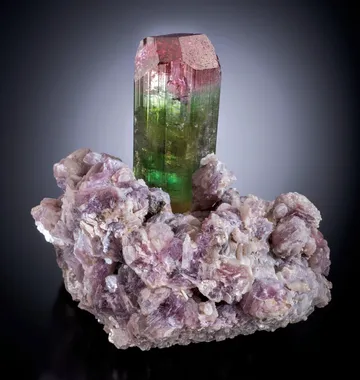
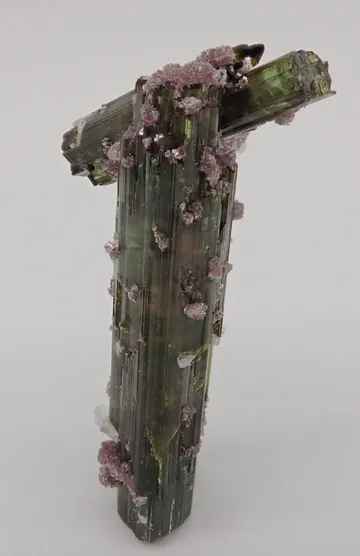
Notable finds are best understood as combination specimens. Paprok has produced cabinet pieces in which pink or green tourmaline rises from snow-white cleavelandite, smoky quartz is cradled by albite blades, and purple lepidolite adds a third color accent at the base. It has also produced rare-species specimens in which albite is part of the pegmatite matrix for beryllonite, hambergite, hydroxylherderite, and phosphate or tantalate minerals. For the albite collector, the locality’s signature is this matrix role: the cleavelandite is often the visual and structural glue of the entire specimen.
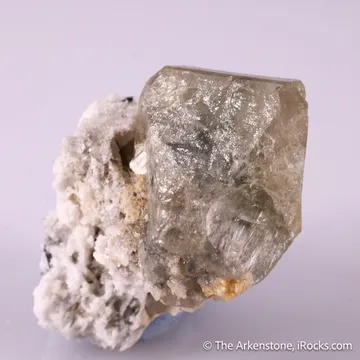
Paprok albite is chiefly encountered as the cleavelandite variety: thin, platy to bladed albite in white, off-white, cream, and occasionally slightly grayish aggregates. It can form rosettes, fans, irregular stacked books, sugary-looking granular crusts, and open bladed masses. On the finest specimens, the albite blades are crisp enough to read as individual crystals rather than a white feldspar lump; they create a luminous, snow-like ground against which tourmaline and quartz stand sharply.
The most characteristic display habit is albite as matrix. Pink, green, blue-capped, and multicolored elbaite crystals may emerge from cleavelandite; smoky quartz points may sit partly nested in albite; lilac lepidolite may occur in plates or granular masses among the albite; and beryl, including morganite and aquamarine, may be associated in the same pegmatite suite. A strong Paprok matrix specimen often depends on the contrast between white cleavelandite and a gem crystal with saturated color. Without the albite, many otherwise fine tourmalines would lose much of their visual punch.
Documented associated minerals from Paprok include albite, cleavelandite, beryl and its gem varieties, beryllonite, childrenite, elbaite, eosphorite, fluorapatite, fluor-elbaite, fluorite, fluornatromicrolite, foitite, hambergite, hydroxylherderite, lepidolite, microcline, microlite-group minerals, muscovite, opal and hyalite, petalite, pollucite, quartz and smoky quartz, schorl, spodumene and kunzite, stannite, stibiotantalite, tantalite-(Mn), topaz, tourmaline varieties, väyrynenite, viitaniemiite, and wodginite. The albite formula is NaAlSi3O8, and cleavelandite is a platy habit of albite rather than a separate mineral species.
Typical specimen sizes vary widely because albite is usually part of a combination piece. Miniatures may show a single tourmaline crystal on a few centimeters of cleavelandite, while small-cabinet and cabinet specimens can carry albite bases in the 7 to 20 cm range with tourmaline, quartz, or lepidolite. Published and dealer-documented examples include miniature tourmaline-on-albite specimens around 5 cm, small-cabinet tourmaline and cleavelandite pieces around 7 to 10 cm, and larger combination pieces exceeding 14 cm. The albite itself is usually valued less by dimension than by how cleanly and aesthetically it supports the main crystals.
Quality factors are specific. The best Paprok albite is bright, undulled, and visually open, with distinct cleavelandite blades rather than a massive, battered feldspar base. Collectors should look for a balanced relationship between matrix and primary crystal: a tourmaline that appears naturally seated, smoky quartz that rises with good separation, or lepidolite that provides color without smothering the albite. Fine white cleavelandite surrounding a saturated pink or green tourmaline can make a specimen read as far more refined than a loose crystal of similar color.
Condition is critical because cleavelandite is fragile. The thin blades bruise, shear, and powder along edges; even an apparently clean matrix may show flattened contact areas, trimmed backs, missing blade tips, or pocket clay trapped between plates. A repaired tourmaline on undamaged albite may still be a desirable specimen if the repair is disclosed and the matrix is strong. Conversely, a pristine tourmaline standing on heavily crushed, chalky, or acid-etched-looking albite loses much of the locality’s charm.
Paprok albite is available on the market, but mostly as part of combination specimens rather than as species-only albite. Most offerings are described as tourmaline with albite, tourmaline with cleavelandite, smoky quartz with albite, or morganite with albite. For that reason, pricing is driven mainly by the associated gem mineral: color, clarity, termination, size, and condition of tourmaline or beryl usually dominate the value, while albite contributes by improving composition, contrast, and perceived completeness.
Authenticity concerns usually involve locality attribution and specimen assembly rather than synthetic albite. White cleavelandite matrices occur across Afghanistan and Pakistan, and detached tourmaline crystals from several pegmatite districts can resemble one another. A Paprok label is strongest when supported by old collection provenance, a recognized dealer history, or a specimen style consistent with documented Paprok combinations. Be cautious with vague “Afghanistan/Pakistan” labels later upgraded to Paprok, especially on loose crystals newly attached to white feldspar.
Repaired tourmalines on Paprok albite are common enough that collectors should expect to inspect for them. Repairs may occur where a tourmaline broke at the base, where a crystal reattached to matrix, or where an old pocket break was restored. A single clean repair on a major Paprok tourmaline may be acceptable in the high-end market if disclosed; undisclosed repairs are a different matter. Look for glue lines at the base of a tourmaline, unnatural gaps filled with powdered feldspar, mismatched contact surfaces, and a crystal whose orientation appears too conveniently display-perfect.
Matrix manipulation is another concern. Because albite is soft enough to be mechanically cleaned and fragile enough to be trimmed, Paprok specimens may have sawn or ground backs, stabilized bases, and areas where excess feldspar was removed to improve the display. Thoughtful trimming is normal in the mineral trade, but over-trimming can make a specimen look theatrical rather than geological. Strong collectors’ pieces preserve a believable pocket geometry: the albite should appear to have grown with the associated crystals, not merely serve as a pedestal.
Treatments specific to albite are not a major issue, but associated minerals can be. Smoky quartz may be naturally smoky, but artificially irradiated quartz exists in the market, and unusually dark smoky quartz on an Afghan pegmatite specimen deserves scrutiny. Tourmaline heating is less commonly documented as a Paprok specimen treatment than in cut-stone contexts, yet any exceptionally vivid or unevenly colored crystal should be judged on transparency, internal zoning, and provenance. Albite itself may be acid-cleaned; excessive chemical cleaning can leave feldspar chalky, dulled, or unnaturally white.
Rarity depends on the collecting target. Common fragments of white albite from Nuristan are not rare. Attractive Paprok cleavelandite supporting a small but good tourmaline is available with patience. Fine, undamaged, unrepaired matrix pieces with saturated tourmaline, balanced smoky quartz, and crisp albite are genuinely scarce and have become increasingly competitive. Albite-dominant specimens from Paprok, where the feldspar itself is the visual subject rather than just the matrix, are less often offered because most material is selected and sold for its tourmaline, beryl, or rare-species content.
Market availability remains active through specialist dealers, auction archives, and collector-to-collector sales. Recent online listings and records show Paprok specimens with albite or cleavelandite ranging from small-cabinet pieces in the low-to-mid thousands of dollars to major tourmaline-on-albite combinations in the five-figure range. The albite premium is not usually stated separately, but serious collectors recognize it immediately: a gem tourmaline standing in clean white cleavelandite is far more desirable than the same crystal loose, repaired to a poor matrix, or buried in unattractive feldspar.
The most striking thing about Paprok is not how easy it is to imagine as a mine, but how difficult it is to imagine as a workplace. The gem pockets are not reached by a drive up to a quarry bench or a morning walk into a wooded pegmatite cut. The workings are high in the mountains northwest of Paprok village, in terrain where peaks rise to about 5,800 meters and the mine area itself is reported around 4,400 to 4,600 meters. Snow rules the calendar. Modern geospatial analysis describes the mining season as September to November, or simply “between snow season,” and notes that snow can cover the mountains for approximately nine months of the year.
In that setting, Paprok’s white albite is almost visually deceptive. On a specimen shelf, cleavelandite looks like snow captured and crystallized around tourmaline. At the mine, snow and white tailings can be hard to distinguish from above. Satellite analysts studying the area reported that harsh weather made baseline imagery difficult, that accessible imagery was often taken in suboptimal seasons, and that snow remaining in gullies and valleys nearly year-round could be confused with white crystalline mine waste. The same whiteness that gives a tourmaline specimen its contrast can become ambiguity when viewed from orbit.
The working style is equally vivid. The mines are adits excavated into cliffsides, and some tunnels have been reported at more than 200 meters long. About 100 people have been described working in teams, sometimes living inside the mines for up to 10 days at a time. That detail explains why Paprok specimens often carry a different aura from showy, open-pit pegmatite material: they come from pockets chased underground, in a high-altitude environment where weather, supplies, and human endurance decide whether crystals reach the market at all.
The locality is also larger and more fragmented than the neat phrase “Paprok mine” suggests. One modern account notes that, according to mineral experts, there could be as many as 300 individual mines in the area. Mindat’s locality description gives specific named workings: Me Tunnel Madan, KAL Tunnel Madan, GUL Tunnel Madan, and Al Madan. “Madan” simply means mine or working, but on a specimen label those names hint at a more complex reality: a swarm of high pegmatite workings, not one famous hole in the ground.
The modern record contains a tantalizing pause. Satellite imagery from September 18, 2019 showed eight large mine tailings and numerous smaller tailings leading to possible portals in the Paprok area. At one location, analysts saw what may have been expansion between September 28, 2017 and September 18, 2019, though they cautioned that the apparent change could partly reflect steep terrain and camera angle. Then the public record thins. The same report states that no usable imagery more recent than 2019 was available for that analysis. In a marketplace where a fresh Paprok tourmaline on albite can appear online with a polished studio photograph, it is worth remembering how little of the actual mountain work is visible from outside.
There is a long arc behind that modern uncertainty. Fine tourmaline crystals were first discovered in the mountains northwest of Paprok village in 1969. After that initial discovery, large Paprok tourmalines began reaching Western collectors and mineral dealers during the 1970s. The locality’s reputation grew not from a single academic description but from specimen after specimen: vivid tourmaline standing on white cleavelandite, smoky quartz tucked into the feldspar, and, occasionally, rare pegmatite minerals that announced just how evolved the system was.
Orris, G.J. and Bliss, J.D. (2002), Mines and Mineral Occurrences of Afghanistan, U.S. Geological Survey Open-File Report 02-110 — Lists Papruk/Paprowk as an active small gem-lithium pegmatite mine in 1995, with Late Triassic slate host rock and significant minerals including albite and cleavelandite.
Peters, S.G., King, T.V.V., Mack, T.J., and Chornack, M.P., eds. (2011), Summaries of Important Areas for Mineral Investment and Production Opportunities of Nonfuel Minerals in Afghanistan, USGS Open-File Report 2011-1204 — Provides regional geological context for the Nuristan rare-metal pegmatites, including the Paprok/Papruk entry with albite, microcline, spodumene, lepidolite, polychromic tourmaline, columbite-tantalite, and cassiterite.
Lyckberg, P. (2011), “Edelstein-Pegmatite in Afghanistan: Paprok,” Mineralien-Welt, 22(3), 46–57 — A key locality-specific publication for Paprok, cited for multiple rare and gem pegmatite minerals from the deposit.
Lyckberg, P. (2017), “Gem pegmatites of northeastern Afghanistan,” The Mineralogical Record, 48(5), 610–675 — Major modern review of northeastern Afghan gem pegmatites, including Paprok workings and mining context.
Natkaniec-Nowak, L., Dumańska-Słowik, M., and Ertl, A. (2009), “‘Watermelon’ tourmaline from the Paprok mine (Nuristan, Afghanistan),” Neues Jahrbuch für Mineralogie – Abhandlungen, 186(2), 185–193 — Analytical study of zoned Paprok tourmaline, documenting fluor-elbaite in the core and chemical variation across the crystal zones.
Wesełucha-Birczyńska, A. and Natkaniec-Nowak, L. (2011), “A Raman microspectroscopic study of organic inclusions in ‘watermelon’ tourmaline from the Paprok mine (Nuristan, Afghanistan),” Vibrational Spectroscopy, 57(2), 248–253 — Spectroscopic study of inclusions in Paprok watermelon tourmaline.
Mindat reference page for Paprok, Kamdesh District, Nuristan, Afghanistan — Consolidates locality coordinates, alternate names, mineral list, and key references for Paprok, including albite and cleavelandite.
MineralAuctions: Elbaite with Albite and Lepidolite, Paprok, ex Rice Museum of Rocks and Minerals — Auction record for a small-cabinet Paprok specimen with a 5 cm indicolite-blue tourmaline in cleavelandite matrix, formerly associated with the Rice Museum of Rocks and Minerals.
EarthWonders: Elbaite, Smoky Quartz, Albite, Paprok, Irv Brown Collection — Large-cabinet Paprok combination specimen listed as published in Mineralogical Record, “Mineral Collections in California,” page 45.
Mindat: Paprok, Kamdesh District, Nuristan, Afghanistan — Best single locality reference for coordinates, alternate names, mineral list, and cited literature.
USGS Open-File Report 02-110: Mines and Mineral Occurrences of Afghanistan — Primary government source for the Papruk/Paprowk mine-occurrence entry and mineral assemblage.
USGS Afghanistan mineral investment summary: Nuristan rare-metal pegmatites — Geological and economic overview of the regional pegmatite fields, including Paprok/Papruk and associated lithium pegmatite mineralogy.
Tearline: Geospatial Analysis of Afghanistan Gemstone Production under the Taliban — Modern remote-sensing account of Afghan gem localities, with a detailed Paprok section on elevation, seasonality, adits, tailings, and mining constraints.
Wikimedia Commons: Minerals of Paprok — Useful visual reference set for Paprok albite, cleavelandite, tourmaline, quartz, and rare pegmatite species.
Wikimedia Commons: Albite-Lepidolite-Quartz-d06-145a.jpg — Rob Lavinsky photograph and description of a Paprok tourmaline, smoky quartz, lepidolite, and albite combination specimen.
Wikimedia Commons: Elbaïte et cleavelandite, Paprok Mine — High-resolution photograph of Paprok elbaite with albite var. cleavelandite.
University of Vienna record: “‘Watermelon’ tourmaline from the Paprok mine” — Publication page for the 2009 analytical paper on zoned Paprok tourmaline.
Jagiellonian University Repository: Raman study of inclusions in Paprok watermelon tourmaline — Bibliographic record for the 2011 Raman microspectroscopy paper.
EarthWonders: Tourmaline with Cleavelandite from Paprok Afghanistan — Market example showing how Paprok albite/cleavelandite functions as display matrix for a pink tourmaline specimen.
EarthWonders: Tourmaline from Afghanistan, Nuristan, Paprok — Recent market listing for tourmaline with quartz and albite, with dimensions, weight, and stated repair status.
MineralAuctions: Elbaite with Albite and Lepidolite, ex Rice Museum — Auction record documenting price, provenance, and descriptive quality factors for a Paprok albite-matrix specimen.
_1.jpg)
