Berg Aukas willemite is one of the quieter classics of the Otavi Mountainland: less immediately famous than the mine’s jet-black to brown spear-point descloizite and less abundant on the market than Tsumeb willemite, but unmistakable when seen well. The best pieces have a dry Namibian elegance—pale tan, ivory, bronze, salmon, orange, or white Zn2SiO4 in sprays, drusy mounds, globular crusts, stalactitic “chimneys,” and tight rosettes, often set against dolomite or paired with translucent smithsonite. Under shortwave ultraviolet light many pieces add a second personality, glowing white to yellowish-white rather than the green most collectors expect from Franklin willemite.

Photo: Wikimedia Commons
The geological setting is the key to the locality’s character. Berg Aukas is a carbonate-hosted zinc-lead-vanadium deposit in the Otavi Mountainland near Grootfontein, developed in Neoproterozoic carbonates of the Otavi Group. In collector language it sits in the same broad mineral province that made Tsumeb, Kombat, Abenab, and other northern Namibian localities legendary; in ore-deposit language it belongs to the Berg Aukas-type Zn-Pb-V family, where sphalerite-galena systems were overprinted by zinc silicate and spectacular vanadate mineralization. Willemite is not merely an accessory curiosity here: it is part of the deposit’s zinc story and occurs as crystalline linings, vug fillings, sprays, and replacement or ore material associated with descloizite, smithsonite, cerussite, dolomite, calcite, goethite, and other secondary minerals.
For collectors, the attraction lies in contrast and provenance. Berg Aukas willemite can be more textural than gemmy: a mat of acicular crystals like dry grass, pastel globules with satin luster, pale drusy crusts under sharp smithsonite rhombs, or odd stalactitic forms that have been confused with smithsonite. A fine specimen is valued not only for crystal sharpness but for being recognizably Berg Aukas—older Otavi Mountainland material from a mine closed in the late 1970s, often carrying old labels and sometimes complicated histories of previous misidentification.
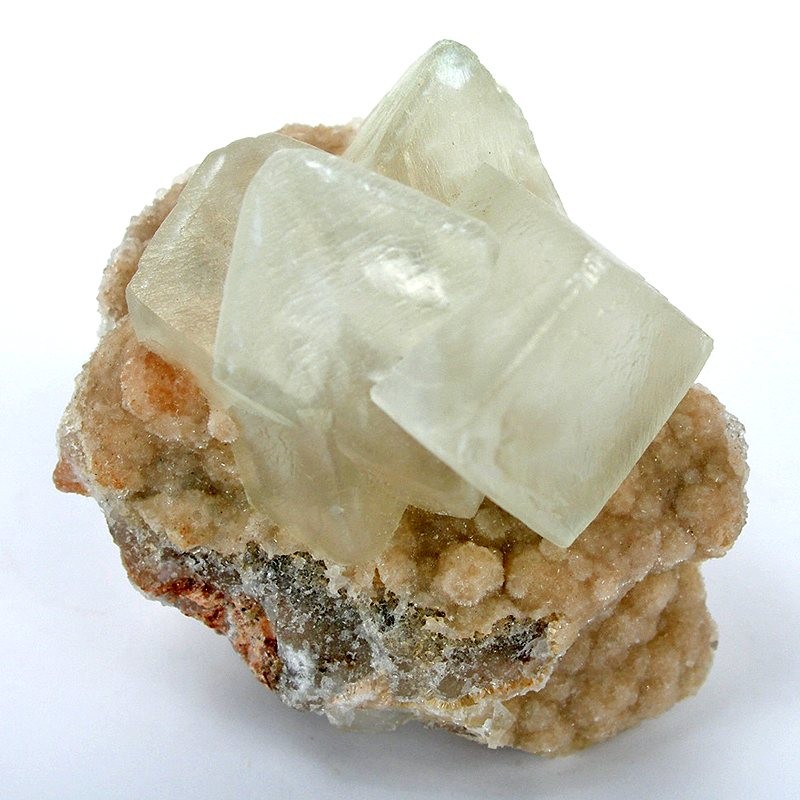
Photo: Wikimedia Commons
Search for specimens: View all willemite specimens from Berg Aukas Mine, Namibia
Berg Aukas lies in the Otjozondjupa Region of northern Namibia, near Grootfontein, in the Otavi Mountainland. The old mine is on the northern limb of the Berg Aukas Syncline, where dolostones, limestones, and shales of the Berg Aukas Formation form part of the Abenab Subgroup of the Otavi Group. These Neoproterozoic platform carbonates were folded during the Pan-African event, then fractured, karstified, mineralized, and later deeply oxidized—exactly the sort of complicated carbonate plumbing that gives the Otavi localities their mineralogical richness.
Two ore styles matter especially for collectors. In the Northern Ore Horizon, lenses of oxidized ore follow the contact between two grey dolomite varieties; primary sphalerite, galena, and subordinate pyrite were altered to secondary assemblages that include descloizite, willemite, cerussite, smithsonite, and goethite. In the Central Ore Body and related intermediate and hanging-wall bodies, mineralization follows solution cavities controlled by steep north-south fractures. These ore bodies were irregular, vertical to steeply dipping, and full of dolomite blocks, clay, mud, and sand. The contacts between ore and country rock could be lined with crystalline willemite, which explains why collector pieces so often feel like cavity or lining material rather than simple massive ore.
The deposit was discovered in 1913 when the apex of the Central Ore Body was found on a hill. Mining began in 1920 and continued until workings reached groundwater level in 1928. The mine was reopened in 1950, and later operations treated complex zinc-lead-vanadium ore, producing vanadate and sulphide concentrates and roasting material on site. Large-scale activity ended in 1978, with historical records citing significant remaining resources and substantial production during the final active decades.
Berg Aukas is not a casual field-collecting locality. It is an old underground mine and former processing complex with unstable dumps, unsecured old workings, tailings, and documented heavy-metal contamination in parts of the former mine town and processing area. The site has also had a modern industrial afterlife: the former mine area and surrounding farm infrastructure became associated with the National Youth Service, and the mineral asset has been reviewed in recent years for possible redevelopment. Collectors should treat any modern “field collected” claim skeptically unless supported by clear permission, provenance, and date.
Notable mineral finds from Berg Aukas are dominated by descloizite and smithsonite, but willemite is much more than a background mineral. It occurs as visible, attractive crystals and aggregates, and it is one of the minerals that make combination pieces from the locality so desirable. The most recognizable collector associations are willemite with smithsonite, willemite with descloizite, and willemite in pale to bronze acicular sprays on dolomite-rich matrix.
Berg Aukas willemite is Zn2SiO4, a trigonal zinc silicate, but its locality expression is far more varied than the formula suggests. Published locality descriptions record it as massive, needle-like, prismatic, and hexagonal, with colors including white, pale yellow-white, and red-brown. Crystals reach about 1 cm in vugs and can form aggregate bundles or radiating rosettes. Dealer and museum-photo records broaden the field habit: acicular sprays in light bronze-golden tones, sparkling white needles, tan drusy spheres, pastel-pink to salmon globular short prismatic aggregates, translucent orange spherical clusters, and stalactitic parallel growths.
The acicular material is often the easiest to recognize. Under magnification it forms tight sprays or jackstraw-like aggregates of slender, glassy to silky crystals, commonly tan, ivory, colorless, pale yellow, or bronze. These specimens reward close viewing: what can look like a dull crust at arm’s length may resolve into hundreds of tiny needles with a lively sparkle.
The globular and mounded material is more deceptive. Some pieces show willemite as rounded drusy spheres, botryoidal-looking masses, or ocherous stalactitic columns. This is the material most likely to be confused with smithsonite, especially when color and luster are subdued. The distinction matters: smithsonite at Berg Aukas is a major collector species and can form rhombohedral, botryoidal, or sheaf-like aggregates, while willemite may form fibrous, acicular, prismatic, or radiating textures that only become obvious under a loupe.
The most attractive combinations place willemite in visual dialogue with smithsonite. Classic pieces may show lustrous translucent ivory, pale green, or mint smithsonite rhombs perched on tan or pinkish willemite. Other specimens have willemite as a sparkling druse along one side of a smithsonite matrix, or as salmon to orange crystalline masses under colorless-to-greenish smithsonite crystals. Descloizite associations are also important: Berg Aukas descloizite is among the world’s great expressions of the species, and even minor dark descloizite on a willemite-bearing matrix can anchor the piece firmly to the locality.
Quality is judged by sharpness, surface life, and locality character. For acicular examples, look for intact sprays with unbroken terminations, visible separation between needles, and a bright sparkle rather than a dusty or abraded surface. For globular or stalactitic examples, look for complete forms, lucency, and natural continuity of the growths. For combination pieces, the best specimens have a clear hierarchy: willemite that is visible and meaningful, not merely a label species, and associated smithsonite or descloizite positioned aesthetically rather than scattered randomly.
Shortwave fluorescence can add value, especially when the response is strong and evenly distributed, but Berg Aukas material should not be judged by fluorescence alone. A good daylight specimen with credible provenance and fine crystals is more important than a dull or broken piece that happens to glow.
The main authenticity issue with Berg Aukas willemite is not a widely documented industry of fakes; it is misidentification and mislocality. Several market records note Berg Aukas willemite material being confused with smithsonite, and the broader Namibian market has long suffered from Tsumeb/Berg Aukas confusion on labels. A pale drusy zinc mineral from northern Namibia should not be accepted as Berg Aukas willemite on color alone. Crystal habit, associations, fluorescence, old labels, and—when the specimen is important—analytical confirmation all matter.
Old labels are valuable but not infallible. Berg Aukas pieces commonly moved through collections when “Otavi,” “Grootfontein,” “Tsumeb,” and “Berg Aukas” were not always used with modern precision. Preserve old labels even when they are wrong, because they document the specimen’s collecting history, but do not let a romantic label override mineralogical evidence.
Condition is a real concern. Acicular sprays are fragile and commonly lose tips. Stalactitic or chimney-like growths may be cleaved off at the top. Smithsonite-on-willemite combinations can show edge wear on rhombs, bruising where the matrix was trimmed, or sawed backs prepared for display. A sawed back is not a defect if disclosed and not intrusive, but undisclosed cutting, glued repairs, or resin consolidation should affect value.
Inspect Berg Aukas willemite with a loupe under daylight and shortwave UV. Broken needles often show flat, brighter, fresher-looking ends. Glue lines may fluoresce differently from the willemite, especially along repaired sprays or at the base of stalactitic growths. Waxy or glossy patches between crystals can indicate adhesive or consolidant. The matrix should also make sense: dolomitic, carbonate-rich, and consistent with the known Berg Aukas suite.
In rarity terms, Berg Aukas willemite is available but not common. Small and modest examples surface periodically, especially as old collections are dispersed, while large, clean, strongly crystallized pieces are much scarcer. Good smithsonite-willemite combinations are especially desirable because they combine two of the mine’s signature zinc minerals. Fine pure willemite examples with sharp acicular sprays, unusual bronze or orange color, or strong fluorescence are worth careful attention, particularly when accompanied by old collection provenance.
The story of Berg Aukas begins with a hilltop clue. In 1913 the apex of the Central Ore Body was found on top of a hill, the visible expression of a much more irregular system below: solution cavities, steep fractures, dolomite blocks, mud, sand, and zinc-lead-vanadium ore arranged in bodies that were anything but simple. Mining started in 1920, but the first chapter ended abruptly at groundwater level in 1928. For collectors, that early period matters because the mine’s best minerals were never the product of a single pocket or one neat zone; they came from a carbonate system where ore, karst, and oxidation repeatedly intersected.
When Berg Aukas reopened in 1950, it entered the era that made its mineral name. Ore was not merely mined; it was processed and roasted on site, leaving behind waste rock, slag, tailings, and a settlement that later took on a second life. The mineral specimens that collectors admire—descloizite spears, smithsonite rhombs, willemite sprays—came from the same industrial landscape that later geologists would map as a contaminated former mine town. In environmental surveys, the old processing area became a kind of ghost image of the mine’s chemistry: lead, zinc, copper, cadmium, arsenic, mercury, molybdenum, and other metals remaining in surface soils long after the last ore was hoisted.
One of the most striking post-mining episodes is the conversion of the former mine infrastructure into a training and agricultural landscape. Houses, workshops, hostels, and fields associated with the former mine were used by the National Youth Service for agricultural vocational training and experimental crops. That reuse brought people back into contact with the old mineral-processing footprint. Surveys in 2005 and 2007 found severe contamination in an ellipsoid-shaped high-risk zone roughly 3.5 km east-west by 2.5 km north-south. Crops such as sweet potatoes, cabbage, and Irish potatoes were tested because the fields were not abstract sample points; they were part of a working institutional farm. The response was practical and immediate: decision-makers were warned against further residential or agricultural development in the worst area, and the vocational-school hostel was moved to an uncontaminated area near Rietfontein.
For a collector, that history changes how one looks at a Berg Aukas willemite. The specimen is not just a pretty zinc silicate from an old Namibian mine. It is a crystallized remnant of a deposit that shaped a settlement, left a measurable chemical shadow, and still draws modern economic interest. The same carbonate host that buffered groundwater and helped preserve vanadium in relatively stable mineral phases also produced the delicate, pale willemite sprays now sitting in drawers and display cases thousands of kilometers away.
 Amethyst
 Quartz
 Fluorite
 Tourmaline
 Malachite
 Azurite
 Rhodochrosite
