Tarnobrzeg sulfur is one of the great European classics: bright yellow native sulfur from a giant Miocene evaporite-replacement deposit, collected chiefly from the former Machów open-pit mine and, in the broader Tarnobrzeg sulfur district, associated with Piaseczno, Jeziórko, Osiek, and Baranów. The best specimens are unmistakable—lemon-yellow to amber sulfur crystals sparkling on darker massive sulfur, on honey calcite, or in striking combination with pale to bluish celestine and white to gray barite.

Photo: Wikimedia Commons
What gives Tarnobrzeg material its special standing is the union of mineralogical importance and collector beauty. The deposit belongs to the northern Carpathian Foredeep sulfur province, where native sulfur formed mainly by bacterial reduction of gypsum and anhydrite in the presence of hydrocarbons. In the ore horizon, sulfur occupies fissures, cavities, and vugs in post-gypsum limestones; those same cavities created the space for free-growing crystals and for the classic association with calcite, celestine, gypsum, barite, and rarer strontianite, aragonite, and hauerite.
Machów specimens are not simply by-products of industrial mining. They are specimens from a once-exposed orebody that is no longer accessible. The immense open pit, later reclaimed as Lake Tarnobrzeg, gave geologists and collectors an unusually direct look into a deposit that in borehole-mined districts would normally be represented only by drill core. That exposure produced a large population of specimens, but the finest cabinet pieces—sharp sulfur crystals on attractive matrix, sulfur with blue or honey celestine, and crystallized sulfur on stalactitic calcite or barite—are now finite historic material.

Photo: Wikimedia Commons
Collectors look for natural crystal architecture: orthorhombic sulfur individuals with bright luster, visible terminations, fresh yellow color, and minimal internal cracking. The locality’s most desirable pieces are those that preserve the deposit’s vug environment—sulfur crystals rising from calcite, scattered over massive sulfur, or nestled among prismatic celestine. A good Tarnobrzeg specimen should feel geological rather than manufactured: a vug fragment from sulfur-bearing limestone, not an isolated yellow novelty.
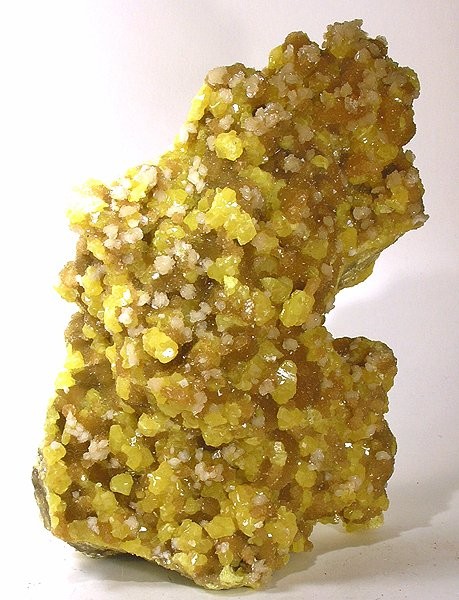
Photo: Wikimedia Commons
Search for specimens: View all sulfur specimens from Tarnobrzeg, Subcarpathian Voivodeship, Poland
The collector locality is centered on Tarnobrzeg in southeastern Poland, especially the former Machów Mine, an open-cast sulfur mine now flooded and reclaimed. Labels may read “Machów Mine,” “Machow,” “Tarnobrzeg,” “Podkarpackie,” “Subcarpathian Voivodeship,” or older administrative variants. The broader district includes the Tarnobrzeg native sulfur deposits of Machów, Piaseczno, Jeziórko, Osiek, and Baranów; for fine crystallized collector material, Machów is the name that appears most often.
Geologically, these are sedimentary native-sulfur deposits of the Carpathian Foredeep. The sulfur is tied to Miocene evaporitic strata: gypsum and anhydrite were altered, chiefly through bacterial sulfate reduction with hydrocarbons, producing sulfur-bearing limestone. In the ore horizon, sulfur occurs in fissures, small cavities, vugs, coatings, massive aggregates, and free-growing crystals. Average sulfur contents in Polish native sulfur ores are commonly given in the 25–30% range, with richer portions reaching much higher values.
The modern story begins in 1953, when Stanisław Pawłowski’s Geological Institute work near Tarnobrzeg led to discovery of large native sulfur resources. Documentation of the Tarnobrzeg deposit followed rapidly in the mid-1950s, and mining expanded into one of the great sulfur industries of postwar Europe. Piaseczno was worked by open pit from 1958 to 1971; Machów followed as the great open pit from 1969 to 1992; Jeziórko was mined by borehole underground melting, a Frasch-type method, from 1967 to 2001. Poland’s sulfur industry reached its strongest production years in the late 1970s and 1980s, before recovered sulfur from oil and gas undermined the economics of native-sulfur mining.
For collectors, Machów’s importance lies in the fact that the open pit exposed the sulfur-bearing limestones directly. Geologists, mine visitors, and workers could see and remove vug specimens of sulfur, calcite, celestine, and barite—something impossible to the same degree in borehole-melted deposits. The mine was not organized primarily as a specimen operation; its business was ore. Yet the collecting that took place during mining preserved countless specimens that otherwise would have gone to crushing and processing.
Access today is effectively closed as a collecting locality. The former pit has been transformed into Lake Tarnobrzeg, a large reclaimed water body with a surface area commonly cited around 455–500 hectares and a maximum depth of about 42 meters. The locality has therefore moved from active source to historic source: specimens now come from old mine-era collections, dealer stocks, estate dispersals, and secondary-market circulation rather than new field collecting.
Tarnobrzeg sulfur occurs in three principal morphological styles: waxy sulfur, dusty sulfur, and coarse-crystalline sulfur. Waxy sulfur is the abundant ore variety—dark yellow, opaque, botryoidal to irregular, and present as millimeter- to centimeter-scale masses, veinlets, or larger pseudolayered accumulations in limestone. Dusty sulfur is pale yellow, friable, and composed of very fine irregular crystals; it may coat other minerals or occur as thicker centimeter-scale accumulations. Coarse-crystalline sulfur is the collector material: well-formed orthorhombic crystals lining cavities, commonly as the youngest sulfur generation in vugs.
Crystal size is an important quality marker. Most free sulfur crystals are only a few millimeters to 1–2 cm, but individual crystals from the deposit are documented to reach about 7 cm. The largest crystals are not automatically the best; sulfur is a poor thermal conductor and large Tarnobrzeg crystals often show internal stress cracks. Smaller sharp crystals with bright luster and undamaged terminations can be more desirable than larger but crazed individuals.
Colors range from intense greenish yellow through bright lemon yellow, amber, honey yellow, and brownish yellow. Fresh, translucent yellow crystals with adamantine to greasy luster are preferred. Brownish or smoky tones commonly reflect bituminous inclusions or contact with hydrocarbons, a deposit-specific feature rather than a defect when the specimen is otherwise aesthetic.
Crystal habits include sharp orthorhombic individuals, skeletal and vicinal forms, stepped-growth faces, hollow “case” crystals, and sparkling crusts of small euhedral crystals over massive sulfur. The best pieces preserve the vug habit: sulfur crystals standing on earlier calcite, celestine, or barite, or arranged over massive sulfur matrix. These relationships are especially important in authenticating the geological character of the specimen.
Calcite is common and often forms gray, straw-yellow, honey, to dark brown rhombohedral crystals colored by bitumens. Machów calcite can also occur as coarse-crystalline stalactitic forms, sometimes with sulfur crystals perched on the surface. These sulfur-on-calcite pieces are among the most attractive Tarnobrzeg combinations, particularly when the calcite provides a pale or honey-colored architectural base.
Celestine is the famous partner mineral. It appears as white, colorless, yellowish, honey, brown, and occasionally delicate blue crystals. Prismatic celestine crystals may be small and gemmy, commonly a few millimeters to 1–2 cm, but larger crystals and aggregates can reach 10 cm or more. Some celestine forms blocky, fanlike, or radiating aggregates; others are needle-like, especially honey to brown varieties affected by bituminous inclusions. Sulfur with celestine is a signature Polish combination, and the contrast between pale celestine and yellow sulfur is one of the locality’s strongest visual appeals.
Barite is also important. It occurs as prismatic to needle-like crystals, tabular crystals, rosettes, spherulitic to botryoidal aggregates, and rare stalactitic forms. Barite crystals are usually white, gray, honey, or brown, and barite stalactites can be coated with well-formed sulfur crystals. Celestine and barite are not typically intimately mixed in the same way one might expect from a continuous solid-solution series; Tarnobrzeg material is notable for the relative separation of celestine-rich and barite-rich associations.
Other minerals add context but rarely dominate sulfur specimens. Gypsum is frequent, including relict “gypsum islands” in sulfur-bearing limestone and later secondary gypsum formed during degradation of exposed sulfur-bearing rock. Strontianite is rare, as yellowish needle-like material or inclusions associated with celestine. Aragonite is rare and may be preserved only partly, because it can alter to calcite. Hauerite, MnS2, is a collector rarity from overburden clays, especially associated with the Jeziórko area, but it is a different collecting story from the classic yellow sulfur cabinet pieces.
The key quality factors are color freshness, crystal definition, matrix aesthetics, association, and condition. Top pieces show sharp sulfur crystals rather than dusty coatings; strong yellow color rather than dull brown ore; a balanced matrix of calcite, celestine, barite, or massive sulfur; and minimal bruising, cleaving, or internal cracking. Provenance matters because the locality is closed: an old label, collection history, or dealer record can add substantial confidence and desirability.
Tarnobrzeg sulfur is a classic but no longer a renewable field-collecting locality. Fine examples remain available because Machów produced a large population of specimens during its working years, but the supply is now historical. Common pieces are still obtainable: small sulfur-on-matrix specimens, sulfur with calcite, and sulfur with celestine appear regularly in dealer inventories and online listings. Fine cabinet specimens with sharp sulfur crystals, strong matrix, and old provenance are much less casual and can perform strongly at auction.
Condition is the first concern. Sulfur is soft, brittle, and heat-sensitive. Tarnobrzeg crystals may already contain internal stress fractures, and careless handling can worsen them. Even body heat from prolonged holding can stress larger crystals. Avoid bright direct sun, hot display lights, closed hot cabinets, and rapid temperature swings. Store specimens in a stable, cool environment with padding that does not rub crystal faces.
Cleaning should be conservative. Do not wash sulfur specimens casually, and avoid solvents unless a knowledgeable preparator has evaluated the piece. Dusty sulfur and delicate coatings can smear or crumble; calcite and celestine associations may trap dirt but are not improved by aggressive treatment. A blower bulb and soft, minimal brushwork are usually safer than water.
Authenticity issues are real for sulfur as a species. Synthetic or artificially grown sulfur crystals are known in the mineral market, and some modern fake sulfur clusters are grown on unrelated matrix or sold with misleading locality claims. The most obvious false pieces have improbable associations, overly perfect repetitive crystals, unnatural matrix joins, glue residues, or a “decorated” look. A Tarnobrzeg specimen should match the locality’s known associations: sulfur with sulfur-bearing limestone, calcite, celestine, barite, and related sedimentary matrix—not amethyst geode, dyed quartz, or exotic fantasy combinations.
Mislabeling is another concern. Tarnobrzeg, Machów, Sicily, Ukraine, and other sedimentary sulfur localities can all produce yellow sulfur on pale matrix, and old dealer labels sometimes simplify locality names. Machów material is often recognizable by its association with celestine and barite, waxy-to-massive sulfur matrix, bitumen-influenced honey tones, and the characteristic calcite/celestine/barite vug assemblage. Still, high-value specimens deserve documentation.
Watch also for repaired crystals. Sulfur breaks cleanly enough that reattachment can be difficult to spot at first glance, especially on crowded drusy surfaces. Examine bases of prominent crystals under magnification for glue shine, foreign filler, mismatched dust, or displaced crystal orientation. Repairs are not unusual in fragile classic specimens, but they should be disclosed.
For display, Tarnobrzeg sulfur rewards careful lighting. Use low-heat LED lighting and avoid putting a yellow sulfur piece in a cabinet that warms during the day. A good specimen will show far more under cool, raking light than under heat-producing illumination. The best visual effect comes from the locality’s contrasts: yellow sulfur against honey calcite, white or blue celestine, gray-white barite, or darker massive sulfur.
The most important field story begins with a borehole, not with a crystal pocket. In September 1953, near Mokrzyszów about three kilometers from Tarnobrzeg, Stanisław Pawłowski’s Geological Institute work encountered a thick sulfur-bearing layer at roughly 80 meters depth. That discovery changed the map of Polish mining. Within months, the first documentation of the Tarnobrzeg sulfur deposit was prepared, and by the later 1950s the region was moving from geological promise to industrial reality.
What followed was spectacularly fast. The Tarnobrzeg deposit lay in the fork of the Vistula and San rivers and became one of the largest native-sulfur geological bodies of its kind. Piaseczno opened first, worked by open pit from 1958 to 1971. Machów became the giant showpiece, mined from 1969 to 1992. Jeziórko, instead of exposing a vast pit, was worked by boreholes and underground melting from 1967 to 2001. For mineralogists, that contrast mattered: in borehole mining, the deposit is largely invisible except through cores; in the Machów open pit, the sulfur-bearing limestone was laid open for direct observation.
That exposure made Machów a collector locality almost by accident. The mine’s task was to produce sulfur ore, not to curate mineral specimens. Geologists and official visitors were allowed to search and carry out specimens, but management viewed specimen-hunting by workers differently: time spent looking for celestine, barite, calcite, or sulfur was time away from ore production. Yet the paradox is obvious today. The unofficial removal of specimens—sometimes by workers looking for immediate cash—saved many from the crusher. Without that informal stream, countless vug pieces that now sit in museums and private collections would have disappeared into industrial processing.
The 1980s and early 1990s gave that stream its historical moment. Poland was opening outward, and Western European mineral shows were hungry for classic Eastern Bloc material that had been difficult to obtain. Machów specimens—sulfur, celestine, barite, and combinations—appeared as fresh, affordable, visually distinctive material. They were not obscure micromount curiosities; they were bright, cabinet-ready, instantly saleable specimens from a locality few Western collectors had previously handled in quantity. The result was a wide dispersal of Machów material into European and then global collections.
There is a final twist. The same specimens that left Poland in quantity when the mine was active have begun, in select cases, to travel back. With the open pit gone and no new supply from Machów, the best examples have risen in value. Polish collectors building important national collections now seek the finest historical pieces, and some of the specimens exported during the boom years have re-entered the Polish market. A once-industrial by-product has become heritage material.
The mine itself underwent its own transformation. Where sulfur-bearing limestone once stood in an immense open excavation, the reclaimed site is now Lake Tarnobrzeg. The geological exposure that made the specimens possible has disappeared beneath water, recreation, and landscape reclamation. The locality has not merely closed; it has changed physical state. That is why a good labeled Tarnobrzeg sulfur is more than a yellow mineral specimen. It is a surviving fragment of an orebody that can no longer be visited in the form that made it famous.
 Amethyst
 Quartz
 Fluorite
 Tourmaline
 Malachite
 Azurite
 Rhodochrosite

